



Politicians in Greenock have joined calls for a controversial cycle lane to be ripped out and replaced with short-term car parking, arguing that the infrastructure is currently being underutilised by the town’s cyclists – because it is “frequently misused” by car and van drivers parking in it.
The cycle lane on Greenock’s West Blackhall Street was completed last year as part of a £6 million revamp designed to revitalise the area and attract visitors by making it more pleasant, accessible, and sustainable.
The project, funded by the Walk Wheel Cycle Trust (formerly Sustrans) and the Strathclyde Partnership for Transport, included the installation of new paving, trees, seating, a simplified one-way system, and active travel infrastructure.
The cycle lane, lightly segregated from motor traffic, replaced a row of car parking spaces on one side of West Blackhall Street, though parking on the other side remained in place. The lane connects the road to the Oak Mall, the coastal route, and National Cycle Network Route 75, creating a direct link to Greenock Esplanade and Battery Park.
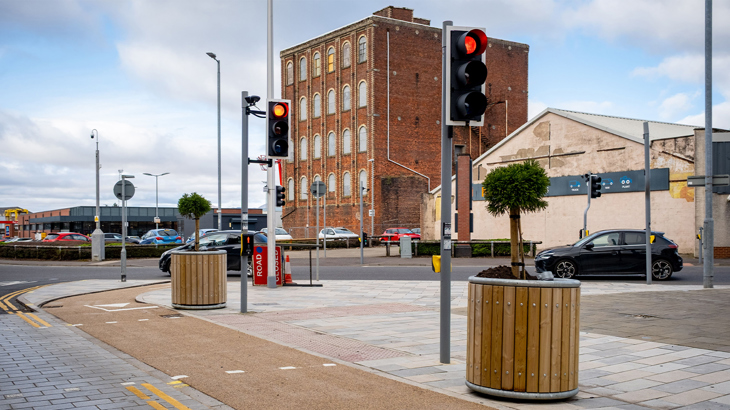
However, the project – and the cycle lane in particular – have come in for constant criticism since the scheme was completed last year, with local business owners claiming the reduced car parking provision on the street has led to a “drastic” decline in footfall and trade, while also increasing congestion in the town.
Earlier this year, Inverclyde’s Provost Drew McKenzie claimed that the town’s cycle lanes are “being used as short-term parking, rather than priority lanes for cyclists”. McKenzie argued that the cycle route on West Blackhall Street “is not being used for its intended purpose” and needs to be reassessed by the council, to conclude whether it is “working”.
And last month, an online petition was launched by local shop owner Chris Jewell, who runs Cradle Care on West Blackhall Street, urging the council to remove the cycle lane and reinstate the previous two-hour parking arrangement.
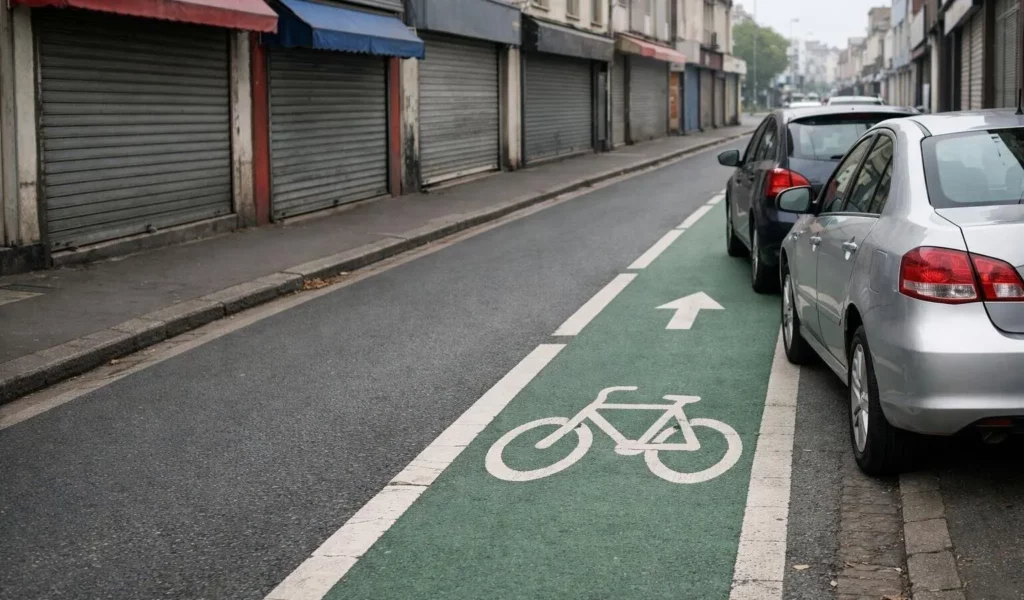
“In recent years, West Blackhall Street in Greenock has been a bustling area of commerce where retailers like myself thrived by providing services and goods to the community and its visitors,” Jewell wrote in the petition, which features what appears to be an AI-generated image of motorists blocking a cycle lane opposite a row of shuttered shopfronts.
“However, since the installation of the cycle lane, my business, as well as many others, has witnessed a drastic decline in footfall and revenue.
“The cycle lane, although well-intentioned for promoting sustainable transportation, has not achieved its purpose due to minimal usage. Observations show that the lane is frequently misused by cars and vans as a parking space, rather than being utilised by cyclists.”
He continued: “This situation is detrimental to local businesses that depend heavily on convenient access for their customers. The removal of these convenient parking spaces has discouraged many potential customers who prefer to drive. A return to the previous two-hour parking system is crucial for the revival of businesses that make West Blackhall Street a vibrant commercial hub.”
After launching his petition, which has so far attracted 973 signatures, Jewell contacted Inverclyde Council to request that motorists should be allowed to park in the cycle lane to “avoid further issues”.
Following this criticism, Inverclyde Council agreed to carry out a review into the lane’s ‘effectiveness’, which is set to conclude in August, with the local authority’s environment and regeneration committee being told that several options for the infrastructure are currently being considered.
However, with the review set to take place over the summer, one of the council’s most prominent critics of the cycle lane has questioned what he regards as the lengthy delay in dealing with the issue.
Conservative councillor Graeme Brooks told the Greenock Telegraph this week that he wanted to bring a motion on the cycle lane to the environment committee in March, but was asked by senior officials to withdraw it. He has since urged the council to provide a timeline related to the future of the lane during the last two meetings.
“I’m very disappointed that I’m sitting here in May and we’ve got no progress,” Brooks told the local news outlet, pointing out that the summer months will prove the busiest for the town centre.
“I was asked to hold the motion back and allow officers to work on options that elected members could review on the failed cycle lane.
“The best they’re suggesting is the August environment and regeneration meeting, which is challenging. All I’m asking officers to do is to give us as much information on what the options are going forward.”
At this week’s committee meeting, councillors were told that the cost of removing the lane were currently being considered, but that details would not be available until August.
Another member of the committee, the SNP’s Chris Curley, asked officers if temporary measures could be introduced to alter the layout of the cycle lane immediately, negating the need for a potential three-month wait.
Curley was told that, of the options being considered, an experimental traffic order would be the “most feasible” within such a short timescale, though even that option would need to be explored in more detail.
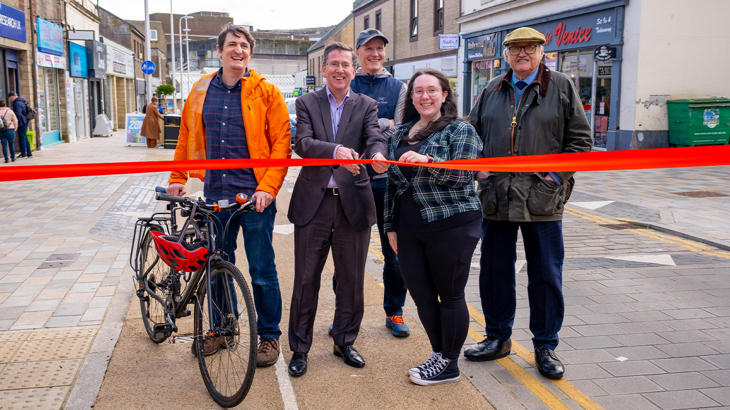
These calls to scrap the cycle lane on West Blackhall Street cap what has been a tumultuous year for the beleaguered new cycling infrastructure, which formed part of the council’s bid to boost footfall, support “café culture and night-time economy”, and make Greenock’s high street more attractive to shoppers and visitors.
Last April, we reported that another local business owner, Tony Bonatti, who owns Tonino’s on Grey Place, said the West Blackhall Street redevelopment has caused chaos for years and failed to deliver meaningful benefits to traders or residents.
“West Blackhall Street might look good with the new cobbles, but what about the empty shops?” he asked. “Honestly, I have had nine years of roadworks and disruptions. I wouldn’t mind, but it never gets any better. The roads are still a mess.
“We now have a cycle lane and reduced parking. It is chaos and there is congestion every day. People park on the cycle lanes. What is the point?”
However, the scheme was defended by both the council and the Walk Wheel Cycle Trust, who described it as a “win-win” for the local community.
“Making places safer and more accessible to reach and move around actively is a win-win for our communities, and we’re delighted to see these changes on West Blackhall Street which give the people of Greenock more choice for their everyday journeys,” Simon Strain, head of the Places for Everyone programme at the trust, said at the time.
“As well as benefitting people’s health and wellbeing, the revitalisation of West Blackhall Street will offer a huge boost to local businesses, who can expect greater footfall as the street becomes a more attractive destination for locals and visitors alike.”
Councillor Jim Clocherty, the vice-convener of the council’s environment and regeneration committee, added: “It was widely acknowledged that West Blackhall Street had seen better days. The council, thanks to support from Sustrans and SPT, stepped up to try and breathe new life into Greenock’s traditional high street.”
“Parking has been retained along the entire length of the street and there is ample parking in and around West Blackhall Street,” the council noted in a statement.
“We are also trying to encourage people to choose healthier and greener forms of transport, such as cycling, and the creation of the new active travel route helps to facilitate that.”




















27 thoughts on “Calls for “failed” bike lane to be scrapped and replaced with car parking – because it’s always blocked by drivers”
Law breakers persistently flout the law so, let’s get rid of the law said no one on West Blackhall St. ever.
@jaymack there is an argument that in the UK (as in other less vigorously authoritarian countries) if many or even most people are ignoring particular regulation then it’s pointless. Especially as police are never going to do more than enforce a very occasional forfeit lottery.
That is often overstated. But I think it is fair to take a step back and question why things aren’t “working”. However not infrequently it seems that the necessary pre-conditions weren’t created in the first place. (More or less deliberately).
Those requirements are often outside the narrow remit of the scheme. Often it’s that motor traffic flows are too high / there’s too much motor access – and effort hasn’t been made to fix that *first*.
Sometimes “not enough (key) people are on board”.
Perhaps money is going to be insufficient to do properly – especially when things are delayed. That often happens when other resources like suitably experienced officers to get changes done are lacking, or the legal stuff isn’t in place so that there are avenues for legal challenges to drag things out.
There’s a real problem where there are numerical / power imbalances. Getting beyond that will take a *lot* of work .
Example: drivers of (not even that many) motor vehicles can simply bully other road users out of the way and occupy space. Or a handful of unhappy locals can simply shift planters, vandalise cameras and even remove new infra, and everyone else will then continue using space as before. This even happened in NL for one of their “demonstration cycle routes”…
@chrisonabike “there is an argument that in the UK (as in other less vigorously authoritarian countries) if many or even most people are ignoring particular regulation then it’s pointless. Especially as police are never going to do more than enforce a very occasional forfeit lottery.”
That is an argument for decriminalising almost everything apart from rape and murder, admittedly we are well on the way to that scenario but its not how I want my country to be run!
@Backladder Indeed … but in some cases the argument is “won by the people” and we think it’s fair.
Anyway – does happen, example being that some police have explicitly said they’re not doing anything about pavement driving (effective decriminalisation). IIRC at one point they’d tacitly done than on some drug use.
I would hope it wasn’t so for road crime but things like speeding and illegal motor vehicle use (electric motorbikes) are so patchily enforced it’s possible to imagine the argument being lost.
@chrisonabike I wonder if someone were to choose to start riding around wearing a mask chucking bricks through the windows of illegally parked cars, would the police suddenly find resources to investigate?
@yodhrin they’d be powerless to do anything except notify the registered keeper of the brick about the offense, and only if it had been witnessed by a policeman, surely?
I wouldn’t be encouraging criminal damage but wasn’t there a spate of (large) car tyres going flat a while back?
Not sure anything came of it though. And i note the government of the day is still rushing to reassure us they’re all for the hard-pressed (ICE) motorist whenever the populace look restive.
Reminds me how “cycle lanes” are put it, with varying degrees of (usually poor) separation but only on what is the gutter of the main road.
This leads to debris in the cycle lane, which doesn’t get cleared by the tyres of vehicles as drivers go through, leaving the surface in a state that is actually more off putting than before the “infrastructure” was put in.
Then people ask why it isn’t used…
Needs. More. BOLLARDS!!!!!
I’d be inclined to avoid the businesses supporting these measures.
Footfall is down because the cycle lane removed some parking spaces, except that people park in the cycle lane? Maybe it’s not cycle lane…
One wonders why the bike lane is all parked up while the shops are empty. Are people parking there and then going elsewhere to shop?
@adamrice Most likely because it’s a fake photo!
It’s an AI image – the article does state that.
It makes perfect sense! 1) Put in a cycle lane. 2) Park cars/lorries in the cycle lane 3) Cyclist don’t use cycle lane 4) Since cyclist don’t use the cycle lane, remove unused cycle lane!
Schrodinger’s customers, they’re both there and not there at the same time.
They’re not there because of the lack of parking caused by the bike path that’s blocking half the parking spaces but cars are parking on the bike path so the customers must be there.
So, the arguments totally ignore a widely reportd “cost of living crisis” tbat can be greatly mitigated by putting in walking wheeling and cycling infrastructure to give people choice, and someone forced to buy a car has £4500* less, after tax, to spend in local shops. * Society of Motor Manufacturers and Traders.
All the research in UK and around the world shows that tbose walking whseling and cycli g to local shopping centres spend far more time in the centre, and far more money in the centre; I can only assume it is shopping centre owners that are funding tbis research, and it is not a little more time and money, it is a lot more time and money, to the extent that the American owners of our shopping centre in Yate want far more walking wheeling and cycling infrastructure, but local.polititians are “avoiding” it.
All the research of district councils in UK is showing an uptake of at least 30% year on year, where effective cycling infrastructure is put in place.
Cycling infrstructure cost considerably less than roads, and lasts decades longer without the weight, in both mass and numbers, of motor vehicles.
I would suggest that the far greater waste of money would be ripping out infrastructure that has been put in place for the new future, replacing the failed 90 year old plan that everyone will have access to the use of a car by the start of our current millenium.
It is often hard to distinguish road.cc from the Daily Telegraph/Mail, because its publishes so much anti-cycling content.
@HarrogateSpa Just have to point out for the 138th time that reading road.cc is not compulsory and many other cycling websites are available. Why do you keep coming back to something that appears to annoy you so much?
@Rendel Harris – @HarrogateSpa might say something similar about your 138 comments on their posts :-p
Perhaps they only love the gravel content?
@Rendel Harris also, though I’m sure road.cc is more sophisticated than this, engage with the articles you like, not the ones you don’t. If the rage bait gets more clicks and comments, we’re likely to get more of it. Meanwhile, very few comments on product reviews etc.
Following this logic there is probably an argument to remove “failed” Greenock in its entirety.
The comments on the petition (query if they’re genuine) are fantastic: “I regularly park in the cycle lane when popping into Cradle Care and have never once been inconvenienced by a cyclist, which I think tells its own story. (Rita)” “I’ve found the cycle lane extremely reliable parking whilst spending the afternoon in the Westburn (Davie)” “I am a cyclist and truly I don’t find this lane beneficial , I would not consider cycling along this part of the town .. there’s nothing much to do there (Gillian)”.
Streetview doesn’t have pics since the cycle lane was installed, but Cradle Care didn’t look that inviting when the parking was there in 2022.
So all shopkeepers now know that if they don’t park and load on the otherside of the road, they can force a cyclepath to be removed as they can prevent it being a cyclepath? After the expence of colouring the tarmac as a cyclepath, it would be cheaper to install bollards then to tarmac the road a second time?
@skriv it’s “what on earth are you doing actively making people’s lives harder while throwing money we don’t have at a handful of MAMILs who don’t even go to the shops” surely?
Alas it may be that it’s “too soon” for Greenock. Shame for them, as it appears there’s potential for active travel around the town (but we have a hill / but it rains) and possibly even a bit of cycle tourism, it being on of NCN 75 and also having fair rail connections.
The infra was above the usual for the UK (albeit with the standard UK “missing the point” compromises). Particularly for what otherwise seems a typical car-infested town. (From brief visit but cycling *through* not doing a safari).
@skriv meanwhile, stuff like the following motor traffic keeper-outers would actually work (for cycling).
Well … at least until they broke because people crashed into them / parked on them / deliberately vandalised them. Alas they do cost money and it doesn’t take many dozy drivers to do a LOT of damage.
And there are enough fools to even defeat a council with deep pockets, if such a thing existed.
I love road.cc. Any time I’m feeling that cycling in Australia is terrible, I login and read how totally dysfunctional the UK is!