



A Middlesbrough cycle lane at the centre of a long-running, often heated saga has been finally ripped out at the cost of £2.7 million, just four years after it was installed, in a move which the local mayor has called “righting a wrong”.
The protected bike lane on Linthorpe Road, which critics dubbed Britain’s ‘most-hated’ piece of cycling infrastructure, has been removed, and the affected sections of road have been fully resurfaced, with parking spaces reinstated and bus stops set to be repositioned.
Middlesbrough mayor Chris Cooke and Tees Valley mayor Ben Houchen, who both pledged to remove the lane following complaints from residents, businesses and road users, visited the site last week after the works were finished.
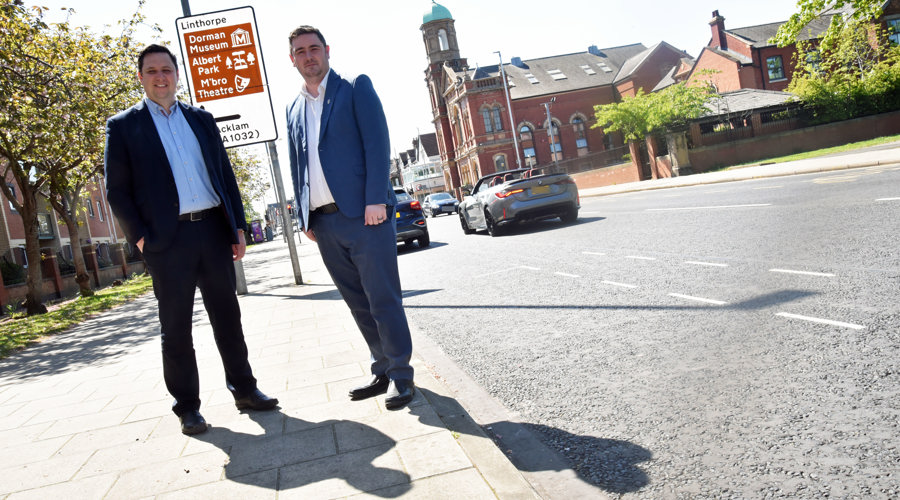
Cooke said: “I’m pleased the cycle lane is no more, and it’s positive to see traffic running smoothly. I’ve already had positive comments from people who’ve noticed a difference.
“I’m all for schemes that support sustainable travel, but they have to be in appropriate places. We’ve righted a wrong by removing the lane, and now it’s time to look forwards.”

Houchen was even more critical of the infrastructure. He said: “The Linthorpe cycle lane was a disaster, causing congestion, hammering local businesses and making life harder for the people who actually use the town centre every day.
“Cycle lanes have to work in the real world, and this scheme has caused nothing but problems since day one. We’ve listened to residents and local firms to finally put this right.”
The cycle lane was originally completed in September 2022 after Middlesbrough Council secured £1.7 million in government funding to promote active travel and create a “quick and safe” route into the town centre.
However, backlash followed almost immediately. Business owners complained the redesign reduced parking and drop-off access, with some claiming it hurt footfall.
One trader branded the route “an absolute disaster”, while others raised concerns that it had the potential to become a “clear getaway” route for shoplifters and drug dealers because of the dividers separating the lane from the road.

Safety concerns also emerged after several injuries linked to the route’s controversial ‘orca’ lane dividers.
Shortly after the lane opened, a 78-year-old pedestrian suffered a broken wrist and facial injuries after tripping over one of the separators.
Days later, cyclist Paul Harris required stitches after being thrown over his handlebars when he collided with one of the dividers near a bus stop.
A Freedom of Information request by the Local Democracy Service in 2025 later revealed the council had paid out £85,728 across 15 injury claims connected to the lane, while six additional claims were still being processed at the time.
However, in response to the FOI request, Middlesbrough Council also revealed that a smaller proportion of injuries on Linthorpe Road had involved cyclists after the bike lane was installed compared to previous years.
The council said that between 2015 and 2021 there were 57 injuries on the road, of which 23 per cent (14) involved cyclists.
But between 2022 and 2024, after the cycle lane was added, just 12 per cent (three) of the 26 injuries recorded were people on bikes.
Meanwhile, data published by the council in 2024 showed that the protected cycle lane, for all its faults, contributed to the number of cyclists using the road increasing by 70 per cent, at the same time injuries were falling.
.jpg)
The orcas were eventually replaced with plastic wands, and plans to extend the scheme were shelved, but pressure for removal continued to grow.
A public consultation in 2024 reportedly found strong support for scrapping the lane, although the removal itself became mired in political disagreement between Houchen and Cooke over who would fund the works.
In December 2024, Middlesbrough Council approved plans to remove the infrastructure, with the Tees Valley Combined Authority agreeing to cover the full cost.
Despite the removal, Middlesbrough Council did not have to repay the original government active travel funding used to install the scheme.



















7 thoughts on ““Cycle lanes have to work in the real world”: £2.7 million removal of Britain’s “most hated” cycle lane complete, as mayor claims traffic now “running smoothly””
Ben Houchen knows what he’s talking about when he says “disaster” – if you believe the reports into Teesport (even some careful work by Michael Gove couldn’t fudge it all away).
And he seems to have listened to a *couple* of local firms…
I don’t know this cycle path but I do know that “protected” cycle lanes won’t “work in the real world” if people are allowed to dump stuff or park in them and if the “protection” is itself a hazard (“did you mean ‘separated cycle *path*’?”).
Or a local authority takes the cash for a route, then fails to continue making a mobility network.
It’s ok, they’re all for cycle infrastructure as long as it’s in the right place, so I’m sure they’re now actively looking for suitable locations.
“Looking for suitable locations”
In the infernal regions, i suspect. Although the road there now also needs expensive resurfacing…
Hmm.
My understanding was the cycle lane has been replaced by on street parking.
Which makes any claim it’s improved traffic flow extremely suspect – a lane lost to parking causes the same, if not more disruption then a lane lost to a cycle track…
@qwerty360
Indeed.
It would be worth seeing if this compares to the one in Kensington I believe where the cycle lane was ripped out enabling drivers to park there thus no improvement in journey times for motorists…
I expect this sort of shit from a Tory fraudster like Houchen (see Private Eye for how this twat has fleeced the taxpayer to amass a fortune for himself and his family) but from a Labour mayor? WTF!?
@Eton Rifle – Labour seem to be speed-running towards authoritarianism and I don’t know if Andy Burnham can save them.