


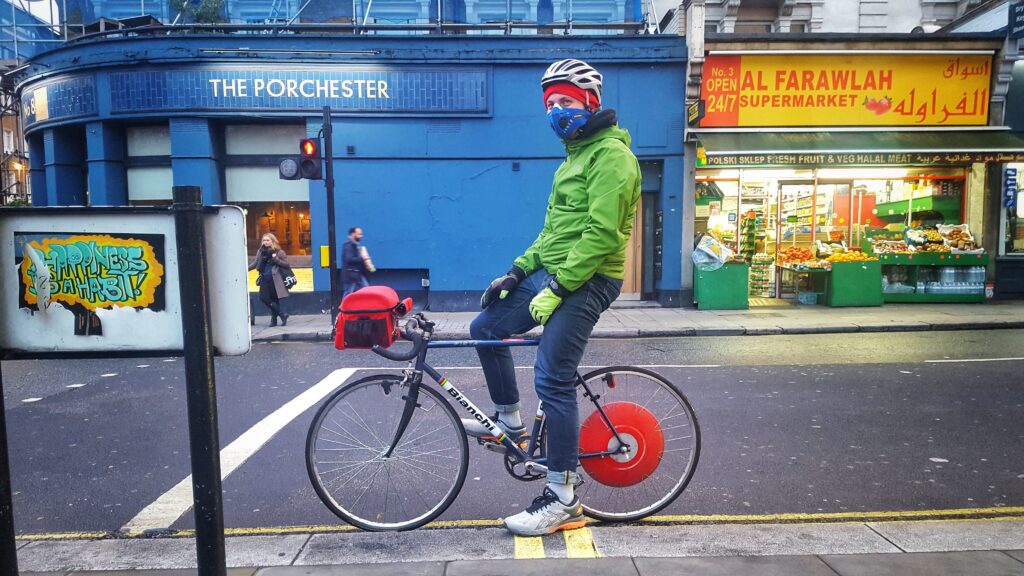

Cyclists should wear face masks covering their nose and mouth whilst riding on congested roads, an academic has said.
The recommendation is due to the heavier breathing caused by cycling, and the subsequently greater inhalation of harmful particulates that could cause damage to several key organs.
Jill Belch, a professor of vascular medicine who also co-chairs the Royal College of Physicians of Edinburgh’s air pollution working group, made the comments within a presentation at Cycling Scotland’s annual conference in Perth, as first reported by the Scotsman.
Belch also said it was important any masks worn are tight-fitting so they move towards the face when breathing in, but warned that they would not protect the body from harmful polluting gases such as nitrogen oxide and nitrogen dioxide.
“Nobody wants to wear a mask while cycling but they can help if you are in a very polluted area,” she said, adding the most effective action a cyclist could take would be to ride on off-road cycle paths wherever possible.
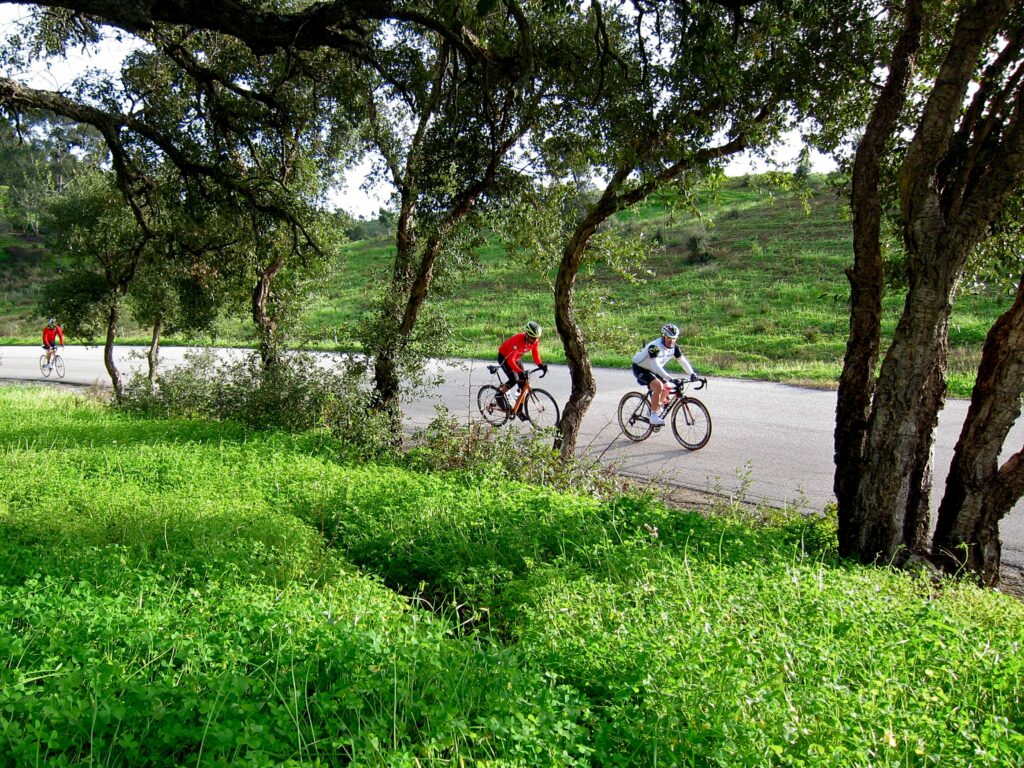
Alternatively, surrounding plants and trees near a cycle lane could also improve the quality of air, whilst physical separation preventing cyclists riding in the same lane as polluting vehicles would also be beneficial.
In response to Belch’s comments, a Cycling Scotland spokesperson reiterated cycling remained a net benefit to a person’s health, whilst noting, “People may understandably have a specific health reason to wear a close-fitting mask while cycling on polluted streets. The most important thing is that more people cycling means fewer polluting vehicles creating congestion.”
“Getting the most dangerous and polluting vehicles out of our communities will benefit everyone’s health. Cycling is fantastic for your health and the research at our conference demonstrated yet another benefit of segregated cycle lanes and more green space in urban areas, separating people walking, wheeling and cycling from the worst traffic fumes.”
Ian Maxwell, from Edinburgh Cycle campaigners Spokes, also told the ‘paper, “Although some people might decide to use masks or helmets, they shouldn’t feel obliged to chose either.
“They can help more by joining campaigns against urban motor transport.”
Last week, Cycling Scotland released data showing the number of cyclists had overtaken the number of cars on Leith Walk in Edinburgh during a morning rush hour for the first time, whilst more than 5,600 cyclists were recording using the cycle lane during a two day period in May earlier this year.
.jpg)
Meanwhile several streets in Glasgow have also recorded their highest ever cycle traffic on several protected bike lanes, as well as their highest ever share of total journeys. Clyde Street, Garscube Road, and Victoria Road, all recorded their highest ever number of cycle journeys having seen two-way protected cycle lanes recently installed, with the latter seeing cycling account for 16 percent of all modes of travel.
Both city councils have welcomed the figures, whilst Scotland’s Transport Secretary Stephen Flynn said “record levels of use demonstrate that the infrastructure we are providing is helping more people than ever travel by bike for everyday journeys.
“Active travel is pivotal in helping people save money, improve their health and reduce transport emissions – walking, wheeling and cycling is transformational for both people and planet.”
However Cycling Scotland’s figures did not show a similar pattern of a reduced number of cars on the roads during this time, suggesting that those motivated to cycle were likely not former drivers along the same roads.



















23 thoughts on ““Nobody wants to wear a mask but they can help”: Scientist tells cyclists they should cover nose and face when riding in high-polluting heavy traffic”
If the pollution is harmful the answer is to curtail the pollution. Cyclists are not the only victims. Everyone using roads and even living close to them is affected.
Clear precedents exist in the UK on how to reduce harmful pollutants from motor traffic for example the LEZ and ULEZ in London.
It is odd that the academic is not recommending such schemes.
It’s not really odd at all, given that transport planning is not their field of study.
@Pub bike …or just make active travel more attractive/feasible than the personal motor car, thereby reducing the pollution (not to mention congestion/noise/space)
@Pub bike Edinburgh, Glasgow, Aberdeen and Dundee already have Low Emission Zones. They probably help a bit, especially for the sort of particulates that a mask could actually help with. But there is definitely room for improvement too – if your vehicle is compliant (most cars/vans from the past 10 to 20 years) then you can just drive in with no restrictions or charges.
@Pub bike To be fair to the good professor, I’m sure as an expert in vascular medicine she would like nothing better than to eliminate pollution but she is offering her advice on how to deal with the situation as it is rather than as we, and doubtless she, think it should be.
@Rendel Harris Yet she then appears to talk about future measures: “Alternatively, surrounding plants and trees near a cycle lane could also improve the quality of air, whilst physical separation preventing cyclists riding in the same lane as polluting vehicles would also be beneficial.”. What about increasing the size of the existing LEZ? More feasible than planting trees near as-yet unbuilt cycle lanes.
@Pub bike Even in a ULEZ (as I – and I think you? – know, living in one) there is still a lot of pollution and there always will be as long as ICE vehicles are still in use. In London it’s made a great improvement but the air quality on busy central roads at rush-hour is still pretty appalling, so mitigation measures are still needed. I didn’t see her talking about unbuilt cycle lanes, why not plant trees alongside those that already exist? They can make a tremendous difference, a number of schools in my area have planted “living walls” to separate their playgrounds from the busy roads on which they are located and apparently they make a very significant difference to pollution levels.
@Rendel Harris that’s more or less exactly why I think that, in the context of presenting research like this, it is vital to reference other relevant research.
And to make your recommendations in clear context that just regular cycling without any mask is already going to improve your health over not cycling.
Scuba example isn’t really a great comparison because taking up scuba diving, as far as I’m aware, doesn’t have potential to be a population wide accessible activity from toddler age up, or to confer immediate health benefits for participants vs non-participants.
Case in point here, regardless of who’s “promoting” it or not, the Scotsman has picked it up and run it as an article on why cyclists should wear face masks. Which absolutely will contribute to deterring cycling. A bit of context with the findings might have helped that message get picked up ina far more positive way.
Do tight-fitting masks help by stopping cyclists breathing effectively, and thus not hoovering up so many particles (more deeply) into their lungs?
Won’t they think of motorists – IIRC you could get a worse dose by driving? And worse still are some of the deep tube lines apparently…
@chrisonabike Tube lines are very bad. Lots of fine iron particles from brake and wheel wear
Still better safe… add it to the list along with hi-vis (with reflectives), helmet, definitely not sandals…
Hmmmm, until this government manages to ban face coverings…..
I had one of the masks in the lead photo in the 90s. Neoprene, with a filter insert and a one way valve. Far too sweaty for summers down here and impossible to properly seal around the nose, so glasses would fog up.
Maybe the authors could be asked to recommend masks that are suitable for this use.
@RayG This is the wrong solution – if the problem is the nose, remove the nose.
@mdavidford Agreed. The comment was to make them see how unrealistic their suggestion is.
@RayG Respro now do an additional silicon seal, and it works.
Children in cars should also wear masks.
https://www.theguardian.com/environment/2017/jun/12/children-risk-air-pollution-cars-former-uk-chief-scientist-warns
Warms the cockles of my heart that the illegal e-motorbike bros put their lung-health first with their black balaclavas.
Can we make it mandatory that whenever someone brings up rubbish like this, they should be required to respond to or at least reference the pre-existing excellent research on the topic, which shows that you’d have to cycle continuously in the highest polluting conditions in central London for over 9 hours before the health detriment from pollution would outweigh the benefit of the additional exercise?
And that there’s no city in the whole of Europe where cycling all day in normal pollution levels would result in overall health detriment compared to not cycling?
https://ig.ft.com/sites/urban-cycling/?spoor-id=cln5y3tl70000at6ys8f9m15n
It’s lovely that they care. But they need to stop the scare stories. Cycling regularly, even in the most polluted UK cities and conditions, is overall health positive. Nobody should be running stories focussed on a non-existent need to “protect” yourself from this.
@Velo-drone I’m sorry but that doesn’t make any sense whatsoever. Yes, the health benefits of cycling do outweigh the health damage done by pollution. That’s because cycling is incredibly good for you. It doesn’t mean the harm that pollution does to you is minimal. If there’s a way to enjoy the health benefits of cycling whilst minimising the detrimental effects of pollution then that is very much worth mentioning and studying. Obviously I would rather that the detrimental effects were mitigated by reducing car traffic and increasing cycle provision away from the most polluted roads, but until that happens it’s certainly worth knowing what the detrimental effects are and how they might be mitigated by personal actions such as wearing a mask, if only in order to allow one to make an informed decision.
@Rendel Harris the issue is, that’s not how this lands with the public.
As a result of stories like this being promoted by cycling organisations, a tiny tiny proportion of people will use masks when they cycle.
A much larger group of people will decide (or add another reason to their list) of “cycling isn’t good for me so I won’t do it”.
I’m not saying don’t do the research. I am saying, cycling organisations will do more harm than good when they choose this as the message to promote.
@Velo-drone Well, I think it’s best for them to be honest and look at all sides of cycling, not just promote positives and pretend there aren’t some problems. Note that this isn’t a cycling organisation choosing to promote this message, it was just a paper presented at Cycling Scotland’s annual conference, they aren’t running a “Cyclists wear masks” campaign. As the late great Richard Ballantine said in his Bicycle Book (from memory from many years ago so forgive any errors), I want you to cycle and I think the benefits far outweigh the dangers. I know some good places for scuba-diving that have sharks as well, I would encourage you to try them out but I would be irresponsible if I didn’t warn you about the sharks.
@Velo-drone Well, I think it’s best for them to be honest and look at all sides of cycling, not just promote positives and pretend there aren’t some problems. Note that this isn’t a cycling organisation choosing to promote this message, it was just a paper presented at Cycling Scotland’s annual conference, they aren’t running a “Cyclists wear masks” campaign. As the late great Richard Ballantine said in his Bicycle Book (from memory from many years ago so forgive any errors), I want you to cycle and I think the benefits far outweigh the dangers. I know some good places for scuba-diving that have sharks as well, I would encourage you to try them out but I would be irresponsible if I didn’t warn you about the sharks.