



Are you a GB-based cyclist (or just visiting) and want all the relevant rules of the Highway Code condensed in one convenient place? In this article we’ll attempt to do just that, going through all the parts of the Highway Code that apply to cyclists and offering some handy tips to ensure you’re riding in accordance with official guidance and, where applicable, the law.
“Does the Highway Code apply to cyclists?” or “Why do cyclists ignore the Highway Code?” are two questions you’ll often see in below-the-line comments on newspaper articles or social media threads relating to people riding bikes on the road. The answer to the first, of course, is “yes,” and as for the second, we’ve previously reported on a study that showed that people on bikes were more likely than motorists to obey traffic laws.
But despite a number of changes made to the Highway Code at the start of 2022 that were principally aimed at protecting vulnerable road users such as cyclists and pedestrians, including motorists having to allow bike riders at least 1.5 metres of space when overtaking them (rule 163), as we reported earlier this year, most people using the roads, whether in a motor vehicle or on a bike, remain ignorant of what the rules of the road are currently.
Regularly refreshing your knowledge of the rules is highly recommended, although you don’t have to spend long on social media, or reading below-the-line comments in the press, to realise that there is a lot of ignorance. Even people who drive for a living are among them, despite the fact that to have obtained a driving licence in the first place, motorists will have had to demonstrate their understanding of the Highway Code.
In this article, we look at what the rules are regarding cyclists using the road as well as how other road users are required to interact with them, put the rules into context, and explain what certain terminology used in the Highway Code means in practice. Where applicable, we have provided a single piece of commentary on several rules, rather than addressing each one individually.
Most adult cyclists do in fact hold a driving licence – in fact, research shows that they are slightly more likely than the overall population to have one – but it remains the case that while you can ride a bike on the public highway without having had to pass a test first to secure a licence, you still need to know what the Highway Code says. This article is in part aimed at people taking to the roads for the first time by bike, perhaps for commuting to work as a cheaper alternative to public transport.
First, it’s worth underlining that the Highway Code does not in itself constitute a piece of legislation; rather, the rules set out within it summarise, in plain language, existing law relating to the use of public highways within Great Britain (Northern Ireland has its own version which differs in a number of aspects), as well as providing advice to road users.
Where a Highway Code rule is backed by legislation, there will be a link to the latter beneath, and we show these in the appropriate places below should you want to fully acquaint yourself with the letter of the law.
One important thing to be aware of when consulting the Highway Code is the difference between rules which are advisory, and therefore not compulsory, often preceded by the word “should,” and those that are a legal requirement, which are typically introduced with the word “must,” in bold and capital letters for emphasis.
While many rules within the Highway Code apply to all road users, and you should familiarise yourself with the full document, the primary focus of this article is on those rules (59 to 82) that apply specifically to cyclists, and we will also look at those applying to other road users when sharing the road with people on bikes.
Overview (rules 59 to 72)
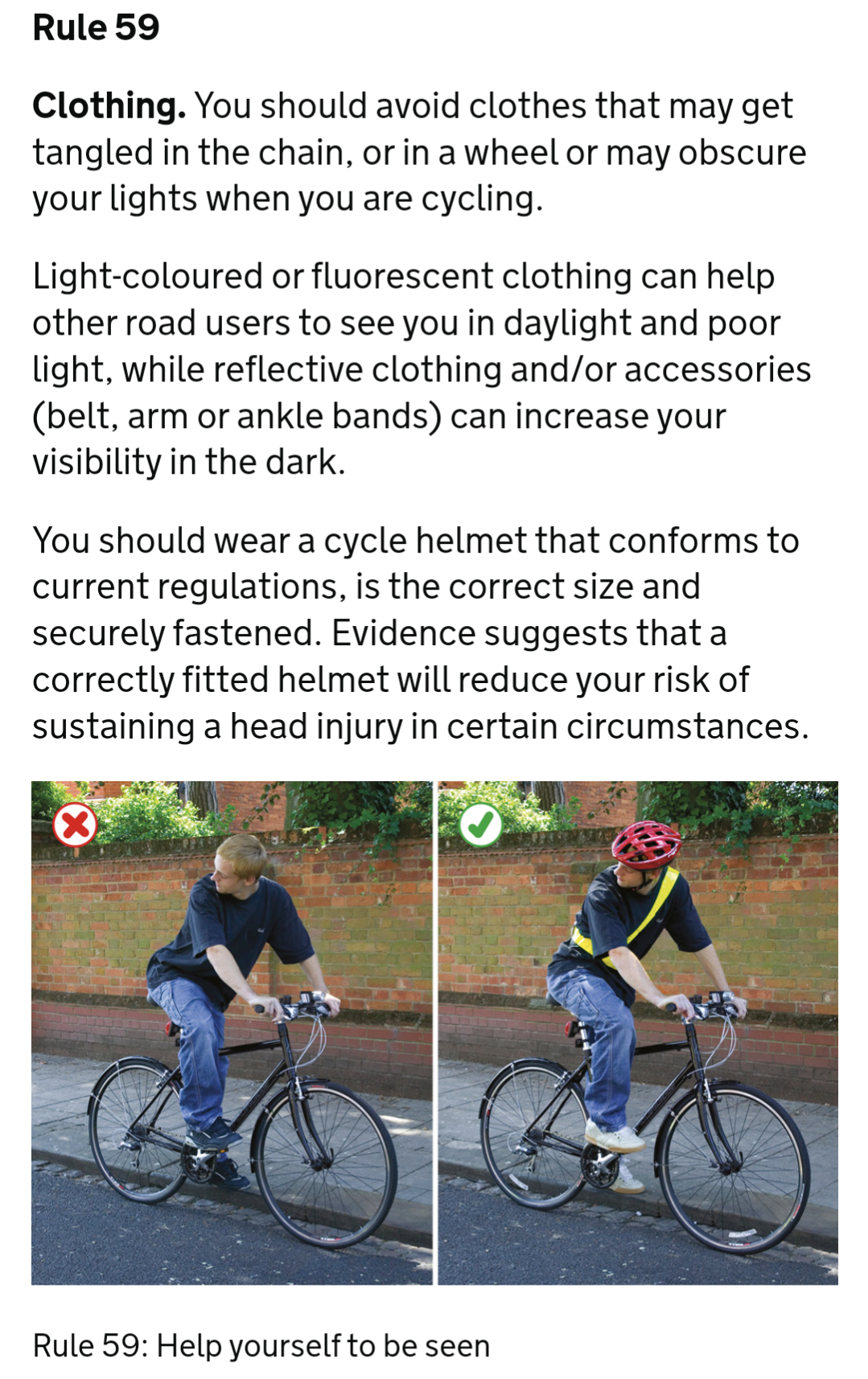
The general clothing issue is common sense, although it’s surprising how many people you see cycling in winter with coats that do obscure the rear light. As for flowing clothing, besides potentially getting caught in the chain, you don’t want to meet a similar end as the unfortunate Isadora Duncan, the dancer whose neck was broken in Nice in 1927 after her long, flowing scarf was caught in the open spokes of the car she was riding in.
Hi-viz or reflective gear, as well as wearing a helmet, are recommended by the Highway Code, but are very much a matter of personal choice. The latter in particular is the subject of a long-running and often heated debate. You may feel safer wearing one, but you won’t be breaking the law if you don’t.

Law RVLR regs 13, 18 & 24
Not only is riding with bike lights at night a no-brainer, it’s also the law, and cycling without them is one of the most common ways to get stopped by the police. Indeed, after the clocks change in the autumn, some police forces conduct operations aimed at ensuring cyclists are using front and rear lights in the hours of darkness.
Given their significant student populations and the timing close to the start of the academic year, such operations are pretty much part of the annual calendar in Oxford and Cambridge, with potential fines often rescinded provided the rider can subsequently provide a receipt proving they bought some lights within a certain number of days after being stopped.
A rear reflector and pedal reflectors are also required by law, though in our experience this is seldom – if ever – enforced. When buying a bike, they’ll usually be fitted, but with road bikes especially will often swiftly be dispensed with by the owner, particularly when swapping standard pedals for cleat-compatible ones.
Riding with a steady front light on unlit roads is essential for spotting hazards ahead such as potholes, which may be more difficult to see if relying on a flashing light. Some cyclists, even in lit urban areas, will use two lights front and/or rear, one flashing, one steady, to increase visibility; again, it is down to personal choice.
Ensure that your front light is dipped downwards not only to cover as much of the road surface as possible, but also to avoid dazzling oncoming drivers and riders – if you’ve ever encountered someone cycling towards you with a particularly powerful front light that’s pointing straight at your eyes, you’ll appreciate the importance of that.
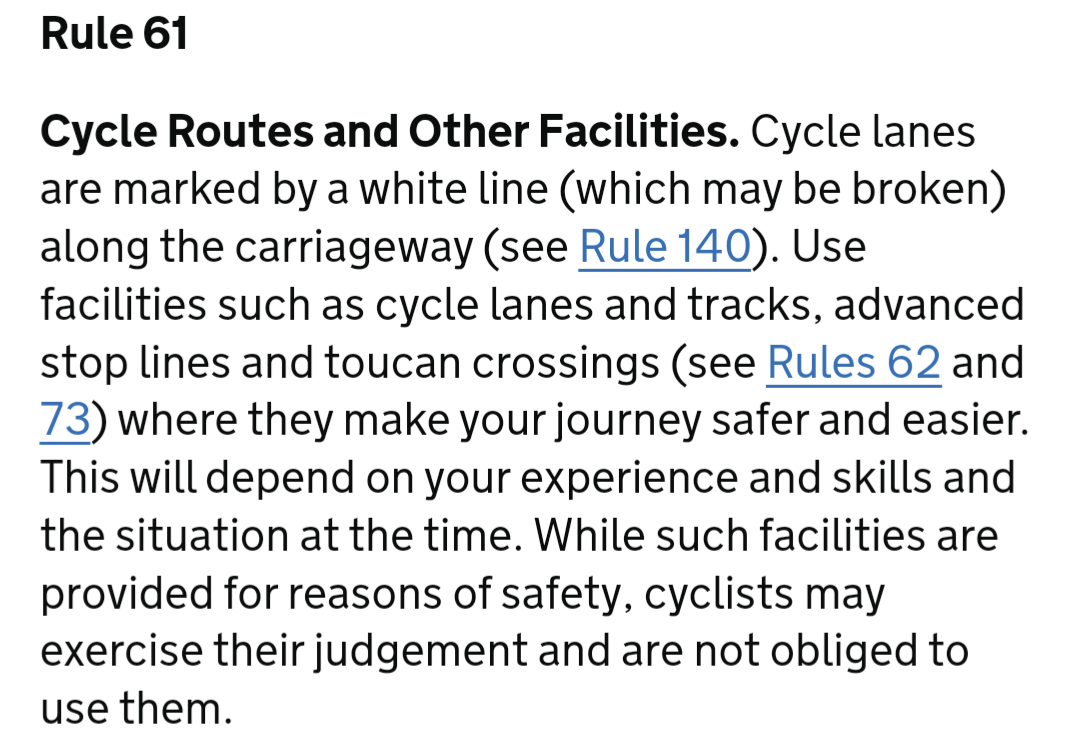
Contrary to what some people on social media or commenting on articles in the media may think, it is not compulsory for cyclists to use cycle lanes and other infrastructure where it is provided, something made clear here.
> Why don’t cyclists use cycle lanes?

Two terms you may encounter are “advisory cycle lane” and “mandatory cycle lane,” the former referring to ones marked with a broken white line, the latter by a solid one. “Advisory” and “mandatory” in this instance are aimed at motorists, who may in some circumstances enter the former during its hours of operation, but not the latter, as further explained in rule 140 of the Highway Code.

Law HA 1835 sect 72
While the previous rule focused on cycle lanes actually on the main carriageway, this one covers cycle tracks that are either physically separated from it (with kerbs or wands, for example) or which are located away from the carriageway and often shared with pedestrians.
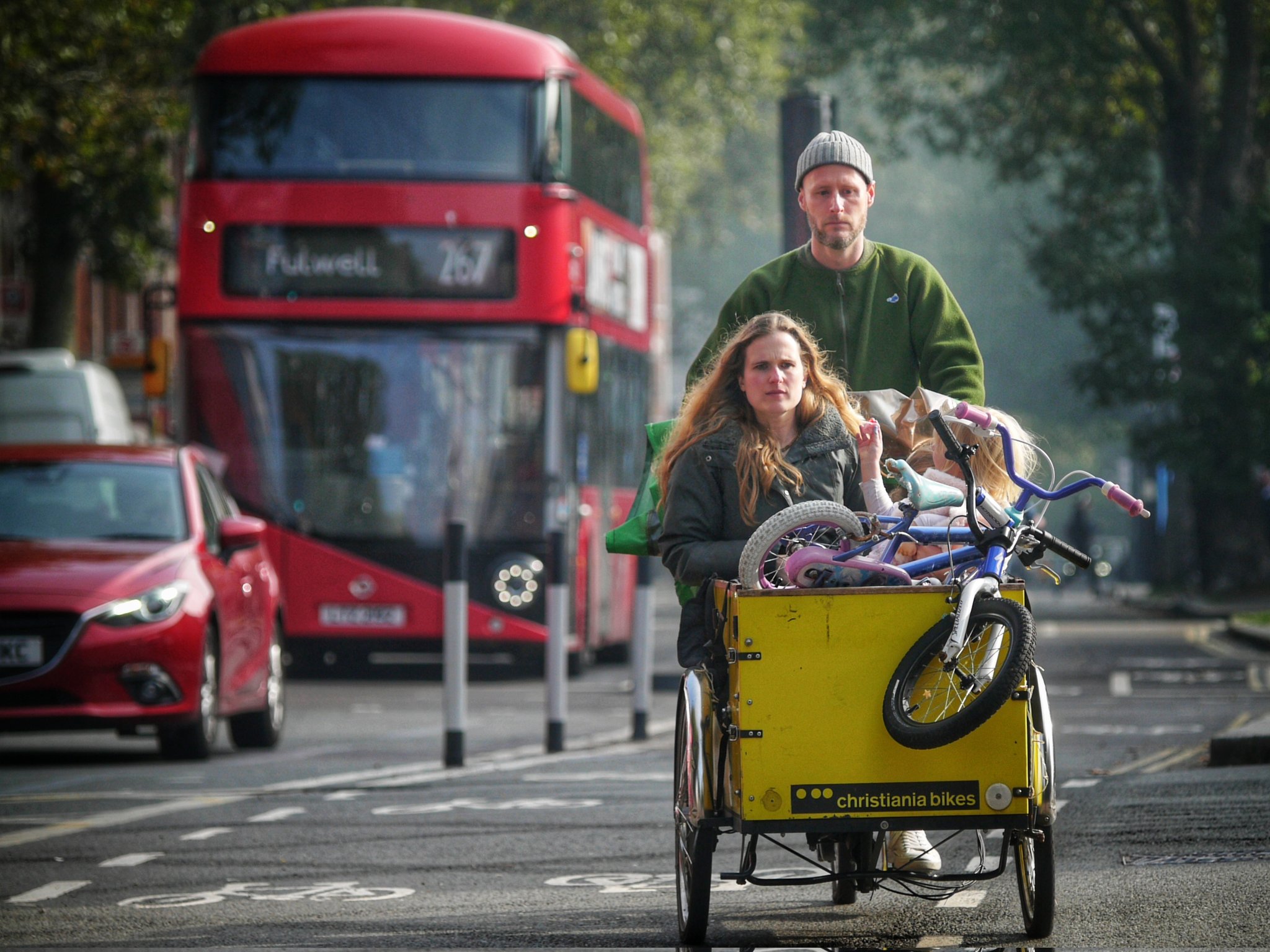
In many places, clear signage, markings on the path and at times the use of different colours on its surface will make it clear which part of the shared space is for people on foot, and which is for those on bikes.
Elsewhere, though, it may be less clear that a footway is in fact shared space due to factor such as inadequate or poorly located signage, or faded markings, sometimes bringing cyclists and pedestrians into conflict.
In both cases, the Hierarchy of Road Users introduced to the Highway Code last year means that you, as a cyclist, have responsibility for ensuring the safety of pedestrians and giving way to them on shared-use paths, in the same way as the rule requires drivers to do so for you on the road as someone who is riding a bike.

This rule expands on the previous one, and applies to places such as pedestrian zones where cycling is permitted, but the principle is the same; with pedestrians (and people on horseback, or who have a horse-drawn vehicle), you are required to take extra care in line with the Hierarchy of Road Users.
In some town centres, cycling in pedestrian spaces is specifically prohibited under what are known as Public Space Protection Orders, and riding a bike there could result in you receiving a fine from a council civil enforcement officer.
It is also worth noting, when talking about sharing space with pedestrians, that most towpaths would not be considered part of the public highway, and that you should follow guidance for using them in England and Wales issued by the Canal & River Trust, and in Scotland under the Outdoor Access Code, and that local authorities may also have specific rules in place regarding cycling on paths in parks, including banning bike riders from part or all of them.

Laws HA 1835 sect 72 & R(S)A sect 129
Comprising just six words, two of those in capital letters, this rule looks straightforward, although in practice it is anything but.
Yes, cyclists are banned from riding on the footway other than where it is designated a shared space, but Home Office guidance first issued in 1999 and subsequently confirmed by the Department for Transport and National Police Officers’ Council is that there are some circumstances in which doing so should not result in the rider being fined.
The guidance, originally issued by then Home Office minister Paul Boateng when fixed penalty notices were first introduced, says: “The introduction of the fixed penalty is not aimed at responsible cyclists who sometimes feel obliged to use the pavement out of fear of traffic and who show consideration to other pavement users when doing so. Chief police officers, who are responsible for enforcement, acknowledge that many cyclists, particularly children and young people, are afraid to cycle on the road, sensitivity and careful use of police discretion is required.”

As well as usually being made available to cyclists during their hours of operation, many bus lanes can also be used by other vehicles such as taxis, motorcycles and scooters during their hours of operation, which will be indicated by signs that also indicate which vehicles are permitted there.
As a consequence, they can be busy on certain routes, but are generally preferable to riding on the main carriageway especially for less confident riders. Care is needed though, and it’s not a good idea to overtake a bus when the driver is indicating that they are pulling away from the stop. It may be better just to hang back until the bus is on its way.
Increasingly, what are termed floating or island bus stops are appearing on Britain’s streets, particularly on routes where there is a physically protected cycle track. On these, the cycle track runs between the footway and the bus stop, so extra vigilance is required for pedestrians crossing here, who in line with the Hierarchy of Road Users mentioned earlier will have priority over people on bikes (indeed, often there will be mini-pedestrian crossing markings across the cycle track at such points).

Much of what is set out here is common sense, although the part that attracted most attention in the mainstream media when the changes to the Highway Code took effect in early 2022 is also the one that is perhaps most misunderstood by drivers – that cyclists are allowed to ride two abreast, with the wording here also underlining that at times it is in fact safer for them to do so – something we look at more closely in the article linked below.
> Why do cyclists ride two abreast?
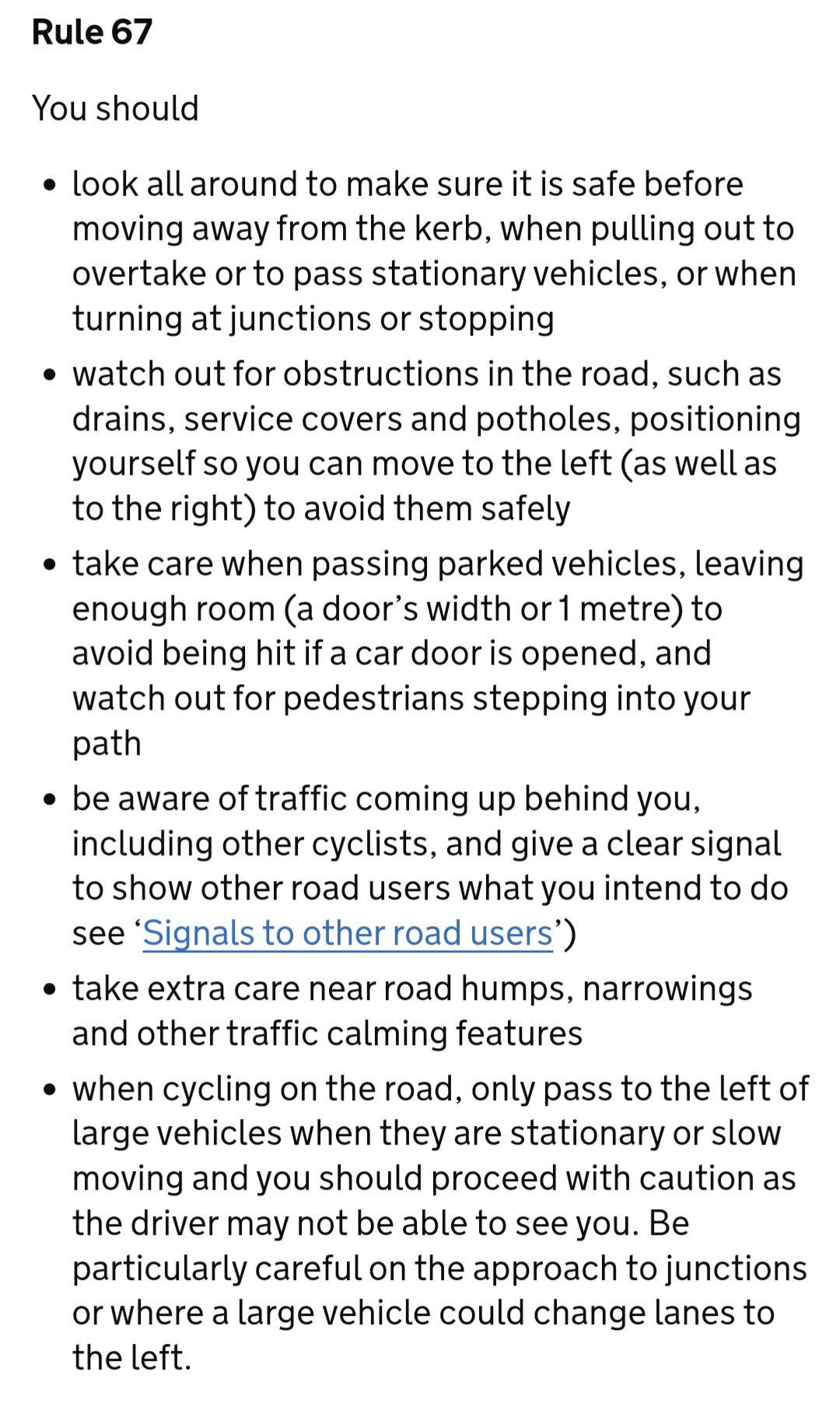
Much of what is covered here relates to roadcraft skills, much of which comes with experience. roadcraft, which comes with experience.
Novice riders in particular may lack the confidence to adopt such a riding position, and may benefit from a cycle training course such as Bikeability, which are often available free of charge through local authorities and where you will learn all the essential skills necessary for riding safely on the road.
One point worth highlighting is the advice to cyclists to leave at least 1 metre when passing parked cars to reduce the risk of being ‘doored’. This ties in with the advice to motorists and their passengers, introduced to the Highway Code last year, to employ what is known as the ‘Dutch Reach’ method of opening a door, again to minimise the chance of a bike rider being hit.
Regarding the final paragraph of this rule, while it does not specifically relate to traffic lights (see rule 73 below), you should never ride along the left-hand side of large vehicles such as buses or lorries while they are waiting at a red traffic signal since, once the lights change, you will be in the danger zone if the vehicle is turning left and the driver, for whatever reason, has not seen you.
Law RTA 1988 sects 24, 26, 28, 29 & 30 as amended by RTA 1991
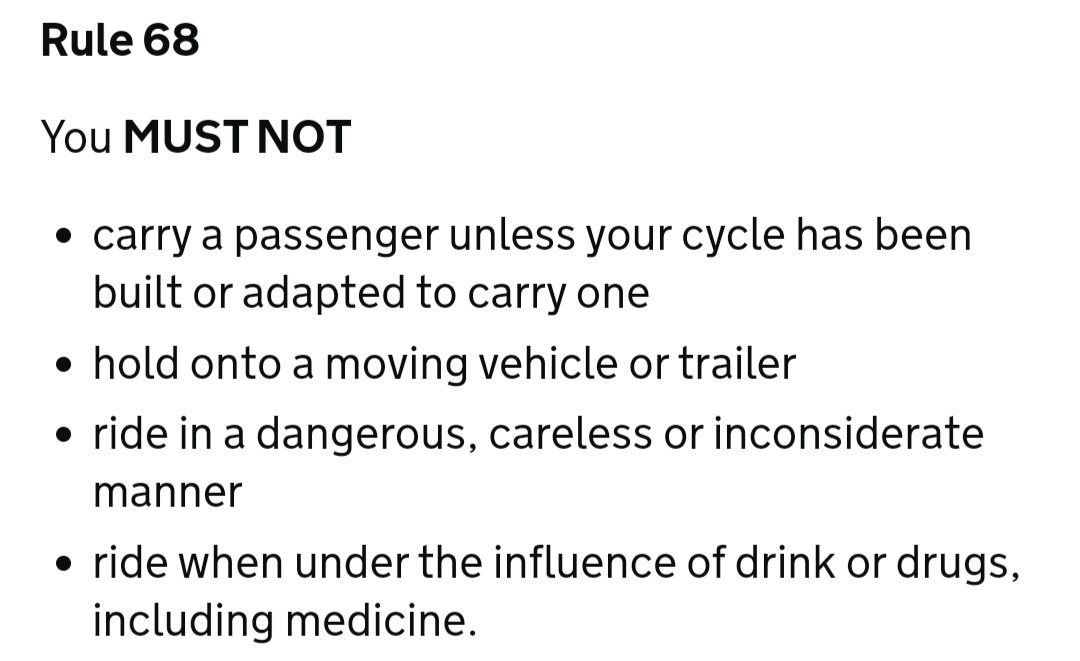
As we explained earlier, the Highway Code does not in itself constitute the law, although some of its rules do summarise certain pieces of legislation, and this one highlights a number of examples of behaviour that could lead to a rider being prosecuted, and provides links to the relevant statutes.
Laws RTA 1988 sect 36 & TSRGD schedule 3 part 3, schedule 7 part 4, schedule 9 parts 4 and 6, schedule 13 part 6, schedule 14 part 2
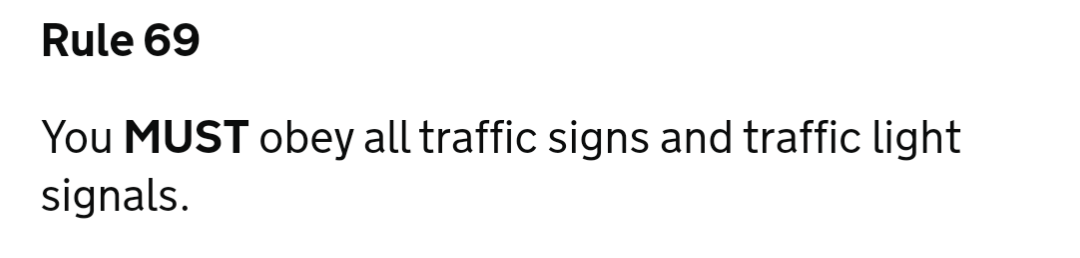
Contrary to what many motorists appear to believe (yes, we’re back to social media and below-the-line comments on news websites again), most cyclists do stop at red traffic signals; not to do so is, after all, breaking the law (although that does not seem to prevent many drivers from ignoring them.
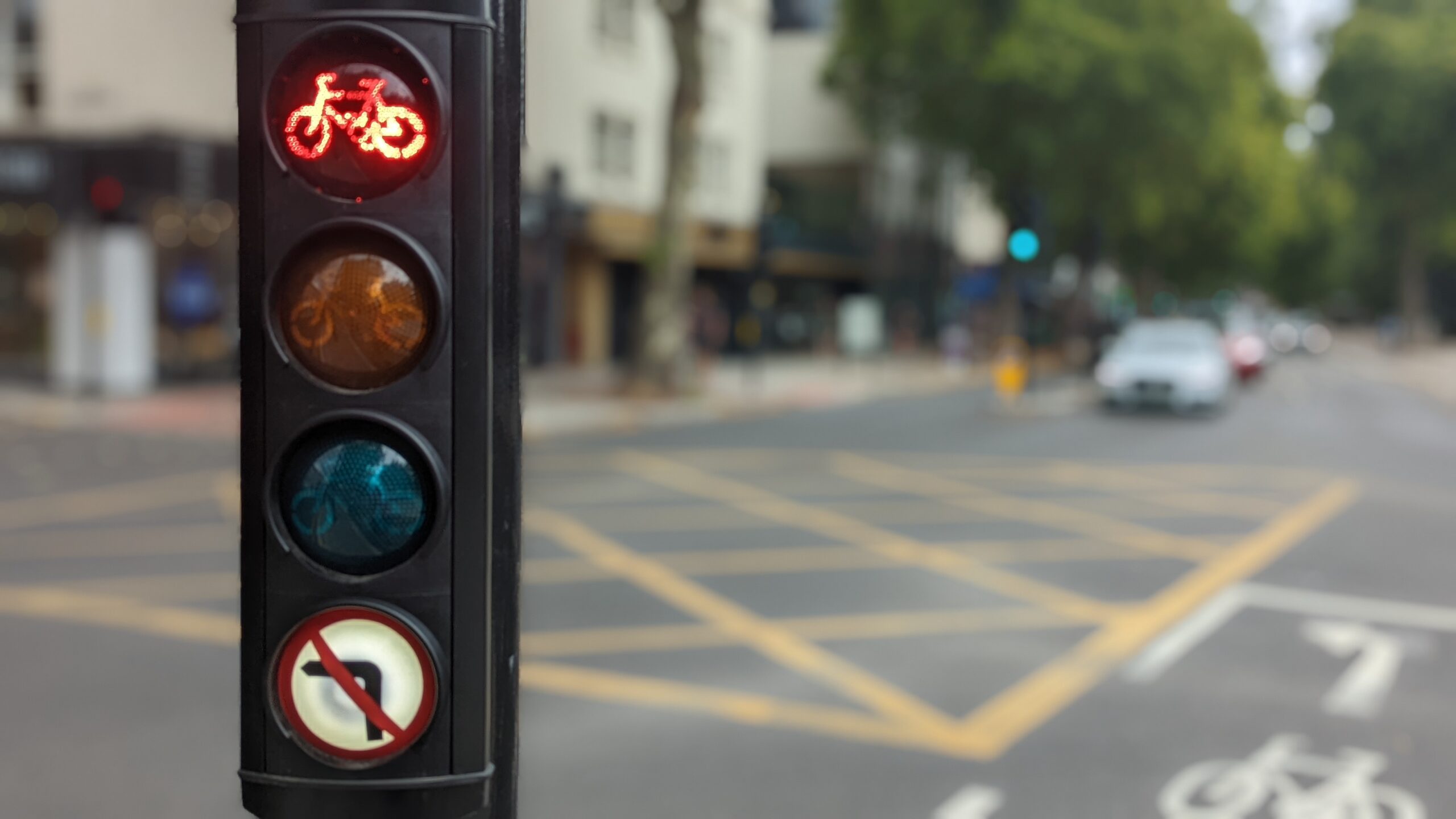
While we certainly would not condone breaking the law, there are some circumstances where there is little choice, such as at a junction where the traffic light is activated by a sensor, and which may register the presence of a motor vehicle, given its size, but not someone on a bike. In that case, our advice would be to dismount and walk across, but if you do choose to stay in the saddle, proceed with caution.
And should you find yourself on an empty road, with a red light at a pedestrian crossing ahead of you but no-one waiting to cross, you may find yourself pondering that age-old philosophical conundrum – “If a tree falls in a forest and no one is around to hear it, does it make a sound?”
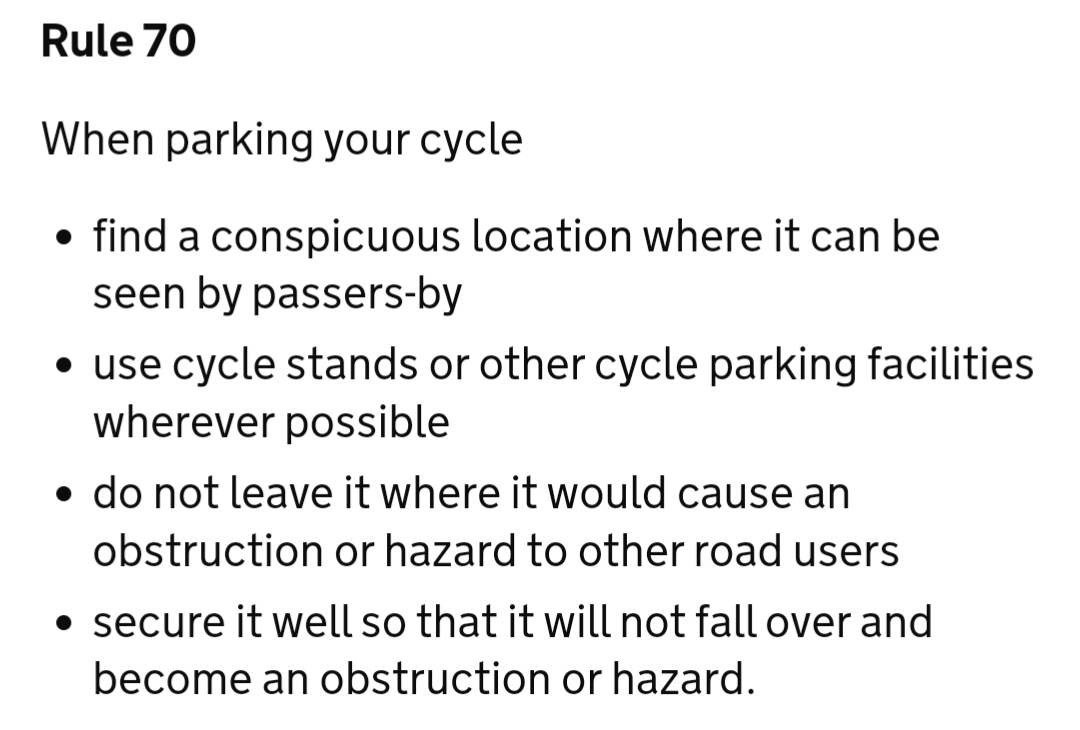
Sensible, if succinct, advice on parking your bike but for a much more detailed overview of how best to secure your pride and joy to ensure that it is still there when you return, take a look at our buyer’s guide on bike locks which has all you need to know about how to choose the best lock for your bike, and how best to protect it.

Laws RTA 1988 sect 36 & TSRGD Schedule 14 part 1
At traffic light junctions and at cycle-only crossings with traffic lights, you MUST NOT cross the stop line when the traffic lights are red.
Sometimes referred to as “bike boxes” and typically marked with a painted emblem of a bicycle on the road surface, advanced stop lines are designed to enable cyclists to get ahead of motor vehicles at junctions.
At times, you may find a motor vehicle occupying the space between the two white lines, but that does not necessarily mean the driver is breaking the law by being within the bike box, since there may be occasions when they have crossed the first line at the point when the traffic signal turns red, in which case they are told under rule 178 that they “should stop as soon as possible and MUST stop at the second white line.”
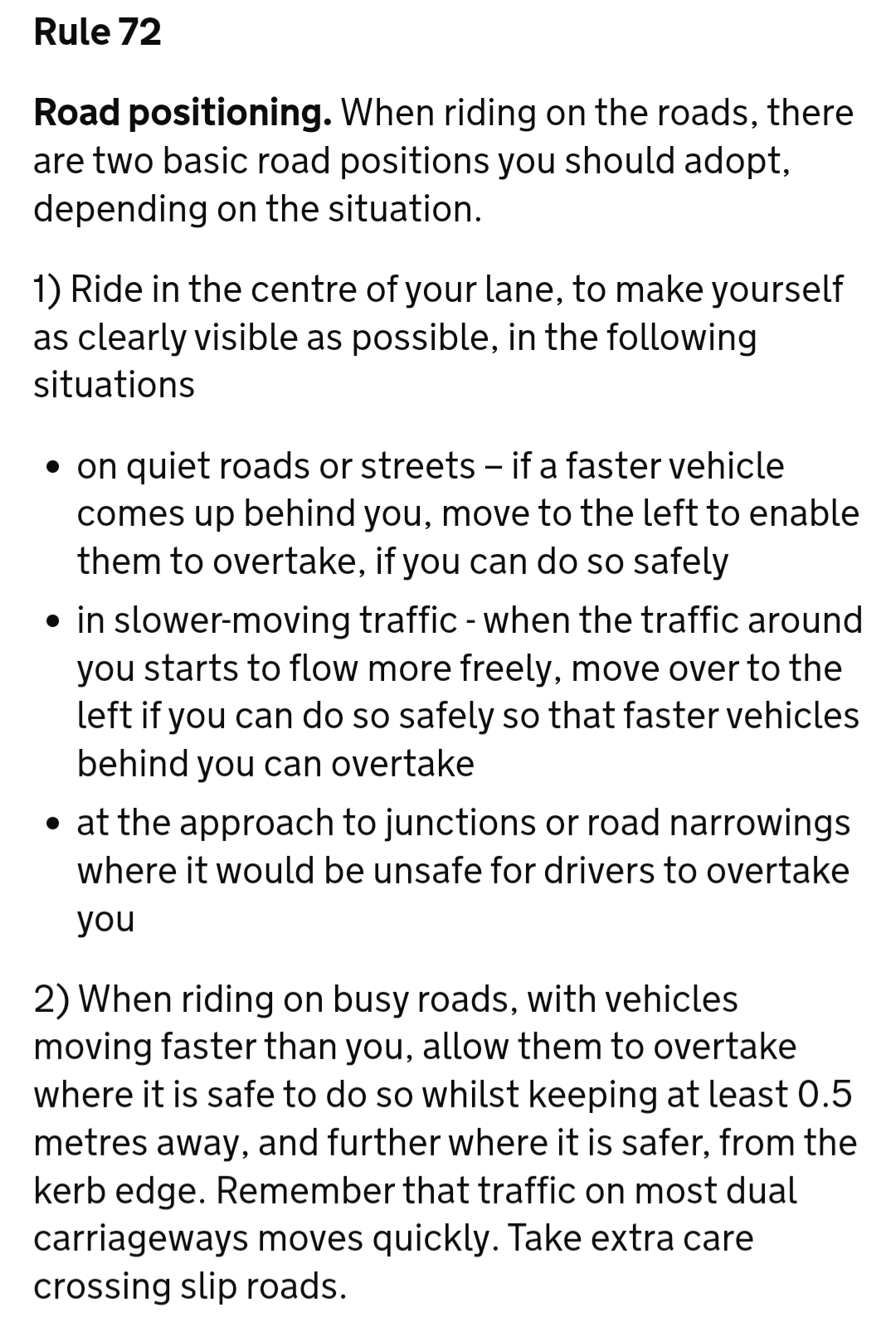
This rule relates to positioning, including taking what is termed primary position in the centre of the road at places where it would be dangerous for a driver to try and overtake you, such as where the road narrows due to a pedestrian island, say.
As with the rule on riding two abreast, this is one that has been misunderstood – and even misinterpreted – by some elements of the mainstream press, with one outlet reporting that the rule “tells cyclists to pedal in the middle of the road” when in reality, the advice relates to road position in specific circumstances, such as in slow-moving traffic or when riding on quiet roads.
In fact, taking primary position is something that has been encouraged by cycling instructors for decades. As highlighted in our commentary to rule 67, it’s another situation where less experienced riders may benefit from taking part in formal cycle training.
Road junctions (rules 73 to 77)


These two rules contain further advice on positioning and awareness with specific reference to junctions, and also underline that it is entirely permissible for cyclists to move up the inside of slow-moving traffic, which is also highlighted to drivers in rule 163.
Rule 74 emphasises once again the Hierarchy of Road Users, with people on bikes required to cede priority to pedestrians at side roads.
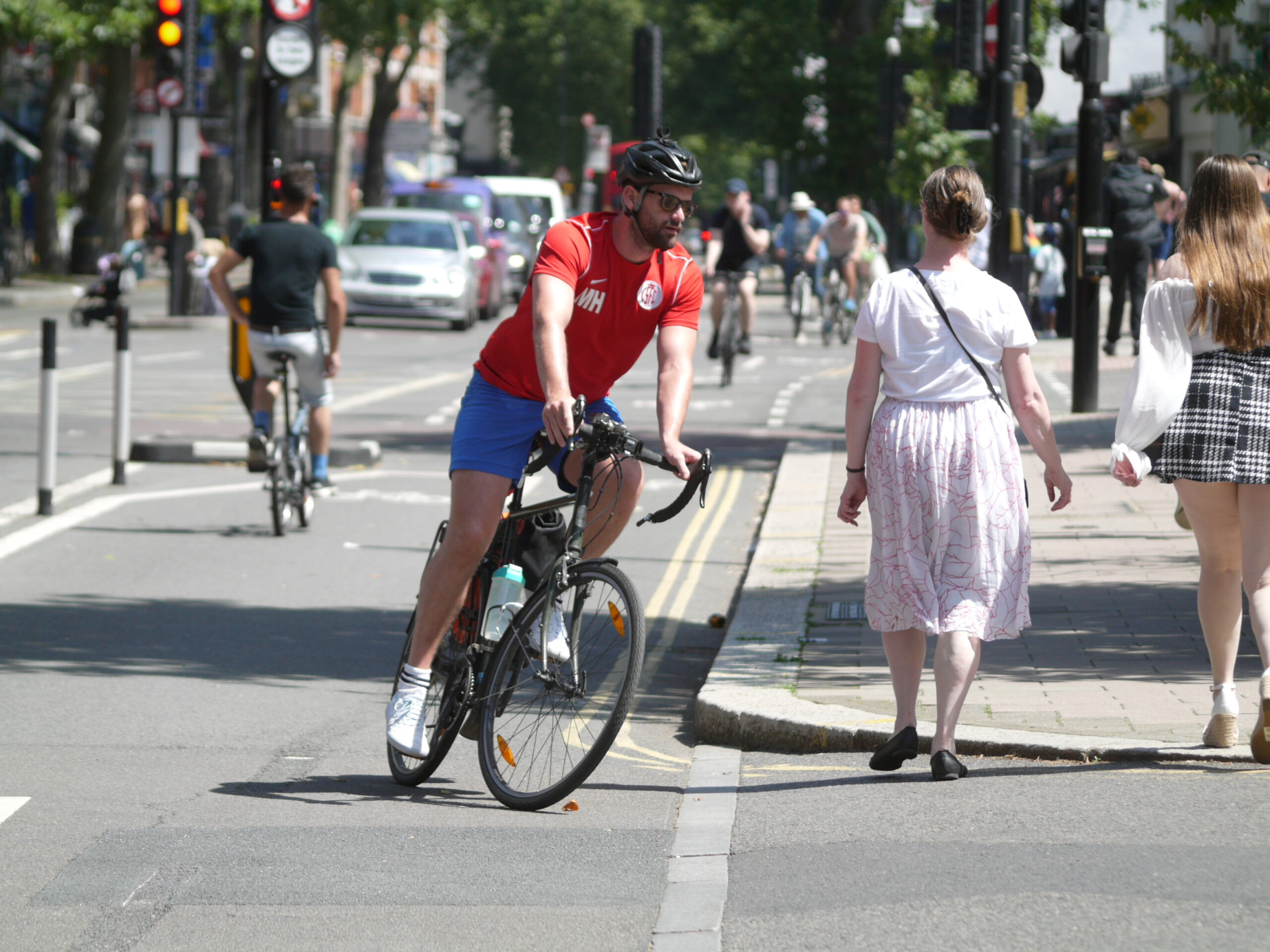
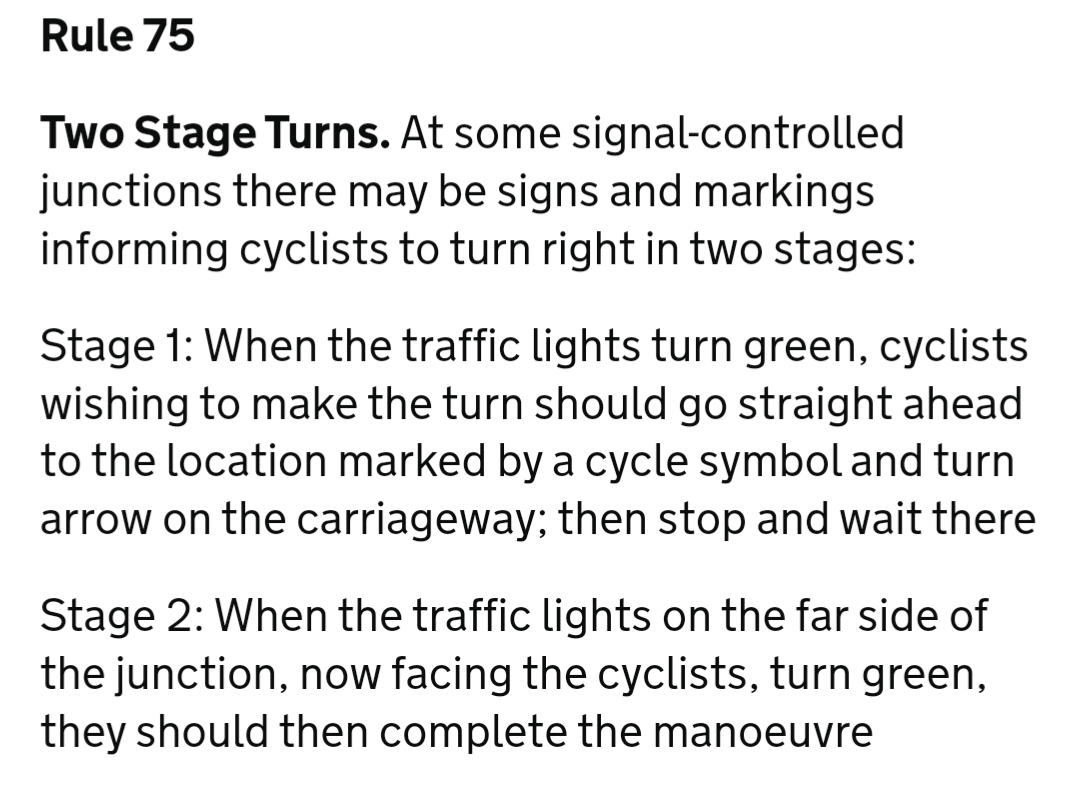
This type of turn is typically used at junctions where either the road layout, or the phasing of traffic lights, might put the cyclist in danger if turning right, with the introduction of a two-stage turn aimed at minimising such risks.
In practice – and this will very much depend on the road layout at the location in question – you may find it quicker and more practical to dismount your bike and wheel it over the crossing before getting back in the saddle (see rule 77 below).
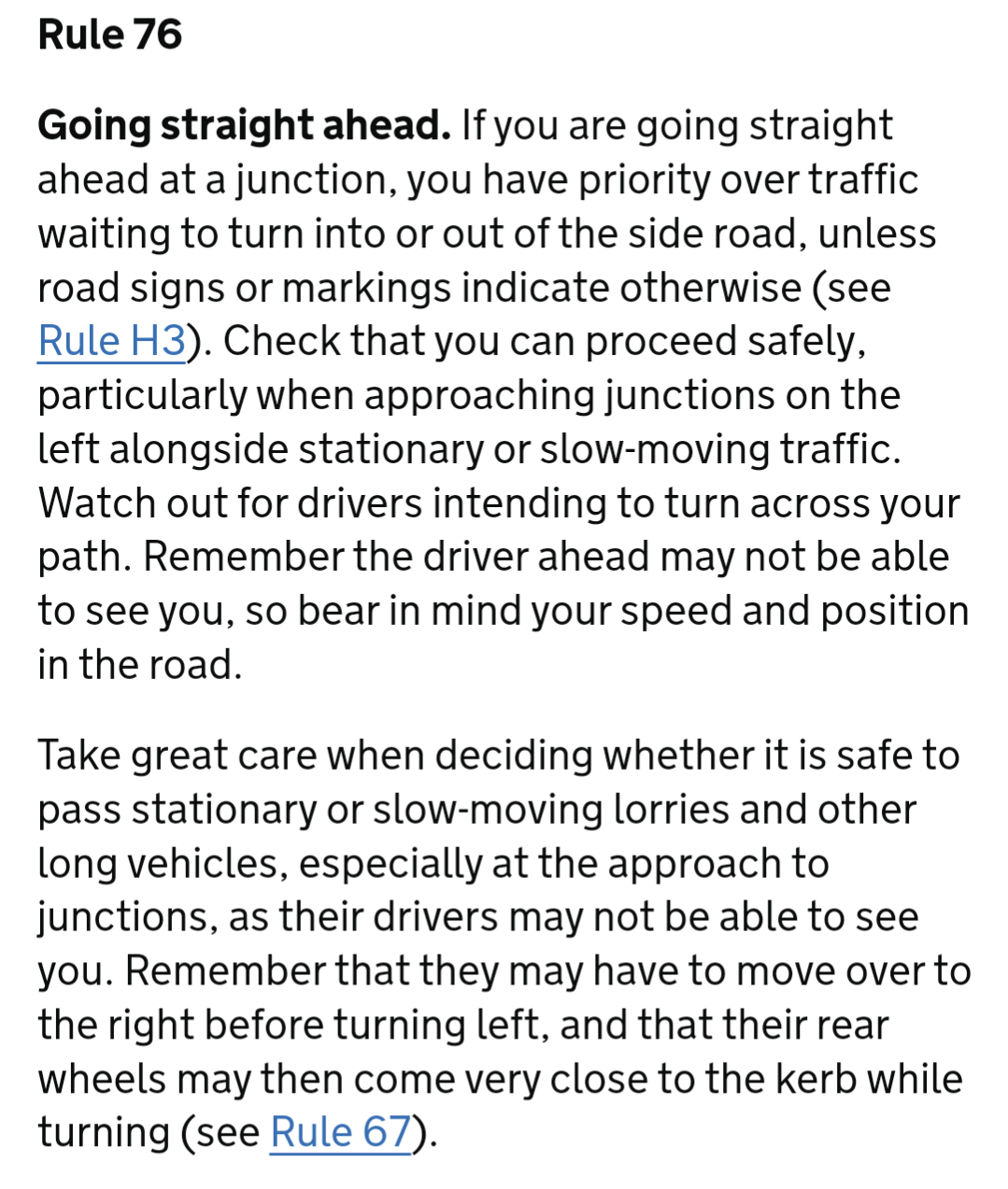
One of the changes made to the Highway Code last year forms part of this rule – cyclists having priority when proceeding straight ahead through a junction.
As we highlighted at the start of this article though, more than half of drivers are unaware of the changes, so be extra-vigilant especially of left-turning vehicles cutting across your path.
And while this rule reinforces the fact that it is entirely permissible for cyclists to filter up the inside of slow-moving traffic, NEVER move up the left-hand side of a large vehicle such as a bus or lorry at a junction.

This will very much depend on your confidence level on the bike, and if you’re new to cycling and find these kind of roads intimidating, you may wish to follow this advice while you build up your skills to the point where you feel comfortable tackling them.
Roundabouts (rules 78 to 80)
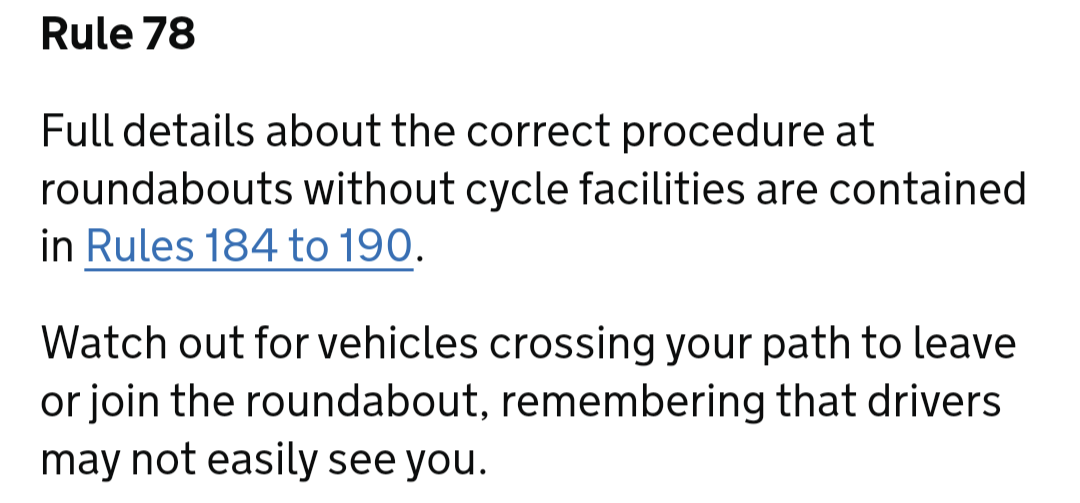


Roundabouts can also be very daunting, and not just for inexperienced cyclists. One common problem is that many drivers negotiating them are looking specifically for motor vehicles at entry and exit points, so they might simply fail to register the presence of people on bikes.
Where crossings or underpasses exist, you may feel more comfortable using these – although as we saw earlier when looking at cycle lanes and cycle tracks, even where a roundabout has dedicated cycle crossings, there is no obligation for the rider to use them.
Crossing the road (rules 81 to 82)


Toucan crossings get their name not from old-school Guinness adverts, but from the fact that their design means “two can” cross – ie pedestrians and cyclists, who do not have to dismount at this type of infrastructure. Again, care should be taken when sharing this type of crossing with people on foot.
As the rule advises, take extra care when riding around tram tracks. We’ve reported on a number of cases in which cyclists have sustained serious injury, and even been killed, after being thrown from their bikes due to a wheel getting caught in the track.
Many railway crossings, particularly in built up areas, will have double gates that block the entire width of the road ahead of a train approaching.
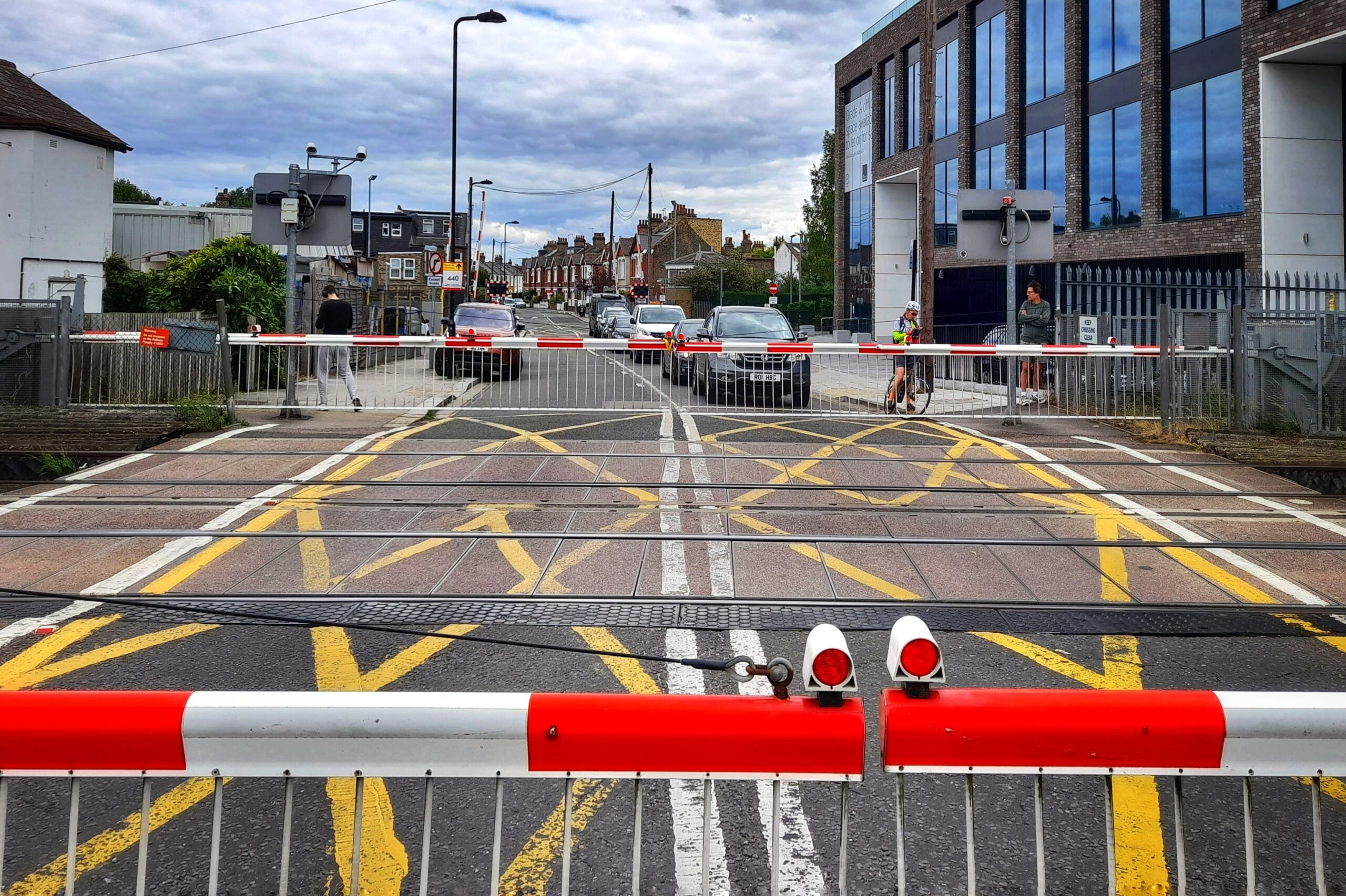
Be alert when approaching to the flashing red lights warning that the gates are about to come down, and unless you are already on your way across, do not be tempted to try and make it through in time – a whack on the head from the gate may be the least of your worries.
Elsewhere, level crossings may have just a single barrier on each side of the carriageway. Never succumb to the temptation of trying to ride across when the barriers are down, even if the coast looks clear; at 60mph, a train will cover the length of two football pitches in around 7 seconds.
We’ve reported on a number of fatalities at level crossings, and British Transport Police regularly shares videos of cyclists who have come within a whisker of being hit by a train when ignoring warning lights and barriers at level crossings. It’s just not worth it.
You and your bicycle
In Annex 1, the Highway Code also sets out advice and legal requirements relating to the “bicycle” – and by extension, trikes etc – itself.
Much of this should hopefully be relatively superfluous if you maintain your bicycle well, and have it serviced regularly and – if taking up cycling for the first time – got advice from staff at your local bike shop on the correct frame size for you, as well as saddle and handlebar height, etc.
Before setting out on any bike ride, you should at least check your tyre pressure, any quick-release skewers on wheels, and your brakes, and you should also regularly check your wheels for any alignment issues or broken spokes, your crank arms and pedals, your stem and headset, and your chain.
The two obligatory rules mentioned here relate to having lights during the hours of darkness, something we covered earlier in this article, and to ensure that your brakes are efficient.
Though not specifically mentioned in the Highway Code, under The Pedal Cycles (Construction and Use) Regulations 1983, bicycles must have independent brakes on both the front and rear wheels, except for fixed wheel bikes where only the front brake is required.
Got any questions or observations? Let us know in the comments below.




















58 thoughts on “The Highway Code for cyclists — all the rules you need to know for riding on the road explained”
Very useful – thank you.
Very useful – thank you.
Never knew toucan = two can!
I am going to regret asking
I am going to regret asking this and I am sorry for doing so, but…
The difference between “should” and “must”. Should is advisory and must is law.
Rule 163 is a “should” yet OpSnap allows me (not wtjs unfortunately) to submit evidence of drivers not following it, which can then (again not for wtjs) result in police action against the driver. If this is a “should” why would the police take action?
The offence wouldn’t be a
The offence wouldn’t be a specific close pass because as you say rule 163 doesn’t declare it as a must/must not, so the offence on the NIP would be either careless driving or driving without consideration for other road users, RTA section 3.
https://www.legislation.gov.uk/ukpga/1988/52/section/3
This week I had this OpSnap
This week I had this OpSnap reply for the first time. Either a new moderator or the rules have changed?
Thank you for the above submission to Operation Snap. It has been reviewed and the keeper of the vehicle XX00XXX will be sent a warning letter regarding the offence of close pass of a cyclist.
Highway Code Introduction
Thank you Rendel and mark1a.
Thank you Rendel and mark1a.
Seems strange to me that they would go to the trouble of updating the Highway Code recently, but not make this a “must” given that the police are acting on it* (especially given the “must”s that they don’t act on – parking in a solid line cycle lane for instance)
I am glad they do act on it – it just confuses me.
*Sorry wtjs, don’t mean to wind you up!
I’m not positive about the
I’m not positive about the requirements but I believe that to make it a “must” there would have to be an amendment to the Road Traffic Act. Which would of course be a very good thing, but the Highway Code can’t unilaterally impose new laws. One day…
To be a “must” there would
To be a “must” there would have to be a specific piece of legislation – which could be an amendment to the RTA, could be an amendment to a different Act (or indeed a completely new Act), or could be enacted using secondary legislation (a Regulation). Although an amendment to the RTA would seem the most likely option.
However, even without such specific legislation, the Highway Code and the advice therein does carry some weight in its own regard – although not definitive, failure to follow the “should” rules can stil be used as indicative of failing to use the roads in a safe and competent manner (the Highway Code is specifically referred to in S38 RTA, to this effect). A change of the Highway Code, even without change to any other legislation, can therefore still have a direct impact on the prosecution of driving offences.
I actually think that I have
I actually think that I have better outcomes from the police if there are muliple infractions involved. The obvious one is close passing whilst there is oncoming traffic. From a police perspective I suspect that making careless driving stick is going to be a lot easier.
As I mentioned before there is a stretch of A509 near me designated a no overtaking zone. In my experience, close passes in this “no overtaking for 1 mile” seem to get a course but outside of it seem to get words of advice.
I actually think that I have
I actually think that I have better outcomes from the police if there are muliple infractions involved
In Lancashire it doesn’t matter how many offences- if there’s a cyclist involved/ reporting it just goes straight in the bin. This Corsa goes for a ‘double’ with illegal crossing of the unbroken white line and No MOT. 8 days later, still no MOT- the police won’t have done anything at all.
https://upride.cc/incident/sh63ymkdg64yvn_corsacrv_uwlcross/
I’ll probably see this one again, with the illegal plate driving around while SORN-ed
I think I would have been
I think I would have been reporting the white Honda (? . Close pass, oncoming traffic, solid white line and too close to the car in front. Surely the very definition of “careless”. I just don’t understand why any police force would not see that an FPN for that driver benefits ALL other road users.
Guidance=can be ignored at
Guidance=can be ignored at all times, police not interested.
Must and Must Not = can also be ignored by motorists, because ‘everybody does it’. Police still not interested.
https://upride.cc/incident/yn67mvj_sainsburys44tonner_closepass/
https://upride.cc/incident/t90jdt_audiwithcaravan_rljatspeed/
That’s just a logical fallacy
That’s just a logical fallacy of anecdote. Don’t be a hippoblimp
Anecdata and all but regular
Anecdata and all but regular readers will note the ample library of facts on this – in a part of Lancashire at least – which wtjs has built up. Loosening logic from philosophy level to “Court of law” or below it’s very possible – if not probable – you find that represents police response in many places. That’s when you report and invoke the highway code, with some evidence (video etc).
Wtjs has several hundred more
Wtjs has several hundred more anecdotes along the same lines…
wtjs has several hundred more
wtjs has several hundred more anecdotes along the same lines…
Certainly have! These are two new UWL crossing offences on the same day at the same bridge, in opposite directions. There’s a lot of traffic on this road, and zero interest from Lancashire Constabulary. There will be a collision some day, and a good chance it will involve me, because there aren’t many cyclists around here- for obvious reasons.
https://upride.cc/incident/sj15agx_sprinter_uwlcross/
https://upride.cc/incident/sh63ymkdg64yvn_corsacrv_uwlcross/
So I have had to work out what to do: take the centre of the lane and hope I can think quickly enough when ‘my’ overtaking nutter swerves sharply into me.
“There will be a collision
“There will be a collision some day, and a good chance it will involve me,”
Oh, looking for trouble then !
Oh, looking for trouble then
Oh, looking for trouble then !
Yes, deliberately going out cycling when I have been warned against it many times- including of the day of the Queen’s funeral against the orders of British Cycling!
Nasty, snide
Nasty, snide
I always watch your videos
I always watch your videos with a mix of horror/fascination and dread the day I visit this site to find a message about you being seriously injured.
Great spot with the CRV licence plate, by the way.
I am genuinely shocked at the lack of interest from Lancashire Constabulary (okay – shocked isn’t the right word, considering your very detailed and vastly documented interactions with them)
I really hope they see the error in their ways before you (or someone else) gets hurt.
Not to rub salt into your wound, but to try to give you some hope, my local force would:
to that close pass.
I really hope they see the
I really hope they see the error in their ways before you (or someone else) gets hurt
Well, they’re really hoping I do get hurt. They people they really dislike are not offenders, but people who report offences. As far as checking plates is concerned: there are so many MOT, insurance and VED evaders in Lancashire, as a result of the Lancashire Indolence Mode of Policing, that it’s always worth checking suspicious vehicles like Audis, BMWs, pick-ups etc. as below. Lancashire used to provide statements about what they were doing (which always included the possibility of the joke ‘advice letter’) until they found out that I was onto them not actually doing anything at all
Well written article let down
Well written article let down by a significant lack of logical rigor around helmet use. Specifically the logical fallacy of Middle Ground
How so? I can’t see any
How so? I can’t see any middle ground being proposed, just a sequence of facts – the Highway Code recommends wearing; it’s a matter of personal choice; it is the subject of a debate; you may feel safer wearing one; you won’t be breaking the law if you don’t. Not here for an actual debate on helmet use, just don’t see the logical fallacy.
You can’t cover everything in
You can’t cover everything in every article. It’s about what the HC says. I’ve worn helmets since the original Bell but had mixed thoughts about their usefulness and possible added danger. Having hit a patch of diesel a few years ago, I concluded helmets are, on balance, worth wearing for the very rare event of going down, without warning, in a fraction of a second, and hitting your temple on a kerb. I now have a MIPS helmet but other, similar, technology is available. Probably should fix a long, flowing, blonde wig to the back of the helmet – it makes drivers give you a wide pass as they think you might wobble and scratch their car
The rules are few and simple
The rules are few and simple 1. after dark wear black clothes show no lights or reflectors 2 ride on pavements as fast as you can hitting wheelchairs where possible 3 ignore red lights and any other safety rules and ride on the wrong side often 4 keep paying into a funeral plan
As the Book of Common Prayer
As the Book of Common Prayer reminds us, man that is born of woman hath but a short time to live…and you spent a portion of your precious time on this earth creating an account just to leave that comment. Well done.
But maybe they take after
But maybe they take after Macduff – does that mean all bets are off?
Was wondering if/when this article would provoke some “humorous” versions; term obvs. used loosely here.
chrisonatrike wrote:
Not at all relevant but there’s an excellent sketch by John Finnemore dealing with the Macbeth/Macduff confrontation: “So you were a ceasarian, you ask your mum if she thinks that still counts as being born, I bet she does. When’s your birthday?” “August 3rd.” “There you are, BIRTHday. It’s called birthday because that’s the day you were born, it’s not about about which exit you use…”
Wheelywheelygood wrote:
Not a great start for you there Mr or Ms Troll.
D- Must do better.
Wheelywheelygood wrote:
I don’t do any of that! Do I still count as being a cyclist?
brooksby wrote:
(weary sarcasm) No true “cyclist” would be more visible at night than required for people to comment on how they can’t see them properly! Or proceed with care near pedestrians while simultaneously not holding up cars. Or follow safety rules which are clearly for their own benefit. They’ll obviously complain that others were endangering them though, shurely?
Sadly it’s the salient minority who engage some commentors. Grain of truth though: it’s likely that people riding bikes may be more inclined to be more casual than drivers. And actually – isn’t relaxed cycling part of its point?
Cycling is a more “casual” means of transport (except when cycling on busy roads, in the UK…) It’s much less dangerous to others or harmful in general than using a motor vehicle.
Another reason to work with human nature – by giving people space to ride in as relaxed (and social!) a fashion as they walk. (This is an instance where cycling is often more like “walking plus” than “driving minus”). Spaces they can do so in safety – for themselves and others!
chrisonatrike wrote:
I know, but I thought this one was funny.
There are many types of
There are many types of people on bikes, scooters, ebikes, escooters. There are also many frail people who are not bothered by cars because they always cross roads carefully at crossing points. However, they are terrified to go out onto the pavement due to reckless people on various forms of bicycle. Having cycled as my main form of transport for nearly 50 years all around London, I am almost ashamed of being thought of as a cyclist. Many reckless cyclists are on heavy machines with large loads, eg delivery riders. Many cargo bikes are not well driven, even when they carry children as passengers
Daylight getting to you
Daylight getting to you lovvie?
1 to 3 seem to be the law for
1 to 3 seem to be the law for bike riders around us in SE London. Doubt they pay into a funeral plan. As for cars: about 10% view speed limits as advisory or as the minimum. Now I’m 68, many of my friends and relatives are quite frail so, walking with them, I’ve become rather ashamed of being thought of as a cyclist. Greenwich and Woolwich foot tunnels so terrifying, my son bought a car to bring his pregnant wife to visit us on t’other side of River. The 20mph limit is annoying: as a cyclist who waits, it is now a very long wait at the lights.
I think the article could
I think the article could have been a lot clearer by re-arranging and clarifying the ‘must dos’ and the ‘cyclists might want to think about this’ . The HC seems to be commonly misuderstood by many people, cyclists and drivers alike due to its insistence on not being clear about guidance and rules. It is a shame that even in the recent HC review/update, the authors did not help those people who still struggle with the difference between shall, should, could, would and all that. The bike stuff actually boils down to very few rules, and a lot of guff written by folks who probably swing their leg over a bike 3 times a year, mainly in August and ride at 6 mph up and down a disused railway track.
bobbinogs wrote:
I’m sure there’s some truth in that but, at least in respect of the 2022 changes, also with input from consultations and cycling campaign groups.
bobbinogs wrote:
My village recently went down to a 20mph speed limit and has got one of those speed detectors with a display which shows your speed and then a smily or frowny face. I was quite pleased to get a frowny face from it
The seriously dumb situation
The seriously dumb situation we have in this country is that we have laws that are used to prosecute road users and we have the Highway Code. They are different things. Until the law is aligned with the highway code or vice versa, the whole thing is just a piece of advice and unfortunately or otherwise there are few consequences for those that choose to ignore it.
It’s rather more than. You
It’s rather more than. You adduce the highway code to demonstrate offences
Eg careless driving, driving without due care.
It’s also the standard for driving tests.
As argued before by HP, there should be a driving examiner expert witness who would state what sort of fault would have been committed and if it would have resulted in a test failure.
there are few consequences
there are few consequences for those that choose to ignore it
Most of it is firmly backed by law, and the cause of the absence of consequences for those who speed through red traffic lights, or drive without MOT, or illegally cross single and double white lines is The Police.
I think it’s important to
I think it’s important to point out that the HC recommends that you ‘should’ wear white trainers. According to the illustrative photos, anyway…
brooksby wrote:
Not quite as odd as it may appear as an indication of legs moving (or arms – but may be harder to see from the rear) does seem a pretty good way of spotting cyclists in the dark. (Anecdote – don’t have studies on that…)
Although they’d need to be shiny / reflective for full marks.
Are they really saying “don’t be like this wrong’un – instead be like this newly-careful cyclist after they’ve been released from prison with their white trainers”. (Presumably having been rightly sent down for RLJ / riding on pavements / “he nearly killed me” on a pedestrian).
(No subject)
Probably breaking the law
Probably breaking the law there. That bike clearly has spokes and pedals.
I have two drop bar bikes
I have two drop bar bikes that don’t have a rear reflector or amber pedal reflectors, but I wouldn’t expect to use these ‘racers’ at night. My other drop bar bikes have full length mudguards that have a permanently mounted rear reflector. They also – even my tourer – have SPD-SL pedals.
So this is just my occasional reminder that you can – and probably should – fit pedal reflectors if you are expecting to go out on such a bike at night. Just saying, I would want to avoid accusations of ‘contributory negligence’ and all that…
It is something I have spent
It is something I have spent some time thinking about. While technically cleats without reflectors are illegal, I reckon a lawyer could argue that reflectors on cleated shoes are in the spirit of the law – since the shoes will be fixed into the pedal.
As lots of people have said on here before, I (and they at the time) have never heard of a cyclist facing any kind of legal snaffle over missing reflectors from pedals.
Of course I have absolutely no legal background and very limited cycling experience!
The cyclist had reflectives
The cyclist had reflectives on their helmet, jacket, bibs, shoes, reflective ankle bands and 4 rear lights but I was unable to see him due to lack of pedal reflectors.
Id say that an admission of guilt.
Hirsute wrote:
Ha ha. You make a fair point – and I often can’t resist liking those tweets showing a marked police car that has been crashed in to by someone who failed to notice all that hi-viz – but I just feel that there is something about the motion of the pedalling cyclist when viewed from behind in the dark that makes it worth the trouble to fit pedal reflectors. Sure, they’re not sexy, but then neither is being avoidably dead.
Or – for a modicum of extra
Or – for a modicum of extra effort – reflective snap wraps (or velcro band etc). If you wear trousers they can help manage the cuffs too! Just snap ’em round the frame when done then they’re there whenever needed. Or discard to save a few grams if you’re sure you’re not cycling at night.
I’ve always got a few on my bikes and they can add visibility to arm signals too.
No clue about whether the pedantic law / insurers would use “but they’re not attached to the pedals” as a way to avoid action or payout of course.
chrisonatrike wrote:
Those snap on ankle reflectors are better than nothing, but as this CTC article points out, “For the sake of visibility, reflective ankle bands are a suitable substitute, but these do not meet legal requirements.”
https://www.cyclinguk.org/lighting-regulations
They are superior to
They are superior to reflectors.
I also mentioned them in my first post.
I find driving at the appropriate speed and looking ahead and middle helps me avoid causing deaths.
Exactly. Been using them for
Exactly. Been using them for years: ankles and wrists plus a couple on the frame. They’re better than pedal reflectors, even if not a legal requirement
I am enjoying this series of
I am enjoying this series of articles – I am sure plenty of people find them really useful. I really hope it helps tip people over their indecision edge, and they give cycling a go.
Are there plans to do a piece on the practical side of cycling? Things like demonstrating hand signals and how/when/which position to take on roads for scenarios (hints for less confident cyclists as well as those gaining in confidence)
Are there refresher cycling proficiency courses out there? Its been many years since I did mine!
HoldingOn wrote:
I find that you can sometimes pick up a trainer (often a follicly challenged man of certain age for some reason) out on the road! For an intensive course, delivered in a punchy style…
More seriously I suspect that most courses / training are aimed more at the “absolute beginner” / “building confidence” end of things. Most areas have some kind like BikeAbility which presumably covers “the rules” as far as they need? (Scotland even has a “training available” site).
Probably you don’t get the chat on legal details that you would on here though!
chrisonatrike wrote:
In London Cycle Confident offer three levels of free training in fifteen boroughs, starting with “basic”, going onto “urban” and then “advanced”.
It looks like Bikeability
It looks like Bikeability offer adult/teenager courses
One of the most useful web
One of the most useful web articles I’ve ever seen. I was just about to go through HC with a fine toothcomb to remind myself about cycling sections. Never knew the Toucan crossing naming reason or the rule.
Great news! I can cycle up Shooters Hill on the pavement. And I can stop getting annoyed at people who currently ride on it while I’m walking – tbf, they’ve all been considerate cyclists. But no excuse for the people who ride on Broad Walk pavement or the narrow, no cycling paths in Greenwich Park