If you’ve enjoyed this article, then please consider subscribing to road.cc from as little as £2.49. Our mission is to bring you all the news that’s relevant to you as a cyclist, independent reviews, impartial buying advice and more. Your subscription will help us to do more.
Jack is group editor across road.cc, off.road.cc and ebiketips, overseeing all three sites in the F-At Digital group to make sure everything’s up to scratch. He’s been writing about cycling and multisport for over a decade, arriving at road.cc via 220 Triathlon Magazine in 2017. He worked across all areas of road.cc including tech, news and video, and also contributed to ebiketips before being named editor of road.cc in 2021 (much to his surprise). Jack has been hooked on cycling since his student days, and currently has a Trek 1.2 for winter riding, a beloved Bickerton folding bike for getting around town, and an extra beloved custom Ridley Helium SLX for fantasising about going fast in his stable. Jack has never won a bike race, but does have a master’s degree in print journalism, and two Guinness World Records for pogo sticking (it’s a long story).
RE flood edition - I've not yet tried the London cycling superhypeways but never mind the flood - is that all of 15 metres of vaguely kerb-protected section, before that peters out and then you fall into some roadworks?
@OnYerBike apples and oranges, but good would be a ramp that everyone can use - ticks even more accessibility / health and safety boxes that stairs!
Of course that would be serious budget, and probably protracted wrangling about where it would go. But lifts are spendy also, and a ramp will keep working when the lift breaks down.
@mctrials23 IIRC almost all "public space" engineering is remarkably if not wildly expensive. Some is doubtless "it's not my money I'm spending" but a lot of it is "this will save money when it doesn't get trashed in a week / cause some injury".
And it might seem very cheap if you find yourself in court, potentially on the hook for hundreds of thousands or more, and can have confidence in stating that all due diligence stuff was covered and you didn't just get your mate to do it for a few beers.
As you know, no, they aren't. They're mitigation for *some* people where "we should have addressed access concerns in general" applies:
- a ramp / underpass could potentially be accessible to *all*
- for a retrofit a lift might be preferred (and noting the group are sensibly trying to get one) "because space constraints" (sounds familiar...). Though lifts are more expensive to maintain and sometimes will be out of order.
As mdavidford says - these things are not even helpful for everyone on wheels. Although if you do have any kind of adapted cycle / a tandem or recumbent you might be advised not to try to get a train anyway (rail companies vary - will any take these?) And aren't some down on EAPCs also?
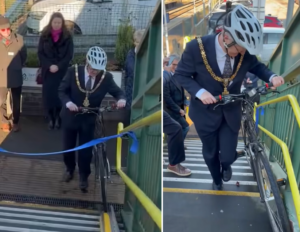
Unfortunately even ones that are correctly installed are likely to present a trip hazard - more if they're easier for cyclists to use e.g. further from the edge.
If someone's done the maths and believes they're on balance less dangerous / costly, then the ones with some kind of brush strips on either side to provide some drag might be advisable?
Compared to the Dire situation at Cambridge main station or even Cambridge North Station those cycle channels are pretty good. well I look forward to the new overbridge at Cambridge which will hopefully deal with the overcrowding issues on summer weekends, and equip the station with some bicycle- sized lifts
There's a good reason why "it has endured quite a tumultuous period of trading" and they are brands without the marketing kudos of Trek, Specialized and Cannondale. Think he would struggle if it was crowdfunded.
Floating bus stops are life saving, and we need more of them if we have any hope of developing the kind of cycling network we need, and there's no doubt a portion of the criticism is very selective hyperbole enjoying making people angry and afraid for clicks. I'm pleased the research has been published to get some hard data out there. BUT, some people are @rseholes, and cycling fast through the bypasses, ignoring pedestrians and refusing to slow down or stop for those trying to cross should be condemned.
I do question the value of the zebra crossings, as they may not be easy for even the most careful of cyclist to spot when they are in a queue of other cyclists, especially without Belisha beacons. They are arguably more helpful on less busy streets, as it gives both pedestrians and cyclists something to aim/not aim for so to speak.
We often talk of how well they work in the Netherlands, or Germany and Scandinavia. That is partly because pedestrians are used to them, but also because cyclists there tend to be better trained, and were raised with them as part of their culture. Dutch-style bikes are famously more upright, so offer a better vantage point than a typical road bike where the view is often the back of the bike immediately in front. Not to mention how fast some people cycle. The Dutch famously don't pedal like they are hoping to be talent spotted.
There is of course the growing issue of (illegal) e-bikes going far too fast for the conditions anyway, sometimes associated with heavy hire bikes, and sometimes with food deliveries, and there's a lot that can and should be done to discourage reckless cycling that frustrate and scare regular cyclists as much as they scare pedestrians.
Unfortunately, some cyclists do act like the stereotype of expecting a clear run, but I'm certain that many who don't spot someone waiting to cross at the min-Zebra crossing were simply focused on the bike in front, or the other pedestrians walking precariously close to the kerb, and better design, along with a culture change, will make it easier for those cyclists to slow down and stop as required. Unfortunately a zig or zag in a path isn't necessarily obvious enough as we have so many of them to dodge lamp-posts and manhole covers. I think rumble strips are more effective at alerting a cyclist's subconscious than a ramp, which IMO is more of a visual cue for pedestrians.
A local bridge over a busy road have these rails installed, they are in my opinion useless. I just lift the bike (hike a bike) I am ok as the bike is light, I would not like to be someone who has a loaded bike or a E- Bike, they are not a proper solution to getting a bike up steep slippery stairs, either put large lifts in that can take a bike and rider without having to balance on the back wheel or put ramps in a gentle enough slope to make it easier to walk for all. Pushing children in prams- buggies- wheelchair users - people pushing bikes and those who may not be as mobile as they used to be, this requires money and space and l do understand that these are often at a premium.