



Strava has responded to calls for a popular segment in London’s Regent’s Park to be scrapped following the widely reported case of an elderly pedestrian who died from injuries sustained when she was hit by a cyclist as she crossed the park’s Outer Circle road, the ride-sharing app reminding users and the public that “hazardous” segments can already be flagged and urging cyclists to “prioritise everyone’s safety”.
The Royal Parks, the charity that manages London’s eight royal parks, contacted Strava asking for the Outer Circle segment to be deleted, believing that this may deter cyclists from riding the route at high speeds.
It comes in response to the incident from June 2022, but that has made headlines in the past week since a coroner’s inquest heard that Brian Fitzgerald — the cyclist riding laps of the Outer Circle as part of a group ride and travelling at between 25-29mph when he hit the 81-year-old pedestrian, causing her several broken bones and bleeding on the brain, injuries she died from in hospital two months later — would not face prosecution as the Metropolitan Police deemed there was “insufficient evidence for a real prospect of conviction”.
In a statement provided to road.cc this morning, Strava urged cyclists to “prioritise everyone’s safety” and stated that “the behaviours related to this incident violate” the app’s community standards.
“We are aware of the tragic cycling incident which occurred in London’s Regent’s Park in June 2022 and our condolences go to the victim’s family,” a spokesperson told road.cc.
“At Strava, safety of our active community and those around them is a priority, and we have community standards that note that ‘sports happen in dynamic environments that we share with motorists, pedestrians, other people, equestrians, pets and wildlife’. Strava expects those in our community to ‘prioritise everyone’s safety and enjoyment of our shared resources and respect the law’. The behaviours related to this incident violate Strava’s ‘community standards’.
“At the end of last week, we received a request from Royal Parks to discuss the cycling route segment where the incident occurred. The ability to flag a cycling route segment as hazardous already exists in Strava. Anyone can report a segment that they would deem as hazardous. If segments are flagged as hazardous, achievements are not awarded for that segment and leaderboards are disabled. Any Strava community member who cycles on that same route segment will receive a warning of the hazards on that segment.”

At the coroner’s inquest, Mr Fitzgerald said he had “zero reaction time” to avoid Ms Griffiths, who had been walking her dog and was crossing the road to a pedestrian island, when she stepped out in front of the group of cyclists. While the speed limit in the park is 20mph, the Metropolitan Police confirmed that it does not apply to people riding bicycles.
The Royal Parks believes removing Strava segments would remove the incentive for cyclists to ride as fast as possible, a spokesperson yesterday stating that the organisation would also be working with the police and “local stakeholders, including cycling groups, to inform our approach”.
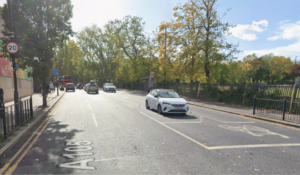
Over the weekend, the Telegraph reported that on 1 May another pedestrian was struck by a cyclist at the same spot where Ms Griffiths was fatally injured. It was reported that Paolo Dos Santos was left with fractures to her eye socket, jawbone and cheekbone when she was hit by a cyclist overtaking “a car which was said to be observing the 20mph speed limit”.
“Apparently, the cyclist didn’t slow down but overtook the car by going around the pedestrian island on the wrong side of the road where I was crossing,” she said. “It means he was very likely speeding and was on the wrong side of the pedestrian island.”
The Royal Parks is also considering other safety measures, such as raised pedestrian crossings and cited Richmond Park in south-west London as a case study for where it has introduced “additional measures to encourage safe cycling”.
A spokesperson for the charity said: “We were extremely sorry to hear of the incident which resulted in the death of Hilda Griffiths. We take visitor safety extremely seriously. The speed limit for motor vehicles in Regent’s Park is 20mph and this is clearly signposted on both the Outer and Inner Circles.
“We are working closely with the police and other partners, notably the Crown Estate Paving Commission, to review if there are any additional measures we can put in place to encourage safe cycling in the park, as we have done in Richmond Park where we have introduced raised crossing points, improved signage and other road infrastructure.”
In a second comment, the charity added: “We will continue to work with local stakeholders, including cycling groups, to inform our approach. We have made contact and will follow up with cycling apps such as Strava to request removal of the Outer Circle in the Regent’s Park as a segment on the app.”
It has also been reported that a letter was sent to the cycling clubs who use the Outer Circle and Inner Circle for organised rides, asking cyclists to observe the “motor vehicle speed limit for the park” and stating that “pedestrians have priority within the royal parks, as they make up the majority of park visitors”.

In light of some of the media attention that the incidents in Regent’s Park have attracted, including renewed calls from some for stricter regulation of cyclists including number plates and registration, former Top Gear presenter James May yesterday called the talk “nonsense”.
“I don’t think people should try to achieve personal bests through places like London. And I don’t think people should race around the park. I think that is disrespectful and irresponsible and can lead to accidents,” he said.
“The vast majority of people can’t achieve even 20 miles an hour on a bicycle. I ride a lot in London, and I’m not particularly fit and I’m getting quite old. But even so, my average speed is usually ten to 12 miles an hour and I’m putting my back into it.
“Trying to cure the world’s problems by adding more admin is pointless and expensive and makes life miserable. I’ve been listening to various debates, including one yesterday on another radio station. There were some terrible things being said on that about regulating bicycles, and bicycles were being blamed for drivers speeding and people were saying insurance would make bicycles safer and all sorts of things that were, to my mind, nonsense,” he said.
Last week, Transport Secretary Mark Harper said tougher laws for dangerous cyclists are “under review” and will be considered “with an open mind”, the comments coming after Conservative Party colleague Iain Duncan Smith tabled a series of amendments to the Criminal Justice Bill that would see cyclists, as well as riders of electric scooters and “personal transporters”, subject to stricter laws if they ride dangerously and kill or injure.














26 thoughts on “Strava urges cyclists to “prioritise everyone’s safety” following pedestrian fatality on popular segment, states “hazardous” segments can be flagged”
I find this sort of approach
I find this sort of approach often works, whether influencing how I ride my bike in any given situation, how I act as a pedestrian or behind the wheel, or more generally in life (it would also work wonders for culture war warriors & clickbaity meeja types).
That needs self-awareness . .
That needs self-awareness . . . but, but, I can go faster in a pace-line & it’s fun!
Exactly this.
Exactly this.
There is a lot of focus on what the law says that you can and cannot do, whereas I see the law as an absolute minimum baseline for you to remain in society.
Not being a dick and being considerate to others should be something we all aim for.
Empathy & common sense. Both
Empathy & common sense. Both in short supply….I think they got phased out along with observing speed limits, ceding priority appropriately when passing multiple parked cars, & indicating whilst driving.
You know, around the same time that returning a wave to other cyclists became optional (places can of worms on the ground and retires to a safe distance).
Clem Fandango wrote:
Are you sure that can of worms wasn’t actually a hand grenade? (they do look very similar)
MTB Refugee wrote:
I think that’s something that’s unlikely to attract much argument.
But it’s completely separate to the question of whether driving/riding/jogging at a speed such that you can’t avoid a pedestrian stepping into your path immediately in front of you is ‘dickish’ or not.
Condolences to all affected
Condolences to all affected by this death.
However, am I missing something here? I have no idea how Strava segments could realistically have anything to do with this. We’re told the group was riding laps–i.e., simply training; i.e., not doing Strava segments–so why is Strava being mentioned at all?
Furthermore, in my experience (not in the UK, mind), cyclists who are serious enough to care about their Strava times also 1) typically have the skill, situational awareness, and good sense to ride safely and courteously and 2) would be called out for their bad behavior, if it were to occur, by others in the cycling community. In fact, I’d posit that, at least where I am, performance-oriented cyclists ride far more courteously and safely than your typical person-on-a-bike, regardless of speed.
I’m a big proponent of improving road safety for all involved, but let’s make sure we’ve understood the issues correctly before wasting our time and resources on things that aren’t actually the problem.
LookAhead wrote:
This has been my reaction to the “speeding” cyclist incident. I don’t understand why so many people are focussing on the speed of the cyclist when it doesn’t seem relevant to the collision. It would make as much sense to focus on what colour the pedestrian or cyclist was wearing and try to dissuade people from wearing those colours for safety reasons.
Of course it’s relevant. If
Of course it’s relevant. If he was going slower he might have been able to avoid her, or wouldn’t have caused so many injuries.
We can’t complain about motorists speeding, and then think it’s OK for cyclists to cycle at 29mph in a 20mph zone.
markvr wrote:
I’ve noted elsewhere that as she stepped in front of the cyclist when he was 2 m away the difference between him riding at 29 mph and the (motor vehicle) speed limit of 20 mph would be 0.07 seconds, he would’ve had no chance of reacting in any way at all, let alone avoiding her, at either speed.
markvr wrote:
If you calculate the speed required to stop a car in 2m, it’s approximately 3.5mph. So, any cyclist or driver going more than 3.5mph is very likely to hit a pedestrian if they step out without warning only 2m ahead of you.
The kinetic energy involved in a cyclist going at 29mph is so much less than a driver going at a much lower speed means that yes, we can complain about drivers speeding as they’ll cause lots of damage when they hit someone/something. Have a look at the thread on here about drivers hitting buildings – a cyclist hitting a building is never going to demolish it.
It’s not the kinetic
It’s not the kinetic collision with the cyclist that kills, it’s the head injury when the pedestrians head hits the ground or kerbing.
You collide with someone on a bike even at 20mph, you’ll push them over, so is 29mph really a sensible speed to ride in these circumstances ?
And you must factor it’s harder to perceive & avoid developing hazards the faster you travel into that.
stonojnr wrote:
Quite – any collision with a pedestrian, especially an older one has the potential for broken bones and even a fatality. This means that whether you’re going 29mph or 9mph, any collision will have a similar outcome, except that it’s more likely going to be bad for the cyclist at higher speeds as they’ll be carrying more momentum.
The hazard of a pedestrian stepping straight out into traffic with only a 2m gap is going to be difficult to avoid at any speed over 3.5mph, so the whole focus on the cyclist’s speed is misguided.
stonojnr wrote:
Ah, so the risk is from being pushed over?
I see, so the problem isn’t the speed of the bike, it’s the stepping out right in front of it.
Well yes, because it doesn’t meaningfully affect the risk – you’re saying the effect of a collision is about the same, and it’s already been established that there isn’t a useful amount of extra reaction time to avoid it happening at all, so there’s really no reason not to ride at 29mph.
I think it’s reasonable to say that everyone on the UK roads has extensive experience with traffic doing circa 30mph.
markvr wrote:
I think you can complain:
– It isn’t a 20mph zone for cyclists because speed limits don’t apply to cyclists even in Royal parks
– The danger posed by a 2 tonne motor vehicle at 20mph is far greater than 85kg of cyclist and bike at 29mph. And in any case very few motorists stick to 20mph in 20mph zones
Similarly in Richmond Park on weekends and bank holidays Sawyer’s Hill is closed to unauthorised motor vehicles (and at all times on the route to White Lodge). Authorised motorists are instructed to drive at 10mph with hazard warning lights switched on. This doesn’t apply to cyclists not least because they don’t have hazard warning lights. This doesn’t cause any problems for cyclists who routinely ride faster than 10mph in the park.
I think the whole speed
I think the whole speed limits don’t apply to cyclists is a distraction, it enables everyone to focus on the wrong point.
Is it sensible to ride quicker than a posted speed limit? no imo, the faster you go the less time you have to react, the bigger the crash, it’s simple physics.
stonojnr wrote:
But once again, as I have stated several times on the threads on here, the difference between riding at the posted speed limit of 20 mph and riding at 29 mph in terms of time available to react is 0.07 seconds if someone steps out in front of you when you’re two metres away, so effectively no difference. It’s just not relevant to this case.
Agree. 25km/h is a decent
Agree. 25km/h is a decent speed to travel on a bicycle with skinny tires and uncertified users, that is why e-bikes are wisely regulated (at least in theory) to stop providing assistance at that speed. 45km/h is a totally different thing and Germany and Netherlands pioneer on such roads and it is confirmed by today article.
https://road.cc/ebiketips/content/news/germany-is-trialling-a-high-speed-traffic-free-cycle-route-where-28mph-e-bikes-will-be
If you add the extra more dangerous factors of lycra riders travelling at 45km/h (even skinnier tires, in many bikes caliper brakes, a riding position that makes you look at your front hub, and a tired body hunting strava times means also poor judgement skills) it gets even more dangerous. Remember, the speed limits for cars in urban areas, are not meant to increase chances of braking/evasion but chances of survival at crashes. Being hit with a pointy hood at 45km/h will probably hurt more than being hit at 25km/h
To be honest though now that I feel old, I am a bit afraid to speed a lot. I never had a speedometer as an adult, (my kid bike had!), but I remember when I was younger and I maxed out my gearing and now I see my past self as Dominique Torreto on pedals.
But to be honest as James May said it is hard to regulate bicycle speed. We need to flood the roads with bikes for many reason that you know and we need to keep it as free as possible. There will always be some Torretos on pedals, they will kill occasionally a few people (usually elderly) which will be very sad for the survivors, but we will be able to reap much more fruits in the meanwhile.
“cyclists who are serious
“cyclists who are serious enough to care about their Strava times”, have been known to shout “Strava” and barge through on occasion. Not all but I think we all have experienced it.
McFrancis wrote:
1. Surely you made that up.
2. Yes, dickheads do exist, and I’d suggest that someone who’s enough of a dickhead to shout “Strava” while barging through didn’t need Strava to make him act like a dickhead.
3. With regard to the specific tragedy under discussion, I still don’t see any evidence that Strava had anything to do with it.
4. Again, if we truly care about the safety of road/public space users, we need to understand what’s actually endangering them rather than just self-righteously expressing blame and outrage.
McFrancis wrote:
Apologies but your statement doesn’t stand up to close scrutiny….
In my school boy physics book Kinetic Energy (KE) = 1/2 x mass (in KG) x velocity (in metres per second) squared.
Bullit:
Google says mass of a bullet is between 0.02kg (20g) and 0.04kg (40g) – lets use 0.03
Google says typical muzzle velocity is 2700 ft. per second or 823 m/s
so, 1/2 x 0.03 x 823 x 823 = 10,159 joules
Car:
Travelling at 20mph = 8.94 m/s
Google says average car has a mass of 1900kg
so, 1/2 x 1900 x 8.94 x 8.94 = 75,927 joules
Cyclist:
Travelling at 30mph (unlikely) = 13.41 m/s
A rider going that fast would be a whippet so, a mass of 100kg for the rider + bike is an over estimate.
so, 1/2 x 100 x 13.41 x 13.41 = 8,991 joules
Conclusion: Your statement is not even close to being true!
You are completely correct on
You are completely correct on this, I forgot to square the velocity, and have removed my incorrect statement above.
McFrancis wrote:
I’ve been riding in some of London and the southeast’s most popular venues (Box Hill, Leith Hill, Richmond Park, Regent’s Park etc) since long before Strava existed and still do, never ever experienced that and never heard any of my fellow riders mention experiencing it either.
Never ever experienced this.
Never ever experienced this.
This feels like virtue
This feels like virtue signalling from Strava to me…
I wasn’t there so I can’t comment on the appropriateness or not of this paceline, or what exactly happened, but I do know that pacelines are generally safe, and moreover, tend to not happen / continue in obviously dangerous environments… its everyone’s skin in the game so to speak.
Therefore I feel it brave for Strava to be publically throwing shade at its potential user base in this way.
Also, when was the last time Mercedes (or any car brand) publically chastised its customers for the standard of their driving.
Jimmy Ray Will wrote:
More likely they’re just responding to a very skewed version of the incident presented to them by Royal Parks at face value.