


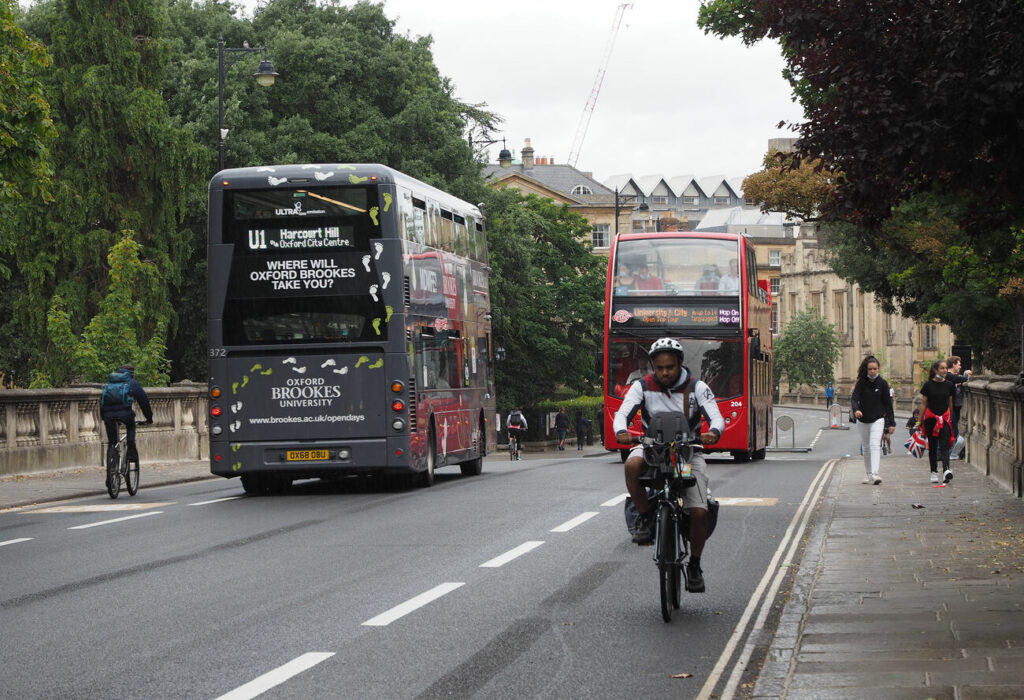

Cycling campaigners have called on Oxfordshire County Council to be “bold” in how it tackles congestion, as the city’s traffic woes reach what they describe as a “crisis point”.
Oxford’s campaign group Cyclox said it welcomed plans for a temporary congestion charge being discussed by the council, which would see motorists pay £5 to drive through certain roads at peak times, with exemptions for Blue Badge holders, carers, emergency vehicles, and local businesses.
Ian Loader, Cyclox chairman, said: “The council must be bold and make the city safe for cyclists, bus users and pedestrians, and that means reducing levels of road traffic.
“Cyclox will study the proposals put forward by the council and work closely with them to ensure that a congestion relief scheme not only improves bus services but also encourages active and sustainable travel.
“It is vital that any funds raised by the scheme are used wholly to support improved public transport and better cycling infrastructure.”
.jpg)
Thalia Carr, campaigns leader at Cyclox, added: “The May local elections delivered a council with a clear mandate to tackle decades of car-dependency in the city and expand the transport options available to the city’s residents.
“We cannot build more roads to magic congestion away. The problem cannot wait until the traffic filters go in in late 2026. We need to find ways to encourage greater use of buses and active travel now.”
She warned that if congestion problems are left alone, “the city will grind to a halt under the weight of car traffic”.
The proposed charge would apply every day from 7am to 7pm on Hythe Bridge Street, St Cross Road, Thames Street and St Clement’s Street, and Monday to Saturday on Marston Ferry Road and Hollow Way. It would end when the delayed traffic filter trial starts in 2026, after the expected reopening of Botley Road.
Oxford Mail reports that the council’s cabinet is due to discuss the scheme next Tuesday (June 17) and will be asked to approve a six-week public consultation, starting June 23. The scheme could be implemented as soon as autumn 2025.

Robin Tucker, co-chair of the Coalition for Health Streets and Active Travel (CoHSAT), said: “We at CoHSAT are glad to see the new council using their mandate and ingenuity to tackle the long-standing problem of traffic congestion in Oxford, and proposing this innovative solution.
“We’re pleased that people and organisations will have six weeks to review the new proposals, and after more than a decade to think, this is the time for anyone to suggest alternatives to fix the traffic problem.
“If the temporary congestion charge proposal does go ahead, by late 2027, we would have a view of the effects of ‘doing nothing’, a congestion charge, and experimental traffic filters, so a decision could be based on what worked best.”
While some campaigners have welcomed the congestion charge as a chance to reduce car-dependency and encourage more cycling and walking, the plans come against a backdrop of heated debates in Oxford, particularly regarding 20mph speed limits.
According to the Oxford Bus Company, implementing the speed limits would make bus travel “less attractive” and increase congestion. Last month, managing director Luke Marion argued that journey times for bus passengers would rise if 20mph limits were extended beyond busy areas.

Meanwhile, in January, Labour’s local leader in Oxford, Liz Brighouse, called for a “halt” to the implementation of traffic filters in the city, saying the measures have “turned neighbours against one another”.
Thalia Carr, pointed out the May local election results, arguing that it “delivered a council with a clear mandate to tackle decades of car-dependency in the city.” She added: “We cannot build more roads to magic congestion away… We need to find ways to encourage greater use of buses and active travel now.”
Cyclox’s push for “bold” change also comes at a time when the future of traffic calming schemes to enable a modal shift towards public and active transport has been thrown into jeopardy following last week’s High Court ruling, in which the judicial body ordered Lambeth Council in south London to scrap an “unlawful” low traffic neighbourhood scheme.
Anti-LTN campaigners called the decision a “wake-up call” for councils, warning them to listen to residents and not impose traffic restrictions without proper consultation.
Despite that ruling, campaigners in Oxford have argued that measures to reduce car use and make streets safer for cycling must continue. Green councillor Emily Kerr said that initiatives like low-traffic neighbourhoods and traffic filters are already common in European cities and needed in Oxford to tackle car dependency.
Emily Cherry, chief executive of the Bikeability Trust, said last month that the Road Safety Strategy should be used to make “bold, historic changes that protect and enshrine the rights and safety of every road user”.
Councillor Kerr added: “The government says that road traffic collisions cost the UK economy around £34bn per year. This is not only a huge financial number, but also underplays the human and emotional costs of people being maimed and killed.
“Given that LTNs can reduce pedestrian injuries by 85 per cent, and that 22,000 people live in Oxford’s LTNs, I think just £55,000 per year on their maintenance represents good value for money. Additionally, there are huge public health benefits from cleaner air and more children walking and cycling.”














30 thoughts on ““We cannot build more roads”: Cycling campaigners call for “bold” congestion charge to tackle car-dependency in Oxford”
Thalia Carr, pointed out the
Thalia Carr, pointed out the May local election results, arguing that it “delivered a council with a clear mandate to tackle decades of car-dependency in the city.”
Please be brave, Oxford councillors, and do what you know is right.
You can be a beacon for all the other places in the UK suffering from decades of promoting only one form of transport, the car. The proposal for a congestion charge will be met with howls of outrage from drivers, because change is frightening, and drivers will feel threatened to have years of privilege removed. They feel, they know, that that privilege is a right, and you can’t take their rights away.
The experiment of mass car transport has been tried and has profoundly failed. Car ownership and use is highly beneficial for the individual, but catastrophic for society. Do it Oxford.
eburtthebike wrote:
Oxfordshire councillors. The city council (red) is fighting the changes proposed by the county council (orange), as part of their power struggle over council reorganisation plans.
Thank you for pointing out my
Thank you for pointing out my error.
This is worth a watch.
This is worth a watch.
“You’ve Been Lied To About Roads For 60 Years”
https://www.youtube.com/watch?v=CVq7XOXkg1U
mitsky wrote:
Very worth watching, though I did get distracted by spotting all the Bristol locations that he used.
Oxford and Cambridge have
Oxford and Cambridge have been bell-weathers on the traffic front for decades. The problems they have now are where most other places are headed 10-20 years down the track if mass car ownership continues. The traffic engineers’ attempts to “improve flow” are long since spent and overwhelmed.
Everyone knows that 55% or
Everyone knows that 55% or more of voters choosing progressive parties is no mandate at all, according the largely foreign-owned press in this country. The right can be bold, the left can only be centrist, which is another word for the kind of laissez-faire approach that lets the rich get richer, and the roads more congested, fueling resentments that eventually lead to the right getting to 50.01% of the vote, or less in the case of first-past-the-post. Which, of course, will be hailed as a stonking mandate for them to implement any reactionary, nationalist and environmentally-damaging policies they wish.
I seem to recall one N Farage
I seem to recall one N Farage saying before a certain referendum that if he lost by a 52/48 split (his exact numeration) then he would definitely go to the courts to appeal the result as that was clearly too close and not a real result. And yet, when he won by 52/48 then it was all fine and dandy and the losers just needed to suck it up…
While I understand the calls
While I understand the calls for road charging and see the logic. Part of me is against it as it drives us plebs of the road to make space and speed things up for the toffs who can happily afford it.
A better system would be rationing journeys. Everyone gets a limited number of tokens to use. The total number of tokens set by the number of journeys reckoned to be viable. So toffs and plebs all get a fair crack at it.
Tokens not limited to car owners but equal share to everyone. They could then be traded/sold by those who choose bus or active travel to those who “must” have their car. Thereby improving wealth distribution.
Tokens would obviously be electronic, counted by roadside cameras.
Is this one of those flip
Is this one of those flip posts where drivers are plebs and cyclists are toffs?
Of course – “normal” people
Of course – “normal” people *have to drive* for eg. work, taking the kids / elderly parents about, shopping…
Cyclists *choose* to cycle – and remember “not everyone can afford a bike”. 😉
Unfortunately while easy to criticise many people do see the car as a requirement, no more optional to a reasonable level of survival than say “choosing” to live in a house or flat rather than a tent.
There are many things that
There are many things that could be said about this idea but I think they’ll all be drowned out by the shrieks from the “trapped in our homes” / “LTNs are an evil plan to control us” crowds…
Already happening:
Already happening:
https://www.oxfordmail.co.uk/news/25233951.oxford-congestion-charge-petition-continues-surge/
[Edit: oops – you were referring to Safety’s alternative suggestion, not the congestion charge. But still…]
Safety wrote:
Which is much more like the way Oxford’s proposed traffic filters are/were supposed to work ( https://www.oxfordshire.gov.uk/transport-and-travel/connecting-oxfordshire/oxford-traffic-filters/how-they-will-work ).
Those have been postponed due to overrunning railway engineering works, with this congenstion charge idea ostensibly being an interim alternative.
I’m not sure how this is supposed to be better though.
Hopefully this morning’s news
Hopefully this morning’s news will result in a sharp, long term rise in petrol prices. Then maybe some of the anti-cyclists might rethink their attitude.
60somethingcyclist wrote:
It certainly had an effect in previous middle east petrol crises, with driving down and cycling up.
But in the UK once the crisis
But in the UK once the crisis passes we breathe a sigh of relief and then it’s more of the same *, whereas one such crisis was (part of) the turning point for others…
* Bit like after the Covid lockdown – well, with driving; other things perhaps changed.
60somethingcyclist wrote:
They might, and as Burt notes petrol prices have suppressed driving mileage in the past, but in this day and age I fear the change in attitude might go less towards why not try cycling and more towards why not buy an electric SUV.
More likely it’ll go towards
More likely it’ll go towards demanding the government reduce petrol taxes, and maybe protesting by driving around very slowly burning lots of that expensive fuel.
We have a bus that goes into
We have a bus that goes into Oxford which is fine during the daytime it’s quite a long journey (18 miles),The only problem is the last bus back is 10pm so that rules out using it to catch a gig in Oxford,So the only choice i really. have is to drive.
Ratfink wrote:
I remember the frustration of the patchy (and early-ending) bus service as a teenager eager to get about in the evenings…
But surely better written as “I can drive (any number of miles) very easily (to do any activity) ergo I sometimes will”?
Our tools don’t just “solve problems” – they actually define how we frame those tasks / what we think we should do.
Not saying others should – nor that I’d do this regularly – but on two occasions I can think of I’ve cycled over 10 miles to see a gig. One of those was not solely out of necessity, the journey was part of the fun … but if I’d owned a car at the time I’d probably have simply driven and not thought about it.
Actually i solved the problem
Actually i solved the problem by just not going! It was more a comment about how transport provision can reduce car journeys.Unfortunately in these parts you do have to weigh up your options due to public transport/costs and quite often the car will win out even for part of the journey.For example to attend a gig in London for 2 using public transport bus,train and taxi, again due to the last bus time is £100 or if i drive to the station pay to park and drive back it’s £70 so that’s what we’d choose to do but if the bus ran later it would be £76 which taking fuel etc into consideration pretty much cancels out the car as an option.
Oxford Tube not an option? My
Oxford Tube not an option? My father uses it when coming down from his home near Witney to visit us in London, admittedly he gets a reduced fare as a pensioner but I think it only costs him about £15 return and buses run 24/7, new service this year from Carterton and Witney as well.
The Oxford tube is another 15
The Oxford tube is another 15 mile drive to get to, the nearest stop at Lewknor and the return fare is £24+any tube journeys,It works out about the same as using contactless from Reading which includes tube journeys £32.80.
To be honest we are lucky with the bus we have it runs between Reading and Oxford but it could just do with running a bit later, go a few miles in either direction north or south and you are in there’s a bus on Thursday territory!
Fair enough, I was only
Fair enough, I was only putting it out there as a suggestion in case it was useful! We did get an excellent bargain a couple of weeks ago going to see the old man on a Saturday, by booking a few weeks in advance we got Oxford to Marylebone (absolutely my favourite London terminus) return tickets with our two together Railcard for £16 each, but obviously for you you still need to get into Oxford for that.
Yeah sure thanks for the
Yeah sure thanks for the suggestion, I like the Marylebone line myself and that’s a great price but Reading is a funny station as going into London the line is run by TFL so there are no advance discount tickets just TFL prices.The off peak return fare to Paddington is £32.80 the same as the Daily contactless cap if you also use the tube.
Oxford congestion charge:
Oxford congestion charge: calls for bigger cars to pay more
https://www.oxfordmail.co.uk/news/25246869.oxford-congestion-charge-calls-bigger-cars-pay/?ref=cprfa
Be brave, Oxford, be brave and er consult about paying a fiver at certain times, on certain roads (the package of roads I assume makes sense on the map.) I think part of the reason the Portswood Broadway bus gate trial in Southampton failed was that it was part-time. This scheme also talks about 100 (free?) permits for local resident drivers which all sounds like a lot of complexity, things to go wrong and admin. Whatever you concede to drivers, it won’t be enough.
Drivers, purveyors of massive injustice on the rest of the world will of course insist on all this being “fair”, beginning with “where do the decision makers live?” – presumably you’re not allowed an opinion if you’re a local (who could easily walk, cycle or bus/ will benefit from less traffic) or an outsider to the city and so on.
“The roads that would be affected by the congestion charge are Hythe Bridge Street, St Cross Road, Thames Street and St. Clement’s Street every day from 7am to 7pm, as well as Marston Ferry Road and Hollow Way Monday to Saturday from 7am to 9am and 3pm to 6pm.”
Item 9 refers – this is a temporary scheme because of the ongoing Botley Road closure.
https://mycouncil.oxfordshire.gov.uk/ieListDocuments.aspx?CId=115&MId=7806&Ver=4
David9694 wrote:
These cover the main routes for people trying to cross the city centre (as much as you can cross the city centre – it’s more like a tight ring around it).
These are part of slightly disjointed ‘mid-way ring’ in the east between the centre and the ring road – they allow you to travel between outlying areas without having to go out to the ring road. Presumably they’ve picked these two as being the most heavily traficked within that ‘ring’, but I don’t see why they couldn’t have included the rest (Between Towns, Windmill Rd, etc.) other than perhaps they were trying to limit the number of people who might oppose it.
carbrain is real
carbrain is real
A city councillor has warned a congestion charge on several of Oxford’s key roads would ‘punish’ locals, particularly those on the outskirts of the city
https://www.oxfordmail.co.uk/news/25248415.oxford-congestion-charge-punish-city-says-councillor/
carbrain is real
carbrain is real
A city councillor has warned a congestion charge on several of Oxford’s key roads would ‘punish’ locals, particularly those on the outskirts of the city
https://www.oxfordmail.co.uk/news/25248415.oxford-congestion-charge-punish-city-says-councillor/