



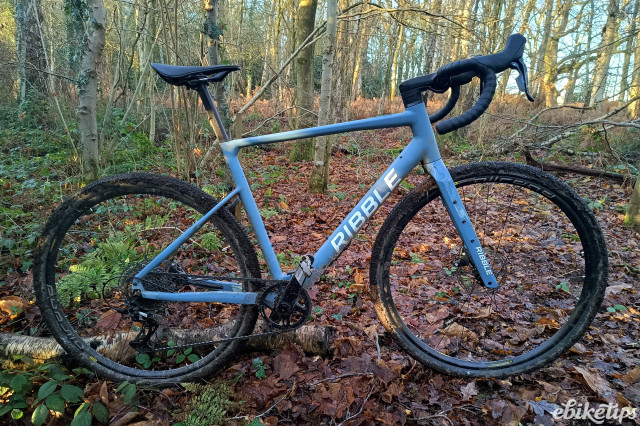
The Ribble Allgrit E AL is billed as offering ‘a natural-feeling electric gravel experience’ and that seems an appropriate summary of its strengths. It’s an e-bike that works both on and off road, where the motor assistance serves as just that – assistance – rather than coming across as the primary means of propulsion.
While almost all e-bike motors are 250W rated, that alone tells us very little. The peak power from large mid-drives is considerably higher. This extra clout comes at a cost, however. Bikes fitted with such motors are heavier and often massively so given the greater output tends to bring with it a larger battery too.
Electric road and gravel bikes typically go the other way, employing lightweight motors and smaller batteries. A bike like the Ribble Allgrit E AL rolls better without motor assistance and this then allows the rider to preserve battery charge for when it’s most needed. The emphasis is a little more on human pedal power with the motor serving as a reassuring presence.
The bike
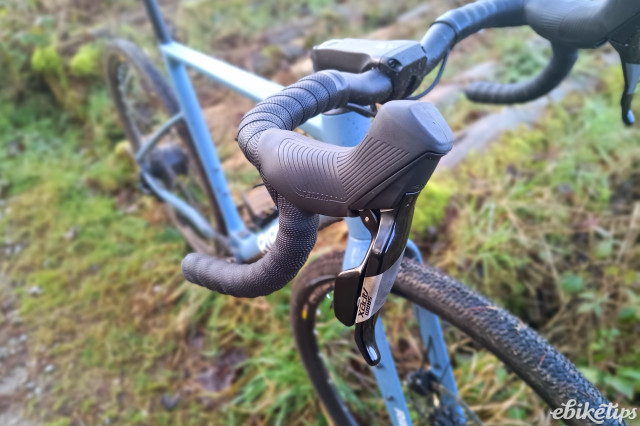
The Allgrit E build reviewed here, with SRAM Apex XPLR 12-speed gearing, costs £2,899. The bike’s also available with a flat handlebar at the same price or with SRAM Apex XPLR AXS wireless electronic shifting for £3,199.

In all cases, motor power is from the Mahle X30 rear hub system combined with a 237Wh battery. We’ll get onto that in a bit. Carbon fibre versions of the bike fitted with the more powerful X20 system start from £3,749.
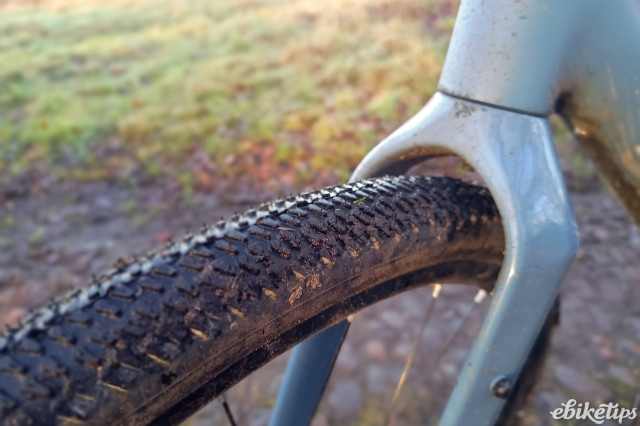
You get SRAM Apex hydraulic disc brakes and Mavic Allroad wheels fitted with 45mm Schwalbe G-One R gravel tyres. I found the latter provided decent off-road capability without unduly slowing me on the road.

The standard saddle is the Selle Italia Model X Light FeC, but you can choose from half a dozen, not all of which will increase the price. Up front you’ll find Ribble’s own Alloy Gravel Riser Bar, which is available in various widths, or there’s a carbon option for another £100.
All manner of accessories are available, including Mahle’s 171Wh external bottle battery range extender, which will set you back another £500.
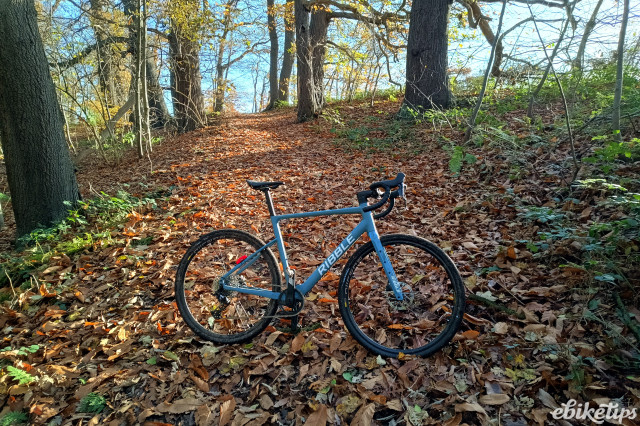
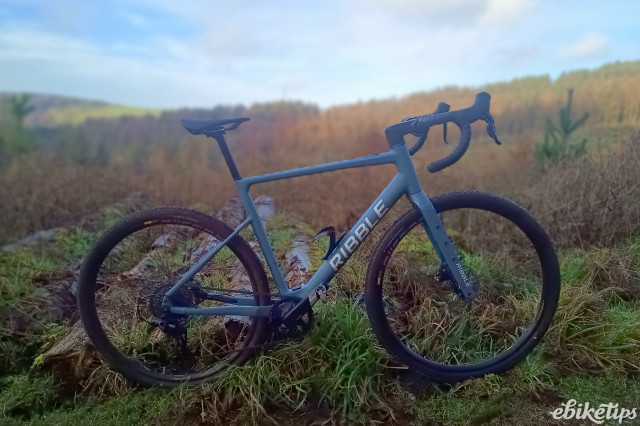
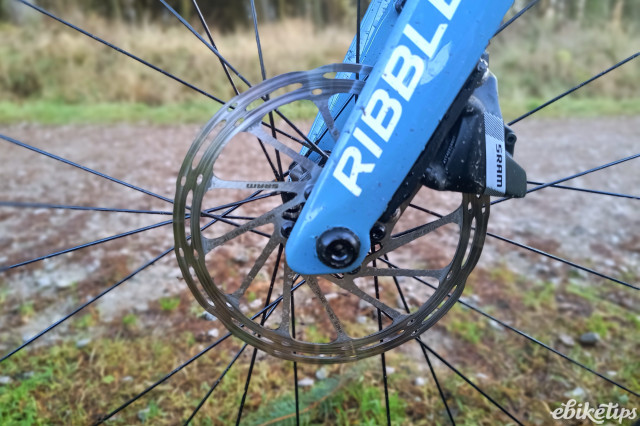
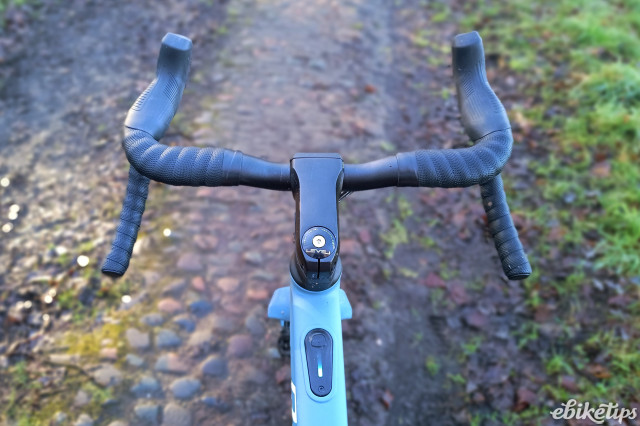
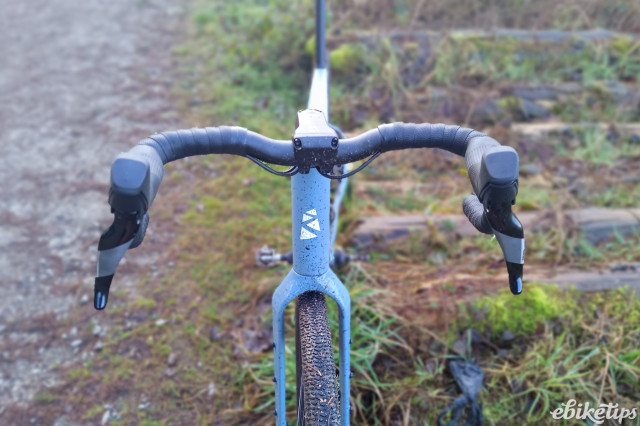
The bike arrives boxed and you’ll need to put on the handlebars, front wheel and pedals, and also insert the seatpost. None of this is too taxing, but depending on your competence it is a place where things may potentially go awry.
For example, I have to do something similar for pretty much every e-bike I review, so I’m pretty experienced, but it wasn’t immediately obvious to me how the seatpost was secured. I then later thought the bike had developed an annoying click in the bottom bracket only to discover that wasn’t in fact the source of the noise – it was actually just that one side of the handlebars needed tightening. This was entirely my own fault, but you may or not be happy to have no-one but yourself to blame for such things.
The ride
Mahle’s X30 rear hub motor sits between the older X35 and the lighter, more powerful X20. It is said to offer peak torque of 45Nm – a notch up on the 40Nm from an X35 motor, but a little way short of the 65Nm the top of the range X20 is said to be capable of.
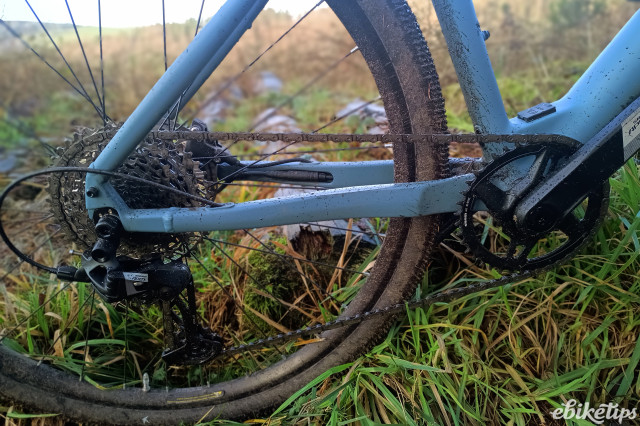
It’s a popular system for road and gravel bikes and with good reason. It’s a smooth operator, incredibly low profile and keeps the bike’s weight down to 14kg.
Despite the presence of the motor, there’s an emphasis on fitness with a bike like this and for someone like myself, who does plenty of his riding on an unassisted road bike, the torque on offer is appropriate and ample.
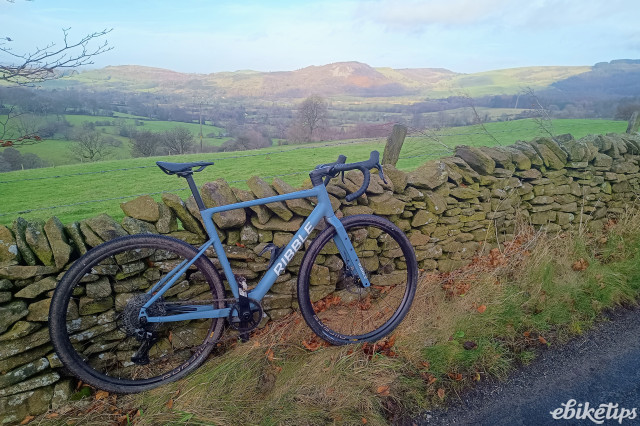
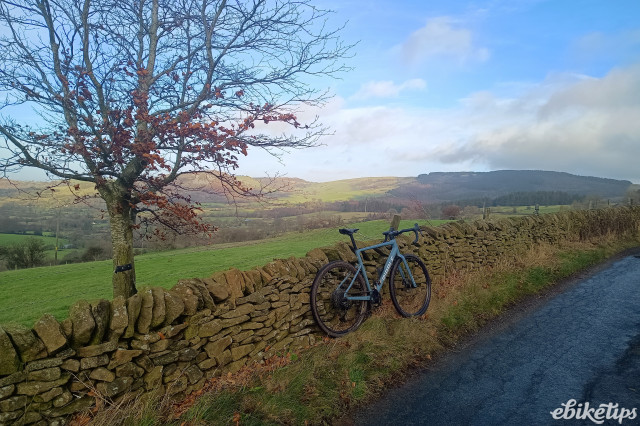
I took the Allgrit E into the Peak District on one ride, on a route that took in off-road stretches and steep double-digit gradients on the road. Mahle’s app, which rather delightfully records your pedalling input as well as the motor’s contribution, confirmed what I’d felt in my legs: even on slopes hitting 15% the motor prevented me from having to make harder efforts. No matter the terrain, it had largely been a consistent, steady ride from my body’s perspective.
Sure, a mid-drive would have got me up some of those hills quicker, but at a major cost in terms of weight. A mid-motor e-bike with a large battery is a significantly different bike.
> Hub motor v mid motor? What’s the difference?
The Peak District ride saw me cover 60km with 700m of climbing in a little under two and a half hours. The motor output averaged about 90W during this time, which meant the 237Wh battery was just about sufficient.
That usage was predictably heavily weighted towards the hills and off-road stretches though. On flatter, road-only rides, the average power output was closer to 40W. It’s also entirely feasible to ride without assistance, if you want.
One dampener
When Mahle launched the X30 in June 2024, it emphasised the motor’s robustness, describing it as ‘bulletproof’. I didn’t find that to be the case.
Not in a literal sense – ebiketips neither arms its reviewers nor seeks to specifically test such obviously rhetorical claims. I did however encounter a degree of fragility that didn’t square with the spirit of the brand’s claim. Most significantly, the motor pretty much entirely stopped working for over a week after I was caught in a colossal deluge.
To be clear, this was unconscionably heavy rain and I was caught in it for about an hour. The motor continued functioning until about the last 10 minutes of the ride, at which point an error showed.
Days later, this was still recurring. I’d set off on a ride with motor power, only to see the error flash up after a few minutes. Sometimes I could clear it by switching the bike off and on again, but generally this would only buy me at most a couple of minutes.
With time, the issue resolved itself, so I assume it was caused by residual moisture. It’s no great secret that water and electrics are a less than ideal combination and it’s impossible to say how another e-bike would have coped had it been subjected to the same conditions. It seems worthy of mention though.
The Mahle X30 electrical components are IP54 rated for splash protection. Ribble says it’s fine to ride the bike in the wet, but does make it clear those components should not be jet washed or fully immersed and advises using a waterproof cover when transporting the bike in wet conditions (such as on the back of a car).
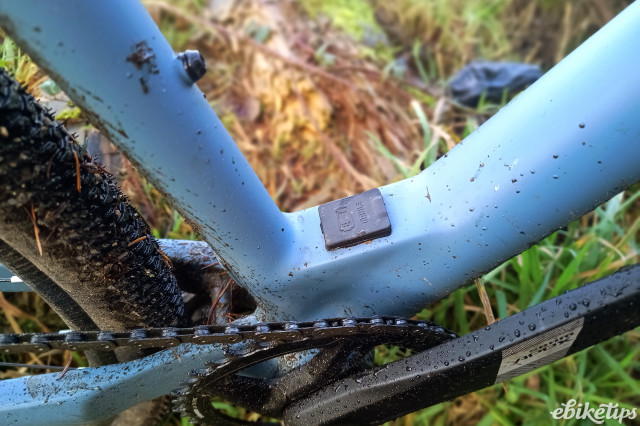
If you get properly drenched, common e-bike advice is to remove the battery to ensure the contacts can dry more easily. That’s not possible with the Allgrit E as the battery is integrated and can only be removed by a certified technician. I also wonder about the positioning of the charge point, on top of the bottom bracket, facing upwards. Even though it has a cover, it feels like water could pool there at least a little.
Set against that, it’s worth saying that this is not an issue peculiar to the Allgrit. Mahle systems are employed on a very large proportion of electric gravel bikes and they’re generally set up the same way.
Less problematically, on another occasion I also encountered a loss of power and software error while riding through thick mud, but restarting the bike immediately resolved this issue.
Controls
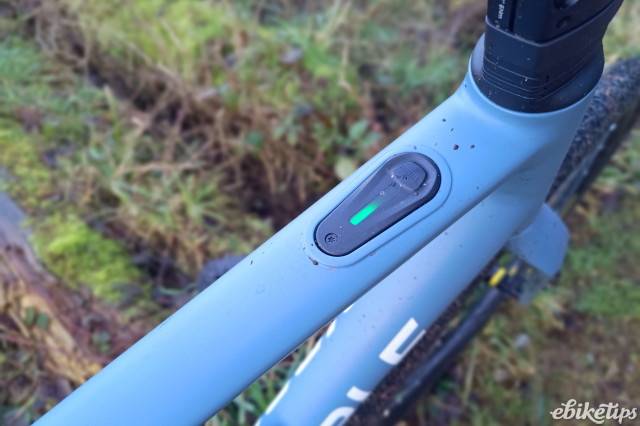
Strikingly, the X30 system is controlled by a single LED strip light and button that is embedded in the top tube. Press it and you’ll cycle through the various assistance modes, each of which can be customised within the Mahle app, if you so desire.
The current level of assistance is indicated by the colour of the light. White is unassisted, green is Level 1, orange is Level 2 and purple is Level 3.
No matter what colour is showing, the length of the strip light tells you how much battery remains.
Other than this, the bike does not have a display. If this feels like a significant omission, you can either mount your phone and use the Mahle app, or invest in the brand’s PulsarONE, which costs £95.
It has to be said, the top tube isn’t an especially great place to control power levels. Fortunately, you also have the option of enabling ‘smart assist’ that will automatically adjust motor power based on your effort, weight and the current gradient. The strip light turns blue when it’s set to this and as with the other modes, you can fine-tune the settings within the app.
I found smart assist worked well enough that I routinely ignored the other modes unless I was absolutely committed to riding in either the lowest or highest for some reason. Aided by the torque sensor, it is proportionally responsive in a way that you can almost forget it’s contributing.
I actually found it rather refreshing to delegate motor assistance to the bike in this way: no manual changes, no checking the display – just riding.
If this is how you choose to ride, the remaining controls are your brakes and a single shifter, as there’s only one chainring. I found the latter crisp and reliable and the former perfectly adequate on the steepest descents.
Value
At £2,899, the Ribble Allgrit E AL certainly seems decently priced. The UK isn’t awash with electric gravel bikes, but something like the Scott Speedster Gravel eRide 50, for example, comes in at £3,199 with Mahle’s inferior X35 system.
The Boardman ADV8.9E is a notably cheaper alternative at £2,099, but the emphasis is a little more on road riding – it’s billed as an ‘electric adventure bike’. Nevertheless, it has a Fazua mid-motor that will provide extra clout on the steep stuff, but also extra weight – it’s 16kg.
The Boardman ADV-E 9.2 is a Mahle hub motor alternative for £3,000. Again, it’s fractionally less suited to off-road riding, but it does feature the superior X20 system.
If the Boardmans sound a better fit for your sort of riding, Ribble’s own CGR E AL is currently available for the same price as the Allgrit E AL. The most obvious distinctions are Shimano 105 gearing, more traditional road handlebars and slightly narrower 40mm tyres.
Finally, and just a touch more expensive, is the recently-launched Estarli G700 Carbon Fibre eGravel (£3,195). This one’s powered by the brand’s own 40Nm motor system and boasts a carbon fibre frame. We can’t yet say how it performs, but we’re going to get our hands on one, so keep your eyes trained on the site for an upcoming review.
Conclusion
Wet weather issues aside, there was very little I didn’t enjoy about the Allgrit E AL. The bike is comfortable, all the basic bike componentry feels solid and reliable, and the Mahle X30 hub motor system is unobtrusive and smooth – especially in smart assist mode.
If you don’t need colossal motor power and a giant battery, and you aren’t too fussed about the nature of the controls or the lack of display, you’ll have an awful lot of fun exploring on this bike – both on and off road.
All the deals displayed on our review pages are pulled from a constantly updating database feed of the best affiliate deals available. The criteria for deciding on what are the best deals is who is offering the lowest, delivered price. In most cases we will be showing the very best deal available online, but sometimes you may be able to find an item cheaper. If you can please feel free to post a link in the comments box below. To find out more about affiliate links on road.cc click here.

1 thought on “Ribble Allgrit E AL”
Class yoke, ideal for those , like me who just need a dig out on stiff climbs