



The debate around low-traffic neighbourhoods in Oxford has continued after a Freedom of Information request (FOI) saw the council reveal that almost £4m has been spent on low-traffic schemes since 2021.
The FOI request, made by the Oxford Mail, was responded to by Oxfordshire County Council, with the local authority confirming that it has spent more than £3.8m on the installation and maintenance of LTNs and ‘quickways’ cycle routes in Oxford between 2021 and 2024.
In response to the story, an independent councillor, Saj Malik, who represents Cowley on the county council, called the spending “completely tone deaf”.
“We expect the county council to provide the services we pay for but then they tell us there’s no money because they waste it on their pet projects like the LTNs,” he said. “In Cowley we’re at the sharp end of these transport restrictions and they make our lives a misery on a daily basis.”
Another independent councillor, David Henwood, said: “The annual running costs of the scheme places additional pressures on the public purse.”
While the headline £3.8m figure has attracted the most attention, the Oxford Mail piece did accept that the cost of installation of the schemes was in fact funded by central government, with the council only covering maintenance costs. Of the £3.8m total, £2.5m was spent in 2022, which was the year the schemes were first implemented.
Now it’s all in place, the annual running cost of the Automatic Number Plate Recognition (ANPR) camera scheme is estimated at just £55,000 and is “covered by revenue from parking fines (penalty charge notices)”, according to the local newspaper.
Green Party councillor Emily Kerr told road.cc that she believes some of the comment around the spending has missed the point about the “huge public health benefits” that enabling more people to walk and cycle can bring.
“The government says that road traffic collisions cost the UK economy around £34bn per year,” she explained. “This is not only a huge financial number, but also underplays the human and emotional costs of people being maimed and killed.
“Given we know that LTNs can reduce pedestrian injuries by 85 per cent — and that 22,000 people live in Oxford’s LTNs — I think that just £55k per year represents good value for money. Additionally, there are huge public health benefits from cleaner air and more children walking and cycling.”
Robin Tucker, spokesperson for Coalition for Healthy Streets and Active Travel (CoHSAT) added: “The £4m Active Travel Tranche 2 funding delivered projects that benefit people’s health, safety and mobility in Oxford, Bicester and Witney – all for a fraction of the cost of a road scheme like the £35 million Lodge Hill slip roads.
“In Cowley alone, the LTNs save eight casualties a year, saving over £168,000 in lost work, medical, police and insurance costs. In addition, more than ten thousand people benefit from cleaner air and reduced noise, reducing physical and mental health problems, and safer streets for their families.”
The 100+ comments on the local newspaper’s story and debate among local politicians is typical of the reaction to low-traffic neighbourhoods which has been seen across the country in recent years.
By limiting through-traffic, via ANPR cameras or physical bollards, LTNs prevent rat-running and promote active journeys on foot or by bike; all with the aim of reducing pollution and improving public health.
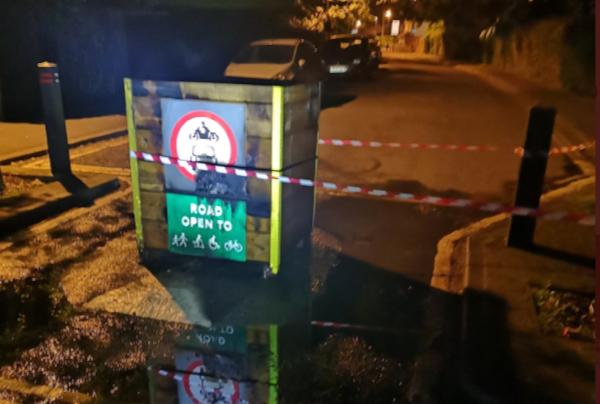
They have, however, been controversial in some local communities and online, attracting protests and, in some cases, vandalism.
> Anti-LTN protestors stop traffic in Oxford
Addressing the challenge of implementing LTNs and other similar schemes such as School Streets (which ban traffic outside schools at the start and end of the school day) Active Travel Commissioner Chris Boardman told the COP29 summit that he had been “involved in the emotional side of this at a local level” and saw the vocal opposition to active travel schemes that is often seen from some in local communities.
“We’ve been doing a lot of focus group work on what plays with people and we’ve spoken to them about it,” he explained. “[Telling people] it’s worth £53 billion to the economy. Don’t care, I’m trying to pay my mortgage. But, when we talked about kids having transport independence and the ability to stay at after school clubs, suddenly they were leaning in and were really interested.
“We were talking about the same thing but we were talking to the outcomes that they could connect to. When you’re going to change the streetscape locally, don’t give it an acronym that people can disassociate from emotionally and learn to hate [like LTNs, for example]. Call it a child safe zone. Then if you want to campaign against it, fine, but you’re campaigning against a child safe zone.
“It just changed the whole framing and people understand and realise why this difficult thing is happening.”


















21 thoughts on ““Huge public health benefits to more children walking and cycling”: Oxford’s low-traffic neighbourhoods defended after criticism of controversial scheme’s £4m cost”
I wonder when they last did a
I wonder when they last did a FOI request on an equivalent motor vehicle scheme? 😊
An Active Travel
An Active Travel representative is quoted as saying, “… all for a fraction of the cost of a road scheme like the £35 million Lodge Hill slip roads.”
Boopop wrote:
I bet they were hoping the results would come back before the local elections so they could complain about them.
But as it happens, the recent elections for Oxford County Council saw a considerable increase in the number of LibDem and Green councillors, which sounds like the general public voting to endorse the schemes brought in by the LibDem and Green administration. At the very least, ordinary voters were not put off by it.
I believe this is similar to what happened at last year’s London elections where cllrs against LTNs and school streets saw a loss in their vote share compared with those who advocated for them.
The Liberals are wasting all
The Liberals are wasting all the money on this global warming nonsense,reducing the speed limits while the roads are in a terrible state. Was the statement from the Tory (not the candidate) that knocked on my door during the election.The Liberals won here in Oxfordshire.
The leaflet they put through
The leaflet they put through our door had what appeared to be an AI rendition of the road to Kyiv after the Russians had retreated all over the front page – bit surprising to find them blaming the Lib Dems for that.
Your comment would probably
Your comment would probably benefit from some quote marks and maybe italics Ratfink! I read it a couple of times before I clocked it wasn’t your view!
The rebuke towards the LTN’s
The rebuke towards the LTN’s are mostly by the car fraternity who literally can’t see past them and cannot get off their lazy asses and get on a bike instead of a big fat car seat
The Oxford Mail – if I
The Oxford Mail – if I remember correctly – is notoriously pro car.
Driver outrage is very
Driver outrage is very clickbaitable.
Luckily the government has
Luckily the government has done all the maths for us so anybody (including councillors and journalists) can calculate the cost benefit of such schemes to society.
https://assets.publishing.service.gov.uk/government/uploads/system/uploads/attachment_data/file/995110/rrcgb-valuation-methodology.pdf
This does not even include the long term benefit to health and wellbeing of having cleaner air and active lifestyles.
As a councillor, I’ve come to
As a councillor, I’ve come to recognise that many, if not all, independent councillors are independent because no party would tolerate their extreme views and lack of logic: Oxford appears to follow that pattern.
If £4m had been spent on a single junction, to “improve” it for motor vehicles, not an eyelid would have been batted, despite the fact that the justification for the scheme would be questionable and the return on investment undetectable. But spend that much on Active Travel over four years, with excellent justification and realistic return on investment, and they foam at the mouth.
Should I be requesting that my MP investigates treating motonormativity on the NHS?
EDIT: Why are road schemes never analysed for value for money after they’ve been built?
Dear Cllr Malik, you make £4m
Dear Cllr Malik, you make £4m sound like a lot of money.
If I’m buying a house, it probably is. In contrast, the council spent £4m on Adult’s & Children’s Services over the last bank holiday weekend.
Meanwhile, LTNs demonstrably save lives and improve public health.
Context is everything.
More populist dogwhistle
More populist dogwhistle politics. I would have thought that Oxford would be one place that needed LTNs given the number of students that cycle.
Greedy, selfish motorists
Greedy, selfish motorists want all the public roads all to themselves all of the time.
It’s pretty hilly around me
It’s pretty hilly around me (Bath) and, whilst a bike is a pretty efficient way to get about, it can involve significant effort, especially if you have a bit of a load, and sometimes you can do without being a sweaty mess. Even if you’re grinding up a hill, it’s nice not to be sat in a queue of traffic. Seeing that I lost my driving licence for 6 mths (medical), I decided that an e bike would be a good investment; now I’m ripping up very hill with abandon and using a bike for routine chores way more than I did before. It’s even made an appearance on the Bristol commute; no need to shower at work and you still get a workout leaving more energy for the weekend sport ride, so what’s not to like. The rest of the household also use it. It really is the alternative to a car in a city. For the first time I genuinely feel pity for drivers as they crawl about with that frustrated look on their face. LTNs are a big subject in Bath (some people are raging against them) but there has definately been an increase in people using e bikes get about since their introduction.
Bike aids mobility in absence
Bike aids mobility in absence of a car; leads to “improvements to life” and better health and well-being! A good story…
This is an excellent example of the “tangible benefits” from making cycling much more attractive. And there’s “one less car” for those trips – albeit you were not supposed to drive at the time anyway.
We may debate about the negatives of EAPCs *. But we hardly need to worry about that before we provide attractive and convenient spaces to cycle. And make some serious efforts to reduce the amount of trips driven, especially within urban areas.
Both of those benefit all kinds of cycling and wheeling – and walking also. And even benefit folks who say they don’t care about the cycling side – we all can get nicer places and those who actually need to drive get fewer other drivers. (Caveat – if done properly…)
* I can see some at “mass cycling” level – albeit it’s all “harm minimization” compared to mass motoring! At least we should consider “what happens when we combine kids with ebikes”.
This is an official WW2
This is an official WW2 poster which encouraged cycling. It’s a pity we don’t get that kind of encouragement now!
Au contraire – about every
Au contraire – about every decade or so a government is happy to put its hand our pockets and find a “posters” level budget for campaigns to “encourage cycling”. Sometimes MPs will even turn up for photo ops – occasionally even on bikes!
What is odd is how we manage to maintain the high level of motor vehicle use without any such effective public campaigning though?
Perhaps that’s why some motorists are jealous when they see all these millions spent on cycling – after all they’re “paying for the roads” all by themselves without any government encouragement! [costs and value for investment – comparing cycle and general road infra] [older article comparing spending on cycling/active travel vs. other modes]
I live in Oxford and don’t
I live in Oxford and don’t have a car or a driving licence. It’s a great city for cycling in three ways: geographically it’s a suitable size and not too hilly; culturally, the vast majority of drivers are conscientious and easy to get along with; and the infrastructure is generally good. There are a lot of cycle routes that are not alongside roads open to motor vehicles. The LTNs aid that by providing through routes to cyclists on routes that are otherwise access-only for those living on that street.
That said, I have my doubts. Close a road to cars except those owned by residents, and then only poll residents on whether it’s a good thing – well yes, of course you get a positive response.
When ANPR cameras were put up to control access to my street, neighbours who own cars could register to be allowed through. Those of us who don’t own cars but might need a friend to come and help out with moving a heavy item once a year can’t get a temporary or permanent permit for them to drive in. We were told “Well, the response in general has been very positive.” Of course it has, most residents are car-owners.
I don’t think an initiative promoted as encouraging active travel should provide benefits that are contingent on owning a car.
No roads have been ‘closed to
No roads have been ‘closed to cars except those owned by residents’. You can still access any road with any car. You just may have to take a different route to access them.
Incidentally, I’d question the idea that the infrastructure is ‘generally good’ – it’s generally not quite as bad as the average UK infrastructure, but that doesn’t make it ‘good’, by some stretch.
DJameson wrote:
Thanks for the local knowledge. Small “university town” so you’d expect a lot of cycling. Is the infrastructure really good? In general if there is much motor traffic or it’s fast at some point we need cycle routes alongside roads (streets – if we really reduce motor traffic sharing should be OK).
When ANPR cameras were put up to control access to my street, neighbours who own cars could register to be allowed through. Those of us who don’t own cars but might need a friend to come and help out with moving a heavy item once a year can’t get a temporary or permanent permit for them to drive in. We were told “Well, the response in general has been very positive.” Of course it has, most residents are car-owners.— DJameson
Is this really as you say here? I am not a local but the Oxford council site explains where these are and the hours of operation:
As far as I can see (from their map and notes) there are only six of these and none of these filters a “no through road”. So it looks like you can access either side of the filter by car, at any time – just not drive through it. As mdavidford points out these schemes do not generally block access: just re-route motor traffic (discouraging through-traffic).
Also – none operate 24 hours a day and a couple do not operate on Sundays – so if you choose your time the filter doesn’t exist.
It is true that permits appear to be limited to those who actually own the vehicle (so no, it looks like you can’t “transfer your pass” or “book a friend”) BUT AFAICS that friend can always reach you because all roads remain accessible as noted above. And they can reach you by any route outside the hours of operation (so 7pm-7am for the most restrictive “gates”).
And according to the council’s info there are actually quite a lot of types of vehicles which are not affected by the filters (emergency services, taxis, buses, deliveries, hearses …). And in fact the filters don’t physically stop any vehicle! You just get issued a fine – (currently) 35 pounds if you pay promptly.
You could choose to see it like that… but currently if you don’t have a car you don’t have the benefits of one anyway? Or you could see it as giving everyone the benefits of reduced through traffic (noting that through traffic is still allowed 7pm-7am) … but simply not putting any new restrictions on car-owning local residents. (Perhaps we should be encouraging some of them to drive less or maybe give up the second car?) Oxford council list the various benefits they believe this will offer on their website.