



A report co-commissioned by the Bikeability Trust and Living Streets charities is calling for the “most radical reforms to road safety since mandatory seat belts” ahead of the Government’s highly anticipated Road Safety Strategy, that will be the first published by a UK government in over a decade. Recommendations include an immediate nationwide ban on pavement parking, default 20mph speed limits for motor vehicles in all urban areas, enshrining mandatory cycle training into the national curriculum and spending at least 10% of transport funding on cycling and walking.
The report, titled ‘Safer Streets for All: The Upcoming Government Road Safety Strategy’, cites “conflict on Britain’s roads” because of “poor awareness” of recent changes to the Highway Code, including the concept of a hierarchy of road users, cyclists being advised to use the centre of the lane, and pedestrian priority at junctions. It says that less than two thirds of adults are able to correctly answer a Highway Code question on pedestrian priority, and that drivers “lack awareness of safe behaviour around cyclists and pedestrians”, failing to understand safe passing distances or overtaking. Indeed, awareness of new Highway Code changes are so lacking that in a call for evidence ahead of the Government’s promised reforms, one cyclist said he was pulled over and cautioned by police for riding two abreast.
The report points to a recent YouGov survey that found that those who cycle weekly are 21% more likely to answer questions about the Highway Code correctly.
Emily Cherry, chief executive of the Bikeability Trust, commented: “The opportunity to create a new Road Safety Strategy is a green light for the Government to make bold, historic changes that protect and enshrine the rights and safety of every road user, now and for future generations.
“Britain’s roads could become the gold standard for promoting active travel and protecting vulnerable users – our report recommendation has been informed by our work with parents, young people, children, teachers, experts, partners and delivery riders.
“We welcome the opportunity to work with Government on reforming road safety as a significant contributor to the Government missions.”

There are plenty of recommendations around the next generation of pedestrians and cyclists, including that call to add cycling to the national curriculum. The report states that increasing levels of Bikeability training is “associated with lower levels of people being killed or seriously injured”, yet that training isn’t yet on the curriculum. It also recommends improved training for adult cyclists, including the development of a national training standard for commercial cargo bike use.
Despite some tabloid headlines suggesting otherwise, the report says there is “public appetite” for more ‘School Streets’ – essentially the restriction of motor vehicles outside schools at drop-off and pick-up times – with surveys showing as much as 81% of people agreeing that there is too much traffic around schools. 20mph ‘quiet streets’, segregated cycle lanes, main road crossings and Low Traffic Neighbourhoods are recommended as the most important measures for making journeys to school safer.
Kidical Mass London said: “Our experience is that children as young as five can often comfortably cycle long distances unaided (for example, rides of up to six miles) and enjoy doing so.
“It is not children’s ability or will that holds back cycling, but rather other factors including the lack of safety and lack of dedicated infrastructure on the road network.”
The report also mentions the rise of the SUV numerous times, saying that supersized cars are “a growing threat” to the safety of cyclists and pedestrians, and that children are eight times more likely to be killed in a collision with an SUV driver as opposed to the driver of a smaller vehicle.
It recommends that the size and weight of private cars on UK roads should be curbed, because SUVs and pickup-style trucks now account for 66% of new vehicle registrations in the UK. It also calls for Swedish-style ‘progressive’ fines based on income, where higher earners have to pay higher fines for traffic violations.
Will the Government actually implement any of these recommendations?
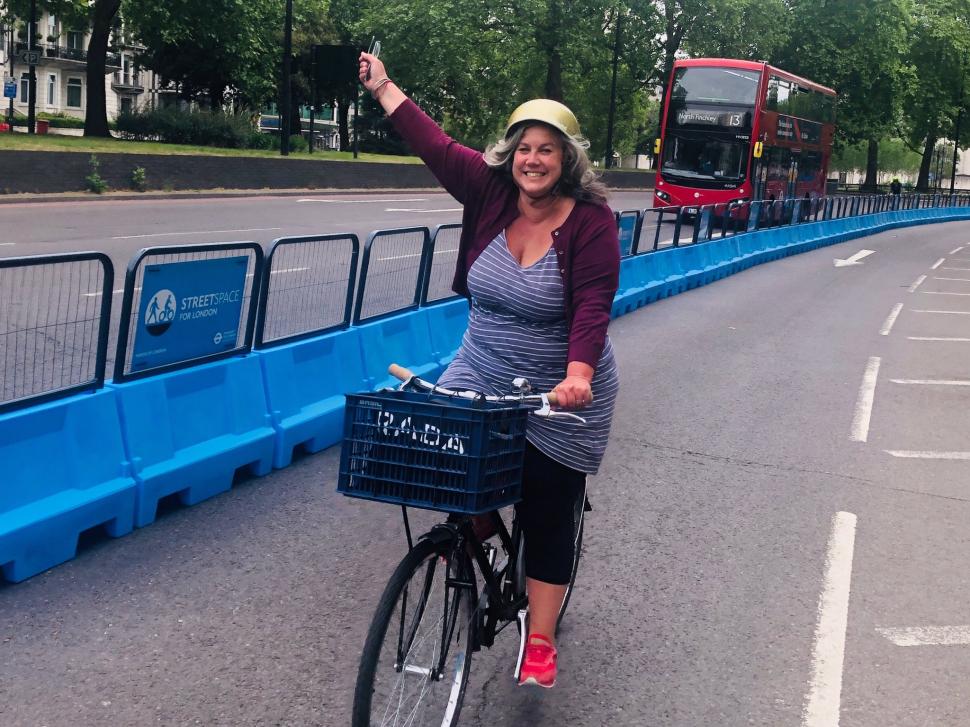
Though Heidi Alexander – the Secretary of State for Transport – is a cycling convert, it could be argued the wider Labour administration she serves in has been somewhat lukewarm when it comes to cycling and active travel since being elected last July. Keir Starmer’s social media feeds have mentioned that the party is “on the side of drivers” a number of times pre- and post-election, and the Department for Transport looks likely to introduce a ‘dangerous cycling’ law that has been condemned as disproportionate and failing to tackle wider problems on UK roads by campaign groups and active travel advocates such as Chris Boardman.
Despite this, a spokesperson for the Bikeability Trust and Living Streets told road.cc that the Department for Transport is “very interested to read” the report, and will take the recommendations into consideration. Alexander and other Labour politicians have already spoken publicly about the need to tackle pavement parking, and it’s this that could potentially prove an easy win – with only a noisy minority of detractors – for a government feeling the pressure after a very humbling round of local elections.
Introducing mandatory 20mph limits and urging councils to implement more Low Traffic Neighbourhoods, restricting the sales of SUVs, spending 10% of the transport budget on active travel and compulsory cycle training for children may all prove to be much tougher sells; but even if a lot of the recommendations don’t make it in, that the Government is coming good on its promise to deliver a Road Safety Strategy in the first place may be seen as a positive step.















31 thoughts on “20mph in all urban areas, a ban on pavement parking and cycling in the national curriculum: cycling and walking groups call for “most radical reforms to road safety since mandatory seat belts” ahead of Government’s Road Safety Strategy”
“immediate nationwide ban on
“immediate nationwide ban on pavement parking”
That would be nice. It’s so messed up greater london has had its own special pavement parking ban since the 70’s but the rest of the country is left to be the wild west.
Don’t forget Edinburgh (a
Don’t forget Edinburgh (a year back) and the Highland Council (last year I think) and Glasgow this year! Apparently genuine fines were issued, even. Only – I’m not sure I’ve noticed much difference and double yellow lines remain merely suggestions…
Renfrewshire has also
Renfrewshire has also followed suit as from the beginning of April. There’s a number of streets that are exempt though. It couldn’t come sooner. Where I used to stay the main road into Paisley was notorious for pavement parking. The drivists are up in arms from what I hear as I no longer live in Scotland and am not benefiting from a clear walk into town.
Despite pavement parking
Despite pavement parking being illegal in London it isn’t enforced well.
Well, you might get the odd
Well, you might get the odd car illegally parked on the pavement. But the difference is quite stark when you’re in a town just outside greater london where every single car will be on the pavement and then you go half a mile into a london borough and the pavements are suddenly accessible again for the most part.
Pub bike wrote:
It would be so easy to improve enforcement – just provide a portal so that members of the public can upload timestamped photo with GPS tagging if possible (e.g. from any smart-phone) and get them to make a simple statement about the time/date/place of the infraction. Then, just post out a fixed penalty notice to the car owner.
It’s like free money
It would be so easy to
It would be so easy to improve enforcement … Then, just post out a fixed penalty notice to the car owner. It’s like free money
Those reasons cut no ice with the police, or councils I suspect- they’re so worried about being accused of ‘the war on the motorist’ they will go to ridiculous and reprehensible lengths to avoid prosecuting drivers and appease them with rubbish non-penalty penalties like the joke driving course, and the hyper-joke advice letter and the [I have no superlatives left except Ultima-joke] even less threatening words of advice. How difficult was it to prosecute the red-light offending driver of this motorhome KN13 AUS ? It’s a busy 50mph 6 road junction on the A6
https://upride.cc/incident/kn13aus_knausmotorhome_doubleredlightpass/
hawkinspeter wrote:
And I think places do have some kind of version of this … but not with members of the public reporting. (I can’t think of examples but perhaps someone knows?).
Alternatively – lots of places already have a form to report incorrect parking – but many explicitly state they’re not taking submissions about … all the normal offenses! Even though it’s now criminal the Edinburgh one starts by disclaiming things it won’t look at, and it’s just “request a parking attendant”.
I suspect the problem is it sounds like free labour and money but (despite some dystopian fantasies) it ends up not being a cash cow. Plus we seem a bit averse to collecting public input via portals in the UK. Perhaps councils don’t actually find them cheap to set up/administer, or they want specific money allocated from somewhere. Or they don’t really understand them?
My uneducated guess is what happens if this does go through is it gets out on the social medias (“snitches’ charter!”). Then some brighter spark puts together an anti-portal portal – perhaps a bit like robot lawyer (fill in your details and it’ll fill out the appeal forms). Maybe the first response is “not my car / cloned plates”? Or something like “GDPR / privacy” (pretty sure this is nonsense but certainly the authorities are quick to invoke it themselves…) Or “fake photo and file data – I’ll see you in court with your digital forensics experts… (council didn’t take it themselves, on their own devices, after all).”
And then the councils decide that while they could start playing whack-a-mole with the appeals … actually they don’t have extra money spare to overcome the “unexpected” initial push-back. So they leave it up for a while but do nothing, then quietly retire it!
Also – depends strongly on
Also – depends strongly on the political winds. Recall the sudden fight against the “War on the Driver” in the couple of years before the last election? Good old Mark Harper was assisting with things like measures to restrict “surplus funds from traffic contraventions”.
Given Starmer seems even more “ruthlessly pragmatic” when it comes to not spooking the horses now than before the election, I could see all kinds of forward thinking measures to police motorists going nowhere, fast. Hopefully I’m plain wrong…
An onion can dream….
An onion can dream….
I’d add that before any money is spent on cycling infrastructure, we must establish and commit to a minimum standards, which should be usable by a competent 10 year old cycling on their own, in the rain, in february. So all weather surfaces, segregation, priority over side roads, plenty of bollards, no dodgy chicanes etc. Otherwise some idiot will waste the budget on white paint.
Amen!
Amen!
If we think cycling will help * we’re missing being explicit about the big one (well – next to money): as you say properly evidenced, good quality, standardised cycle infra.
If there were no cars we wouldn’t need so many interventions (just a bit of hard surface maybe, drainage, lighting…). But as there are – most people simply won’t cycle **. And that’s understandable – a population of humans using motor vehicles just can’t seem to avoid driving frighteningly close to or hitting vulnerable road users on our current roads.
So what do we want? We want networks of routes! In my dreams: we start to think in terms of separate networks for different modes, rather than “obviously the cars must go everywhere so how can we squeeze in some cycling”?
Routes that are measurably safe, feel safe and are “socially safe”.
Secure places to park your bike [1] [2] [3].
In my dreams – routes that as standard encourage people to cycle socially, just like how they’d walk or drive or catch the bus…
* Summarising Chris Boardman: providing for cycling and walking – the least shit option.
** Of course people will also need pushing out of their driving habits also, which needs things like public transport …
Talking about white paint,
Talking about white paint, Clevedon virtually back to how it was and only £1.5M spent.
The councils spin
https://n-somerset.gov.uk/news/clevedon-seafront-changes-completed
The BBc version
https://www.bbc.co.uk/news/articles/cq54w75jd93o
At least they’ve got the 20mph bit done.
Absolutely, and we already
Absolutely, and we already have good minimum standards in LTN 1/20 – it’s just a question of making sure they are applied in practice.
This effort is good – but
This effort is good – but what this report highlights is just how low-level current national UK ambition is. Understandable enough, given the negligable progress decades of “encouraging cycling” have made (with warm words! With campaigns to “share the road”! Even with a couple of million for a “route” here and there!)
So in the UK the following ideas from the report represent “radical reforms” (!):
– That we might consider spending more than a penny or two in the road transport pound on people not in motor vehicles.
– That we could reduce urban speed limits from “people are more likely to die when hit than live” to the other way round. (Noting that in many areas the average speed is pretty low anyway).
– That we could have (temporary!) safer areas next to schools.
– That we could do mandatory training for kids.
Be very, very suprised if
Be very, very suprised if anything changes because of this.
They are trying desparately to win over the far right (Reform / modern tory) and they utterly despise anything that could affect drivers…even when stats say drivers will be better off.
Evidence based decision making is dead…or seemingly on it’s last legs…
Hmmm…
Hmmm…
https://www.theguardian.com/politics/2025/may/21/reform-uk-ltn-council-areas-none-exist
When will the govt’s Road
When will the govt’s Road Safety Strategy be published? And when will its Local Transport Plan guidance be published?
In Louise Haigh we had a Transport Secretary with ambition for active travel, and one who got things done.
The business with the lost phone may have been part of the reason why she was sacked, but I guess No. 10 also wanted a more obedient Transport Sec who wouldn’t rock the boat.
I’m not sure that
I’m not sure that implementing the manifesto could be called ‘rocking the boat’.
Parking on the road is just
Parking on the road is just as much a nuisance as pavement parking, as well as an added danger to other road users (including peds trying to cross the road) since it restricts room, visibility and the ability to go wide enough when passing them to avoid door-openers lurching out. There’s a lot to be said for banning road parking altogether; for forcing car owners to park on their own property or be charged a large daily fine with an eventual towing away.
No chance, of course. Motornormativity says that free parking for motorists is a human right rather than a dangerous blockage of no-longer-free ways.
***********
Cycling and walking will not be encouraged by carrots, especially so-called cycling infrastructure carrots. A stick to the motorist is far more likely to see people take up walking and cycling, as car ownership and use is made even more inconvenient and costly – as inconvenient and costly as it is to those who don’t have one but have to put up with car litter and projectiles at every turn.
***************
20mph speed limits in urban areas ….. Wales has proved the case for this reducing car murders and maimings by a very significant amount so it’s becme indefensible not to introduce the 20mph limit throughout all the urban areas of Britain.
Whilst we’re at it, how about a reduction of the 70mph national speed limit to 50 mph? The great majority of drivers becme significantly more dangerous above 50mph given the poor state of their driving ability and the poor state of British road design. How many times, whilst cycling the back roads (or, for that matter, the main roads) have you observed people driving at speeds well above their competance?
A 50 mph limit actually reduces traffic jams and makes only a very small increase in typical journey times, even over long distances. It also reduces pollution and fuel consumption. It will (like the 20mph urban limit) reduce the car murder & maiming rates. Despite Reform loonies gleefully adopting a 200mph limit in response, it might even be very popular
Wales has proved the case for
Wales has proved the case for this reducing car murders and maimings by a very significant amount so it’s become indefensible not to introduce the 20mph limit throughout all the urban areas of Britain
Agreed
Mostly agree, but…
Mostly agree, but…
I think it’ll have to be a lot more costly (read: even apathetic UK folks taking to the streets – or media – in government-toppling numbers).
That is – without a complete revolution (which you may be hankering for?)
As I see it the issue is “alternatives to driving” – they’re either not clear, awkward/much less inconvenient or genuinely absent.
I think there are a lot of people who believe there’s no alternative to driving their current trips. They are probably wrong about some of those… However there are also lots of people who would have to radically change their lives (new shift, new job / career change, new school for kids (or new arrangements to care / collect / transport them), new house…). That is especially true in the countryside / smaller places.
Of course – people can and do adapt all the time. But like donkeys they’ll dig their heels in if you try to push them where they don’t think it’s pleasant or safe to go or only appear to be punishing them.
On “carrots” – while the relative convenience of cycling or walking to driving is the key (where it’s easy to drive, Brits drive) … it is also about removing “blocks” as well as providing encouragement. There are lots of people who could cycle (or wheel) some trips but simply won’t with current traffic speeds and levels. They’ve decided it doesn’t look safe or pleasant. (This is a bit like “social safety” – it may be statistically safe to walk around quiet, poorly-lit areas at night but some people are simply not going to chance it.)
So without making spaces that people feel safe to cycle in (which certainly can be streets … if the motor traffic is managed) many just won’t. So after that it’s walking (perhaps “too far”), public transport (perhaps “unreliable, infrequent or non-existent”) or … cars!
That’s the challenge – yes we do need to push people out of the cars, but also we need something else to pull them towards.
Gonna say it again – you have
Gonna say it again – you have to believe a particularly ludicrous set of lies to be opposed to widespread 20 mph in residential areas. The black is white / fast is safer / cleaner obvious nonsense that people convince themselves of never ceases to amaze me.
“The best we can do is the
“The best we can do is the occasional bit of paint on the roads which makes your life worse and more dangerous and telling cyclists to be more careful”.
mctrials23 wrote:
And tell them to wear a helmet, all because they are too terrified of the driving lobby to reduce the cause of the problem.
Work sometimes leads me into
Work sometimes leads me into conversations about population health – people angsting about widespread obesity, air pollution, crappy environments /isolation, junk food / poor diet and other factors.
Cars guys, the word you are looking for for probably half of this is cars.
David9694 wrote:
And yet the media dare not say the c word, instead being obsessed with food, endlessly repeating the mantra that it’s all about what you eat, not what you do.
Out of my depth here (e.g.
Out of my depth here (e.g. NICE overview here) but (pedantry) I think the current wisdom is that the inputs side (what you eat) is probably more significant in controlling weight than the outputs (exercise *) as your body will adjust your behaviour to balance (via e.g. increased hunger after exercise).
On how you’re wired up on that: picking the right parents (both genetics and upbringing / habits) is important!
I certainly agree that in the UK we’re living in an obesogenic environment both in terms of imbalanced nutrition / eating habits and we’re mostly under-active. (Or our activity is unhealthily stereotyped e.g. same gym routines + sedentary job).
While “mass cycling” or “back to 70s level of active travel” won’t mean we all get major cardio workouts there is potential for a lot of people to get a meaningful amount of “incidental exercise”. Such activity can also help with mental wellbeing.
* Unless you’re doing so much it suppresses appetite e.g. you’re a serious endurance athlete – but in that case your genetics may have already tuned you to “run lean”…
chrisonabike wrote:
Weight control is more about what you eat than the exercise you get, but exercise does have an effect on weight, and has a myriad of other benefits: all of which are roundly ignored by the MSM.
Work sometimes leads me into
Work sometimes leads me into conversations about population health – people angsting about widespread obesity, air pollution, crappy environments /isolation, junk food / poor diet and other factors.
Cars guys, the word you are looking for for probably half of this is cars.
Cue Murdoch Media “war on
Cue Murdoch Media “war on motorists”. Watch labour back down. Reform gains more support. Deaths from out of control drivers continues. Is our nation as stupid as America?
polainm wrote:
Silly throwaway comment really. There are certainly differences (they do work harder in the US – would that make them stupid or show they are?) But I’m pretty sure we can interbreed: we all speak fairly mutually intelligable dialects of the same language so …
– They have a two-party system … we have a two-party system.
– They have mass motoring … we have mass motoring.
Actually – I think the key point is motornormativity to the same extent in both countries. (e.g. The Dutch also have mass motoring, but are moving away from complete modal dominance by cars and indeed have a bit less mental blindness to their problems).
Why would things be different after that?