



Glasgow – it’s just like Amsterdam. Or at least that’s the opinion of Cycling Scotland, whose latest traffic survey found that cyclists are outnumbering car drivers at rush hour on a busy road in the south of Scotland’s largest city.
In fact, according to the cycling charity’s figures, bikes accounted for over 16 per cent of all journeys on Victoria Road over a two-day period last September, a mode share Cycling Scotland said “wouldn’t look out of place in the Netherlands or Denmark”.
The success of Glasgow’s South City Way cycle lane forms part of a broader record-breaking picture for Scotland’s protected cycling infrastructure, with routes across the country recording their highest cycling modal shares yet, highlighting what campaigners describe as the “colossal” impact of safe, segregated bike paths in encouraging people to cycle.
On 24 and 25 September, Cycling Scotland carried out its most recent 48-hour traffic survey along protected and non-protected cycle routes in Glasgow, Edinburgh, and Stirling.
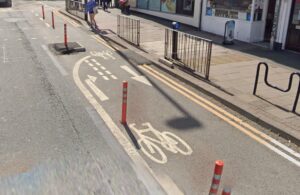
Over the two-day period, 5,287 bikes were recorded on the South City Way route on Victoria Road in Govanhill, a 2.5km, fully protected two-way bike lane linking Glasgow’s Southside to the city centre.
A total of 32,894 methods of travel were recorded during the same period, meaning that 16.1 per cent of people cycled their journey.
Perhaps most notably, during peak travel hours (8-9am and 5-6pm), there were more bikes than cars recorded along Victoria Road on both days, a first for the stretch of infrastructure.
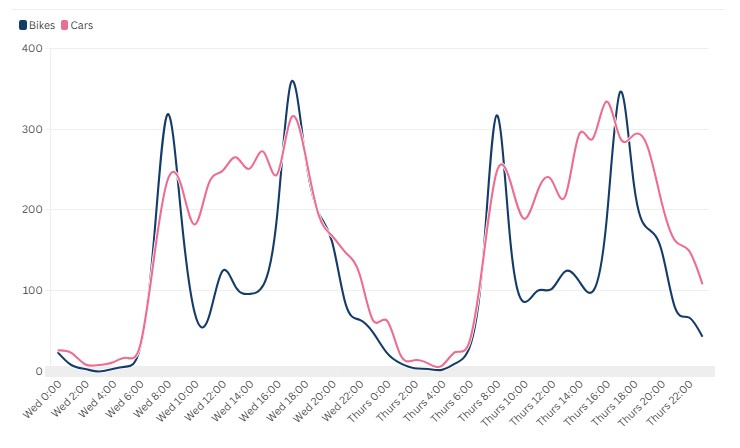
Those figures are supported by a separate study which found that 13,487 cycle journeys were recorded on the South West City Way route in September 2025 – more than double the 6,241 bike journeys recorded in September 2021, three years before the protected route’s completion in 2024.
A pair of nearby cycle counters, located at the junctions of Victoria Road with Calder Street and Alison Street on the northbound and southbound cycle lanes of the South City Way, also recorded a combined 131,324 cycle journeys over the full month of September 2025, compared to 70,827 in September 2021, an 85 per cent rise.
Meanwhile, on Clyde Street in Glasgow’s city centre, where the South City Way meets a new, protected cycle lane, 3,065 bikes were recorded over the two-day period on 24 and 25 September, representing 12.1 per cent of all journeys.
And in the city’s West End, 1,681 bikes were recorded on the bottom half of Byres Road, where a protected cycle lane has recently been completed.
Garscube Road, which boasts a 1km protected cycle lane connecting Maryhill to the city centre, saw similar numbers, with 1,636 cycle journeys recorded over the two days.

In contrast, on Saracen Street in the north of Glasgow – where there is no cycle lane of any kind – only 1.3 per cent of journeys were made by bike.
“It’s made a colossal difference having the protected routes,” Glasgow resident Katy Hastie told Cycling Scotland.
“Being well separated from traffic means I’m able to travel in safety. I’d go so far as to say I wouldn’t be cycling as much for my daily commute or at all without the protected cycle lanes now in place.
“I really like that I can squeeze some fitness and fresh air into my daily routine with cycling – and how efficient it can be. Often, it’s the fastest and cheapest way to get somewhere. I like that extra five minutes in bed, the fresh air and the free workout. It makes a huge difference mentally, health-wise, is quick and mega cheap. Win-win, all round.”
The importance of having safe, protected, high-quality cycling infrastructure is underlined by the huge disparity in the total number of cyclists choosing to ride on the road where a cycle lane is available.
For example, during peak hours, cyclists using the Victoria Road cycle lane outnumber their on-road counterparts by 40 to one, a trend replicated on all of Scotland’s segregated bike lanes.

The success of Glasgow’s protected cycling infrastructure has also been replicated in Edinburgh, where 4,744 cyclists were recorded using the much-maligned Leith Walk cycle lane on 24 and 25 September, a record 9.7 per cent modal share.
A similar modal share – 9.3 per cent – was recorded on the new City Centre West East Link at West Coates in Roseburn, where 2,798 bikes were counted over the two days, while usage records were also broken a York Place and Great Junction Street in Leith, evidence Cycling Scotland says of “the growth in cycling being supported as routes join together”.
In the south of Edinburgh, safety improvements to the junction of Gilmerton Road and the Pillars Path, where two cycle routes meet, have resulted in a 200 per cent increase in cycling between September 2021 and September 2025, rising from 1,561 journeys a month to 4,676.
And in Stirling, the protected cycle lane on Goosecroft Road near the city’s rail station saw an 11 per cent increase in usage compared to the year before.
“The data here speaks for itself,” Edinburgh City Council’s transport convenor Stephen Jenkinson said in a statement coinciding with the publication of Cycling Scotland’s latest figures.
“We’ve consistently seen that where we commit to creating and improving cycling infrastructure, new users will follow. From supporting more liveable local neighbourhoods, to getting physical exercise and choosing to get around more sustainably, I’d encourage anyone thinking of getting on a bike this year to give it a try.
“Under our City Mobility Plan, we’re committed to making Edinburgh as easy for people to move around as possible, and cycling is one of the key sustainable transport modes that supports this.”
His Glasgow counterpart, Angus Millar, added: “These results demonstrate the growing impact of high quality cycling infrastructure across Glasgow, showing that more people are choosing the bike as an option to get about the city when safe, protected routes are provided.
“From the South City Way and Clyde Street in the city centre to Byres Road, Garscube Road, the South West City Way and the East City Way – protected routes are enabling more people to cycle safely and confidently for everyday journeys.
“Alongside the wider evidence base for increasing numbers of cycle journeys in the city, this is another clear indication of the growing success of Glasgow’s protected active travel network and its potential to enable more Glaswegians to choose active and sustainable travel more often.”



















2 thoughts on “Cyclists outnumbering drivers at rush hour on busy Glasgow road, as campaigners hail “colossal” impact of safe cycle lanes”
Glasgow’s South City Way sounds great, does it not? As a user from before and after I wholeheartedly welcome the construction of the segregated route, but so much of the detailed construction is poor, if not unsafe. I provide a link to a presentation I made when construction was half complete (a personal view) and the construction errors remain outstanding to this day: crossed by high speed flared road junctions, poor colour differentiation, car door zone risks and so on. And yet cyclists come because they feel safe. It’s a complex subject but IMHO the feeling of safety (or lack of) is a critical component. https://drive.proton.me/urls/B67AK44G90#CFueBGjscoWr
This is the case for many pieces of cycling infrastructure IME – they are not actually that safe or at least not safer than riding on the road with the other traffic, often due to poor design. However, they make many inexperienced people FEEL much safer, and that is apparently more important than reality. Fortunately, just getting more people on bikes does make cycling safer for everyone who is cycling, and this seems to have worked in this case. Therefore, in a very roundabout way, having this infrastructure in place does increase overall safety. Of course, it would be even better if the infrastructure was done right / intelligently and did directly improve safety, but we can’t have everything. Small steps.