


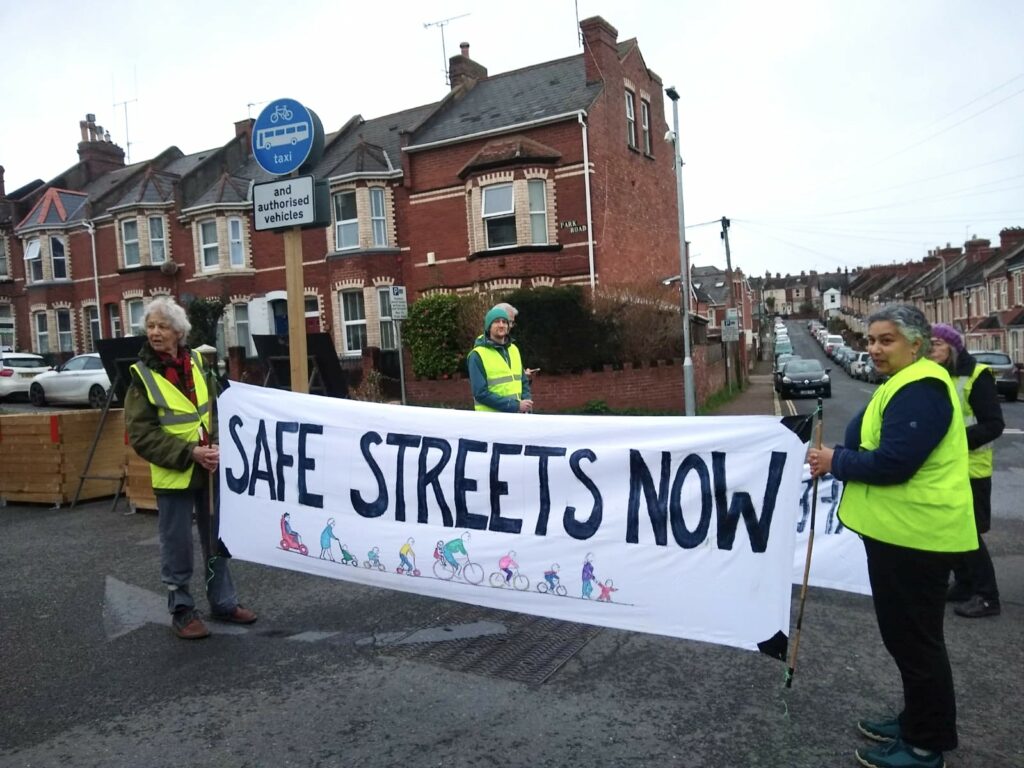

Cyclists in Exeter say they are “underwhelmed and disappointed” after the local council revealed that there is no funding for new school traffic safety schemes in an area where a low traffic neighbourhood initiative was controversially scrapped last year – and where children on bikes were hit by motorists flouting the traffic restrictions.
The revelation came at a meeting of Exeter’s Highways and Traffic Orders Committee (HATOC), which examined the outcome of a series of consultations and focus group discussions with residents and local schools, held to assess what could be done to promote road safety in the aftermath of the decision to scrap the city’s Active Streets trial early.
Despite the committee hearing that locals wanted action on road safety around schools, officers told the meeting there was no money currently available to implement these initiatives – while also insisting that they were determined to learn from the “mistakes” of last year’s LTN experiment.

Exeter’s Heavitree and Whipton ‘Active Streets’ scheme was introduced at the beginning of August 2023, as part of an 18-month trial by Devon County Council, and featured modal filters using bollards or planters in a bid to prevent through traffic and increase safety, encourage walking and cycling, and reduce pollution on some residential roads, while bus gates were installed to allow access to local residents, buses, and emergency vehicles.
However, the scheme proved highly contentious and was at the centre of a prolonged political controversy in the city fuelled by vocal, and often confrontational, opposition, vandalism, and protests.
A week after the trial began, masked youths ripped out the bollards at the entrance to the LTNs before fleeing on bikes, prompting the police to warn that removing such barriers constitutes a criminal offence and that they were monitoring anti-LTN groups on social media.
A few months later, protesters sent death threats and filled the letterbox of the local MP’s house with faeces, leading to one man being cautioned by police, while a councillor’s bike tyres were also slashed.
A month after an aborted attempt by some council officials to bring the 18-month trial to an immediate and premature halt in January 2024, Lorna Devenish, the spokesperson for the Heavitree and Whipton Liveable Neighbourhood Group, told road.cc that many motorists were simply ignoring the bus gates, often speeding through them, while some signs were sprayed over by vandals.
This situation, Devenish said, led to drivers coming into conflict with the increased number of people walking and cycling in the area thanks to the scheme’s initial promise of quieter, safer streets.
Outside Ladysmith School, located within the boundaries of the Active Streets trial, a child was knocked off their bike by a motorist, while a woman riding a cargo bike with her baby in the back was reversed into by a driver attempting to manoeuvre around the bus gate.

These incidents prompted residents supportive of the scheme to act as ‘human bollards’ at the bus gate, leading to often tense stand-offs and angry confrontations between neighbours.
But, after January’s aborted move to scrap the trial, it was eventually abandoned early in June after a recommendation to the Exeter Highways and Traffic Orders Committee (HATOC) that the scheme be “suspended as soon as is practicable”.
An impact assessment carried out by the committee showed that more than 82 per cent of the 24,000 respondents were opposed to parts of the scheme, with just 18 per cent in favour. A report into the trial also claimed that the project had a “disproportionate negative impact” on people with protected characteristics such as disability and age.
However, Exeter Cycling Campaign claimed that the report betrayed the council’s promises to properly back the scheme, arguing the trial met its aims of boosting active travel and reducing car journeys, and arguing that councillors were put in an “invidious” position by their officers’ report.
“It should not require bravery to cycle to school,” the campaign said at the time.
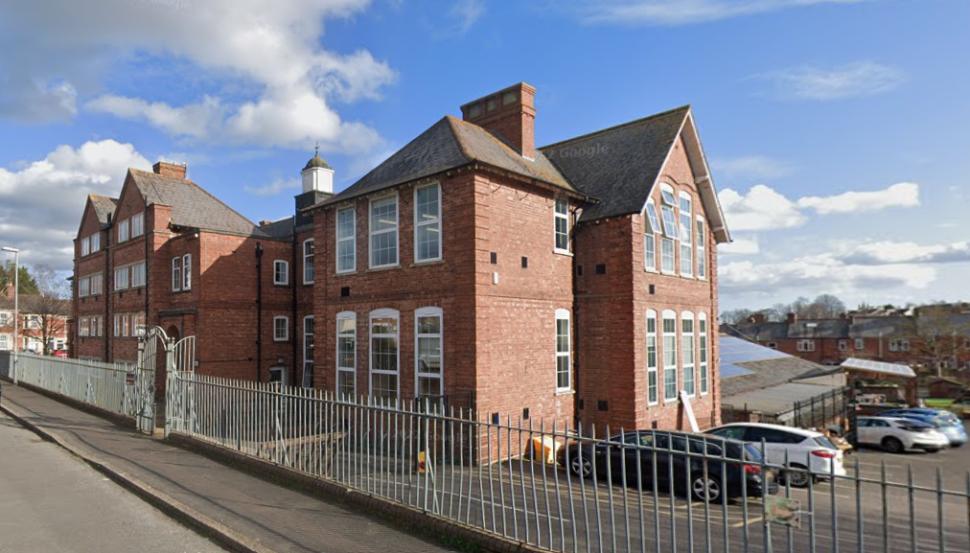
Ladysmith Junior School, Exeter
Fast forward eight months, and it appears that bravery may be exactly what is required for young cyclists to attend Ladysmith School, after the local authority announced that there is no funding available to implement safety measures for active travel in the area.
The report delivered to HATOC, made up of councillors from Devon County Council and Exeter City Council, last week said the focus groups consulted on the failed LTN believed work was needed to “improve safety for children around schools during peak times”.
However, Hannah Clark, transport strategy manager at Devon County Council, told councillors it was not clear “what funding streams might be available”.
Nevertheless, Labour councillor Tracy Adams said she did not want the results of the public consultation to be “lost in aspic” and argued the committee needed to focus on what it could do to improve safety around schools.
“We can’t wait for there to be some horrible accident outside Ladysmith School,” she told the meeting, noting that the discussions with local groups were “heartwarming at the end of a very difficult trial”, and included a number of positive pointers for the future.
“Democracy is important,” Adams added. “People have given their views very clearly, and if we don’t do something about that we have to analyse ourselves as a council and think about what we are doing for our residents.”
Meanwhile, councillors agreed to work with residents of Lower Hill Barton Road on looking at their plans to alleviate traffic in the area around St Nicholas Primary School.
More generally, Cllr Carol Whitton admitted that “the consultation processes were not what they could have been” in relation to the trial.
“We have had to deal with the fallout from that, and we need to restore the community’s faith in the process,” she said.
Meanwhile, Labour’s Su Aves told the meeting that residents “had got back into bad habits since the trial finished”, including cycling on pavements and parking on zig-zag lines outside schools, she said.
Aves noted that councillors would be asking for more enforcement and more fixed penalty tickets to be handed out for law-breaking drivers and cyclists.

Following the meeting, the Exeter Cycling Campaign’s Edward Pickering, a cycling writer and the editor of Rouleur magazine, said he was “underwhelmed and disappointed” by the council’s response.
“It was nice to see feedback from the focus groups, but Exeter still faces the same issues of pollution and congestion, safety, and health that we did a year ago,” Pickering told the BBC.
Meanwhile, Ian Frankum, who campaigned against the LTN, said he was pleased to see “a recognition” from councillors that there were “lessons to be learned” from the engagement process that took place before the LTN was launched.
“It’s clear funding is going to be a big issue going forward and the emphasis has switched to school safety which is something we’d obviously all encourage,” he said.



















26 thoughts on ““We can’t wait for some horrible accident outside the school before we do anything”: No funding for safety schemes at school where driver hit child on bike, as council vows to “deal with fallout” from scrapping of controversial LTN”
Pro-Motorist Media
Pro-Motorist Media
I suggest there is a term that is not in every day media parlance and that is the “Militant Motorist”.
When I ‘Googled’ the term, virtually all the results returned with “Militant Cyclists” instead, with a few “Militant Runners” to boot.
But over the last few years, all the news stories surrounding LTNs has been regarding the numerous ways they have been vandalised by, you would suspect, the pro ‘freedom to drivers’ activists.
In parts of outer London, the new ULEZ enforcement cameras have been subject to £multi-million damage, and I was ‘fortunate’ enough to experience a roadside bombing of one ULEZ camera nearby.
Yet the term “Militant Motorist(s)” has never seemed to have made it to the headlines, perhaps it is because those responsible are considered by mainstream media as the oppressed majority?
Going back 30-40 years and the LTNs were never this controversial. I can think of two roads near me that were closed off, to prevent ‘rat-running’ drivers avoiding traffic lights. These were introduced with almost the full support of local residents.
Today the media tide has changed. LTNs are reported upon as if they are an infringement of the Human Right to Free movement. Proposed cycle lanes are robustly contested by the ‘vocal majority’. Time and time again, Celebrities, Lords, Politicians are in the spotlight calling for legislation to ‘force’ cyclists to have licence plates and insurance. Even on the BBC, interviews with Road Safety activists voicing uncontested statements that “cycling is literary a lawless activity”. That “the penalties for careless cycling are merely summary offences”, whereas drivers receive penalty points on thier licence.
Sorry, the weather is miserable and I’m just venting my spleen at the sh*t anti-cycling mainstream media that has materially affected my enjoyment of cycling in many incremental ways….
Mr Anderson wrote:
Didn’t we have a referendum so that we could get rid of that?
If we kowtow to follow our
If we
kowtow tofollow our partner in the Special Relationship we’ll obviously realise that it would be betraying our great citizens if we let ourselves remain in thrawl to bad, biased rules made elsewhere! (Not to mention ripping them off – to pay for wasteful bureacrats to choke us with red tape!)I well remember the BBC
I well remember the BBC rolling out their environment correspondent to criticise LTNs.
Mr Anderson wrote:
What’s strange, about the anti-LTN movement, is that just about any relatively modern housing development is a defacto LTN (and usually without any modal filters) but nobody ever complains about those. In fact, the quietness and low traffic levels are probably a factor in people moving there.
*cough* cul-de-sacs *cough*!
*cough* cul-de-sacs *cough*!
I think that’s largely true, but a) these are often built in the edges of existing urban areas – so they are connected to “fast roads” or at least when you drive off one you’re generally on a “distributor” or higher capacity road. b) Within urban areas and older developments in the UK the pattern is to be more permeable / connected. So it’s more a grid or network.
I think the solution seen eg. in NL is much wider use of one-way treatments. The good thing about that is it applies effectively to older areas. And by making things one-way you can grab a (now free) lane for parking, mini-parks etc. (Width-saving “echelon parking” can work better also). Also the single lane can then have horizontal displacement eg. weave through the area across what was the two-lane space. That helps further slow drivers.
Of course – the flip side is that yes – this *will* slow drivers and make it less convenient. And if someone gets a delivery / needs to stop, other traffic may well be unable to get through. Apparently that is acceptable in other countries – but this would currently lead to crowds with burning torches on the streets because “trapped in our homes” in the UK!
chrisonabike wrote:
*cough* culs-de-sac *cough*
Alright, I know you can say cul-de-sacs, but it doesn’t mean you should…
Rendel Harris wrote:
*cough* culs-de-sac *cough*
Alright, I know you can say cul-de-sacs, but it doesn’t mean you should…— chrisonabike
Reminds me of the strange fact that the French have no word for ‘baguette’.
mike the bike wrote:
Eh? Yes they do. Don’t they?
mike the bike wrote:
Or joie de vivre, of course.
But if you were going to you
But if you were going to you’d probably say les impasses or les voies sans issues (my French is doubtful on the last), no? Otherwise “dead ends” or “no-through-roads”?
It is still French also … I guess it’s “when do we ‘win’ the tug of love for a word” and get to decline it as we see fit?
Rendel Harris wrote:
*cough* culs-de-sac *cough*
Alright, I know you can say cul-de-sacs, but it doesn’t mean you should…— chrisonabike
I’m not entirely convinced that is right. Cul-de-sac literally means “bottom of the bag” so putting the s on cul would make it “bottoms of the bag”. I’d have thought you’d want it to be “bottoms of the bags”, ie culs-des-sacs?
Steve K wrote:
Don’t ask me squire, ask the French, that’s how they say it!
Rendel Harris wrote:
The French don’t say it at all.
Steve K wrote:
Don’t ask me squire, ask the French, that’s how they say it!
— Rendel Harris The French don’t say it at all.— Steve K
It’s been used for dead-end street in French since the C14th and is still in the French dictionary (just checked in my excellent Collins Robert) though admittedly it is now somewhat archaic (supplanted by impasse or sans issue) but when they do/did use it they definitely pluralised culs and not sac.
Well if we’re going that far
Well if we’re going that far back what I’m now wondering is what Caecilius called his? (Pretty sure he was doing alright – wasn’t he a banker? He certainly wasn’t stuck in an insula…)
chrisonabike wrote:
Via terminata?
Porta omnibus?
Porta omnibus?
I feel Google needs one of
I feel Google needs one of Henry Beard’s books for more up-to-Silver-Age colloquial source material (or even better literal translation)…
Quote:
All because they wouldn’t be allowed to rat run through a couple of roads?? Someone really needs a sense of perspective…
This isn’t just angry locals,
This isn’t just angry locals, these are the same organised right wing loons who see LTNS as an attack on their freedoms.
I object to this defaming of
I object to this defaming of loons by suggesting that they’re all dangerous right wingers.
Although admittedly some of them don’t help.
Good point. And actually
Good point. Although are they organised?
Also fruitcakes have something to be said for them, even if they’re a bit nutty.
Ah – I have now read
Ah – I have now read Wikipedia on loons, and perhaps I can understand their objections:
“loons have difficulty walking on land, though they can effectively run short distances … when frightened”
So … they have to drive!
I can only cite Chris
I can only cite Chris Boardman again talking about what they did in Greater Manchester…
The choice to do nothing is key. You don’t have to do anything, but you have to live with the consequences if you do nothing. It’s up to you. Now it’s not all roses, so then you start to implement and you hear “what do you mean, you’re going to take my car parking space?” and then it gets sticky, but people could see the big picture and were proud that “this is our plan” …
Whoever owns the outcome gets to make the choices. If you free yourself from the outcome … you own the questions, not the answers – it doesn’t half make life easy!”— Chris Boardman
Unfortunately in the UK
Unfortunately in the UK people may simply not think there is any “choice”.
And the consequences (doing nothing) for all are continually softened by each government. So we keep the price of fuel lower than it might be. If there is a small but noisy opposition (sometimes appearing after change e.g. “we missed the boat, but now we’re really angry!) we back off.
And individual drivers can offload their issues onto others (driving around planters and barriers, getting more aggressive, actually making things *much* worse).
So … sadly it might just be “too soon” for the people here.
And while it’s “never the right time” apparently for transforming our transport systems and public spaces … it is currently a difficult time:
– there is financial stress.
– there is a major cultural (and political) upsurge of “sod the environment, the future, other people (including actually lots of “our own” people e.g. children, the old, those with disabilities) … we want the same but more so, and we want it right now! Drill baby drill, fill the pot holes, one more lane!”
Of course – if you’ve got less money and feel the world is less stable, surely that is the best time to bring in money saving solutions and more (locally) resilient systems? As Chris Boardman says “Cycling and walking – the least shit option!“