


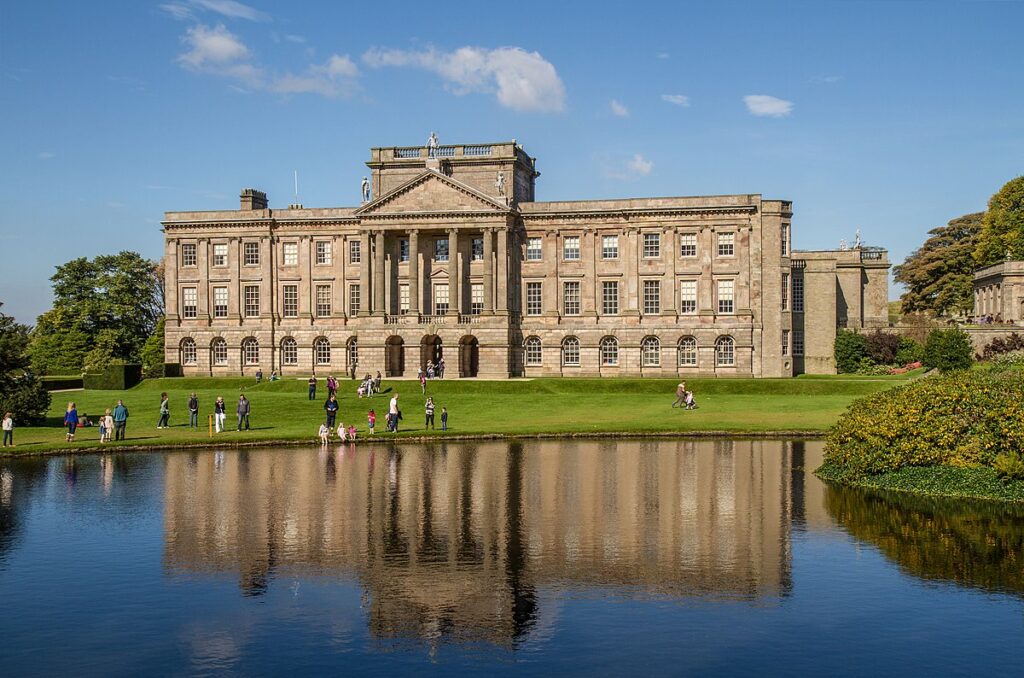

The National Trust has drawn criticism after unveiling plans to build the Peak District’s largest car park — at its Lyme Park site — plans which do not include any extra provision for those wishing to visit by bike.
The announcement comes within the wider context of the National Trust having pledged to be net carbon zero by the end of the decade, something critics have said the charity will not achieve if it continues to design sites around cars and fails to move away from a “car-dependent business model”.
The plan for a 1,065-space stately home car park, increased from the current 395 spaces, was first reported by the Guardian who note that 300,000 people visit the historic hunting estate each year. Car visitors to the site, which has been home to the Legh family for more than 600 years, have to pay £6 (£3 per child) and it is free to walk or cycle into the park.
However, with Disley station less than a mile from the gates — and most visitors, of which 199,945 arrived by vehicles in 2019, instead using the A6 — some have questioned if enough is being done to encourage visitors out of their cars.
The National Trust admitted that the plans do not include any extra bike parking provision and the new car park would be built next to one of the most popular walking and cycling routes into Lyme, at West Park Gate.
But the charity has insisted it is not adding any new extra spaces, merely repurposing some of its current overflow spaces which can only be used during good weather.
A petition on Change.Org calls for the National Trust to withdraw its “ill-considered application and come up with an alternative, fit-for-purpose plan for access, which truly reduces the impact of motor vehicles on this special place and has sustainable travel at its heart”.
> National Trust to trial e-bikes and e-cargo bikes in bid to reach net zero carbon emissions
“No complementary measures whatsoever are included for cycling or sustainable travel and these plans would even make access more difficult for non-car visitors,” the petition states.
“In fact, the plan states the pithy four main cycle parking stands will be moved further away from the hall, to the Timber Yard. Versus 1,065 car parking spaces, there would be only eight acceptable public stands to lock a bike to. There will be no new or improved paths for cycling to protect people on bikes, who will have to share narrow roads with increased vehicle traffic right through the park, including coaches, making it a much less pleasant place to cycle.”
“Car-dependant business model”
Harry Gray from Walk Ride Greater Manchester said it was “concerning” that the National Trust appears to be “reliant” on a “car-dependant business model”.
“It is time to invest in greener transport modes, such as better access for Active Travel, as well as park and ride links to the nearby train station. The National Trust claim they’re ‘part of the global fight against climate change’ – yet their actions on the ground speak otherwise.
The director of policy and communications at national walking charity Living Streets, Tanya Braun, added: “We need to stop designing places around cars and start thinking about what people want and need. It’s disappointing that there are no accompanying plans to improve access for people walking.
“Adding in safe and accessible walking routes will enable more people to choose to walk, helping to cut congestion and air pollution. Without improving options for more sustainable transport modes, it will force people into their cars and exclude those without access to one from enjoying National Trust properties.”
The deadline for objections on the planning application has been extended to 9 May, with more than 150 already in.
A National Trust spokesperson said the changes are all about making the site “more resilient” to extreme weather.
Lyme currently has a total of 1,000 car parking spaces, but many cannot be used during wet weather. We are not increasing the overall number of spaces but we are upgrading facilities and infrastructure to make it more resilient to extreme weather events.
We’ve carried out preliminary ecological surveys to minimise any impact and will be reverting the existing car park to rich grassland habitat. In previous trials, park and ride hasn’t reduced the overall number of visitors arriving by car, but we will continue working with groups and individuals to find more sustainable ways that people can travel to Lyme.



















45 thoughts on “No new bike parking but a car park with 1,065 spaces? National Trust urged to break from “car-dependant business model””
Quote:
They don’t get it! They think the environmental impact is about how much turf they pave over – nothing to do with how many vehicle miles they generate.
I suspect they do get it, but
I suspect they do get it, but they also realise that visitor numbers would be decimated if they significantly reduced parking.
But just by sinking in a few
But just by sinking in a few Sheffield stand you can park ten or more bicycles in the space that one car takes up.
Three or four reduced spaces out of a thousand, just beyond the less than able spaces, see how it does. If it proves popular then a few more car spaces might be sacrificed to a few drivest spots.
Again, transport heads for
Again, transport heads for Lyme Park are tantalisingly close, at less than 2 miles. I get that it’s a 200 ft height difference from train Disley station to the house. I get that all the houses in their care are hungry.
The NT’s website is decidedly unhelpful: how to get here – the cycling tab just has a link to Sustrans, which is a cop-out. There is a free minibus from near the main entrance operating most of the year (under arrival by bus). Looks great for walking and and upgrade for cycling would surely not be that difficult.
At one NT place local to, me an exhibition on decades of capital punishment for homosexuality, starting with the entrance hall full of nooses – unexpected, challenging and informative. It’s great that the NT place so much emphasis on disability access and that they feature a diverse range of people visiting in their brochures.
But all those people need access to a car to join in in all but a few cases.
Stourhead
l’ve seen this expand the parking offer as Lyme are doing: it creeps from grassed “overflow” areas, and then it’s “we’re only upgrading existing areas we can’t use year round”.
In this case, it’s miles from anywhere, apart from the A303. On the plus side the catering and toilets are outwith the admission booth, so it’s popular with cyclists as a rest stop.
Catering
while I’m on it, this often seems like a missed opportunity as too many places are stuck, catering-wise, in a model of the Bad Old Days when sites opened three afternoons a week from April to September – you studied the annual handbook intently to work out the puzzle.
Too small, and frustratingly, too slow.
Please, please, please all caterers – don’t mix the food queue with the complicated coffee queue. Barista Coffee is lucrative, but you’ll lose food sales if you don’t have the capacity and skill to produce it quickly – it is quite labour intensive. I get that you are weather bound, staffing isn’t easy, so gear the offer accordingly with more self-service, don’t try to hold on to some genteel model of old. Most places I visit I am staggered by how disorganised and unproductive the arrangements are at busy times. it spoils the experience.
Well that’s nothing compared
Well that’s nothing compared to what they did at Waddesdon Manor: created a massive car park so far away from the house, they have a fleet of shuttle buses running around it all day!
To be fair at Waddesdon, there is e-bike hire and a traffic free route to the railway station.
There are a lot of NT places
There are a lot of NT places that cause havoc on their peak days. Typically they are quite inaccessible by car, historically because the house owners owned swathes of land and ensured development was far away from them.
This is just one example. NT really need to rethink their whole business model which is based on encouraging people to drive long distances to tick off the NT list. Many retired people seem more interested in the cafes rather than the history. I hate to think what the real food miles are for an NT cafe.
Let’s be fair, without a
Let’s be fair, without a massive car park there wouldn’t be any need to have the National Trust membership sticker showing in the Volvo estate as a public display of civic respectability.
It is an hours cycle for the
It is an hours cycle for the average person from the nearest large towns, which also involves a rather significant amount of climbing for said average person. If they want to restrict the number of people visiting each year to a few hundred they should absolutely get rid of the car park.
And given the stated
And given the stated proximity of Disley station, they should encourage people to visit by train. Maybe increase the parking charge to at least equal the train fare from the nearest large town, put up signs from the station, etc (maybe they already have signs?). Being realistic, this is more likely to get people out of their cars than cycling.
The site catering for “the
The site catering for “the answer is me driving my car, what’s the question?” is over thataway.
Sorry, this must be the site
Sorry, this must be the site for delusional cycling extremists who think that a family going for a day out with 4 people, a dog and a picnic set are suddenly going to decide to cycle for hours carrying all these things to get to their destination.
How is Fido’s eyesight these
How is Fido’s eyesight these days?
ITK2012 wrote:
Not sure about the dog, but surely four people can carry a picnic between them and make the ride a part of the day out?
Well, if a husky can pull a
Well, if a husky can pull a sled, I’m sure the average dog could be used as an aid to the slowest rider. But no whipping, please, it’s cruel.
brooksby wrote:
Obviously I like cycling (I mean, who would come here to post if they didn’t like cycling?) and yes, four like minded people could ride to a NT property with a picnic. I’m sure many could also get there through a combination of rail and bus etc. But for most NT visitors, I’d wager that would be a massive put off when we have made the car so convenient. I’m not saying NT can’t or shouldn’t change, just recognising it’s a tough ask when the vast majority of visitors currently arrive by car.
“…We have made the car so
“…We have made the car so convenient” – driver privilege in action, you’re so so close…
Convenient for whom? At what price? How big does the car park get?
Well I’m sure the NT have a
Well I’m sure the NT have a good grasp on who’s visiting and where their cash comes from – and are actively thinking about how to keep the show going. I suspect a LOT of NT visitors are in the older age bracket. So them being “realistic” about travel considerations – to at least ensure they exist for the next decade – is understandable. Even if they’re not paying as much attention to the non-motorised as we might hope.
Given that a lot of their estate is places built by the elite, for the elite and sometimes damn the expenses though… perhaps the whole idea of sustaining such places needs careful consideration. If we’re not to live beyond our collective means. It might be righteous that now all us hoi-polloi can visit these properties fairly ad-lib. Many are in places deliberately remote from population centres however.
On “sustainability” – apparently Capability Brown was so popular partly because (having worked his way up from apprentice gardener) he was good making parts of his designs functional as well as beautiful. He well understood that the whole needs to support its own upkeep. I’m sure he’d have approved of National Trust gift shops and cafes!
I agree with you. I’m just
I agree with you. I’m just recognising that fighting that ingrained carcentricity is hard to do. Being a thought leader and having minimal parking provision may be the right thing to do, but for an organisation like NT it is also likely to deter a large part of the current customer base and threaten their short term viability.
quiff wrote:
You’d be surprised…
Sadly not!
Sadly not!
I’d love to meet the 4 year
I’d love to meet the 4 year old who can cycle 10 miles including 8% gradients carring a couple of picnic chairs and a coolbag. At least the way home is mostly downhill to Stockport.
Well that sounds like a big
Well that sounds like a big trip out! 8% gradients are considered a bit much for “casual cycling” in places where it’s normal, like the Netherlands. Carrying kids also – give yourself an ebike – or even a couple! Maybe a Tern GSD that the road.cc folks like. And/or a bakfiets type – perhaps even an Urban Arrow?
This video of lots of people getting around with small children isn’t recorded in the UK. It could look like that in more places here though if we choose (via heckling our governors and other organisations). That’ll be too late for most current 4 year-olds, unless their parents move. It could certainly be important for their children.
The bigger point is – currently we define what’s normal mostly in terms of “what I can reasonably do / where I can get to when equipped with a car”. That may well change. Either by choice (collective enlightened self-interest) or by fiat.
ITK2012 wrote:
You’d take picnic chairs to a NT property? There’s posh – do you own a Volvo?
(You’ve heard of picnic blankets?)
Too frugal for the National
Too frugal for the National Trust cafe! They can be … ambitiously priced.
We should improve society
We should improve society somewhat.
Cyclists – let’s have a cycle track
drivers- my entire world will cease to exist
ITK2012 wrote:
No, it’s the site for delusional cycling extremists who cycle for hours to get to a NT property… whilst the rest of the family travel there by car (guilty!).
Does Mrs Darcy know about
Does Mrs Darcy know about this?
Don’t know, but Mr Collins
Don’t know, but Mr Collins was heard to remark that the car park at Rosings is much larger.
quiff wrote:
At Calke Abbey, a National
At Calke Abbey, a National Trust house and huge estate, in Derbyshire, cars have had to pay to drive through the estate road for as long as I can remember, but bikes WERE free. Not any more.
Bikes now have to pay just to ride through on the estate road (unless you are a NT member). Entry to the house, is of course, extra.
The ride through the eastate is very nice, and many, many cyclists used to ride through and visit the tea room (free entry). But not any more, so it has cost the NT loss of profit from the tea room sales.
I regularly ride through
I regularly ride through Calke Abbey and visit the tea rooms without paying (except for my cake!) , theres a cycling/shared use trail round the whole park that you can access without going though the estate road. Google “Calke Abbey Tramway Trail”. Or if you are driving there and don’t mind a bit of a walk – park at Ticknall village hall for free.
Like the wider world, the NT
Like the wider world, the NT continues to follow a car centric policy that has no future. No future means it’s not if it needs a re-think, but when. How much demand are they going to induce down unsuitable country lanes, how much of the site gets sacrificed to cars? If you’re all about inclusivity (ok so that probably translates as mass membership), this is a no brainer.
My message to the NT is that they need to be thought leaders on this issue.
The solution will be different for each site, but I think it involves minimal on-site parking for visitors and high capacity, sustainable links to nearby railheads and bus-heads. It could include e / bike trails to/from centres of population – many sites are within a (theoretically) rideable distance of nearby towns/railheads.
The Vyne near Basingstoke
By train
Basingstoke 4 miles – taxi rank available outside of train station. Bramley 2½ miles – requires a walk of 2½ miles from this station. Note: Vyne Road has no foot paths.
Quite how there comes to be an existing country bus on a 15 minute headway (Aldermaston?) travelling up the A340 through Sherborne St John, I don’t know, but Morgaston Wood is part of The Vyne estate so you’re 90% there – but no mention of this on the website. Clearly in cycling in terms it’s no distance at all from either train station – if people felt safe, if the NT wasn’t inducing demand by expanding its car parking.
https://www.nationaltrust.org.uk/visit/hampshire/the-vyne
https://tiscon-maps-
stagecoachbus.s3.amazonaws.com/Timetables/South/Basingstoke/Basingstoke%20Route%202%20__16-04-23_.pdf
Basildon Park, west of Reading
A meagre twice-daily bus service, however a main train line (I won’t be the first to have said this) passes the front door, but there is no station. It’s Tantalisingly close to Pangbourne (2 miles), but the only direct route is along a horrid “A” road, or by boat (?). There’s a 4.5 mile cycle ride from Pangbourne.
Cragside, Northumberland
My non car owning brother in law went a few months ago – it’s on my list to do. I was interested in how they managed to do it – he said arriving quite early in the nearby town they got talking to someone who worked at Cragside who showed them the way. On the map, it looks like a 3/4 mile walk from Rothbury along a B road with no footway, or maybe the 471 bus to Alnwick (not Sundays).
It seems genuinely new this year that the X14 from Morpeth now makes a couple of visits to where you drive in to the Cragside estate from the public roads – there is a free NT minibus around the estate (I had to read the accessibility guide to confirm), but it sounds like you need to be a driver or cyclist to do the 6 mile carriage ride.
https://api.arrivabus.co.uk/routes/services/NMS_AN_X14/230416-230727/X14-Newcastle-to-Thropton-from-16-Apr-2023.pdf
https://bustimes.org/services/471-alnwick-thropton?calendar=3917394
https://www.nationaltrust.org.uk/visit/north-east/cragside
Shurely many National Trust
Shurely many National Trust properties are literally designed for access with renewable-fuel- using transport – by coach … and horses?
Also – I find the most
Also – I find the most culturally appropriate way of viewing the properties* of existing or former aristocrats or the “nouveau riche” seeking to emulate them is to cycle there and jump over the fence. It’s what they wouldn’t have wanted…
* Or indeed areas of natural beauty they once owned.
I was idly googling for the
I was idly googling for the NT transport policy and couldn’t find anything, but I did come across this from 2001 “Journeys to heritage attractions in the UK: a case study of National Trust property visitors in the south west”
which includes this:
“The National Trust recognises that most journeys to properties are by car and has a strong commitment to reducing car-dependent travel to its properties. In a number of documents it sets out its views on promoting alternatives to the car The National Trust, 2001a, The National Trust, 2001b, The National Trust, 2001c, The National Trust, 2002b. At the 1995 Annual General Meeting a member resolution on green transport aimed `to reduce the proportion of car-borne visitors to its properties from…..”
Something seems to have happened between 2001 and 2023, and they don’t seem to care about reducing car-dependent travel to their properties any more.
Lanhydrock House has a
Lanhydrock House has a parking area big enough to show up on the OS map, and it’s a half mile walk to the house from there. Being so close to the A30 at least they aren’t inducing cars down miles of county roads. But it’s 1.75 miles walk to Bodmin Parkway station along very nice made-up pedestrian and cycle paths. They make very little of this feature.
David9694 wrote:
To be fair, this features prominently in the ‘getting there’ information, where arrival by foot, train and cycle all feature before road. But perhaps you meant they could capitalise on it better on site?
Even I don’t think that the
Even I don’t think that the NT can succeed at present time by ignoring the fact that most people will visit by car- and I cycle everywhere I can. There is as yet no possibility that people will be penalised for not travelling by bike- after all, flying remains encouraged, plane fuel is not taxed, nutter motorsports still carry on etc. etc. However, NT has to show willing by taking not very expensive steps to help people arriving by bike, and to even reward them for climate-friendliness in some way.
Took a ferry to the Isle of
Took a ferry to the Isle of Wight for a day out during the easter holidays and cycled down to the National Trust place (name escapes me) on arrival we were told where to park the bikes but found the bike racks had been removed to make way for a mobile toilet block.
Staff were very helpful but arriving by cycle is clearly an afterthought for the National Trust.
North Norfolk is still
North Norfolk is still relatively well serviced by bus and Sheringham Park is a nice visit at this time of year for the azaleas.
We last went in 2011 and we caught a bus from Sheringham through Upper Sheringham to outside the park entrance – I distinctly remember the driver saying he wasn’t meant to stop there – perhaps it was a no 5. As mentioned by the NT, the no 9 to Fakenham goes that way with 3 or 4 departures in each direction Mon-Sat.The NT don’t mention the bus stops on the access guide, but lots of parking information.
The 44 operating 7 days passes along the A148, but there is no stop. Wouldn’t you make it your business to get one if you were serious about inclusivity? The NT are not even doing the basics.
Mr 18 posts can put his obstacles in the way with children and animals, but the fact remains that if they don’t have a car they barely stand a chance of accessing this as things are.
https://nt.global.ssl.fastly.net/binaries/content/assets/website/national/regions/norfolk/places/sheringham-park/pdf/sheringham-park-map-2023.pdf
https://bustimes.org/services/9-fakenham-little-snoring-melton-constable-briston?date=2023-05-13
North Norfolk was served well
North Norfolk was served well by buses and arguably better than Suffolk is, not sure its quite that good now, but its just as easy to get the train to Sheringham and to the park for the rhododendrons.
My first thought was this
My first thought was this picture – blue is the tank for the Orca at SeaWorld, red is the boating lake and guess which bit is the car park
https://slate.com/business
https://slate.com/business/2023/05/parking-spots-cities-paved-paradise-cars.html
That’s just normal US/Orlando
That’s just normal US/Orlando craziness though, I once stayed in a hotel there not more than 2miles walk from one of the theme parks, the only legitimately recognised way to get there, because walking along a road without a sidewalk makes you a vagrant apparently, was to go by vehicle on a highway and park in the 4th largest car park in the whole world, number 5 is just down the road, and it has shuttle buses because its so big, to drive you to the entrance. I didn’t check if they had cycle parking, I very much doubt it.
Awavey wrote:
Actually it’s just more visible because it’s in one place.
More than a third of Scottish city space is taken up by motor vehicle infra.
Many UK cities (“our streets are too narrow”…) have football-pitch-sized junctions.