


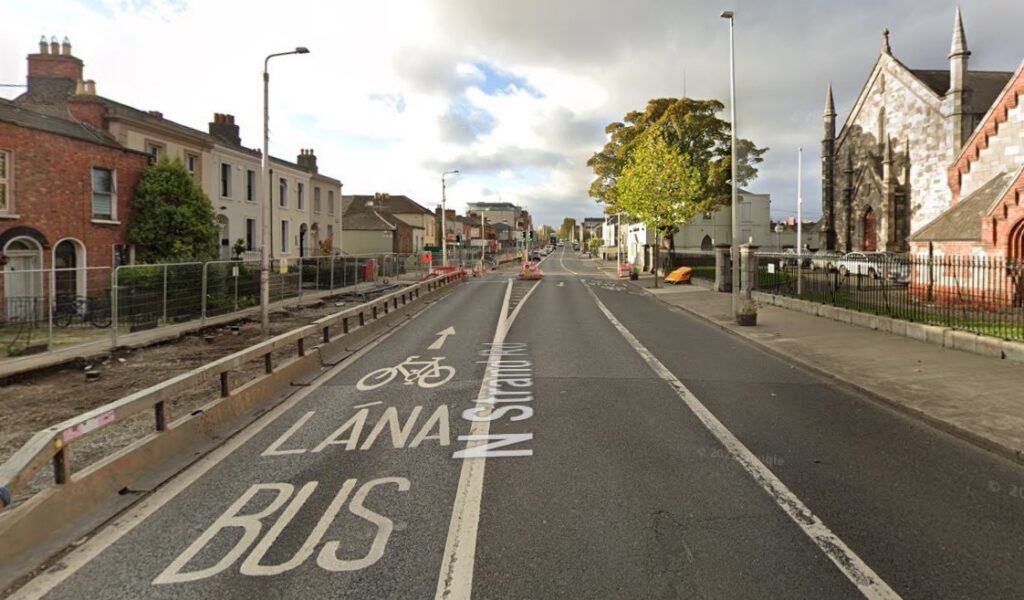

A Dublin resident has blasted the council’s decision to remove several bus stops along a new cycle route into the city centre, which she says has made it difficult for her elderly neighbours to access public transport.
Currently under construction, the Clontarf to City Centre cycleway will provide segregated cycling facilities and bus priority infrastructure along a 2.7km route from Dublin’s Northside to the city centre.
According to Dublin City Council, the route will offer “high quality, continuous and consistent” cycling infrastructure on each side of the road, catering for existing and future demand, and aims to “protect vulnerable road users”.
The council also says the new route will “improve bus journey times and reliability” and “simplify the interchange between bus services and other transport modes”. This will be achieved by the removal of seven bus stops, four inbound and three outbound, along the new route.
> Bus company investigates employee filmed driving on cycle lane and pavement
A report on bus stop spacing along the route into the city centre found that “improving bus stop spacing can benefit all bus service stakeholders and will help maintain an equal frequency of services along this major corridor.
“Design guidelines suggest benefits such as increased bus reliability, reduced bus journey times and reduced operator costs. Concentrating passengers at fewer stops improves boarding times.”
However, the decision to remove the bus stops has come under fire from locals, who have argued that the increased distance between stops now falls outside “international best practice”.
“It is absolutely awful for me and my neighbours,” 63-year-old photographer Paula Nolan told the Irish Independent this week.
Ms Nolan, who lives on Strandville Avenue in North Strand, has lost the bus stop at the top of her road, with the nearest remaining stop a further 200 metres away, up a substantial hill.
“Our bus stops have been taken away and it’s absolutely terrible. It’s permanent too, not temporary,” she said.
“My neighbour has MS and she has lost her bus stop, it’s terrible. I can’t even tell you how upset we are. For me, I’m 63 and I carry photography gear, but I had surgery which means I can’t carry too much heavy stuff.
“Now it’s so difficult, especially if we want to go to the airport with luggage.”
She continued: “I don’t have some muscles after surgery, so it was already very hard with lifting. To pull the bags up the hill to the next bus stop is so tough, and it’s all just to make room for cyclists.
“I always use public transport for awkward and heavy stuff. We used to go to the top of our road and be in town in ten minutes. The one across the road is scheduled to be removed too.”
> Pedestrian safety fears raised over floating bus stops on new cycle lane in Bath
The new cycleway will also incorporate floating bus stops, a concept common in the Netherlands and elsewhere, and which is increasingly being rolled out in the UK, in which segregated bike lanes on roads used by buses run alongside the footway at bus stops, which are placed on an island between the footpath and the main carriageway.
A similar initiative in Bath came in for criticism this week after some locals claimed that the infrastructure puts pedestrians getting on and off buses at risk.
On the subject of Dublin’s new cycleway, Ms Nolan continued: “They are creating island bus stops to accommodate cycling lanes, because there is not enough space for both, I understand that. But it needs to be integrated together for both bus users and cyclists. It’s not fair that the elderly must walk much further to a bus stop, especially up a hill.
“International best practice is that stops in urban areas should be no more than 400 metres apart, now here they are 600 to 700 metres apart.
“They have misinterpreted international best practice. I don’t expect to see the bus stops reinstated, but I would like to shine a light on current and future planning.”

-300x199.jpg "“He wants bikes in traffic lanes. Give him what he wants”: Cyclists urged to “slow every street down to bicycle speed” and ride in middle of lane amid premier’s war on cycle paths + more on the live blog")









18 thoughts on ““It’s all just to make room for cyclists”: Locals blast removal of bus stops on new cycleway route”
Oh great. It doesn’t see that
Oh great. It doesn’t see that the lanes and the stop removal is particularly related but cyclists get the blame anyway.
I despair of Bus companies who don’t realise that for public transport convenience for passengers needs to trump everything. Be that frequency or number of stops. Every additional passengers on a bus is a win.
I’ve never forgiven my local bus dropping from a 20 min service to 1/2hr. It’s amazing how much it impacts my willingness to use it.
Secret_squirrel wrote:
Totally agree, and would add information to the list. If you know that the next bus is in 12 minutes and can rely on that, it makes a big difference.
The other thing to remember is that most people don’t live on the road the bus uses. So if stops are 700m apart, passengers may well be walking a lot more than 350m to the nearest stop. And if you’re elderly, that can be a long way (though I have seen people run fast to catch a bus and then present an over-60 pass, they’re a small proportion).
“Locals blast” = “one local
“Locals blast” = “one local blasts” a decision that on the information given in the article has nothing to do with the cycle lane and everything to do with the bus service requirements.
From the piccie it does not
From the piccie it does not look very narrow.
Was the removal necessary?
mattw wrote:
Not for the cycle lane, no, been looking at the plans (stuck in bed with manflu, nowt better to do) and the cycle lane is totally segregated and has no influence on how many bus stops there are. The removal of the stops is clearly all about how the bus service is run, as the council said:
but this lady has seen the cycle lane and decided that must be to blame. As far as I can see from Googling the scheme she is literally the only person complaining about this.
Gotta say I tend to hate
Gotta say I tend to hate using a bike/bus lane, never met a bus driver who didn’t try to intimidate me off the road.
They’re replacing the current
They’re replacing the current bus/bike lane with a properly segregated cycle lane and a separate bus lane.
The drawings on the council website look excellent (though I haven’t looked at all of the design details – I’m sure they’ve managed to cock up some parts of it, they always do).
The number of bus stops appears to have nothing whatsoever to do with the cycle lane, it’s just a decision to have fewer stops because they want to the buses to run faster.
We have a lot of bus lanes
We have a lot of bus lanes here that are specifcally bus only and no cycling. It wouldn’t be so bad if there was a cycle lane as well, but the solution for cycling is to make the footpath shared use. This doesn’t work along the route to the train station in the morning commute, as there are so many pedestrians. Common sense is to use the bus the lane regardless, but for that I have been deliberatly close passed by a bus at speed. I have also seen a bus driver slow up and berate a cyclist in the bus lane, depsite the fact she was clearly using it to avoid a pedestrian with dogs. This is Arriva in North Kent, and to be honest their drivers standards are appaling in general.
I cycle a lot in Dublin, and
I cycle a lot in Dublin, and while i keep my distance from buses as best i can , i find most bus drivers here considerate of cyclists. It helps that there are many CCTV cameras on the bus, so big brother is watching their driving 24/7
“Now it’s so difficult,
“Now it’s so difficult, especially if we want to go to the airport with luggage.”
if you can fly abroad, I’m sur you can afford a taxi.
“To pull the bags up the hill to the next bus stop is so tough”
Unless they are in a valley, they could walk in the opposite direction.
I don’t think we should be in
I don’t think we should be in a position where we are saying “no bus, just get a taxi”. If we want less traffic, we should be encouraging people to use buses.
But as others have said, it does seem (as always) cyclist and cycling infrastructure is being blamed when there’s no indication it’s the reason for taking out bus stops.
hirsute wrote:
The cost of the flight is probably more akin to the cost of a bus than the cost of a taxi.
“It’s all just to make room
“It’s all just to make room for cyclists”
And that’s a bad thing?
If its at the expense of
If its at the expense of others, then yes. It isn’t clear that this is the case though, it seems just yet another story to pitch people against each other for the sake of it.
In this case it seems to be
In this case it seems to be simply “council removes bus stops” and the complaint / story has no connection with cycling.
However in general it’s all choices and priorities. It’s definitely not a zero-sum game but over generations we have made it so. “Convenience for driving” vs. “anything else”.
So yes: if we want change it’s cycling at the expense of current driving and parking convenience. Avoiding controversy by only building cycle infra where it doesn’t impact drivers won’t lead to lots more people cycling.
Or rather – for more journeys to be cycled and walked they need much more suitable space (the “pull”). Taking this from existing driving space helps the “push” part of change. Driving has to be less direct and less convenient than walking or cycling for many journeys. Because in most places where it’s easy to drive, people drive.
The article is specifically
The article is specifically about bus use being impacted to provide for cyclists, as stated I don’t feel that was the case, but that is the subject here. Maybe I wasn’t clear but responding to an article on bus stop removal I thought it was. Ultimately if you want to reduce car use public transport is the priority, more so than cycling.
It’s never going to be a one size fits all either. Even accounting for a holiday in the Highlands with over 1600 miles of driving, I’ve cycled more miles than I’ve driven this year. However I’m not getting rid of the car, as public transport here is so woeful, I’ll cycle where possible but a car is a must. End of. You can’t apply the same logic everywhere and assume car use equals laziness.
So neither of us feel in this
So neither of us feel in this case bus use is being impacted to provide for cyclists – and it’s just one person that they got a quote from via another paper. Bit road.cc indeed.
Well, if something like this does actually happen in the future then we can come back and chat about that then.
I wouldn’t be very worried about bus lanes and stops being torn up to make way for crowds of cyclists if I were you though. The bus companies have plenty more leverage over the average council / regional body than any cycling group currently. What with them making money rather than being charities and providing a service that I presume the councils have some kind of duty to keep going.
Adam Sutton wrote:
I think it’s both. If you’re weaning people off making journeys using a very flexible, go-anywhere, anytime private means of transport … it’s unlikely that more public transport alone will satisfy. Maybe in city centres but suburbia maybe not so much (leaving the countryside question entirely for now).
Don’t forget – the majority of car journeys are short. It may be that people go a long distance in total, but I think it’s very often a case of “I came here in the car, so…” Waiting to see if rich_cb’s autonomous taxis jump into the gap.
Public transport is in as much of a vicious circle with driving as cycling is. It would be a lot more expensive to fix, I suspect. In busier places cycling can help get some of those cars off the road so public transport can get through.
As to ” [don’t assume] car use equals laziness.” well – it’s car use equals default (we drive because we have a car), car use equals status (don’t have to ride the bus), car use equals possibility (of things we would do differently, or otherwise wouldn’t do), car use equals convenience (just run to the shops, drive up any time). There’s a reason – apart from great marketing and political shenanigans – that we have learned to excuse them taking up all that space, the death and injury toll and the expense and high resource usage!