



The Coospo Realroad CS600 is a budget friendly, medium-sized bike computer that aims to give you a high end experience for a much smaller price than usual. It gets some of the way there, but a few of its drawbacks leave you wanting a bit more.
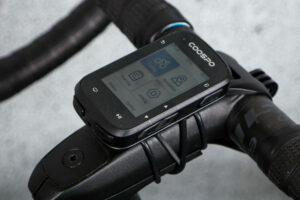
Physically, the CS600 is an attractive, modern-looking device. It is comparable in size to a Wahoo ELEMNT Bolt or a Garmin 530, and indeed it uses the same quarter-turn mount as Garmin, so it’s easy to find a different mount should you want one. Coospo is reasonably generous with the extras, so you get a screen protector, a safety tether, and a basic elastic band mount to get you started immediately.
The 2.4-inch colour touchscreen is surprisingly responsive and supplemented by physical side buttons; handy if you’re wearing full-finger gloves or riding in the rain. It is possible to lock the touchscreen should you want to.


It’s a pretty intuitive device, at least in its basic functions. After 10 minutes playing with it once you’ve opened the box, you’ll be used to it.
However, the menu logic is notably clunky. Changing between profiles (such as switching from Indoors to Outdoors) is an awkward, multi-step process that requires entering the settings, finding the ride mode, clicking the profile, and then enabling it. Similarly, changing a data field on the device itself is a chore, as you cannot edit them on the fly. It’s far easier to manage these tweaks through the CoospoRide app, which provides a much more intuitive interface.
In terms of position location, it’s got it all: GPS, BDS, QZSS, GLONASS, and GALILEO, to ensure a quick and stable satellite lock. I had no struggles with location during the test, and it worked as expected, even in the mountains.

The battery life is impressive – up to 36 hours on a single two-hour USB-C charge, aided by an auto-backlight feature that intelligently manages power consumption. A rubber bung covers the charging port to help this thing to its quite impressive IPX7 waterproof rating. That’s high enough to withstand actually being submerged.
The CS600 lets you customise your readouts across 150 data types and various riding profiles. You can tweak your screens to show exactly what you need, from instant values and power averages (3s, 10s, 30s) to battery percentages and e-bike metrics.
You can display up to eight fields per screen, though this does get a little crowded on the 2.4-inch display – it’s best reserved for a summary page, in my experience.
Navigation and mapping
This is where the ‘budget’ nature of the CS600 becomes most apparent. While it has built-in maps and supports turn-by-turn directions, it lacks it own navigation. You can’t just sync a route from Strava, either; you have to download the route file to your phone, and then manually send it via the app to the CS600. It’s a tedious process that feels outdated, like a Garmin from about 10 years ago.
Get it all arranged and the routing works okay, but inevitably it lacks the sophistication and clarity of high-end units. It often feels a step behind the big brands in terms of UI polish and routing logic.
The CS600 is a generally reliable companion, but it has some annoying interface quirks. For instance, if you accidentally tap the flag icon in the bottom-left corner, the ride finishes and saves immediately. It’s far too easy to accidentally end a ride mid-workout, a feature every other major computer handles with an ‘Are you sure?’ prompt.
Connectivity is handled via Bluetooth and ANT+, making it easy to search for and connect to sensors, lights, smart trainers, and even e-bikes. Connections are easy to make or delete through the settings.
However, the CS600 won’t sync with your phone automatically, which is a bit annoying. You have to open the app and manually trigger a sync to upload your rides to Strava, and I’ve found it doesn’t always work on the first try either, sometimes forcing me to wait until the following day. Furthermore, the device doesn’t support phone notifications, so you won’t see incoming calls or texts while riding.
You are able to sync to Strava and TrainingPeaks directly, but no further apps. If you use other training software, you’ll have to work out a way to sync them from Strava or similar.
It also doesn’t seem to auto-power off. I’ve found it still powered on when I’ve left the office, having obviously forgotten to shut it down that morning, which is quite an odd omission. At least it only takes a second to remove from the mount and take with you.
Otherwise, the computer doesn’t miss a step generally, So long as you’re overlooking the weird quirks this has when compared to a mainstream offering, it’s actually not bad. For the basics it’s reliable and just works, and it’s reasonably small and light too.
Value
At just under £130 – and the sort of product that, in real life, is permanently discounted – the CS600 is a decent entry-level option. The screen is good, the battery life is great, and the sensor support is everything you need. It lacks the polish of more established brands like Bryton, Magene or Stages though.
The Magene C506 Smart GPS Bike Computer is now £99, and I know from experience that Magene computers sync more seamlessly than the Coospo, plus it displays notifications too. You can’t sync routes straight from Strava however, just as with the Coospo.
The Bryton Rider S810 I reviewed last year is considerably more expensive at £249.99, but it feels much more premium for it. It has a larger screen, an amazing battery, and the ability to natively sync routes from Strava.
The Stages Dash M200 is £279 but can currently be had for £139, and while it has a few downsides – such as a micro USB charging port – it’s good option for that price. It’s likely to be old inventory (Stages went bust in 2024), but as the brand was bought and resurrected by Giant the same year, it’s still a safe buy.
Overall
If you’re looking for a reliable, cheap data logger with a nice touchscreen and don’t mind a bit of faff to sync your rides and routes, the CS600 is a good choice. It’s a good one for casual riders, too. If you’re more serious, however, or just want that ‘it just works’ functionality, you may be better off putting the money towards something a little more polished from a more established brand.
Test Report
What does the manufacturer say about this product?:
Coospo doesn’t really sum this up beyond the fact it’s a ‘smart cycling computer.’
Tell us some more about the technical aspects of this product:
• Physical Dimensions: 84x53x18 mm
• Display Size: 2.4” Colorful Touchscreen
• Weight: 69 g
• Automatic Backlight: Yes (By Light sensor)
• Battery Life: 36 hours with GPS
• Charging Time: 2 hours
• Positioning System: GPS + BDS + QZSS + GLONASS + GALILEO
• Charging Interface: Type-C
• Storage:8 GB
• USB Connection:Yes
• Parameter Displayed: 150+
Any further comments on quality?:
It’s nicely made, fits a Garmin mount well, and feels nicely put together.
Any further comments on performance?:
As a simple bike computer it works well, but it’s lacking when it comes to phone connections.
How does the price compare to that of similar products in the market, including ones recently tested?:
It’s entry-level.
Does the computer have a waterproofing rating?:
IPX7
Did you enjoy using the product? So so
Would you consider buying the product? No
Would you recommend the product to a friend?
A beginner, yes, probably.
Use this box to explain your overall score
This is a nicely made and works well, though it’s lacking some of the creature comforts which have becom the norm in the last five years.
About the tester
Age: 25Height: cmWeight: 72kg
I usually ride: Storck AerfastMy best bike is:
I’ve been riding for: 10-20 yearsI ride: Every dayI would class myself as: Expert
I regularly do the following types of riding: Road racing, Commuting, Touring, Club riding, Mountain bike XC, Mountain bike Enduro, Mountain bike downhill/freeride


8 thoughts on “Coospo Realroad CS600 GPS Bike Computer”
I personally don’t see any reason in not going straight to Byrton if you are not a Garmin or Wahoo fan, or you want a value alternative to the big two. I currently run a Bryton 420 and in 4 years of owning and using it has been fab, if I had some cash or needed to replace then I now would not hesitate to buy a Bryton again.
I’ll counter that by saying the Bryton 750se I have drives me nuts at times.
Inconsistantly picks up on routes created on Komoot and the app re-syncs every few seconds when trying to set up the device and sends me back to the home screen.
The most infuriating one is that I turned live track on. Once. It now won’t turn off and repeatedly flags up the live track is starting, and then disconnecting every few seconds whilst riding. I haven’t timed it but it wouldn’t suprise me if 10-20% of the time the the screen is covered with an error message. That’s been about 6 weeks now.
Other than that it’s great :/
I’d like to see some reviews of the IGPSport cycle computers & smart lights which are available on Amazon in the UK. They appear to be well equipped with GPS models in the £150 – £200 price bracket offering great features and very good value for money.
If they are good enough to be supporting the Groupama-FDJ United World TourCycling team, we should be looking at them as a contender. It would be interesting how these compare to the Garmin and Wahoo models that are considered the industry standard.
@bikercub
https://road.cc/content/review/igpsport-igs800-314291
https://road.cc/content/review/igpsport-sr30-smart-radar-taillight-314105
Not too difficult to find using a popular internet search engine.
I was referring more to the cycling computers they produce, but I’m sure an opportunity to snipe couldn’t be missed.
The article you refer to is for the older of their radar lights.
My suggestion was that they have several cycling computers in a popular price bracket that seem to offer good usability.
It would be nice to see those reviewed.
The first link is to one of their cycling computers.
@bikercub “If they are good enough to be supporting the Groupama-FDJ United World TourCycling team, we should be looking at them as a contender.”
No, that only means that they paid enough to become a sponsor. Let’s put the “pros use better stuff” myth to sleep, finally.
And by the way, the trickiest part of a GPS computer is not data collection – that can be done by absolutely all of them. The hard part is the general user interface and turn-by-turn navigation, none of which really matters for a pro cyclist – and that brings us back to why any GPS computer could be good enough for just about any pro cyclist.
I had to do a double take when reading CS600: I owned a Polar CS600 many moons away (and really liked it). How unlikely is it that a different manufacturer would reuse the name within the same product class?