



The London Standard has accused Transport for London (TfL) of “covering up” its data showing an increase in serious injuries which occurred while cycling in the capital, despite TfL releasing their full dataset to the public.
road.cc reported on the latest statistics for 2025 on Friday 29th May, and quoted TfL as being “deeply concerned” by the increase, which outstripped the growth rate of cycling in London compared to 2024.
However, The Standard has this morning published a story which criticises the transport authority for choosing to headline its press release with the drop in total cycling fatalities rather than the overall increase in injuries sustained. It is not clear why the newspaper has chosen to publish an article criticising the structure and headline of a press release it received when all the datapoints were presented to the media.
The article also quotes two long-term critics of active travel infrastructure, John Stewart and Vincent Stops. Stewart suggested that “TfL tried to cover up these shocking figures,” whilst Stops, a former Hackney councillor, argued, “the number of cycling KSIs (killed or seriously injured) on London’s roads is at a record high.
“By failing to point this out, they (TfL) are not being honest and sufficiently open and so policy making will be poor.”
Stops is a favoured source for the ‘paper, having in February asked why “there are no alarm bells ringing at TfL” in response to data showing a 14 percent increase in the number of cyclists seriously injured in London to May 2025. That figure is compared to a 12.7 percent increase in cycling’s popularity during the same time.
Consequently, it appears Stops’ own open-mindedness to the statistics have left him vulnerable to forgetting the statistics he’s previously been presented with, from the data providers he’s now accusing of covering up the data.
Responding to the Standard’s reporting, London’s Walking and Cycling Commissioner Will Norman posted on social media, “Sad to see anti-cycling campaigners Vincent Stops & John Stewart accusing us of some sort of cover up.
“We’ve been clear. Falling cycle deaths is good news, but rising numbers of serious injuries shows we’ve much more to do. Hence our new Vision Zero plan – inc more bike lanes.”
That point was echoed by Simon Munk, who told The Standard he suspects the growing number of injuries is more related to London cycling infrastructure than the surging demand for e-bikes. “The current level of risk is on the rise and there are more serious injuries than there was growth in cycling.”
“That’s absolutely the wrong direction and highlights the need to do a lot more for cycling and walking.”
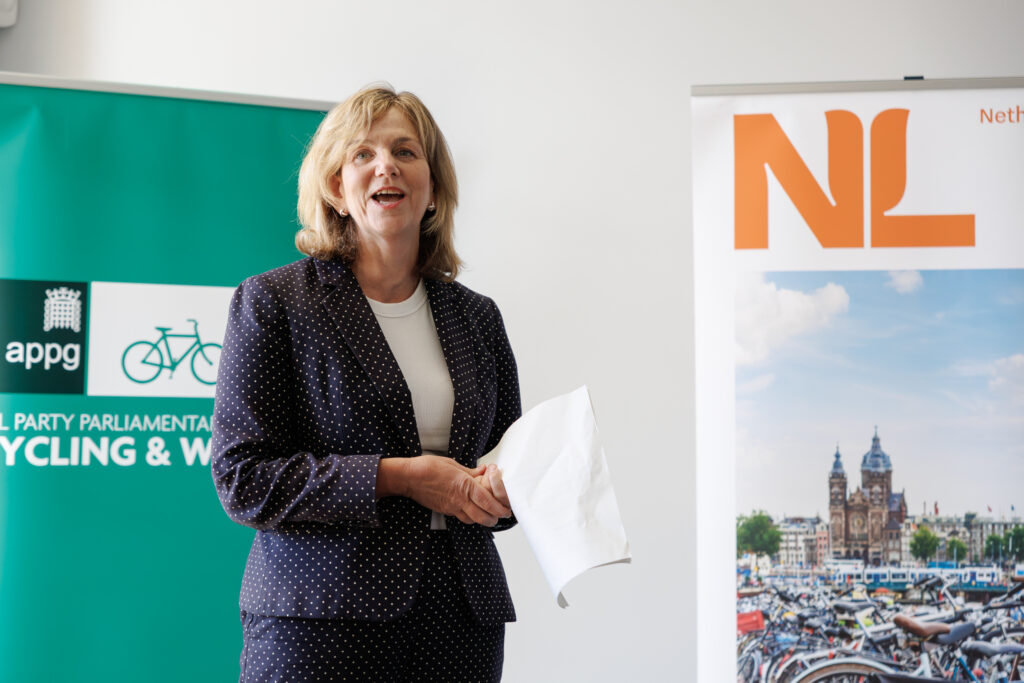
The Standard’s article was published the same day as the All Party Parliamentary Group for Cycling and Walking issued a statement confirming that the Local Transport Minister Lilian Greenwood MP that a third Cycling and Walking Investment Strategy (CWIS) is “imminent” and that the Department for Transport had “considered the evidence to help us shape a strategy with clear targets, one that weaves cycling and walking into the fabric of our national transport network.”
The second CWIS, published in 2022 under the previous, Boris Johnson-led Conservative government, was criticised by Cycling UK for presenting “a glaring mismatch between the increases in cycling and walking the Department for Transport is aiming to achieve, and the funding available for doing so.”
The strategy provided £3.78 billion in active travel schemes until March 2025. However active travel targets were criticised for overly focusing on urban areas and over short distances, and were for failing to address the environmental damage of car dependency over longer distances.




















11 thoughts on “Standard ‘exclusive’ with anti-active travel campaigners claims Transport for London “covering up” cycling crashes – weeks after government released figures”
I have a couple of issues with this article. Firstly, the headline states that The Standard interviewed “anti-active travel campaigners” including someone cited as Vincent Stops.
Having never heard the name before, I decided to check Vincent Stop’s anti-cycling credentials. I visited his blog (https://cycleandwalkhackney.blogspot.com/?m=1) and found no evidence of this. In fact, according to the blog, Vincent has deep and valuable experience “working on streets policy, mostly bus, cycle and walk.” It states he has cycled in London for more than 20 years. He would appear to take an evidence-based approach to transport, and his previous blog post (https://cycleandwalkhackney.blogspot.com/2025/11/hackney-transport-strategy-submission.html?m=1) appears to be reasonable and balanced.
Second, looking at the actual data vs the press release shows (in my view ) a deliberate political spin on deaths being headlined in the press release rather than a nuanced introduction (https://tfl.gov.uk/info-for/media/press-releases/2026/may/london-road-deaths-down-again-in-2025-but-more-work-to-do-to-reduce-road-danger-says-tfl) giving a brief summary of the statistics.
The press release immediately and breathlessly states “Number of people killed in London reduced by 13 per cent from 2024 – the second lowest figure on record outside the pandemic, provisional data shows…. Since 2015, more than 250 deaths are estimated to have been prevented on London’s roads thanks to the Mayor, TfL and Vision Zero partners’ collective action.”
This clearly omits KSI figures, and in my view is symptomatic of Sadiq Khan’s mayoralty – slogans and politicisation over strategic thinking, transparency and results. No unbiased member of the public would read the press release and think it was in any way balanced or indicative of the underlying data set.
So tldr I believe The Standard is correct in its reporting. Sorry!
@jackcycles Sorry Vincent, but your legacy will be to be remembered as a grumpy failure and pub bore, who twists facts to suit narratives and has never knowingly been correct about anything in his miserable life.
Serious injuries as defined in statistics span from an uncomplicated fracture of a forearm bone to catastrophic multiple injuries that result in death in subsequent weeks and months. Consequently without further analysis they may be quite misleading, it may be that the statistics disguise what would otherwise have been fatal injuries at the roadside due to effective early treatment by first responders and subsequent trauma care OR that they reflect an increase in injuries at the lower edge of the severity spectrum OR neither. From the numbers alone we do not know and so are not in a good position to draw inferences about the seeming fall in deaths and rise in reported serious injuries.
@jackcycles wait a minute… I’m getting a sense of déjà vu …
**Khan!**
Also on Mr. Stops – despite being at Hackney (which have done some good work) I believe he’s been … skeptical… of cycle infra. Perhaps he’s of the vehicular cycling “I can so why can’t everyone else” cult?
Apparently he’s also been involved with the National Federation of the Blind UK – a fringe group who managed to get some of the bigger groups on board a campaign taking aim at bus stop bypasses. (They believe these will cause havok for the visually impaired, despite these uncontroversially working in many places abroad. And indeed in the UK, for decades – but just not under that name.)
Are you arching one eyebrow while stroking your mustache?
Not only that, I bet you’re winking too!
@chrisonabike Moustache, please, we are in the UK after all!
@Didsbury Which, of course, means we secretly want to be French.
@mdavidford Surely we have been Norman since 1066?
@mdavidford Surely we have been Norman since 1066?
The TfL Press Release literally says:
Unfortunately, there has been an eight per cent increase in serious injuries, rising from 3,597 in 2024 to 3,900 in 2025. This increase was driven by both injuries to people cycling and travelling in a car. Cycling in London continued to boom in 2025, accompanied by the widespread adoption of e-bikes, both dockless rental bikes and privately owned bikes. While injury risk per journey has increased compared to 2024, it remains lower than the historical baseline.
Poor Vincent cannot get over the simple fact that given the choice people prefer dedicated cycling spaces, rather than pretending to be cars like vehicular cyclists.