


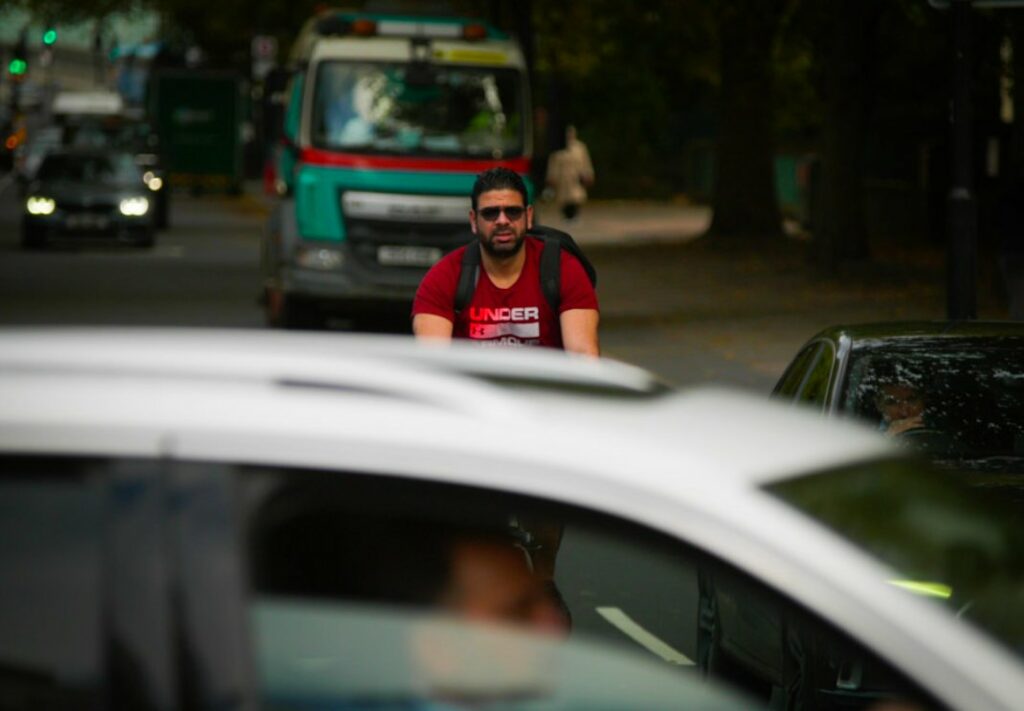

Cycling UK has called on the government to reverse cuts to road safety campaign THINK! and fund a new awareness driving focused on the changes made to the Highway Code in 2022, “updated for today’s digital landscape”, as part of Labour’s new road safety strategy.
Changes to the Highway Code were implemented in January 2022 to better protect vulnerable road users, and included establishing a hierarchy of road users with those most vulnerable (pedestrians, cyclists, and horse riders) placed at the top.
Other updates included advising cyclists to “ride in the centre of your lane” to increase visibility on quiet roads, in slower-moving traffic, and when approaching junctions, and to stay 0.5m away from the kerb even on busy roads.
The Highway Code also acknowledges that it can often be safer to ride two abreast, particularly in larger groups or when accompanying less experienced cyclists, and while dedicated cycling infrastructure can make journeys “safer and easier”, cyclists “may exercise their judgement and are not obliged to use them”.
> The Highway Code for cyclists — all the rules you need to know for riding on the road explained
However, when introduced four years ago, those changes prompted much discussion, hysteria, and a great deal of confusion, especially in the UK press. Just days before the revisions came into force, two major newspapers misrepresented the rules around the ‘Dutch Reach’ technique, designed to reduce the chances of dooring a cyclist.
A further concern came with the lack of communication of the changes to the public, with Cycling UK at the time calling for a long-term public awareness campaign to help produce a “mindset shift” on British roads.
In fact, it took until July 2022, six months after they came into effect, for the changes to be promoted in a THINK! road safety campaign, though an AA survey from three months later showed that 61 per cent of drivers had not read the new rules.
That trend has appeared to have continued, with a survey of 2,000 motorists from last year revealing that a majority of UK drivers are still unaware, or do not correctly understand, the rules around cyclists on the road.
In a statement issued by Cycling UK this week, the national active travel charity argued that a new public awareness campaign is crucial to the government’s own “safe systems approach” to road safety, which forms part of Labour’s new Road Safety Strategy published earlier this month.
Earlier this month, the Department for Transport unveiled its Road Safety Strategy, which it says will save thousands of lives on the UK’s roads by tackling drink driving, improving training for young motorists, introducing mandatory eye tests for drivers over 70, and targeting mobile phone use at the wheel.

The strategy, the government’s first published road safety plan in over a decade, forms part of Labour’s stated ambition to reduce deaths and serious injuries on Britain’s roads by 65 per cent in the next ten years. However, the strategy did raise a few eyebrows due to the absence of any measures specifically designed to improve safety for cyclists.
Nevertheless, Cycling UK says the strategy’s general focus on a “lifelong learning approach” for motorists lends itself to a new Highway Code-centred campaign, which could entrench better, safer driving habits around cyclists.
> Changes to the Highway Code mean very little if they are not known or followed by motorists
The charity has highlighted how spending on THINK!, the government body responsible for promoting road safety, has been cut by two-thirds since 2019, “at a time when road danger remains a real concern”.
Describing THINK!’s initial 2022 campaign as a good, albeit short-lived, “first step”, Cycling UK said “more needs to be done to ensure people know the road rules have changed and to address entrenched behaviours”.
That argument was backed by MPs this week during a parliamentary debate on women’s safety while walking, cycling, and wheeling.
“We can’t expect people to follow rules they don’t know about,” Cycling UK’s director of external affairs Sarah McMonagle said in a statement.
“What we need is a balanced approach to improving road safety that combines education, prevention and enforcement of the rules. It’s important we clearly explain why these changes came into action and how they work to protect people walking to the shops or cycling their children to school.”
The charity also stressed that while reporting systems for careless and dangerous driving, including close passes, are vital, “enforcement and education need to run side by side”.













49 thoughts on ““We can’t expect people to follow rules they don’t know about”: Government urged to fund new driver education campaign to raise awareness of Highway Code changes four years on”
Guaranteed that a new
Guaranteed that a new awareness campaign would have some drivers complain of a Labour war against cars.
CUK are right, the changes to
CUK are right, the changes to the HC do need more promotion, as the average drivers hasn’t looked at it since they passed their test, which could be decades ago. Having rules that most drivers don’t know about seems particularly pointless and a token effort rather than real change.
We need a complete change in driver behaviour and attitudes, from the “I pay for the road so I have the right to drive how I like.” to “Everyone has a right to be there and I am responsible for the safety of other people.” You can have all the rules you like, but they mean very little if there is no respect for other people.
Sorry, no. Everyone does NOT
Sorry, no. Everyone does NOT have a right to be on the road. ONLY pedestrians, cyclists, horse riders have a right to be there. Drivers are allowed to be there if they have proved they are competent and have the appropriate insurance etc
I’d guess that money spent on
I’d guess that money spent on a safety campaign would work out a lot cheaper than paying for better traffic policing (though we need that as well) and certainly a lot cheaper than the cost of traffic collisions. In that case, it’s a bit of a no-brainer, similar to the cost benefits of decent mobility infrastructure.
I just hope they don’t produce stupid victim blaming videos about being on the inside of buses/trucks etc.
There is no reason at all
There is no reason at all that people shouldn’t be forced to take an online course every year or two to confirm they are up to date with the latest highway code changes. If they fail they lose their license until they can pass. There will then be no defence of not knowing the rules because either you cheated and should lose your license because you shouldn’t have it or you are purposefully ignoring the rules and should lose it. Very simple.
iirc, on passing the driving
iirc, on passing the driving test, we signed a document that included agreement to keep up with THC. Totally agree about the need to test people often.
There would need to be robust
There would need to be robust ID processes in place. Not insurmountable.
But I think periodic in-person courses with a “satisfactorily completed” requirement, which implies also passing the attitude test, would be appropriate as ongoing training for both theory and practical. One of those would be a cycle awareness course.
Also, with police checks, they should be able to ask random HC questions from a PC’s app: fail enough of those and you need to take an extra course.
Ignorance has NEVER been an
Ignorance has [B]NEVER[/B] been an acceptable defence in the eyes of the law, why has it been so for the last 4 years in relation to the HC changes?
**EDIT**
Why is ingorance an effective defence for Road Traffic Act infringements, when it has never been a leg to stand on in any other field of the law?
ROOTminus1 wrote:
It’s not a defence, but the ignorant drivers aren’t necessarily breaking the law (or at least only in a “specific and limited way”). Yes, there’s lots of clueless but well meaning drivers around, so the idea is to improve their knowledge so that they abide by the “new” rules without dragging them to court.
On the other hand, I quite like the idea of random traffic checks and stops, whereby drivers are handed out fines for breaching the new rules – that would learn ’em too. I suspect that the police don’t have time to do that (probably too busy arresting Palestine Action supporters).
Ignorance, stupidity, not
Ignorance, stupidity, not giving a fuck, barely paying attention. All of these have been very strong defences when it comes to appearing in court after hurting someone in a car.
ROOTminus1 wrote:
longer than that – from almost 10 years ago:
Because “we have to drive” and ”
driving is a completely normal, everyday activity once you’ve “joined the club” (test once per lifetime). And so people feel sympathy for the poor overwhelmed / not competent driver and “they’ll have to live with themselves from now on”…
people feel sympathy for the
people feel sympathy for the poor overwhelmed / not competent driver and “they’ll have to live with themselves from now on”…
The evidence is that offenders experience no difficulty in living with themselves later – see elsewhere on here about the man and his wife inventing stories about his disability (interesting that nobody seems to be bringing up the point that he shouldn’t have been driving with this ‘disability’) to get him out of facing a trial for killing a motorcyclist; and see The Vanishing Cyclist on BBC Sounds where the drunk driver and his brother kill a cyclist at Bridge of Orchy, load him into the vehicle, bury him in a remote off-road spot by the Fort William railway, and they get away with it for about 3 years until shopped by a, presumably former, girlfriend
https://www.bbc.co.uk/sounds/play/m002ql5h?partner=uk.co.bbc&origin=share-mobile
wtjs wrote:
From the CPS I assume it was “pick *one* charge which – on paper – has the highest penalty – which we hope will stick”?
But I agree – this seems to be an almost textbook example of “for driving offences a confession can actually be used as defence / mitigation!”
Yeah, the “they’ll have to
Yeah, the “they’ll have to live with it argument” is a very good one for explaining why cycling dangerously doesn’t only affect the person who is doing it. Its not a good argument as punishment/deterrent from drivers being shit.
Thats the problem with the way we look at things. We look back after the fact and say “what a tragic accident when that driver wasn’t paying any attention”. No, it wasn’t a tragic accident. It was a result of a pattern of bad driving that we have come to accept.
I watched a crash investigation program last night and it pissed me off. The woman talking us through it and in charge of the reconstruction of the incident was downplaying everything the driver did. A driver hit someone on an e-scooter because they turned across them without paying attention. My partner said the person on the e-scooter lost their leg but I didn’t see that bit to be 100%.
They showed a series of still of the e-scooter rider coming towards the car saying things like “hmm, you can’t really tell thats the scooter lights next to the signs at the side of the road”. “The high vis is obscuring the light”. Its a fucking moving vehicle with quite a bright light on the front. If you can’t see that, you are not safe to drive. If you cut across the road without looking properly, you aren’t safe to drive.
The icing on the cake was when she then said at the end “hes probably done this same route and turn hundreds of times and wasn’t expecting that e-scooter rider to be there”. Fucking hell. These are the people in charge of investigating bad driving.
Guy got a £300 fine or something. Not even sure he got points. Disgraceful and a great example of the absolute joke standards we expect of drivers.
Disgraceful and a great
Disgraceful and a great example of the absolute joke standards we expect of drivers
Yes, it’s the BBC Crash Detectives, ostensibly well-meaning enough but the Force (to excuse drivers) is Strong in this series. Look for the one where they ‘investigated’ the killing of a keen female cyclist by a lorry driver. The facts are obvious immediately, but they drone on about them for ages: she was was well over to the left but he drove into her with his nearside. He did get a not-grossly-lenient sentence because he’s an Eastern European- even the ‘I don’t know how it happened, I will have to live with this for the rest of my life’ dodge didn’t get him off.
The police view is that cyclists should ‘man up’ and be grateful every day they’re not KSI’d as they deserve, and they’re not prepared to lift a finger to prevent that happening. I know that the really unpleasantly anti-cyclist Lancashire Constabulary will ignore this, just as they ignored a very similar offence in the same place 2 years ago because they’re bastards who will go to any lengths to avoid acting against drivers- as I show below. You can see the oncoming Audi A4 stationary in the right turn lane ahead as the lorry overtakes me- I think he moves sharply left to avoid the lorry heading towards him.
https://upride.cc/incident/sm23jpj_daf_closepassdwlcross/
https://upride.cc/incident/b5hol_tanker_closepassdwlcross/
What’s your guess for what the police will do about this driver of Mazda CX5 PO19 UTJ? Same day as the Elite Linen Services lorry attack.
Years ago the government used
Years ago the government used to show public information films on the BBC…. the people own the BBC, we pay for it, so why isn’t it still being used to inform the population?
davz-cinelli wrote:
We “own” the BBC? I suppose in principle, yes we do, but I don’t feel like I have any control over them. My many complaints to them take ages to get a reply and the reply is usually just meaningless drivel and a statement that they corrected the article although the correction is so late as to be meaningless.
As far as I can see, the BBC is more interested in giving Farage/Reform as much airtime as possible – probably so that their millionaire chums can exploit yet more people and end up paying almost no tax at all.
But yes, I’d like to see effective public information campaigns on the BBC.
hawkinspeter wrote:
My biggest complaint about the BBC is that my complaint has been noted and written in some mythical book that all producers look at before producing anything. If they do, they ignore it.
Hah! Because information by
Hah! Because information by itself gets the channel changed (especially since rmote controls came in) and BBC is ruled by clicks and viewing just as if it was a private business.
Hence The Archers on Radio 4 was developed to inform rural communities about farming policies and advice. Popular shows like sitcoms have been used to raise awareness of some issues. Maybe they could bring road safety and discipline into story lines?
Of course, nowadays, viewing figures, even via catch-up, are much lower than in my youth so BBC informational material will have less impact thanin my day
E6toSE3 wrote:
Can’t speak for the sitcoms, but The Archers gets regular appearances from Linda Snell’s Speedwatch, had Leonard being ticked off for tearing carelessly around the place on his bike, often has complaints about drivers lacking patience around livestock, and, of course, George Grundy’s just done a spell in prison after trying to blame the serious traffic incident he caused on an inebriated Alice Carter.
And then there’s Justin “Scrooge” Elliott having his life changed by picking up the Hitchhiker of Christmas Future… though that one may not be quite so relevant here now I come to think of it…
I’ve been saying for some
I’ve been saying for some time that nobody seems aware that The Highway Code exists. While it’s an offence not to keep up to date with it for drivers, virtually none do, at least they know it exists.
But cyclists, ebikers, scooters, and pedestrians have no clue about it. The days of Tufty Club and Green Cross Code are long gone. Almost all cyclists ride furiously thtrough the Greenwich & Woolwich Foot Tunnels. Cyclists ride on pavements when there’s a perfectly good bike lane a yard away – sao they can overtake other cyclists, cars sticking to 20 mph, and they ride in either direction, often with no lights in dark clothing with nor reflectors – I said how this is bad enough when I’m with my low mobility wife but it’s terrifying when pushing my 2-year old granddaughter.
Pedestrians wander aimlessly in bike lanes and ignore the pedestrian lane while dead to the world listening to whatever or holding phone calls via earbuds. Heavy runners take blind corners fast with no care for slipping or bumping into weaker, lighter, more frail people they can’t see until impact.
Pedal cyclists ride furiously on Thames Path taking blind corners flat out – like they’re unaware pedestrians or other cyclists exist. Even otherwise totally legit pedal cyclists often have their front light on the left of their handlebar, not a big thing but still contrary to Highway Code and bright lights are not nice for a 2-year old in a pushchair on the nearby pavement.
I’m back to cycle commuting three days a week. Age 70 and after some time cycling rarely, I’m still surprised by bikes overtaking me with no pedalling effort up Shooters Hill. But I am quite pleasantly surprised at the power and speed I’m putting down, after about ten minutes warming up
What I find extra annoying a
What I find extra annoying a lot of trolls (motons for want of a better word) seem to know about it, from their outbursts on social media but as you say peds dont 🙁
Perhaps … but I would say
Perhaps … but I would say most people (including drivers) are at best vaguely and selectively familiar with it.
… and as the existence of your post suggests even fewer have grasped that the Highway Code isn’t law. It contains some legally binding rules but much of it is guidance (albeit in theory it could be used to support prosecution for driving offences).
More, some of the rules therein which *are* codified in law are very much treated as “guidance” by most people, at least some of the time (see speeding, driving on footway or cycle path …)
I actually saw a very near
I actually saw a very near miss a few days ago, late at night, an ebike going about 10-15 mph up a hill on the wrong side of the road, no reflectors, no lights, dark clothing, practically invisible except right as they went under a streetlight, car going down the hill on the same side of the road (the correct side for the car), car swerved at the last second. Person on the bike didn’t seem to notice at all.
This car didn’t have
This car didn’t have headlights then? Not excusing the cyclist in any way – riding without lights at night is extremely foolish – but I often wonder when I hear drivers saying that they didn’t see a lightless cyclist straight in front of them, what what were they doing with their headlights?
“. . . MPs this week during
“. . . MPs this week during a parliamentary debate on women’s safety while walking, cycling, and wheeling.”
. . .And HORSE riding and driving ? – some cyclists are as unaware as car drivers of guidance.
I have been overtaken by
I have been overtaken by cyclists riding fast and close while approaching my horse silently from behind, but it is at least possible to talk to a cyclist to ask them to slow down or go wider and encourage them to call out ‘cyclist’ or even a cheery ‘morning ‘ so we can ensure the horse has seen the bike before it passes. We are all in this together.
We are all in this together
We are all in this together
Well, we should be, but some riders at least display a superior and righteous attitude. I remember on the Pennine Bridleway being sternly condemned by a horserider coming towards me for having a tiny flapping flag on a fibreglass pole at the back of my trailer
Bloody cyclists always
Bloody cyclists always getting on their low horse about some perceived slight!
Regular, compulsory theory
Regular, compulsory theory retesting would also help. We have to renew our photo driving licence every 10 years so why not an online theory retest (and maybe even medical check) as part of that renewal process.
Many motorists have never looked at the HC since the day they passed. In some cases that can be 50 years ago!
OldSkoolOldFart wrote:
Whilst wanting driving retests is a popular opinion here, I think it’s too costly for the proposed benefits. An online theory test could easily be gamed unless they design it really well (something like recording video of you completing the test so that your identity can be verified and randomising the questions and answers). I’m more of a fan of spending that money on traffic policing as traffic policing can address far more issues than a retest feasibly can do. (Wtjs disclaimer: assuming that the police can do that effectively).
hawkinspeter wrote:
I agree it would cost, but there are pros/cons in that (some of) the cost could be paid directly by the people who want to continue driving, just like most other licenced activities.
BUT while i don’t have figures to back this up I suspect the full costs of “more police” to a level which we’d notice would be *massive* (plus all the rest of the legal system to support that, probation, courts, prisons…). And that we may overestimate the effect even a significant increase will have on driver behavior on average (and how well will it check the actions of the most problematic few percent?)
I wonder if some of the ideas about tech might offer the best effect for money (eg. vehicles that just don’t let you speed / won’t allow people to drive when banned)? However all of those would seem primed for “spy in the car” / “we’re being set up for repressive state control / criminals hacking our vehicles” theories and push back. And indeed it may be true that this tech is also quickly worked around…
As a first step I’d like to
As a first step I’d like to see a system in place that forces drivers to view and acknowledge the new rules that have been introduced since their last license renewal, this would be an effective way to introducing the new rules to as many people as possible in the correct format, whether people would actually read them or just tick the boxes to say they have is another matter, though tick-boxes such as this ARE legally binding if presented properly, so the drivers could no longer use “I wasn’t aware of the new rules” as a defense.
You could even tie-in a system like this to the vehicle tax or insurance renewals to reduce the latency between updates.
I’m more of a fan of spending
I’m more of a fan of spending that money on traffic policing…
wtjs disclaimer: assuming that the police can do that effectively
They can’t if they’re determined to avoid policing the traffic, even when all the work is done for them. This is HN21 VXB, No MOT for 6 months, No VED for 22 months, first reported to the police 28.8.25- his local Garstang Wrights joinery business is on Facebook. The vehicle spent 2 days (the preceding Thursday midday to Saturday) continuously parked in a ‘2 hours only’ spot outside the library which is 150 yards from Garstang Police Station. I informed the joke Neighbourhood Policing Team on Thursday afternoon and again on Friday afternoon. There has been no reply, despite them publicising their email so that the public can report offences for a quick response.
Back when these rules were
Back when these rules were introduced, everyone I know that drives were well aware of the details of them.
However many cyclists mis-interpreted them (mostly due to the media skipping important details) and for example cycled in the middle of the lane during rush hour traffic.
There needs to be a method for updating the public (drivers, cyclists, pedestrians, etc.) with new rules that doesn’t rely on the media, who often skip important points in order to sensationalise their articles.
There are some rules included in the Jan 2022 changes that can actually be dangerous if only some of those involved know the new rules.
For example a pedestrian now has right of way when crossing a road if they haven’t changed direction in order to do so, but only if the vehicles in the road have changed direction (for example when turning at a junction pedestrians crossing around the corner would now have right of way), this can be dangerous if for example the pedestrian knows the new rules but the driver /cyclist/etc. doesn’t.
RPGpro wrote:
Rush hour traffic, when vehicles tend to be slow-moving and queueing, seems like a good example of when (unless you’re filtering) it would be a good idea to take the lane, to avoid finding yourself squeezed against the kerb or close-passed by the inattentive/inconsiderate.
mdavidford wrote:
Rush hour traffic, when vehicles tend to be slow-moving and queueing, seems like a good example of when (unless you’re filtering) it would be a good idea to take the lane, to avoid finding yourself squeezed against the kerb or close-passed by the inattentive/inconsiderate.— RPGpro
Yes, that is exactly the type of traffic these rules were seemingly designed for (as well as rural roads with few cars and potentially low visibility), however this was also happening on roads with fast-moving traffic (or would be fast moving if not stuck behind a cyclist), luckily it was only a common occurrance for a couple of weeks after the new policies were introduced.
There are two roads I can think of on my daily commute where the traffic is slow moving, one of these has a particularly nasty junction, where most cyclists dismount and use the pedestrian crossing (which is also probably faster as the road doubles back on itself which the crossing bypasses that), the other has a cycle lane for its entire length.(which by some minor miracle the local council has actually designed sensibly, including allowing for car parking/bus stops/etc., this being the same council that bankrupted both a famous bakery and award-winning chippy by converting ALL of their parking spaces, including their loading access, into a cycle lane).
RPGpro wrote:
Strange – they could just overtake… unless they were stuck because more motorists wanted to come the other way? (Honestly, why can’t they just us the special expensive motor infra like motorways if they really want to go fast?)
I’d say to a first and probably second approximation we’re all stuck behind a car in some sense (or because the lights changed, which are only really there to support this level / speed of motorists).
Given the pressure on our public spaces we’ve allowed or actively encouraged it’s often hard to see a way forward in the UK. It seems everyone “has to drive” or “has to park right there”.
And “slow” and “fast” are of course defined by our current motoring speed targets (er, limits). Few say “traffic was heavy in town, and it was still way more convenient than carrying all my shopping back myself!”
There *are* better ways things can be done though – we know that because they exist in several places (most obviously in Europe – but there are even a few spots in the UK).
RPGpro wrote:
A rather confusing, inaccurate, rambling sentence.
Pedestrians don’t have right of way (I presume you mean priority: they always have right of way) when crossing a road, whether they’ve changed direction or not. What they have, and have had for at least forty years, is priority at road junctions.
https://www.gov.uk/government/news/the-highway-code-8-changes-you-need-to-know-from-29-january-2022
Seems like someone would
Seems like someone would benefit from an education campaign on the Highway Code…
RPGpro wrote:
I must not have encountered anyone you know then as I have not encountered a single driver who appears to know that they have to stop to let pedestrians across junctions.
— RPGpro
A cyclist has the right to use any part of the lane they wish, in any traffic. The HC suggests that they move over to let faster moving traffic through when safe to do so (that’s when the cyclist decides it’s safe, not the driver) but there is no obligation to do so. It appears to be you who is misinterpreting the rules by believing that HC “shoulds” are mandatory.
The time of day has no
The time of day has no bearing on the matter. You cycle in the middle of the traffic flow unless it is safe to be overtaken, irrespective of whether it’s “rush hour”. A cycle is a vehicle. This was in Bikeability training at least 20 years before the changes to the highway code. Those changes were simply to make these things clear to drivers, who were largely ignorant of them.
This one popped up last night
This one popped up last night.
Lucky escape for the cyclist and driver, but underlines the need for a 1.5m minimum gap.
underlines the need for a 1
underlines the need for a 1.5m minimum gap
Unfortunately, as the police never tire of telling us, there is presently no such thing as a minimum gap. Given that police forces are inventing ‘rules’ stating that they will take no action over close passing where there is no collision, it seems highly unlikely that there ever will be a minimum gap. That’s where almost 1000 NMotD have got us!
Anybody asserting that there’s a 1.5m gap in the photo below, or that the police will be taking action over the incident?
Hirsute wrote:
Wow that would have been awful.
1. Am I right in assuming that if the car had been overtaking when the cyclist lost control and hit the cyclist then the 1.5m rule could be used in any civil action which followed to establish liability?
2. Would the police have been involved?
3. Would the police take action against the driver?
My current understanding is that the answer to 1. and 2. is yes but the answer to 3. is no.
I would guess for 1 liability
I would guess for 1 liability would be split between the parties. 2 and 3 no for me !
Bungle_52 wrote:
I’d say probably no; the 1.5 metre rule is a Highway Code “should”, not a law, and so the onus would be on the cyclist’s lawyers to demonstrate that if the driver had obeyed the rule there would have been no collision. As the cyclist veered across the whole lane they quite probably would have been hit by somebody who was observing the minimum passing distance in any case. The outcome would probably depend on the point at which the cyclist was hit, if they had only veered 50 cm at the point of contact the defence would have trouble proving they would’ve gone further; if they were hit at the apex of the swerve they could probably successfully argue that with the cyclist filling the entire lane passing distance wouldn’t have made any difference. Arguable either way but judging by the usual form of the courts I think the driver would get away with that one.
Thanks for the considered
Thanks for the considered response. I had imagined the cyclist swerving as the car was passing so they would have hit the car at less than 1.5m. Had the cyclist swerved into the middle of the road before the car arrived and was then hit by the car then I can see what you mean.
I am a cyclist and a horse
I am a cyclist and a horse rider. The rules for horses changed too. Vehicles should pass at 2m and 10mph. We too can take the centre of a lane if that is safer, for instance to prevent being overtaken from in front or behind while passing parked cars. We too can ride 2 abreast to protect a nervous horse or rider. Yet we are overtaken fast and close almost everyday. As a BHS volunteer I have tried to get into local secondary schools to talk to 16 and 17 year old about the changes to the highway code. I want to help youngsters understand the rules for both horses and cyclists and their rights and responsibilities as riders on 2 wheels or 4 legs but I am being ignored even at schools who know me from my teaching career. A horse a week is killed on our roads every year. Nothing will change unless motorists know the rules. I am sure the BHS would support the cycling community. We are in this together.