


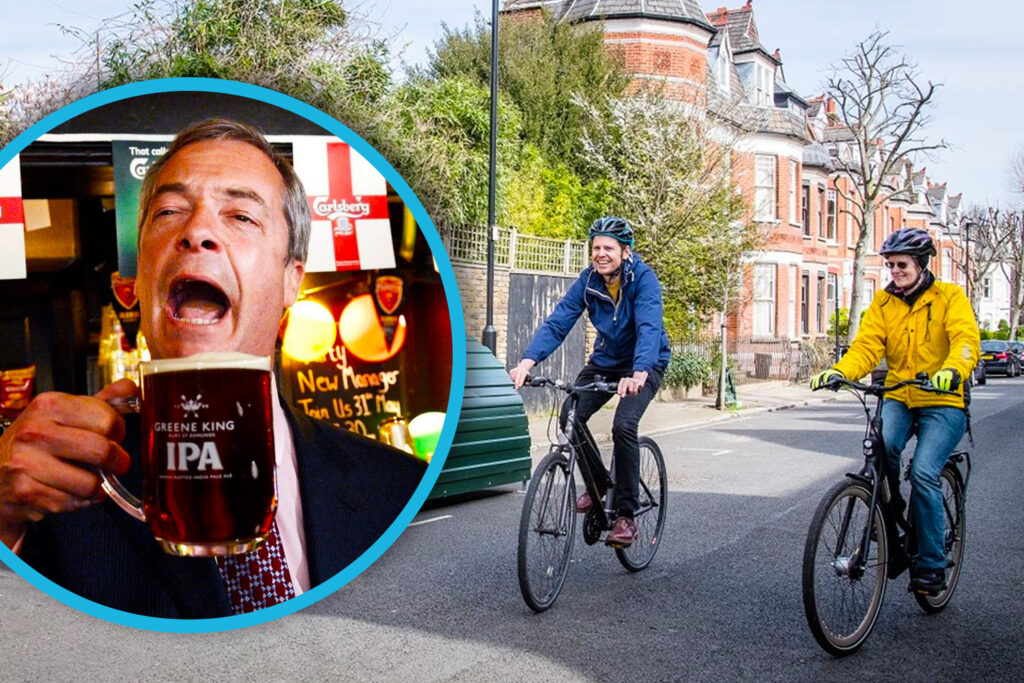

The Labour government’s plans to lower the drink drive limit in England and Wales have been branded “absolutely ridiculous and wholly unnecessary” by Nigel Farage, who claimed the proposals were the work of the “Islington, north London bicycling classes” who “hate” rural Britain.
On Wednesday, the Department for Transport unveiled its new Road Safety Strategy, which it says will save thousands of lives on the UK’s roads by tackling drink driving, improving training for young motorists, introducing mandatory eye tests for drivers over 70, and targeting mobile phone use at the wheel.
The strategy, the government’s first published road safety plan in over a decade, forms part of Labour’s stated ambition to reduce deaths and serious injuries on Britain’s roads by 65 per cent in the next ten years.
> Wheelchairs and mobility scooters could be allowed in cycle lanes under new government proposals
As part of this aim, the government says it will consult on lowering the drink drive limit in England and Wales, which is currently the highest in Europe, having remained unchanged since 1967.
In 2014, Scotland changed its legal alcohol limit from 80 to 50 milligrammes per 100 millilitres of blood, and from 35 to 22 micrograms per 100 millilitres of breath. However, England, Wales, and Northern Ireland’s limits stayed intact, and any consultation on lowering the limit in England and Wales will likely focus on whether the two countries should belatedly fall in line with Scotland.
According to the government’s casualty figures for 2023, one in six road fatalities that year involved drink driving. As well as lowering the drink drive limit, the consultation will also explore the potential use of preventative technology, such as alcohol interlock devices in vehicles, and powers to suspend driving licences for those suspected of drink or drug driving offences.
However, according to Reform UK leader Farage, Labour’s aim to clamp down on drink driving would, instead of making the roads safer, simply sound the “death knell for country pubs across Britain”, the Clacton MP arguing that the proposal was dreamt up by north London’s cycling “elite”.

“It’s a tragedy what’s happening to pubs, it’s been going on for a very long time,” Farage said during a Reform UK press conference on Wednesday.
“I listened to a Labour minister on the TV this morning about the new drink drive laws, basically saying if you want to have a drink, don’t drive.
“This is because we’ve got laws being designed by the Islington, north London bicycling classes. What about rural Britain? No-one cares, of course. In fact, many in Labour seem to hate rural Britain.
“But the drink drive thing is absolutely ridiculous, wholly unnecessary. We’ve been where we’ve been since 1967, it’s worked pretty effectively. If you actually look at road casualty figures, through whatever cause, we are now incredibly safe on our roads. Incredibly safe. Much safer than France, way safer than Germany.
“We’ve actually reached a level on accidents, beneath which it is impossible to go, because there will always be human error of some kind.”
> Cyclist gets new 3D printed face after drunk driver left him with severe facial burns
Farage’s criticism of the proposed policy was echoed by Jonathan Neame, chief executive of Britain’s oldest brewery, Shepherd Neame, who labelled it “socially, morally, and economically wrong”.
“I think there is a real risk that Rachel Reeves is doing to our sector what Margaret Thatcher did to the miners,” Neame told the Times.
However, speaking to LBC, transport secretary Heidi Alexander pointed out that studies have shown that there has been no significant long-term impact on rural pubs in Scotland since its new drink drive limit was introduced in 2014.
“I’m sorry, but rural pubs still do exist in Scotland. The law changed there in 2014, we’re not proposing to do anything different than what the Scottish government did a decade ago,” Alexander said.
“I think that even though it’s quite a marginal difference that we are proposing, I think the vast majority of people are responsible and that they don’t drink and drive when they go to the pub.”
Of course, this isn’t the first time that Farage or Reform have publicly taken aim at cycling and cyclists. Back in 2020, when the former Brexit Party had just rebranded as Reform, Farage announced that the party would target councils that promote cycling and walking in the following year’s local elections.
And more recently the Clacton MP derided local authorities “on the verge of bankruptcy” for wasting “tens of millions” of pounds on “cycle lanes that no one uses”.
Elsewhere in Labour’s new Road Safety Strategy, the government says it will consult on introducing a mandatory three or six month minimum learning period for new drivers, in a bid to tackle the inexperience Labour says is costing lives, with drivers aged between 17 and 24 accounting for 24 per cent of all fatalities and serious collisions on the roads, despite making up just six per cent of all licence holders.
Meanwhile, a consultation on mandatory eyesight testing for drivers over the age 70 will be launched, along with new measures targeting illegal number plates, uninsured drivers, and vehicles without a valid MOT.
> What to expect for cycling if Reform UK get into power
However, the strategy largely avoids the role of cycling and cyclists on the roads, though cyclists will be included as part of a National Work-Related Road Safety Charter pilot. The scheme encourages employers to “promote good practice, accountability, and compliance with existing legislation” when it comes to dealing with employees driving or riding to work.
The strategy was welcomed on Wednesday by Cycling UK – though the charity pointed out that more still needs to be done to educate motorists and increase awareness of the Highway Code.
“The new Road Safety Strategy is a welcome and hugely important step from the government towards making our roads safer for everyone,” Cycling UK’s director of external affairs Sarah McMonagle said in a statement.
“We particularly welcome the inclusion of clear casualty reduction targets, which were scrapped in 2011. This was despite them being instrumental in halving road deaths under the previous Labour government. We’re also really pleased to see a Road Safety Investigation Branch with the aim of preventing future collisions.
“It’s also great to see the government encouraging more walking, wheeling and cycling – including by placing the internationally recognised Safe Systems Approach at the heart of the strategy. This suggests the government is serious about preventing collisions and saving lives by better managing and enforcing safer speeds.
“However, if we want safer streets, we also need to educate people on the rules and increase awareness of how the Highway Code changed four years ago. People first need to know the rules of the road before they can follow them.
“We urge the government to kick-off its ‘lifelong learning approach’ by investing in a major new road safety awareness campaign; the first step towards safer behaviour on our roads.”










74 thoughts on “Nigel Farage claims plan to lower drink drive limit “designed by the Islington cycling classes” – as Reform UK leader says: “We’re now incredibly safe on our roads””
Everytime someone is injured
Everytime someone is injured or killed by a drunk driver, both NF and Jonathan Neame should be made to face the victims/their families, look them in the eye and repeat what they are saying here.
Not agreeing with NF but ont
Not agreeing with NF but not enforcing a 50mg limit will be absolutely no different from not enforcing an 80mg limit. How about key safes and breathalysers in pubs to stop beople even attempting to drive home drunk?
Indeed.
Indeed.
https://www.journalslibrary.nihr.ac.uk/phr/PHR07120
slc wrote:
It’s helpful to see the facts, and it’s unsurprising that the lack of enforcement proved the critical issue.
Presumably, Nigel Farage was unaware that [i]alcohol consumption remained unchanged[/i] in Scotland when the country tightened its drink-driving limit.
Another_MAMIL wrote:
I mean, it’s Scotland, they like a drink up there
It’s helpful to see the facts
TBF the paper does not show that but speculates a cause for the unexpected null result. If I was in charge of science publication, such speculation would be banned 🙂
I love the “but nobody has
I love the “but nobody has any idea what the limits are and how can they tell if they’re over?” litany from many men of “common sense”.
It’s the new “it’s impossible to drive, or drive safely, at 20mph!”
I believe it’s called a breathalyser, you can get them from anywhere including Halfords *. No doubt “but not calibrated the same as the legal ones / what about all the uncertainties!” But I’d say it’s a useful second line of defence – as in if it says you’re over, don’t drive maybe?
Of course the gold standard being “just don’t drink alcohol and drive”. Don’t get plastered then drive the following morning.
Hard to beat that one… except if you think more people should be dying ** and being maimed on the roads because *we* think discipline is something that should apply to others.
* maybe don’t get them to fit it for you though.
** Including motorists…
From my observations in the
Safer on the roads these days?
From my observations in the Peterborough area the standard of driving is worse than it was 10-15 years ago.
Awareness of potential hazards is often shocking, allowance for weather conditions is often non-existent, drivers are often selfish and impatient and it appears that more drivers drink and take drugs.
Good old Farage. Finger on the pulse as ever.
I’m also thinking the pic of
I’m also thinking the pic of NF at the top of this article is funny/ironic.
Is he drinking that or deporting it…?
What other “non-British” food/drink items should he be boycotting/deporting?
IPA is so called because it
IPA is so called because it was brewed in Britain and exported to India. It isn’t an import to the UK.
Yes but wouldn’t you feel
Yes but wouldn’t you feel like a right berk if you voted for someone and then found out he drank Greene King!
Some of the current offering
Some of the current offering bring to mind Watney’s Red Barrel.
I’m a bit of a real / craft
I’m a bit of a real / craft ale bore.
If I wanted to project an image of being a John Bull type English or British beer drinker, there are dozens of other beers I would rather be pictured with.
I suspect Nigel Front is a drinker of expensive French, Italian, Spanish wines. But don’t tell anyone, it doesn’t fit with his Brexiteer image.
(Thinks – “Once this pesky photo shoot is done, I’m off home to listen to that Elgar CD I bought for the election campaign, over a piece of Valencay, crackers and a bottle of Pouilly Fume”.)
What would Hogarth draw?
What would Hogarth draw? Good old jolly English Beer Street * vs. sinister, foreign, miserable Oatmilk-matcha-chai Cycle Lane.
* Technically more of a Beer Road, as despite passing through the middle of Farage-on-Session (soon to be renamed Trumpington) it’s now the A666 and a dual carriageway).
** Thanks to our years of policies “encouraging cycling” this is 90cm wide (45cm in each direction, although most of it is actually bus stops) – but hopefully that can be reduced as the street is too narrow.
“absolutely ridiculous and
“absolutely ridiculous and wholly unnecessary”
If the frog-faced moron herder thinks that, then clearly it’s sensible and necessary.
Reform UK leader Farage
Owner, proprietor and profiteer, surely? He’s a cult, just like Trump, and if you’re paying attention to what’s happening in the USA now, then you should be scared, very scared. Alternative facts, the latest being that the woman shot by ICE was trying to run over one of them, are utterly blatant, but the xenophobic bullies can’t be persuaded that their guy is wrong: he’s Trump, therefore he’s right. Farage is using the same playbook.
As for being safer on the roads, the biggest cause of the drop in death rates is probably better, faster medical response, not a decline in crashes. It’s always better to reduce the cause than treat the symptoms, which seems to be what the approach of the Road Safety Strategy, so going the right way.
Anyone who thinks are roads are safer can’t spend much time on them.
It is, and has been for a few
It is, and has been for a few years, unnecessary to comment further on the type of scum to which Farage belongs and the large scum community who vote for him and who he epitomises so well and precisely.
But the drink drive thing is absolutely ridiculous
It has become almost axiomatic that when the right wing vermin describe some proposal or social change as ‘ridiculous’, it’s likely to be highly beneficial for society and humanity as a whole.
Ironically, my quite
Ironically, my quite extensive researches into country pubs over the last several decades have shown that it is in fact the elite Islington classes and their regional counterparts that have kept such establishments open by visiting on their weekend breaks to partake of the much-more-profitable food side of the business. Very few pubs these days manage to survive just on a locals-only beer income. Not saying that’s necessarily a good thing but Mr Toad might want to consider all the facts before apparently saying let’s allow a bit of impaired driving to support the alcohol industry.
Yes, Farage is only following
Yes, Farage is only following Sunak’s example with this ‘Drink-Drive Out to Help Out’ campaign. All very well if you’re not one of those who died following Covid surges, or somebody killed by a drunk Farage supporter
Yes, Farage is only following
Yes, Farage is only following Sunak’s example with this ‘Drink-Drive Out to Help Out’ campaign
?I don’t usually listen to these because I already know the solution to the alcohol problem, but this one is from a Big Hitter at Imperial: Professor David Nutt
https://open.spotify.com/episode/1hfwwxSHfw8LB29mTI5WVE
Sadly, this how Farage and
Sadly, this how Farage and Trump get votes, the Daily Fail gets ‘readers’ and Fox News gets viewers: appeal to the hard of thinking who are only interested in what they perceive as inconveniencing them, unable, or unwilling, to see the bigger picture.
“…basically saying if you
“…basically saying if you want to have a drink, don’t drive.” Yep, that’s it in a nutshell and completely unremarkable
Isn’t that the lite-Trump
Isn’t that the lite-Trump-wannabe? You, know that racist that’s in Putin’s pocket
https://www.theguardian.com/politics/2026/jan/08/go-back-home-farage-schoolmate-accounts-bring-total-alleging-racist-behaviour-to-34
He’s absolutely not a racist!
He’s absolutely not a racist! Those 34 or so people from his schooldays, including one of his ex teachers are making it all up.
Furthermore, Richard Tice said that he wasn’t a racist. Why would he lie?
And besides, they were different times. The black and white minstrels were still on telly.
He does have the look of a prime minister, in the same way as Liz Truss. An unteachable natural ability to look like a complete dildo in any photograph.
Mr Blackbird wrote:
Given the purpose of the analogous implement, that presumably presents somebody with something of an emotional challenge.
7% increase in drink driving
7% increase in drink driving deaths over the past 10 years – something has be done to stop them – the law as it is is not working.
But it rather depends on the
But it rather depends on the level of alcohol drunk in those cases.
There have been a number of news items in the last couple of years suggesting two things:
1. the effect of alcohol consumption up to th current limit is that drivers are more cautious than usual – potentially with a lower risk profile to other road users
2. The clear majority of accidents and fatalities where alcohol is cited as the cause involves drivers who are substantially over the current limit – with double or more the level of permitted alcohol in blood.
If either of the above are true the proposed legislation won’t cut road deaths – only more enforcement will. Greater enforcement / roads policing isn’t being proposed.
open_roads wrote:
This is a myth which has origins way back in 1964 with the “Grand Rapids Dip”, a statistical anomaly in the Grand Rapids study of drink-impaired driving on which blood alcohol limits for driving were based in many countries. This study found, surprisingly, that drivers with a BAC between 0.01% and 0.04% were apparently safer than drivers with a BAC of 0. The problem was this study was carried out on a univariate (single statistic) basis and didn’t account for variables such as age, gender, normal alcohol consumption etc. Once these variables were factored in it was shown that the risk of a crash when drinking rose steadily from 0 through 0.04% BAC and beyond, as expected. All research since has demonstrated that alcohol begins to have a detrimental effect on driving and causes a higher risk of crashing in any quantity above zero. Subject to correction of course but I’ve never seen a scientific study that demonstrates that people who drink alcohol but aren’t over the limit are safer than sober drivers; it sounds very much like the sort of thing that might be found in a survey of drivers’ perceptions (“Q: Do you believe that you drive more carefully when you have had a small amount of alcohol?”) but that wouldn’t be supported by actual hard evidence. It has been conclusively demonstrated that alcohol increases confidence and creates an illusory feeling of enhanced competence, so drivers who have had just below the legal maximum may well feel that they are being more cautious/are safer than normal but they will still be impaired and at a greater risk of being involved in incidents.
Rendel Harris wrote:
I think there’s a lot that depends on the person there. As an average, then yes, you’d probably find a slight increase in risk.
It’s a bit like the link road near me. For decades it was national limit (60mph in a car) and you were permitted to overtake. I used to drive down there all the time at the limit (when safe to do so) and also overtook occasionally. Never once did I think it was a problem.
But there were three fatal collisions on that road – all involving excessive speeding and reckless overtaking. Now it’s a 40mph limit and overtaking is banned.
Am I less risk to myself and others doing 40mph and not overtaking? Undoubtably there’s marginally less risk.
Has it solved dangerous driving and speeding on that road? Nope.
Greater enforcement / roads
Greater enforcement / roads policing isn’t being proposed
Oh yes it is! Oh no it isn’t etc…
The word is used 7 times on Page 38 at the start of Theme 4, entitled Robust enforcement to protect all road users. It’s just that it’s the epitome of lip-service, they don’t mean it and the police will ensure it doesn’t happen.
PK06 AAF was detected as ‘No MOT’ on 23.5.25 and reported. The vehicle failed MOT on 27th May for several ‘Repair immediately. Major Defects’. Detected again at Sainsbury’s on 22.10.25, again reported, again ignored by Lancashire Constabulary. Today, although I haven’t detected it again yet, it’s No VED since June 25 and No MOT since May 25. There’s no possibility that these hyper-idle, pathologically pro-driving dimwits will do anything but actively work against the Government’s Road Safety Strategy, because they’re not interested in the non-driving members of the public.
wtjs wrote:
I haven’t read it all but if it doesn’t contain words to the effect of ” large increase in numbers of traffic police” then its all just waffle.
But it rather depends on the
But it rather depends on the level of alcohol drunk in those cases.
There have been a number of news items in the last couple of years suggesting two things:
1. the effect of alcohol consumption up to th current limit is that drivers are more cautious than usual – potentially with a lower risk profile to other road users
2. The clear majority of accidents and fatalities where alcohol is cited as the cause involves drivers who are substantially over the current limit – with double or more the level of permitted alcohol in blood.
If either of the above are true the proposed legislation won’t cut road deaths – only more enforcement will. Greater enforcement / roads policing isn’t being proposed.
There have been a number of
There have been a number of news items in the last couple of years suggesting
two thingsobvious bollocksNews items, especially from the hyper-junk press, frequently suggest and even state rubbish. In the 90s there was a lot of attention given to junk statistics indicating that ‘light alcohol drinkers’ were healthier than long term complete abstainers. That was bollocks too.
Big shout out to all the
Big shout out to all the people who believe driving slightly drunk is safe.
I heard probably the same
I heard probably the same interview on the radio with the Minister that NF referred to and unfortunately it wasn’t great. She did essentially say that the change in law just means you shouldn’t drive. No mention that it is possible to visit a rural pub and not have alcohol, that there are more choices of non alcoholic drinks, you can have designated drivers etc etc – anything that might have made her look less insensitive to publicans and the Telegraph readers, or provide such an open goal to them.
I fear this good initiative is going to end up the same way as many of the Government’s plans – ditched in the face of load moaning by Reform, Telegraph, Daily Mail, Jeremy Clarkson etc
Smiley775 wrote:
She didn’t say anything of the sort. She said “If you’re going to drive, don’t have a drink. If you want to have a drink, leave your car at home.” Unless you believe that by “drink” she meant all consumable liquids and not just alcoholic ones then she did not say what you claim.
Your observation confirms my
Your observation confirms my point. She just said a simple ‘don’t drive to the pub’ message, and my point was she didn’t take the opportunity to explain you can drive and have a different drink or take other measures etc etc. Which is the open goal to NF and the right wing press that I said. The Government, and cyclists, need to be smarter to counter the predictable pro-motoring lobby in how they will attack any sensible suggestions to make roads safer. It’s no good just bemoaning how the likes of how NF and others twist facts.
Smiley775 wrote:
Again, no she didn’t, she said don’t drive to the pub if you want to drink alcohol. Do you really think people are so stupid they need a government minister to explain that they can drive to the pub if they’re just going to have a lemonade? You appear to be blaming her for Farage’s nonsense when the reality is she could have spent half an hour eulogising the options available to non-drinkers and he’d still have said the same thing and the same people would still believe him.
Rendel Harris wrote:
Yes, don’t you?
Backladder wrote:
This is a cycling web site.
I think people are so stupid they need a government minister to remind them that they could cycle to the pub and have a modest amount of whatever they fancy.
I also happen to think they atre so stupid they will just listen to the blah-blah merchants describing it as the war on motorists and, for some reason, publicans.
GMBasix wrote:
well done you for adhering to the snobbery of the liberal elite. Don’t let anyone tell you to walk in the shoes of someone poorer, less educated and less pious, don’t fall into trap of become fabulously wealthy and powerful either, you’ll never get to moralise or look down on anyone again…
One day they will break the
One day they will break the stranglehold cyclist have on government policies and british politics. Until that day though I will enjoy our world class cycling infrastructure and overblown spending on active travel that it brings.
Good point! We should keep
Good point! We should keep quiet. Ever since we captured the government, the police and the judiciary it’s been a cycling utopia!
For one we’re allowed to wear lycra – even if we’re not particularly athletic and even in late 80s colours.
For another drivers aren’t allowed to run us over * – even if we’re in the way!
I’ve saved the best ’till last – we don’t even have to obey speed limits so I could cycle at 90mph in a 30 and laugh at motorist. All while we pay no road tax at all!
* Well, mostly. On paper, at least.
Poor Islington – why does it
Poor Islington – why does it get all the flak. Most of Islington is quite run down. I’m in Camden – we are much posher and just as liberal and woke. Can’t we take the credit for being the ‘bicycling metropolitan elite’ for once? (Although we did give you Starmer – well I didn’t, for which we should apologise)
Rome73 wrote:
Haven’t you heard – his father was tool maker!
I feel qualified by geography
I feel qualified by geography to talk about rural pubs. I live in rural Essex (yes, there is such a thing, it isn’t all Thames Corridor, Basildon and Harlow honest). No pub in the village since last one closed in the 1980s. Two pubs within walking distance for most people in adjoining villages. I do walk to one, I would walk to the other if it wasn’t for the idiots who drive on the NSL pathless road between here and there. I would be mown down in minutes, even if I wore high Viz and carried torches. And worse, I know I would be blamed for walking along a country road after dark with alcohol in my blood.
LeadenSkies wrote:
Exactly. Part of this comes back to our long-term transport choices / private car hypermobility.
Amongst many other wrong ends of sticks being grasped, those who are saying “but what about my right to drink?” have usually missed the boat because for some decades we voted against the pub by getting booze … at the supermarket. (Nothing stopping you still getting it there.) Facilitated by being able to drive *there* of course.
And for those still saying “save the village pub?” one good thing would be to fix it so that people *can* walk to and from it safely (or there are buses / taxis), even if not somewhat inebriated…
Rural roads without a
Rural roads without a footpath are the norm, which is unforgivable and I feel dreadful when people have to scramble onto the grass verge to escape death. We could and should do so much more for the most vulnerable and not just pandering to the hard done by motorists. I don’t even want to start on Farage either..
Rural roads without footpaths
Rural roads without footpaths are not inherently unsafe, until you add motorists to them and even then it’s only the minority of motorists that barrel around way to fast to stop should they encounter pedestrians / cyclists/ horse riders / wildlife or just don’t give a flying fig about the safety of others. Unfortunately many narrow country lanes don’t realistically have any way of supporting a pavement along their length and we certainly couldn’t afford the cost of installing and maintaining them but we should educate and enforce to ensure that those driving on such lanes do so in a way that allows for the possibility of meeting a pedestrian.
The England and Wales drink
The England and Wales drink/drive limit is a disgrace in the developed world, paralleled only by North America.
Looking forward to them
Looking forward to them rolling back the rules on not inhaling nitrous oxide and driving (or indeed at all) under pressure from the catering trade…
Actually that won’t happen but tinkering with driving rules AND drink is triggering many overlapping interests: hard-done-by hospitality trade, some drivers, people who just want it to “be how things used to be” (but actually weren’t, or where we’ve just forgotten the side effects eg. the terrible death toll on the roads).
David9694 wrote:
I’m not having that, we’re worse than them! Yes the USA and Canada do mirror our limit with 0.08% BAC (apart from Utah which has 0.05%) but both countries have lower limits and in many states/provinces zero tolerance policies for young drivers and commercial drivers; in the USA you can still be charged with driving impaired if you show other signs of impairment even if your BAC isn’t over the limit, and a number of provinces in Canada have sanctions including fines and suspensions for driving over 0.05%.
I was very impressed by the
I was very impressed by the regulations described by our bearded American friend covering booze and boating.
ktache wrote:
I was commissioned a few years ago to write a set of mock exams for Canadian learner drivers, I was interested to learn they had strict drink-drive laws for snowmobiles which applied even when on your own private land. Also you can have your car impounded if you lend it to someone who drives it drunk or who has a suspended licence due to drunk driving.
I was interested to learn
I was interested to learn they had strict drink-drive laws for snowmobiles which applied even when on your own private land
I’m sure the UK authorities would claim to have strict laws about red traffic lights and vehicles with no MOT, but the police make sure they’re not enforced. So the question is: anybody live in Canada who knows for sure that these strict laws are enforced with real penalties?
1967: ‘Three thousand
1967: ‘Three thousand publicans marched against the breath tests’ for drink driving
2026: ‘Pubs blast new drink-drive limit’ – front page of motonormative local rag
@theoxfordmail.bsky.social
If your pub needs drink drivers to survive, your pub needs to close NOW.
https://bsky.app/profile/bookllyfr.bsky.social/post/3mby6jerfik2w
The alcohol industry’s ugly
The alcohol industry’s ugly underbelly fully exposed now. Sorry folks, pubs have no special right to exist.
“While the county’s publicans stressed they did not support ‘drink-driving’, many questioned the effectiveness of lowering the limit while all said it was adding to the industry’s challenges.”
https://www.oxfordmail.co.uk/news/25750828.oxfordshire-pubs-bemoan-governments-nail-coffin/
(And here we are not at all supporting drink-driving with still more pub car parking:
https://www.oxfordmail.co.uk/news/25748530.jeremy-clarkson-victory-latest-battle-cotswolds-pub/. )
David9694 wrote:
Nothing new about that – it’s on show up and down the country most days of the week.
David9694 wrote:
However, pubs can function as community hubs, so I think they do deserve extra consideration due to that.
My unpopular opinion is that they should be promoting drunk cycling – don’t drink and drive, cycle, drink and cycle back home. Yes, some people will fall off and quite possibly get in the way of sober drivers, but the amount of harm is limited whereas drunk driving causes a lot more issues. Also, the hurt will mainly be felt by the drunk cyclists which can be a learning experience whereas drunk drivers mainly hurt others.
Remember, every wobbly drunk cyclist is someone who could be a murderous drunk driver, so we should encourage that choice.
Inspired by the “friends don
Inspired by the “friends don’t let friends walk drunk” idea (Freakanomics, was it?) I don’t think this is a *great* idea either, albeit it sounds like an improvement… but consider NL (with really good cycle infra everywhere making it much safer than UK) … with enough tipsy cyclists falling off this might be a bigger problem.
Making it so that nobody has to travel very far (and encouraging people to travel in groups) would seem to be the best way, given our drinking culture. But… not sure that works if it includes some measure of “go to pub in the countryside / a long way from population”.
Andy Cox Detective Chief
Andy Cox Detective Chief Superintendent, Northamptonshire Police. Road danger reduction advocate:
Around 250 people a year in the UK are killed in drink-driving related road crashes. This [view] does a disservice to every victim and bereaved family, reflecting outdated and dangerous attitudes that still need to change.
So who does this reduced
So who does this reduced limit actually benefit? Most drunk drivers who kill, maim or injure are steamingly drunk. The limit at the moment is suffice to stop anyone becoming a danger. It is also reasonable in the event that someone has had a drink, but is forced to drive does so legally. I don’t think drunk driving is acceptable, but the only beneficiary of this tightening is tax revenue. So I think it is a disaster and utterly pointless. The current rules prohibit drunk driving anyway, so what is this achieving? Just like everything else this government does, very little.
Colin Peyresourde wrote:
No, it isn’t. Alcohol starts to impair your driving as soon as you start drinking. Somebody who’s just below the limit is proveably slower to identify hazards and take evasive action than when they are completely sober. 999/1000 times this will not cause a problem, the other time that extra fraction of a second in braking or swerving could be the difference between life and death for a pedestrian or cyclist. The only safe level of alcohol when driving is no alcohol. A review of research by the National Institute for Health and Care Excellence in 2010 showed that drivers with a BAC between 0.02% and 0.05% were three times more likely to be involved in a fatal crash than sober drivers, and those with a BAC between 0.05% and 0.07% (still legal as the law stands) six times more likely. To say that allowing people to drive with up to 0.079% BAC suffices to stop them being a danger simply isn’t true.
Who are these people who are “forced” to drive after having a drink?
Rendel Harris wrote:
they’ve requested anonymity. So zero tolerance is the only way? Who will that save?
No, it isn’t
No, it isn’t
Surely, somebody this dim and blinkered actually IS Farage?
The NICE numbers look very
The NICE numbers look very alarming and headline grabbing, however a tiny number multiplied by 3 is still a very tiny number.
What actually matters is absolute risk, this can be calculated based on number of drivers, miles driven per year and rate of accident:-
sober driver:- 0.0000005 chance per mile
BAC 0.02–0.05%:- 0.0000015 per mile
Still a very tiny chance of accident.
Everyone. Years ago when I
Everyone. Years ago when I passed my test i took my family to a country pub. I had just one pint of beer and couldn’t believe how it affected my driving. I just didn’t feel safe on the road and was relieved to get home. I’ve never drunk and driven since and luckily my enjoyment of life has not been affected at all.
On the very rare occasion
On the very rare occasion that we as a group pop into a pub after work, generally saying goodbye to colleagues, I will have a pint of Guinness, with straws if they have them, large taches and Guinness foam can get messy.
Then the mostly off road commute commences. I’m up to over one and half thousand goes by now, so I notice the way the puddles change, how the mud develops and dries, how the sand and gravel moves, how the traction changes and where the best grip moves to, how the potholes begin and progress, on the public motor vehicle track, and how useless any form of filling or resurfacing is.
But none of these differences compare the the changes wrought by the booze contained in that one pint. My balance is off, noticeably so, and my steering. I’m just not as good. And I am aware of this, but my risk taking still increases and so does the thrill I get with speed.
Any booze affects you, that’s it point. Don’t drink and drive.
Pretty fact free response.
Pretty fact free response.
Alcohol impairs your driving, there is no safe limit.
No one is forced to drink and drive.
How will tax revenue go up when people drink less? A soft drink will only bring in vat and not duty.
Hirsute wrote:
Perhaps it’s a mixture of “I *had to* have a drink” (habit and social obligation, or because “it came with the food…”) to go along with “I *had to* drive” (also habit and social expectations to a surprising extent)?
Then there’s “it doesn’t impair people very much”. (Only a few hundred people die on the roads, that’s not much when you consider all the driving… it’s much worse most places / in the past…)
And there’s an us and them element – “most drink driving is by *those* wrong’uns, over there, the ones who are taking the piss”. (Echos of “we’re not *those* cyclists, the ones jumping red lights and riding on the pavement dressed in black…”).
Of course that is like any fashion – tacitly understood and immutable, until it changes.
In my youth I recall finding that when going out after work on Friday nights that “more than three or four – or at a push five” pints was the amount commonly held to be “taking the mick”. Although apparently how fast you drank had some bearing. So perhaps this was all about the likelihood of passing breath tests?
Pretty fact free response
Pretty fact free response
I have pondered this, and have gone back on my usual rule of not reading anything from an obvious right wing nutter. I am forced to conclude that this one is so barmy and anti-social that he must really be a Farage parody by Black Ops in favour of a reduced alcohol limit
Reform depends on impairment
Reform depends on impairment by alcohol, drugs, head injuries etc for voters.
Their ideas seem closer to sense after a few drinks.
Sobriety threatens Farage’s income.
One group of their supporters have poor impulse control, confuse it with R freedom, and want to not be frustrated.
Farage is one those people
Farage is one those people you should pay close attention to – if you ever find yourself agreeing with him, you should go. and check your reasoning very carefully.
To put some perspective on
To put some perspective on this using maths:- there are 42.5 million drivers in the uk holding a licence + plus drivers without a licence!
336.2 Billion, yes Billion miles are driven every year in the UK.
260 deaths every year with drink driving a factor but not necessarily the absolute cause.
That is one death for every 1.3billion miles driven.
Statistically the chances of being killed by a drunk driver is 0.00061% per year
In comparison there are 11,000 accidental deaths in the home every year, I don’t see government tackling that.
I see a government meddling with an attempt to solve a problem which isn’t a problem, new legislation will have zero effect, those that drive drunk will always drive drunk and any tightening of the rules will continue to be ignored.
Just responding as someone
Just responding as someone who was reminded of this … what is the base rate?
Accidental deaths in the home can be due to a vast array of causes. (And i believe there are efforts to address some of those). We also spend far more time at home than out on the roads.
You also don’t have to be killed for drink driving to have an impact … speaking for a vast array of buildings and other infra. (See “car crashes into building” for examples).
Seen that way, adding a further reminder to the careful to be careful (on drink driving) may be low-hanging fruit?
But certainly for the shameless it likely won’t do much. That needs more enforcement (expensive ATM) – and ultimately cultural change.
I think we *have* achieved change (compared to eg. my youth). But it is imperfect, and very slow, and perhaps not all the result of the policing and advertising campaigns. And as patterns change people may be driving intoxicated in other ways, or effectively so because phones and other devices…