


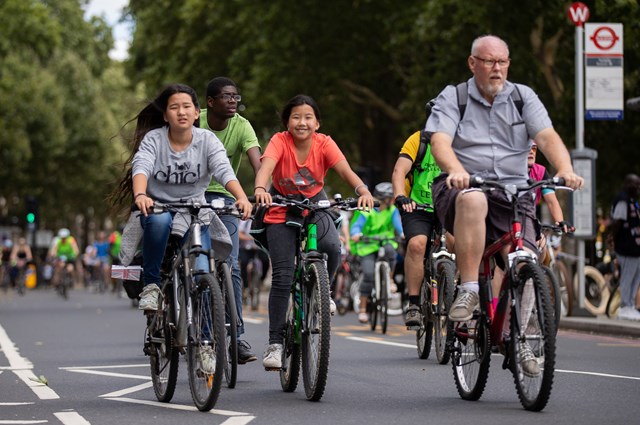

By spreading out and riding further apart as a motorist attempts to overtake, cyclists riding in groups can reduce their exposure to harmful vehicle emissions, a recent study has found.
That’s because, according to academics specialising in aerodynamics and environmental flow, pollutants from the exhausts of passing cars can become trapped within a tightly-packed group of cyclists, thanks to a “complex aerodynamic field” generated by the riders.
The study, carried out by researchers at the University of Surrey, assessed the different ways in which cyclists can be exposed to car fumes while riding in groups in urban environments through a series of experiments conducted at the university’s Environmental Flow (EnFlo) wind tunnel.
The researchers, whose findings have been published in the Journal of Wind Engineering and Industrial Aerodynamics, captured results – using a scale model of a typical London street – from a vehicle positioned in front of the four riders and one adjacent to them, replicating an overtaking position.
They measured the pollutant concentration around the cyclists based on the position of both the car exhaust and the riders, as well as the wind direction and strength.
The findings confirmed that, when a motorist is driving in front of a group and there is little wind, the pollutant exposure decreases the further a cyclist is from the vehicle, regardless of their position within the group.
When the wind is stronger, however, positioning with the group becomes more important, and the researchers say that riding towards the back on a blustery day can be a good strategy to minimise exposure.
But when a driver is passing a group of cyclists, things become more complicated. According to the results of the experiment, when a vehicle is adjacent to a group of cyclists, the exhaust fumes can be trapped by what the researchers describe as a “complex aerodynamic field” generated by the riders (similar to the effects of drafting), increasing their exposure to harmful pollutants.
In the case of a passing driver, then, riding at the front of the group – regardless of your proximity to the car exhaust – will minimise your exposure to fumes.
To mitigate the effects of pollution on all members of the group the researchers recommend that, when a motorist is overtaking, the riders within it should spread out, allowing some of the trapped fumes to escape.
Overtaking drivers are also recommended to give cyclists as much space as possible when passing, and to avoid pulling too sharply in front of them, thereby increasing the proximity of the fumes emanating from their exhaust.
> How long do you have to cycle in London before effects of pollution outweigh benefits of exercise?
“Cycling is encouraged to reduce congestion on the roads, as well as traffic emissions, yet despite many encouraging health aspects of cycling, the exposure to and inhalation of vehicle pollutants is something not to be forgotten, especially when used as a regular alternative transport method,” says Joy Schmeer, a postgraduate researcher at the University of Surrey and the lead author of the paper.
“The findings of these experiments highlight group cyclists needs to consider their routes and position within a group, especially when roads become busier and narrower.”
The new research, as well as advising pollution-conscious cyclists on the best riding position within a group, also suggests that group riding should be considered by urban planners when designing mitigation strategies to minimise cyclists’ exposure to fumes within towns and cities, especially where busy and narrow cycle lanes often result in cyclists riding in line.
According to the study’s conclusion, as being as far away as possible from both polluting vehicles as well as other cyclists is key to avoiding exposure, policy makers should therefore be advised to construct wider cycle paths or, “even better” (in the words of the researchers), completely separate riders from road traffic.
“The results of these experiments reveal important recommendations that cyclists and drivers should know to increase health and safety while cycling in groups,” Dr Marco Placidi, Senior Lecturer in Experimental Fluid Mechanics at the University of Surrey, added.
“While drivers need to maximise their distance away from riders before overtaking them, cyclists should aim to distance themselves from the vehicle’s exhaust, but also potentially from other riders if a vehicle is driving adjacent to them.
“As for further recommendations, experiments like these show the need to consider repercussion of peak utilisation of urban cycle lanes during their design stages.”
















26 thoughts on “Cyclists told to spread out while riding in groups to minimise effects of pollution from overtaking vehicles”
I love riding in a large
I love riding in a large groups (6+) of people but I think we will try splitting up next time we’re riding in the city centre.
Just ride like a race team –
Just ride like a race team – everyone takes a turn at the front.
Im very dubious of this
Im very dubious of this research. I dont get why its theoretical work with a wind tunnel when its far better to have done this empirically with groups of cyclists and cars on a real street.
Also I see nothing that says how material the impact is to the cyclists health compared to the control scenario.
Feels like a group of scientists with a wind tunnel looking for a problem to solve tbh.
It’s odd that no numbers are
It’s odd that no numbers are reported here. Might the the results have shown a significant increase from very little to still really not much?
I can’t be bothered to find out.
Real life road conditions
Real life road conditions would make repeatability difficult to achieve. While the wind tunnel may not exactly duplicate the road it does make small changes easier to detect, changes which we might reasonably expect to also occur on the road.
I’d suggest breaking up
I’d suggest breaking up groups on account of the shear number of potholes and road defects at the moment. I appreciate that this will make it more difficult for drivers to make their way past the same number of cyclists but safety first.
Its going to be popular with
Its going to be popular with motorists when we spread out all over the road for health reasons, also will race organisers have to use electric cars only in front of the peloton?
So the car driver behind us,
So the car driver behind us, dipping the clutch and high revving, is really thinking of our healthby stopping the build up of particulates caused by low engine and ground speed?
Awww … and there was me thinking they were just trying to be an intimidating arse
To minimise the effects of
To minimise the effects of pollution personally I’d reduce the pollution.
My thoughts exactly, it’s
My thoughts exactly, it’s like telling bar staff they shouldn’t work indoors if they don’t want the effect of passive smoking. If vehicles didn’t pollute we’d all be better off.
Meanwhile the non poluting
Meanwhile the non poluting (yeah right) electric car comes up behind so quietly it spooks a rider, who then falls off and is another casualty to add to the numerous under age Bolivian miners that supplied the raw matierials for the batteries.
Sounds like a good case for a
Sounds like a good case for a ‘friendly toot’ (©A.Neal).
Don’t Teslas have a “smart
Don’t Teslas have a “smart warning” mode already? It could come up behind you and e.g. inform you “Give you space? I’m sorry, Dave, I’m afraid I can’t do that”.
I wonder if they consider the
I wonder if they consider the bigger picture of overall risk to life, riding in a group as opposed to strung out individually, in urban settings? Riding as a group, motorists are obliged to overtake when there is as much room as to overtake another car; singled out they can all be close-passed in succession.
Of course they haven’t. And I
Of course they haven’t. And I call nonsense on the pollution claim too. Numbers so tiny a fart in the breeze would upset the conclusions.
In general the big health
In general the big health risk for me is air quality when I ride, not getting hit by a car. I ride in some not too congested roads, and after every ride I feel I have lost a part of my smell and sometimes eye pain. You stink easily more after a hot day in exhaust fumes, whereas in countryside, you may sweat but not stink. Even worse I cannot really understand recreationist cyclists and runners, cycling or running next to high car volume avenues, filling their lungs with pure cancer, when they could go to places with less traffic volume.
There are a thousand of arguments against electric cars, but the improvement in air quality they will bring is undeniable. And maybe paired with true autonomous driving so that the drivers of BMWs, Audis and tuned cars will be demoted to passengers, that will bring more cyclists on the roads too, as they will have nothing to be afraid of.
“Even worse I cannot really
“Even worse I cannot really understand recreationist cyclists and runners, cycling or running next to high car volume avenues, filling their lungs with pure cancer, when they could go to places with less traffic volume.” Did you even consider that some recreational cyclists/runners HAVE to be beside congested roads in order to get to less polluted areas before you typed that? Or do you expect them to buy an EV to get them there first, adding to the congestion? (Hang on, back to the old autonomous-EV solves everything argument…feels familiar).
I don’t think that any
I don’t think that any recreational cyclist or runneris obliged to select a congested avenue.
When you travel for recreation you just chose any possible route that you like and if you are wise a route that has no risks for your health too. For commuting, things of course can be very different because you are de facto searching for the laziest/fastest route, but even so you can make choices at route planning. I mostly commute and sometimes I take longer rides to avoid congested roads with poor air quality
No such thing as no risks.
No such thing as no risks. And if you live in a busy city, you will by nature of where you live have to deal with congested routes at times…that’s how urban life is. I live on the edge of a city, and for a recreational ride I will stay take the fastest route out of town…not the least congested.
I agree, there are never 100%
I agree, there are never 100% no risks. But it is always good trying to minimize them.
Even when I worked at a heavily congested urban center, I sometimes chose a route that had extreme grades and slightly longer lenght to avoid not only the speeding cars, but their exhausts too.
I live in a city-centre
I live in a city-centre location. Even to access my nearest open trail running space, I have to run at least 2-3km from where I live (so an unavoidable 15 minutes each way in urban, trafficked conditions). I’m afraid your rhetoric of ‘recreational = able to choose where they travel, commuter = unable to choose doesn’t really work.
I don’t have the fantasy
I don’t have the fantasy running on everywhere on green fields, but leaving everything to destiny is not wise.
For instanse, in my previously mentioned example about commuting to the city centre the two options were a 2-direction 4-lane avenue and a narrow, mostly oneway road with low traffic. Most often I would take the big avenue on the way to work, as it was entirely slightly downhill, meaning I would have to ride with not great effort thus not breathing more polluted air than a pedestrian. But on return I would take the even hillier route (it had uphills and downhills parts) narrow road, unless I was in a real hurry to get home.
There are ways to protect your lungs, it really matters https://news.usc.edu/195662/air-pollution-outdoor-workouts/
I know, that’s an extreme
I know, that’s an extreme example. However, I maintain that the equality politics of being able to simply ‘avoid pollution’ are more complex than you say in your comments. I’m glad you’re able to simply divert and take a relatively pollution-free route! However, I and probably many, many others don’t really have the choice.
There is always a flip side
There is always a flip side and the additional carbon emissions from speed changes- accelerating, braking etc- is a significant cause of both CO2 and local emissions (NOX). Im not convinced having a gaggle of cars idling, breaking and accelerating is helpful.
Claire87 wrote:
It isn’t which is why we need to get people out of cars and benefitting from active travel.
Surely this misses the point.
Surely this misses the point. If more drivers cycled, there would be fundamentally less pollution – therefore it’s the drivers’ fault for driving, not the cyclists’ fault for “making drivers behave badly”…