



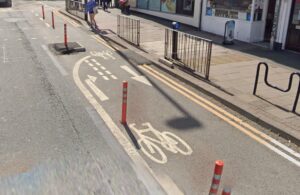
Cyclists in England could see an end to the “perverse outcomes” that deliver “half a cycle lane and then you’re chucked out onto a dual carriageway” as the Transport Secretary says long-term funding for cycle routes could be in the pipeline from next year.
Secretary of State for Transport, Louise Haigh, told the Transport Select Committee today the £100m allocated for cycling and walking in the recent Budget was the “initial direction” to achieving her previously promised “unprecedented” levels of funding. However, she said, routes have to be delivered with local people, to detoxify the narrative, adding it’s “too important that we get it right”.
Haigh also said traffic deaths and serious injuries have been “normalised for too long”, and if people were dying in any other way “we’d be treating it as a pandemic.”
Conservative MP for South West Devon, Rebecca Smith, asked Haigh about earlier pledges for “unprecedented levels of funding”, and about linking up funding for cycling, and connecting stop-start routes themselves.
In response, Haigh told the Committee: “It’s exactly that, that the Integrated Transport Strategy is wanting to address because it’s so frustrating for people to see half a cycle lane and then you’re chucked onto a dual carriageway or a very unsafe stretch of road, and we need to make sure that whatever is delivering those very perverse outcomes at a local level are properly addressed and part of the reason for that is the stop start approach.”
There was disappointment in the cycling world after the recent budget saw £100m allocated to walking and cycling – a figure that’s generally accepted as too low to deliver the government’s aims for active travel.
However, Haigh suggested next year’s spending review, expected in spring, could see a change in tack. She said: “I think the initial direction was set in this first phase of the spending review where we reversed the cuts of the previous government to active travel and provided £100m to Active Travel England [ATE].”
At present while rail and roads enjoy multi-year funding settlements, cycling and walking have long been bedevilled by stop-start funding that make routes hard to deliver. These can end up costing more as councils and delivery bodies lose staff at the end of a funding cycle, and then rehire them when more money becomes available. More complex, larger projects cannot generally be planned and delivered within a single year. An Integrated Transport Strategy, Haigh told the Streets Ahead podcast in August, could include long-term cycling and walking funding for the first time. Cycling charities estimate England needs to spend £50 per head, or 10% of the transport budget, to grow active travel.
Haigh says she hopes to build on the “fantastic job” of cycling delivery body, Active Travel England, which is led by Chris Boardman, with the body “going out to local authorities and skilling them up”, to write bids for funding and to deliver cycling and walking infrastructure.
However, she added, it’s important that routes are delivered with local people, saying “it’s too important that we get it right”.
“I think the lessons from Covid was that the money was out the door and they required it to be built too quickly and it lost the support of local communities in some instances, and it’s really important that things are done with local people otherwise it can get into a very messy culture war that can become very unpleasant and toxic.
“I was very clear in the summer that we are certainly ending any toxicity or politicisation of this issue because it’s too important that we get it right but as we look to the second phase of the spending review we will hopefully move to those multi-year settlements in order to end that stop-start and constant rescoping which not only delivers poor outcomes but ends up costing the taxpayer more as well.”
On pavement parking, when asked by Labour’s Arthur Scott, MP for Edinburgh South West, about banning pavement parking, Haigh said she wanted to tackle the issue as quickly as possible.
Said Haigh: “We’re considering what options we have available because we want to make sure that any measures are not burdensome on local authorities and are done in the most effective way but I am really committed to responding to the consultation – I think it was two governments ago – as quickly as possible and I’ll write to the committee in the coming months as we respond to the consultation”.
On road collisions, Haigh took a strident tone, saying: “I really think one death on the roads is too many. I think we treat road safety in a way as if it was a natural accident. I think if the numbers of people being killed or seriously injured on our roads were killed in any other ways, we’d be treating it as a pandemic and I think we have normalised it for too long.”

















21 thoughts on “Transport Secretary wants end to “perverse half cycle lanes” and hints at long-term funding for cycling and walking”
Encouraging words. Now she
Encouraging words. Now she needs to add, “replace the cycle lanes that aren’t fit for purpose”, “criminalise hate speech about people on bikes” and “review road safety law to keep vulnerable road users safe”. Then we can start to see some modal shift towards sustainable travel.
lesterama wrote:
How about, for every cyclist/pedestrian fatality caused by motorists, they’ll allocate another £100m from the road budget over to Active Travel.
However, that money should be kept out of the hands of local councils as they’ve already demonstrated their incompetence at making protected infrastructure.
I tend to agree with you
I tend to agree with you about local authorities.
It’s easy for government ministers to say ‘they know their areas best’, but the reality is that many are completely incompetent (hello North Yorkshire Council) when it comes to active travel.
Unless you are lucky enough to live in Oxfordshire or Camden, you will be let down by your council.
Oxfordshire councils are
Oxfordshire councils are quite capable of letting you down too!
I always have a little hollow laugh when I’ve sat on the bus as it queues for half an hour to get about a mile around the ring road, and then we pass the sign that proudly proclaims Oxford ‘a cycling city’.
Fair enough, but my
Fair enough, but my impression is that Oxfordshire County Council is genuinely starting a process of positive change.
Excellent link!
Excellent link!
Yes – in fairness, the
Yes – in fairness, the current lot are at least trying to make some baby steps in the right direction.
In terms of disappointment, though, it’s hard to know who scores worse – this lot, for promising a lot and delivering a little and somewhat broken; or the previous lot, for promising next to nothing and failing to deliver even that.
Tbh pretty much all LA’s.
Tbh pretty much all LA’s.
I live just outside Loughborough and m7ch of the cycle infra is either shared narrow paths or if dedicated, so convoluted and stood/start at every junction they become impractical and pointless.
Why is it thought that LA’s know their region and what it needs? They have proven time and again that they don’t.
Andrewbanshee wrote:
Guessing they see a “need” to devote lots of space / money to drivers? And even if they have been told to do some active travel stuff they know they need not to upset some shouty folks by making active travel anywhere near as convenient as driving (covering the extreme human emotional reaction to their “inferiors” getting more).
Fully agree with
Fully agree with criminalizing hate speech. If some of the things that are said about cyclists were said about race, gender etc the perpetrator would be in the nick by the end of the week. Seems like we’re the last remaining target for right wing populists.
Safety wrote:
I imagine if cycling became a protected charistic they’d find some other out group.
We generally ad -ist to these people so we get rac-ist, abl-ist, sex-ist etc. cyclist-ist doesnt quite go so we’d all just have to be content with being cyclists – even our haters become cyclists – now THAT really would annoy them – especially if they got arrested for cyclism.
Maybe the b
ikeuck stops here.worried that “routes have to
worried that “routes have to be delivered with local people, to detoxify the narrative” means a continuation of NIMBYs vetoing everything. Locals should be able to suggest alterations, as long as it stays within the guidelines, but not to veto.
Perhaps a £200 bike shop
Perhaps a £200 bike shop voucher for people living on a new cycle route.
Amen.
Amen.
Problem is even ignoring simple NIMBYism a) almost no-one knows “what works” for cycling * b) even those who do know simply cannot believe we can achieve what is needed here or even visualise how it would be on the ground.
* In fact it’s quite simple in a sense (and we can go to several countries and actually experience the reality, look at the details, question those who’ve delivered this etc.):
a) make cycling inclusive, make it feel safe, social, convenient / efficient and quick enough and – for some journeys – more attractive than driving.
b) make driving less attractive (but still *possible*) – so for shorter journeys (a) but with good alternatives for some longer trips. That must be in the form of excellent public transport (NOT robotaxis!) – which combines very well with walking and cycling.
But it turns out that actually requires an awful lot of ducks to be aligned! The pull of “where we are now” and “politics” (people trying to stay ahead in the future). Ultimately thousands of people attached to the motoring and related industries, which command billions of pounds. Millions of people mentally attached to driving. And several generations of people and the built environment adapting to that.
Yes I agree with that. Unless
Yes I agree with that. Unless there is backbone and a timetable, nothing will get done.
Having said that, Haigh’s comments are overwhelmingly positive.
HarrogateSpa wrote:
“Backbone”? – Is this the notion that our political representatives (a government of MPs and Lords, currently) should represent the interests of those who elected them, whether those electors like it or not? That would be a first! Generally those politicians represent the interests of the already powerful; yet they are not immune either to the huge inertia of the status quo and its clutching gravity that prevents changes for the better.
And don’t forget that the real rulers are The Hate Mail owner/editor and similar guttersnipes.
“…a timetable”? – The first law of of planning is that the plan will always go wrong/fail and cost 10X the intitial estimate.
**********
The nice words of Ms Haigh might signal a genuine intention swirling about her bonce. Such good intentions often remain nothing but; and even if they take off into reality, they often pave a new road to another bit of human-wrought hell via a route full of unintended consequences.
****************
Starmer is said to favour a polity that’s primarily defined and run via the rule of law, seeing as that was his mode for years and years and the alternative Toryspiv mode of The Divine Right of Boris&Co has proved so damaging. Why not follow that intention, then, and solve a thousand pressing problems (including motornormativity) by applying just the current laws to road traffic?
After 64 years of cycling about on them, I can assure you that the roads are very good for cycling – if the car loons are taken off them and the inept are forced to be ept by gimlet-eyed traffic rozzers & cameras, prevention of loon-pleasing car tech and various other laws inclusive of their actual application.
Last paragraph:
Last paragraph:
___
On road collisions, Haigh took a strident tone, saying: “I really think one death on the roads is too many. I think we treat road safety in a way as if it was a natural accident. I think if the numbers of people being killed or seriously injured on our roads were killed in any other ways, we’d be treating it as a pandemic and I think we have normalised it for too long.”
—-
Strong words.
This needs to be coupled with adequate resourcing of police and courts to ensure dangerous drivers are punished sensibly (to deter re-offending and others who will see the examples set) and those who think the law doesn’t apply to them (with multiple convictions/over 12s points etc) are taken out of public circulation.
Sounds good on paper.
Sounds good on paper.
Hopefully Nottingham and Derby continue their excellent work, by UK standards anyway, and bid for even more funds to provide proper infrastructure.
Owd Big 'Ead wrote:
Really??? I know the UK standard is low but to call the awful dangerous efforts that Derby in particular come up with ‘excellent’ is quite a stretch.
You need to get out of Derby
You need to get out of Derby then. Go somewhere else, because while not perfect, Derby is streets ahead of the vast majority of places I’ve lived or worked throughout the Midlands and South East.
Sounds like bread today, jam
Sounds like bread today, jam tomorrow. Words are nice, actions are better.