



A cyclist who was chased and racially abused by an enraged driver in a terrifying road rage attack through a suburban neighbourhood has explained the reasons behind his “extraordinary” decision to forgive the motorist.
Earlier this month, cyclist Abdirashid Abdi, from Brisbane, Australia, urged judge Peter Callaghan to show leniency towards Shelley Anne Alabaster as she faced imprisonment at Brisbane Supreme Court for “turning her vehicle into a weapon” during the shocking, unprovoked chase.
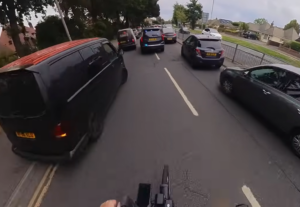
At around 3.30am on 30 October 2021, Alabaster struck Abdi from behind with her Nissan Patrol SUV. After initially assuming that the collision was an accident, Abdi was then forced to flee on foot as the motorist – a complete stranger – began to pursue him, driving on the pavement and smashing through garden fences while hurling racist abuse at the cyclist.
In footage captured on Abdi’s GoPro, Alabaster can be heard, above her vehicle’s revving engine, shouting, “I’m gonna kill you bitch”, while Abdi tells witnesses “someone is trying to run me over” and “I’m dying, she’s going to kill me”, as he takes refuge in a neighbour’s front garden.
A mother-of-three who chased and threatened to kill a cyclist on an early morning ride has been released from jail. @NatarjshaKramer #9News pic.twitter.com/Kq9wxrHpQG
— 9News Queensland (@9NewsQueensland) December 6, 2022
Alabaster was initially charged with attempted murder but later pleaded guilty to charges of dangerously operating a motor vehicle, threatening violence at night, and assault occasioning bodily harm while armed.
Defence barrister Jakub Lodziak said his client was remorseful and “embarrassed” and, while not drunk at the time of the incident, had been an alcoholic since her 20s and had suffered “trauma” growing up.
She was sentenced to three years in prison but immediately released on parole after the court heard Abdi’s impact statement which, remarkably, called for compassion towards his attacker, in what judge Peter Callaghan described as “one of the most extraordinary documents I’ve seen”.
While noting that “I am no longer the person I was prior to the incident” and that Alabaster had “transformed my life in the worst possible way”, Abdi nevertheless argued that prison is “not the right place” for the mother-of-three.
Addressing Alabaster in his victim statement, Abdi wrote: “I [am] pleading with you to take this opportunity to seek help and transform your life for better. I forgive you from the bottom of my heart and wish you the best in life.”
> Aussie road rage driver chased cyclist and smashed SUV through suburban fences
In an interview published earlier this week by Guardian Australia, Abdi explained the reasoning behind his remarkable call for leniency, though he admits that the trauma of his ordeal remains fresh.
“I was certain that day that I was going to die,” he said. “I’ve been reliving it every single day – it plays in my head in a loop. I can hear her voice. The red truck.”
However, the cyclist told the newspaper that he is more concerned with the impact the incident has had on Alabaster, and says that he rues the time she spent in prison away from her partner and children, who he describes as “innocent parties”.
Abdi is also concerned that the motorist, born in New Zealand, will be deported (according to government policy, New Zealanders who have been sentenced to at least a year in prison face deportation) and says that he is seeking to intervene with the immigration department on Alabaster’s behalf.
“That would be a travesty of justice,” Abdi says. “I choose to forgive her, because I believe compassion and forgiveness is justice in itself. It’s another form of justice.”
The cyclist, who fled war-torn Somalia as a teenager in the early 1990s, continued: “I don’t know if it is appropriate for me to say this, but in Australia they are obsessed with punishment. Crime and punishment.
“It emotionally fulfils our need of feeling safe, when you have someone sent to jail on your behalf, or the state avenges on your behalf, it gives you this emotional satisfaction.
“But, at the end of the day, nothing has been achieved.”
Abdi then said that the incident has prompted him to reflect on the circumstances that may lie behind violent attacks such as the one Alabaster inflicted upon him.
“That day she was going to run someone over, because she was in a dark tunnel,” he said. “I happened to appear in front of her. [But] she was just a conduit. What attacked me, or tried to run me over that day, was mental health and drug abuse. That’s how I see it.
“I knew for me to recover and move on, I will have to forgive her, and for her to get better, she would have to be forgiven.
“Compassion, forgiveness. It’s found in every human being.”

















23 thoughts on ““I was certain that day that I was going to die”: Cyclist forgives SUV driver who chased him in shocking road rage attack”
I can’t help but think that
I can’t help but think that Abdi’s forgiveness is misplaced. Alabaster may well have various issues, but continuing to chase a cyclist with clear intention to cause harm (never mind the racist abuse) is a classic example where the public needs to be protected from that person.
Indeed. I also think that his
Indeed. I also think that his forgiveness is irrelevant. Punishing the driver would serve as a deterrent, much needed time to re-educate and re-programme, and respite for the general public from a dangerous person.
I hope that the victim and the perpetrator both get the support they need.
Another “both!” We should
Another “both!” We should encourage virtue but we need to punish – or at least call out – vice.
We have to encourage driver virtue – or rather “basic competence” as I’d call it. Because it’s unlikely we’ll ever be able to catch ’em all.
BUT we’re human so that will not happen unless there is negative feedback on poor driving. That’s mostly “chance of being caught” times *consequences that will actually discourage bad behaviour*. Including *actually* stopping you driving if your actions were dangerous. Not just “we will ban you another time”.
This is a social acceptance thing also. We’d have a much bigger drink driving issue were it not socially frowned on so people discourage / report offenders. Needs both that AND the law!
Exactly. We don’t punish
Exactly. We don’t punish people because the victim wishes it in many cases. We do it because that person is a danger to society. Thats great that he forgives her but what happens when she does this again because she has learned nothing from the encounter.
mctrials23 wrote:
She had already spent thirteen months in prison pre-trial, during which she received mental health treatment, so if that hasn’t had an effect I doubt a few more months (assuming Australian parole works much like ours) would make any difference. This does look like a case where the woman has serious mental health issues, which notoriously are not well treated in prison (UK anyway), getting proper treatment for those is far more likely to prevent recidivsm than simple jail time. What would be useful in such cases, in my opinion, would be if an order were made that she was not to get her licence back until a panel of psychiatrists agreed that she had resolved her issues to the extent that she no longer posed a danger to other road users (or no more than whizzing around in a tonne of lethal metal normally poses, anyway).
You’re a better man than me,
You’re a better man than me, Abdi. He is right, and it is better to forgive than to hate, and as the old saying goes “hate destroys the hater.”
You are of course correct.
You are of course correct. But I feel it may also be somewhat easier to forgive personally when the perpetrator has been brought to book, held accountable and actually received a meaningful punishment for their actions.
Mungecrundle wrote:
The two things are not mutually exclusive. Offering personal forgiveness so as not to carry that anger and resentment with you should not require that justice not be served in the eye of the law … although, as the victim has here, calling for leniency is part of that personal choice.
Also when the offender has
Also when the offender has pled guilty.
You can forgive someone but
You can forgive someone but that does not remove their accountability for their actions nor the wider effects on the community.
hirsute wrote:
Why wouldn’t he forgive them? The crime never even happened. He just made the whole thing up. I didn’t see a rear-facing camera recording of the incident. I bet you can’t find a single still in the video in the article that supports Mr Abdi’s side of the story.
[Sarcasm = off]
However there are plenty of
However there are plenty of frames that show the vehicle chasing the cyclist and audio of her threatening plus other witnesses.
And why the sarcasm?
Nah, those frames only show
Nah, those frames only show the driver following the cyclist and certainly wouldn’t hold up in court.
And the audio only shows A driver (not THE driver) threatening someone. The driver could just say “it must have been someone else threatening to kill the cyclist!”. Even if it did get pinned on them, the driver could just say “I wasn’t threatening to kill THEM, I was only threatening to kill SOMEONE, so it’s totally irrelevant”.
[Again, sarcasm = off]
(And why the sarcasm? I think you know, but I’m happy to explain. Hirsute suggests on another article, that because a video taken during a hit and run was only front-facing, it doesn’t actually show a collision at all, and is in fact totally irrelevant. You yourself AS made a similar argument to the above on that thread. It’s as ridiculous here as it was when you made it there.)
You do realise what you see
You do realise what you see in the news article is sections of the evidence supplied to the Police and the courts? So yes, YOU could state your opinion based on the extracts above, however the courts decided the account of the cyclist matched the account of the WITNESSES and what was SEEN on the FULL videos supplied to them.
As for the other video, all myself, Hirsute and I think Awavey are stating is that there is no impact actually seen on the video posted by the user and shown to the Police. There is barely any movement on the camera to indicate an impact and the defence would have argued that it could easily have been caused by the cyclist looking around. Also as the cyclist pedalled away without even a flat, let alone a damaged wheel, he couldn’t even use that as evidence. I don’t think any of us have stated we didn’t believe the cyclist events, just that it was a shame he didn’t get a witness statement from the cyclist who obviously saw it and was gesturing at the driver as well as the video shows nothing to help him.
AlsoSomniloquism wrote:
Good for you. You are entitled to your opinion and I am entitled to mine. My opinion is that when a vehicular collision occurs and video evidence is provided, the police should do something about it. My opinion is that the driver in the video (and they WERE in the video, and the video DID show a vehicle being driven dangerously) is dangerous and should be punished accordingly. And my opinion is that your’s, Hirsute’s, Awavey’s and the police’s opinion that the statement by the victim and the video evidence provided is insufficient for any further action, is woeful and depressing.
The fact that you agree with the police in that is, in my opinion, a depressing sign that even amongst cyclists (I assume you are cyclists by frequenting this website), we no longer expect a level of effort by the police that protects us on the roads.
I will continue to expect that from our police services, regardless of your opinions on the matter.
It did stand up in court. She
It did stand up in court. She was convicted.
Yes I was being sarcastic,
Yes I was being sarcastic, sorry. In another thread a video taken during a collision was considered by some posters on here to be insufficient to require any police action.
I like you Abdi. You sound
I like you Abdi. You sound like a great guy.
Quirks of the system.
Quirks of the system.
“Threatening violence at night” carries up to 5 years behind bars.
In the day is up to 2 years.
http://www5.austlii.edu.au/au/legis/qld/consol_act/cc189994/s75.html
“an alcoholic since her 20s”
“an alcoholic since her 20s” – how come she has a driving licence?
“and had suffered “trauma” growing up.” – haven’t they all?
“banned from driving for 2 years” – why not life?
“Has 3 children” – those poor kids.
bikeman01 wrote:
How would she lose it unless she was caught drink driving? Being an alcoholic isn’t an offence; alcoholics are not necessarily, or indeed often, people who are permanently pissed. I’ve known alcoholics who were absolutely scrupulous about not drink driving because they knew that to be caught would give away to their partners, employers etc the extent of their problem.
Wow. Powerful words from Abdi
Wow. Powerful words from Abdi. I really hope she reflects on those and changes her life – especially with three kids who are all no doubt learning from her. I don’t know if Australia does restorative justice but this seems like a good opportunity for it.
Late to the story… the odd
Late to the story… the odd Christmas Baileys…
I’m wondering when the charge dropped down from attempted murder… at what point during the 16 minutes of chasing, damaging property shouting “I’m going to kill you” and racially abusing the victim before deliberatley driving into him does the prosecution think the driver changed from actions that were likely to murder him to simply operating a vehicle dangerously?