



A San Francisco-based cyclist is suing autonomous driving tech firm Waymo after she was seriously injured when one of the brand’s driverless taxis stopped in a cycle lane and a passenger opened its back door, striking the cyclist and causing her to smash into another Waymo car that was also illegally blocking the bike path.
According to the lawsuit, the Safe Exit system employed by Waymo, formerly known as the Google Self-Driving Car Project, which aims to alert passengers of surrounding dangers and hazards, failed – with the injured cyclist claiming that Waymo knows its cars are ‘dooring’ cyclists.
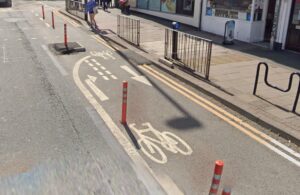
Jenifer Hanki was cycling in a marked bike lane on San Francisco’s 7th Street on 16 February, on her way home to her flat, when a Waymo taxi carrying four passengers pulled over into the cycle route on the right-hand side of the one-way street, before parking next to a no-stopping sign.
> Waymo self-driving car lets cyclists pull out of blocked cycle lane
“The kerbside Waymo’s left passenger door suddenly swung open directly in the bike lane,” the 26-year-old said in a statement announcing the lawsuit, according to a report by the San Francisco Chronicle.
“I had no room or time to swerve. With no room or time to react, I crashed violently into the door and interior.”
After she was ‘doored’ by the passenger, the impact of the collision shunted Hanki into a second Waymo that was also illegally parked in the cycle lane, before she landed on the road “disoriented and overwhelmed”.
“As there were no human drivers in Waymo’s vehicles, it exacerbated the chaos,” she continued. “The passengers were visibly confused, the two Waymos remained as they were, obstructing both the bike lane and regular oncoming traffic.”
According to Hanki, the passengers then told the injured the cyclist that it was their first time using Waymo’s autonomous taxi service, and that they were unsure how to report the crash. Hanki says they simply shrugged and left the scene after a few minutes, as other passers-by called for an ambulance.
The 26-year-old was taken to hospital, where she was treated for “serious bodily injuries”, including a brain injury, as well as spine and soft tissue damage.

In the wake of the “violent” crash, which has left her unable to work or ride her bike, Hanki this month sued Waymo and Google’s parent company Alphabet in San Francisco County Superior Court alleging battery, emotional distress, and negligence, while seeking unspecified damages.
According to her lawsuit, one of the safety systems marketed by Waymo is its Safe Exit, which is “supposed to be designed to detect nearby cyclists and pedestrians and notify disembarking passengers to avoid collisions”.
When it first launched as Waymo back in 2016, the firm said its cars are also programmed to recognise cyclists as “unique users of the road”, drive conservatively around them, and recognise common hand signals.
In 2019, the company also released a video showing one of its vehicles predicting that cyclists will move out onto the road to pass a car blocking a cycle lane, with the taxi slowing to allow them to safely move across.
However, Hanki says the company’s Safe Exit system failed, and that Waymo has long known that its cars are ‘dooring’ cyclists.
“Unlike Uber, Lyft, or taxis, where drivers actively monitor traffic and often lock doors or guide passengers to exit safely, Waymo’s system fell short significantly,” she said.
“There was no alert issued in the illegally parked car as according to the passengers. Human drivers prevent accidents every day by assessing real-time risks, something Waymo’s ‘Safe Exit’ system clearly cannot handle.”
> Uber warned over safety issues with its self-driving cars days before cyclist killed
While Hanki says she is not against self-driving technology in general, she believes there’s a “gap in accountability” when it comes to safety.
“As technology moves forward, we believe it is crucial for all autonomous car companies to not move forward too quickly,” Michael Stephenson, Hanki’s attorney, added in a statement.
“In the interest of public safety, they must make sure they are adequately testing and refining their technology before subjecting the public to these cars.”
Since the crash in February, 26-year-old Hanki says she is “yet to touch a bicycle because I am afraid of revisiting the same experience”.
“I feel anxious, stressed, and unsafe. Before the crash, cycling was a source of joy and freedom. Now how it feels like I’ve lost that part of myself,” she said.
Hanki isn’t the first cyclist injured at the hands of a Waymo ‘robocab’ in San Francisco. In February 2024, a cyclist was left with “non-life-threatening injuries” after one of the company’s taxis failed to detect his presence and struck him.
According to the company, “the cyclist was occluded by the truck and quickly followed behind it, crossing into the Waymo vehicle’s path. When they became fully visible, our vehicle applied heavy braking but was not able to avoid the collision.”
In November 2019, Waymo secured permission from the California Department of Motor Vehicles for its vehicles to carry passengers without the need for a safety driver who could intervene in the case of a potential collision, making it the first company in the world to secure such clearance.
It has since established itself as the market leader in the United States for self-driving taxis, with commercial operations in San Francisco, Phoenix, Los Angeles, and Austin, and has this week announced that it is planning to test its autonomous ‘robocabs’ in New York City.










58 thoughts on “Cyclist ‘doored’ by passenger of driverless taxi illegally parked in bike lane sues Google-owned company after tech failure caused “violent” crash”
Could this set a precedent
Could this set a precedent for the Company being responsible for the actions of its “self-driving cars” in the same way as is the driver of a normal motor vehicle?
Has the heat stolen your
Has the heat stolen your reason? Don’t you know how important these businesses are for saving the world ( / growth / keeping up with the digital Joneses? (We’re worried that someone else will build the Matrix / Skynet before we do…)
And haven’t you noticed that since “chips with everything” the tech businesses are now giving the established shopping / fuel / power / transport industries a run for the money? Literally – as in “do we have a display big enough to show our cash flows?
* “green tech” innit? Although “harm minimisation compared to paper” apparently, so that’s OK then!
I’d be interested in the
I’d be interested in the background to this story. Have Waymo’s insurers declared that they are not liable? In which case the passenger may be liable, although might not have insurance nor money. However, the passenger in question is surely the primary witness for the failure of the warning system, although I presume there’s cctv in the vehicle.
IanMK wrote:
“Oh dear, so sorry; those files appear to have been corrupted…”
“Oh dear, so sorry; those
“Oh dear, so sorry; those files appear to have been corrupted…”
Yes, that is indeed how the police work. It is reminiscent of this case:
https://upride.cc/incident/md68fwc_apcovernight_whitelinecross/
This was the early days of camera work, before I realised the depths of deception and lying the police are prepared to sink to, and I complained to ‘Professional Standards’ (it makes me squirm to think how naive I was). The report of the police officer about another police officer was that the NFA decision was correct because it was necessary to have confirmatory video from the offending vehicle and ‘surprise, surprise’, there wasn’t any even though the vehicle was fitted with a camera. Apparently, it wasn’t working. Therefore, concluded Lying Sgt Shyster, ‘the police couldn’t do anything’. That was the first, and only, use of the We Must Have Video from The Offender’s Vehicle Dodge. Now they have moved onto the We Never Respond to Submissions from Scum Cyclists Dodge. The response of Sgt Shyster to my comment about the visible shock I noted on the face of the driver of oncoming Focus ST04 LJK was ‘the driver wasn’t contacted’. The police, you see, think that they are dead clever and members of the public are really thick- implying that the driver couldn’t be contacted without the risk of anybody discovering that nobody ever tried
This seems like an attempt to
This seems like an attempt to go after the deepest pockets.
To my mind, it should be primarily the individual that opens the door that should be liable. However, going after the driver makes sense if the passenger doesn’t leave their details, but I would imagine that Waymo could produce the details of the passenger in this case.
It does seem like Waymo need to correct their vehicles though if they’re stopping in no-stopping zones and parking in cycle lanes.
In the UK the driver is
In the UK the driver is responsible though?
The question of liability has
The question of liability has been raised before, should you be in collision with a vehicle that is in auto drive mode, is the driver liable?
I believe the answer is NO. Therefore, the victim will be in a legal struggle with the manufacturer, maybe even having to prove the vehicle was malfunctioning?!
Autonomous vehicles parking
Autonomous vehicles parking illegally? Sounds like a system designed by some deskbound dipstick with a university degree who doesn’t have a driving licence.
Or a nerd who was recruited
Or a nerd who was recruited by Elon Musk for his training school. After passing the “no common sense” diploma, with flying colours (and never having a girlfriend), he was headhunted by the Waymo driverless taxi programme. He used his first paycheck to buy a second and third pair of underpants and a robot Pot Noodle maker.
I’d say that someone with a
I’d say that someone with a driving licence is every bit as likely to programme it to annexe cycling infrastructure.
And that to maximise
And that to maximise utilisation of the car thus maximising income and profit.
I have to admit that I am
I have to admit that I am really looking forward to seeing the first driverless ice cream van. The future is really exciting.
Oh come on – children out in
Oh come on – children out in the streets? Is 2000 still in the future? It’ll arrive by drone!
Or the ice-cream will be
Or the ice-cream will be emailed as a recipe and you will print it on a 3-D vari-temperature food printer, which also plays “Greensleeves”.
I’m sorry, but these
I’m sorry, but these autonomious cars are not ready for prime time, how many people will it take to get hurt and killed before they wake up to that fact. Maybe in 25 years it might be ready, but they haven’t been tested near enough, they are rushing the technology onto the streets, and letting us be the crash test dummies.
froze wrote:
Pretty sure that’s part of the business plan. Like when the gig economy companies explain that they can’t possibly afford to have all their riders as employees…
looks like nothing has been
looks like nothing has been learned by the diabolical Ford Pinto scandal.
But they’ll point to cars 1.0
But they’ll point to cars 1.0 and the car-nage that ensued, and (after over 100 years later) continues, and say “it’s literally a no-brainer – we need to take the brains out of the equation! It’s exactly the brains with their cheap kludges and historic artefacts of design, their glitches and their emotions – that are the problem! And we can fix that!”
And then, perhaps this… though I think (hope) this is a slight exaggeration – but not because there’s a principled reason why this won’t happen. Noting we already have the app-based “delivering stuff” companies “outsourcing risk in the public space” onto members of the public via setting up a “fight to the bottom” with human not-employees. At the very least I’d expect more commercial pressure on public space – which we’ve seen already in a slightly different context.
They aren’t. I believe that 4
They aren’t. I believe that 4 levels of testing and certification are required before an automatic car can drive itself, without any human attention. Level 1 has not yet been cleared within the UK and Europe. Hence Elon Musk’ s comment that European bureaucracy needs to be addressed. My concern is that governments often jump the gun for the good of commerce and we will end up with these cars being on the road and causing a lot of problems, by which time the manufacturers will have less incentive to resolve problems. (Similar to recent introductions of disposable vapes, E-scooters etc). In the US, auto cars have been involved in a lot of fatal crashes.
I believe that 4 levels of
I believe that 4 levels of testing and certification are required before an automatic car can drive itself, without any human attention. Level 1 has not yet been cleared within the UK and Europe
Even at Level 0 they’re going to be safer than Audi and BMW drivers (other psycho-nutter marques are available)
https://upride.cc/incident/cd10wer_audiq7_closerpass/
The only advantage for us where nutter human drivers are concerned, given that neither they nor the Skynet processor could care less about the safety of cyclists, is that the humans care about their cars more than anything else in the world. The major disadvantage for us is that the the humans think they’re technically much better drivers than they actually are and display a total lack of insight.
wtjs wrote:
A good point! Per the second point not enough people think “I could easily lose control here and take someone out / take a wall down”. But some of the less “high on life” folks might have a worry about scratching the paintwork
… perhaps there *is* a place for that idea of some plastic pipe sticking beyond the sides of the bike… 🤔
Statistically they are
Statistically they are already safer than human drivers.
Given that and the fact that they will continue improving we should be rolling them out even faster than we currently are.
Rich_cb wrote:
Although: https://www.bbc.co.uk/news/articles/cg75zv4gny2o
I’m not against autonomous vehicles per se, but Teslas are an abomination due to their lack of Lidar. They’ve painted themselves into a corner as Musk sold earlier Tesla models as “fully FSD capable” which means that if they decide to take advantage of the much cheaper modern Lidar sensors, they’d be on the hook for retro-fitting them to older models.
Waymo seem to be much further ahead with their vehicles and I’ve heard that there’s a few Chinese companies that are on par or overtaking(!) them
https://restofworld.org/2025/robotaxi-waymo-apollo-go/
hawkinspeter wrote:
In order to park in the cycle lane in front of them?
mdavidford wrote:
Well, maybe not on this little beauty: https://road.cc/content/news/217380-longest-elevated-cycle-path-world-opens-china
Tesla are nowhere near the
Tesla are nowhere near the market leaders despite Musk’s bluster.
Eventually they’ll get found out and a lot of people will lose a lot of money.
Waymo and Baidu are definitely the ones to watch.
UK will get fully driverless Ubers next year with our own company providing the driverless tech, hopefully that will be a success but catching up to the market leaders gets harder every day.
Rich_cb wrote:
Tesla’s stock price continues to amaze me, but then “The Market Can Remain Irrational Longer Than You Can Remain Solvent” (possibly Gary Shilling)
(Price to earning ratio of 187 compared to BYD’s 22)
It is very tempting to short
It is very tempting to short them regardless!
I think this is just “selling
I think this is just “selling resource-intensive new solutions to old mistakes” – and inevitably adding new problems, while not directly addressing the old ones.
However – that is the way humans and technology have been since forever so I’m really complaining that the sea is wet here! It just seems to be coming in fast … but I’m getting older so that’s a normal perception perhaps?
There are certainly some benefits of these to “people at large” compared with “the current wild west”. There are definitely huge benefits to tech companies, it keeps the power and motoring industries going, and it’s good for authorities in favour of more centralisation and control *. Then for businesses in general there are the usual cost savings in eliminating human workers. Perhaps there are some “resource savings” – although the course of history shows they are often small or entirely negated by greater use of the system.
I doubt that they’ll live up to many of the touted advantages. Mostly because some of these run counter to current human behaviours (e.g. people want their own private vehicle on standby 24/7 until the instant they want it. And for more “public” models – this has been available forever – see jeepneys, taxis – …).
Many of the proposed advantages seem to require that in adopting new tech somehow people can agree to work together to maximise the benefits **. Whereas we usually see pretty fierce if not outright violent competition when “conquering new terrain” (cf. current wars etc.)
I am mostly concerned with the increasingly centralised private appropriation of “public goods” (e.g. public space, data …). Plus the fact that you effectively have to adopt more tech to “remain in society”. But again – those are not really new complaints!
* Which cuts both ways – there is the potential for economies of scale and great efficiencies. There’s also the “easy for the state or an aggressor to deny use of the system”. A hostile actor before would have to blow up roads, bockade tankers, or otherwise sabotage fuel supplies – and many vehicles would still keep moving. Now they just have to do a bit of hacking – and not only could they bring everyone to a standstill, they could potentially use all the vehicles as weapons.
** e.g. agree standards, or the “we can use all the extra space – assuming this generates it – for active travel, parks etc.” – that is a lovely vision and almost certainly wildly utopian! OTOH a few places are managing to turn “driving space” into more efficient / pleasant for humans spaces, against the expected flow of “motoring profit” – so it is at least possible. But also clearly we don’t need tech for that – this has been done in a completely separate domain (political choices and will).
I would rather take my chances with a driverless Waymo than a bunch of ciclysts at a pedestrian crossing in London.
Come on, who put 10p in the troll?
I note you’ve rushed back to a year-old article in your concern, but chin up! Those cyclists are almost zero risk to you in your car…
I hear that many in London have concerns about antisocial cyclists. Alas humans aren’t always careful about others and they take shortcuts and make up their own rules. Ultimately “safer that person on a bike than in a motor vehicle”.
Most people still aren’t cycling, and there’s still the perception of cyclists as like little drivers. And I suspect there’s still a bias of riders towards “the fit and the brave” vs. 8-80 cycling.
That and the substandard infra designs here build on conflict. Good enough in places for cyclists to tempt them in numbers but not good enough at minimising conflict between cyclists and pedestrians.
That’s apparent at traffic lights; here the UK mostly has cycle *lanes* with little or no separation from the main road. In better designed places (with separate cycle paths) the traffic lights may not apply to cyclists in some directions (less temptation to jump lights). There’s also space for pedestrians to wait after crossing the cycle path (informally – no lights needed) before dealing with the motor traffic (motor vehicles are why lights *are* needed). Easier and more convenient for all.
Apart from saving on the
Apart from saving on the driver’s wages, what is the point of driverless vehicles? They still take up as much space, they still congest, pollute, create noise and, in the event of a collision, damage as much as a vehicle with a driver. So what is their point?
I guess their ‘point’ is that
I guess their ‘point’ is that they don’t break the speed limit, drive under the influence of drugs or alcohol, drive without insurance or get distracted using a mobile phone etc etc.
If the technology ever gets to the point where it is 100% safe of course.
That’s just the sales pitch
That’s just the sales pitch to the regulators though…
Benefits to users – do all the stuff you want like being on your phone or getting drunk, not a problem. Saves the mental effort of driving.
Benefits to companies – fewer employees! Far less scope for liability / wages!
Benefits to those producing them? It’s business, but I suspect something more, from the absolutely crazy money being flung at these companies. Perhaps it’s just another “betting on this being a great leap forward and this delivering incredible wealth in the future” / those *not* in this going belly-up?
Consider that most cars sit
Consider that most cars sit idle 95% of the time taking up valuable space.
Driverless cars reduce the need for private car ownership and thus free up huge amounts of road space. We could use that space for bike lanes or whatever else took our fancy.
Human error is, reportedly, responsible for >85% of road collisions. Reduce that figure and you save a lot of lives.
Finally, the ability to autonomously deliver things will reduce the need for large lorries and vans on roads during daylight hours, further increasing available space and improving safety.
car can drive itself, but you
car can drive itself, but you still have to open the door manually?
The alternative is to be
The alternative is to be locked in while the car does endless loops of an airport car park like that fella a few months ago
A shit design and it is set
A shit design and it is set up to create an unsafe situation.
So yes I would be seeking to sue the vehicle designers and the vehicle operators.
But as with these issues we again have the problem of riders going into dangerous spaces, eg undertaking turning lorries etc and some sense of self preservation may have avoided the conflict, esepcailly considering:
However, Hanki says the company’s Safe Exit system failed, and that Waymo has long known that its cars are ‘dooring’ cyclists.
Although these two situations seeem quite different one is allowing cyclist to pull out around parked vehicles – good, whereas the incident appears to be allowing the car to pull in front of cyclists and allowing the doors to be opened into the cyclist’s path to enable passengers to disemabark. Yet the victim knew about the problem and did not mitigate it by allowing extra time or space – why?
Last paragraph is classic
Last paragraph is classic victim-blaming, of course the victim knows about it now after they were doored, but why would they anticipate the doors would be enabled in a no-stopping zone alongside a cyclelane?
That should be a scenario where “computer says no”.
I hope the victim is able to
I hope the victim is able to win a case on this point. The driverless car tech isn’t good enough.
Why do we need driverless
Why do we need driverless vehicles? I don’t believe there is a shortage of drivers.
Repeating others, if they can
Repeating others, if they can be made to work properly they will follow the rules of the public highway (no speeding, road rage, etc., etc).
For me, the passengers are at least as responsible as the vehicle manufacturers/owners.
But this one stopped in a
But this one stopped in a cycle lane and next to a no stopping sign. So less on the rules of the highway. This “behaviour” has been allowed by the “programmers”, very drivist.
Anyone want to take a bet that higher end driverless vehicles will be “encouraged” to exceed the speed limit?..
Google et.al. are wasting so
Google et.al. are wasting so much money trying to reinvent the wheel.
We already have driverless vehicles with their own infrastructure in which reasonably foreseeable variables have been controlled.
If people want driverless vehicles that aren’t a threat to pedestrians, cyclists and all other road users, it’s called the DLR.
Muddy Ford wrote:
“The Neolithic revolution was a terrible mistake”
… I have some sympathy with this one – we were almost all less healthy and happy thereafter. But humans will invent stuff and continually change things to get advantage over other humans. It’s just another happening in the world of “creating things that we can sell to people that concentrate money / power for us”.
The answer to “but human drivers are terrible” is to observe that our usual pattern of mitigating the misuse / side effects of one technology with a more complex one has a rather … spotty history. (But dealing with “but humans” is very hard…)
chrisonabike wrote:
….because our financial
….because our financial systems are geared towards the benefit of capital owners rather than labour. Capital can be amortised over 5 years which makes it ultimately cheaper than labour all other things being equal.
How those same financial systems will deal with an lack of wage input into the economy of the results of favouring highly automated capital intensive machines remains to be seen. We are potentially at a similar inflection point as we were when Agriculture was automated but its less clear what the future equivalent of Mills will be to soak up the excess workforce.
Working age population is
Working age population is plummeting across pretty much all advanced economies.
We need to find a way to automate a lot of work and quickly.
There will be no excess workforce to soak up.
Waymo doors are locked until
Waymo doors are locked until it pulls to a stop and then an announcement will direct passengers to take appropriate care when leaving the vehicle which includes making sure you are aware of other road users or peds – so responsibility is with the ‘confused’ passengers in this case. Would they have normally blamed a taxi driver in this type of incident, hence the bewilderment? There are multiple ways of alerting Waymo staff from the vehicle And the app, so no excuse.
I’m kinda ‘confused’ as to how the cyclist crashed into the Waymo’s interior AND also another taxi that was in the cycle lane further along. Some of the details just don’t add up. Is there an ambulance chaser lawyer involved who is egging details? How would the cyclist know the messages or safety tech hasn’t worked as she arrived after this process has been completed? For sure, Waymo’s shouldn’t be parked in cycle lanes and this needs sorting, and will likely be resolved long b4 analogue drivers will stop doing this.
I’ve found travelling in Waymo’s to be cheaper, safer and more relaxing and without the discriminatory chat.
FauxPlesse wrote:
As long as you can avoid those responsible for self driving vehicles on the social medias / in the news, that is…
FauxPlesse wrote:
They were going by the passengers’ account:
I would have believed the
I would have believed the passengers version if they hadn’t slunk off, leaving the injured cyclist to fend for herself. People that do that will have no qualms in saying it wasn’t their fault they opened a door without looking despite any warnings.
FauxPlesse wrote:
So seems like it wasn’t already in the bike lane, as road.cc have rendered it, but was passing alongside the first car on its way to pulling in to the bike lane.
That SF version kinda helps
That SF version kinda helps but I’m still confused as to how she crashed into the interior (her words).
When using Waymo’s i was amazed at how quickly it responded when drivers would cut up the Waymo in a 3+ lane system- they either knew it would allow this by reacting in deference or they would sue the firm if there was a collision (?) The Waymo response calculated for multiple vehicles around it instantaneously (whereas we need to check mirrors and make a decision to slow, change or speed up to avoid a collision). This incident required a prefect storm of malfunctions & lack of awareness, but the accounts don’t add up.
The fact these cars have been
The fact these cars have been programmed to stop in bike lanes at stop signs means its there is ahared blame here ,Google are on the hook for most of this because if the car hadn’t stopped in the no stopping the oassanger would never have been able to open the door .This lady is in for a large payout
[Pedant] Google aren’t on the
[Pedant] Google aren’t on the hook for anything. In the unlikely event that liability extended to the parent company, that would be Alphabet. [/pedant]