



In one of the more bizarre racing controversies of recent times, an Italian pro cyclist saw his one-day race victory stripped following a sensational 60km solo breakaway, the commissaires ruling that his Cervélo’s handlebars did not comply with the UCI’s new minimum width rules.
Filippo D’Aiuto thought he had landed a sensational win at Polese Memorial on Saturday, a national one-day race held near Treviso in Northern Italy, however after the finish line his joy turned to disbelief and frustration as race officials measured the width of his handlebars and deemed the distance between his brake levers to be too narrow.
As per the rules newly introduced at the start of this season — which attracted widespread criticism from riders, staff, bike-fitting professionals and other figures from across the sport — riders must now use a bar width of 400mm or wider and the distance between the brake hoods can only be 280mm at a minimum.
The UCI cited safety when introducing the rules, the governing body evidently keen to clamp down on what it views as increasingly ‘extreme’ set-ups, however many have questioned the impact of the rule on smaller riders and the female peloton, many of whom are now forced to run wider bars than they have been prescribed by bike-fitting professionals to meet the UCI’s limit.
In an added twist to the story from the Italian domestic scene this weekend, D’Aiuto’s General Store-Essegibi-F.lli Curia team insisted his team-issue Cervélo was fully compliant with the regulations at the start of the day, and blamed the post-victory irregularity on a crash which left their rider cut and bloodied prior to making his race-winning move.

It is impossible to tell from the YouTube live stream of the race if this was the case although, of course, hoods can bend to avoid snapping in cases of crash impact. The team believes D’Aiuto’s bike was set up to the legal width and during the impact a hood was bent inwards, meaning that it fell foul of a commissaire’s tape measure.
Lorenzo Magli won the sprint for second place and was ultimately promoted to first following D’Aiuto’s disqualification. However, during the podium ceremony, Magli and Davide Boscaro left the top-step empty “as a sign of respect” to D’Aiuto.
View this post on Instagram
In a statement shared later that evening, D’Aiuto’s General Store-Essegibi-F.lli Curia team gave their side of the story, insisting the bike was “regulated in all its components” at the start of the race, but a crash “resulted in a shift in the position of the levers which, because of the impact, ended up at a distance less than the allowed”.


It would be a large understatement to say that the UCI’s new maximum handlebar width regulation did not go down well in some parts of the cycling world, many accusing the rules of being particularly unfair for smaller and female riders. In fact, at least 7,000 people signed a petition on change.org to appeal the new regulations.
That petition argued, “The new ‘one-size-fits-all’ policy does not account for the variety in body types and biomechanics among riders. Cyclists come in all shapes and sizes, and their equipment needs to reflect that diversity. Not every cyclist can perform optimally under the same conditions; some require wider handlebars to accommodate broader shoulders, while others need narrower grips for better control and manoeuvrability based on their body’s build. The regulation particularly impacts female cyclists who, based on our own extensive database (one of the largest in the world) and other studies, on average require a 38cm handlebar.”
The petition said that this regulation could inadvertently place riders at risk of injury – the opposite of the UCI’s intended consequence – on the basis that “improper bike fitting can lead to chronic pain and musculoskeletal issues”.


















9 thoughts on ““It’s ridiculous”: UCI’s controversial new handlebar rules see pro cyclist disqualified after 60km solo win, but team insists ‘illegal brake levers’ were bent in crash”
Even more ridiculous than the UCI-rule he breached is his lame excuse.
I’ve seen a better picture him finishing and both levers are tilted inwards at about the same angle. I’ve had my share of crashes and it seems rather unlikely you’ll move both levers in a crash, let alone moving both levers to about the same angle.
If it was set up originally to the minimum allowed, it would only have needed to move fractionally to take it to an illegal position, in which case it would be near impossible to tell just by looking at a finish line photo.
Zooming in on the finish line photo here it looks fairly obvious that his left lever is bent more inwards than the right, do you have a link to the clearer picture you mention? In any case, as MDF sagely points out, there’s no way to tell from a picture whether one shifter is a couple of millimeters farther in than the other, enough to breach the rules if they were at the limit before the crash.
I bent both my levers inwards when I crashed in January – hit an unpainted speedbump hidden by the shade of a tree in Thailand – so it’s entirely possible. Although I fell to the left the right shifter was also pushed inwards and the rubber hood was ripped, suggesting the left shifter dug in (fortunately I fell into the verge) and caused the bars, forks and wheel to spin round.
bent both my levers inwards when I crashed in January – hit an unpainted speedbump hidden by the shade of a tree in Thailand – so it’s entirely possible. Although I fell to the left the right shifter was also pushed inwards and the rubber hood was ripped, suggesting the left shifter dug in (fortunately I fell into the verge) and caused the bars, forks and wheel to spin round.
Working as a bike mechanic, I can attest that it is possible to have both levers bent inwards after a crash – seen it multiple times.
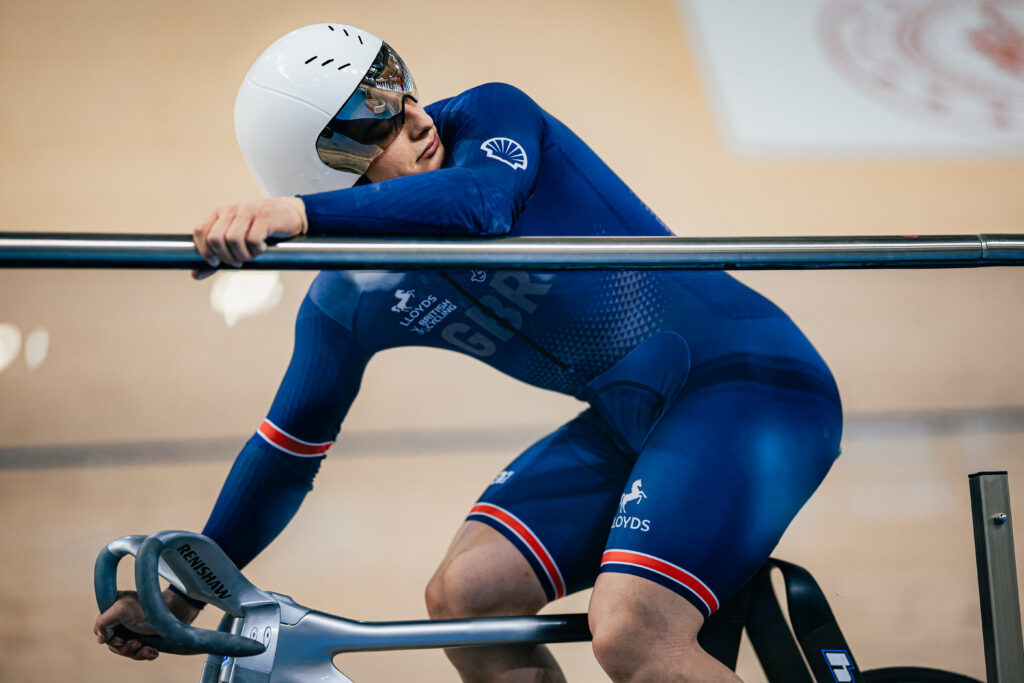
I do have sympathy with the race commissaires on this one – the image included in the article clearly shows the rider resting on the hoods to get more aero’, and since the team admits that the levers were too narrow after the crash, this is gaining an unfair advantage over other riders, regardless of how that setup was achieved or how the bike was setup before the race. I’m not defending that the rule makes sense, but if the rule is in place then it should be enforced when it applies, and clearly that’s the case here. Needing to change a bike after a crash is a normal part of racing, and he chose not to, thereby gaining an advantage.
Without full knowledge of his exact set up I’d say that’s probably a bit of an assumption; I have inward-turned levers on my road bike (for wrist comfort rather than aerodynamics) and this makes it possible to ride in the position he’s shown using in the photographs, hands on top of the levers and forearms resting on the flat part of the bar. However, as I have a 44 cm handlebar to suit my broad shoulders and the levers are turned in about 6cm each, making an angle of about 30° from straight forward, I am still well within the minimum lever-to-lever distance. It would be interesting to know what the rider’s set up was and by how much the commissaires said he was breaking the rules.
“however after the finish line his joy turned to disbelief and frustration as race officials measured the width of his handlebars and deemed the distance between his brake levers to be too narrow”
So, the way I understand this is, on measuring POST RACE the bars were deemed to be illegal. It would be fair t o assume that all bikes are checked for conformity at the start. So, in reality, what is stopping riders bending them further in while racing and then back out as the cross the line? its not difficult to do. you dont need a great anount of force to move a shifter in or out. Crashes happen, so unless the UCI states any time a rider goes down they must swap bikes how is this actually 100% enforceable?