

- News
- Reviews
- Bikes
- Components
- Bar tape & grips
- Bottom brackets
- Brake & gear cables
- Brake & STI levers
- Brake pads & spares
- Brakes
- Cassettes & freewheels
- Chains
- Chainsets & chainrings
- Derailleurs - front
- Derailleurs - rear
- Forks
- Gear levers & shifters
- Groupsets
- Handlebars & extensions
- Headsets
- Hubs
- Inner tubes
- Pedals
- Quick releases & skewers
- Saddles
- Seatposts
- Stems
- Wheels
- Tyres
- Tubeless valves
- Accessories
- Accessories - misc
- Computer mounts
- Bags
- Bar ends
- Bike bags & cases
- Bottle cages
- Bottles
- Cameras
- Car racks
- Child seats
- Computers
- Glasses
- GPS units
- Helmets
- Lights - front
- Lights - rear
- Lights - sets
- Locks
- Mirrors
- Mudguards
- Racks
- Pumps & CO2 inflators
- Puncture kits
- Reflectives
- Smart watches
- Stands and racks
- Trailers
- Clothing
- Health, fitness and nutrition
- Tools and workshop
- Miscellaneous
- Buyers Guides
- Features
- Forum
- Recommends
- Podcast
 Richmond Park collision caused by dangerous driving (credit: Royal Parks Police)
The Telegraph continues campaign against 'dangerous' cycling in London parks — but collision data actually highlights "dangerous driving" and "serious collisions" caused by drivers
You might have seen this week The Telegraph published its latest story about cycling in London's Royal Parks, this time claiming that collision data shows "more walkers hit by cyclists than cars in royal parks" and that the findings "contradict claims from bicycle campaigners that cars are main problem" in London's green spaces.
 Telegraph Royal Parks story (credit: The Telegraph)
We got hold of the collision data to dive deeper into the incident and collision reports across all eight of London's Royal Parks, including Regent's Park, Richmond Park and Hyde Park (the first two particularly popular destinations for the capital's cyclists), to see what the reports actually say about road danger in London's green spaces.
It's worth noting from the start that The Telegraph's headline statement that "more walkers hit by cyclists than cars in royal parks" is true, as per the reported figures provided by the Royal Parks, and reading through the full incident reports from January 2024 to April 2025 highlights several cases of people on bicycles causing safety concerns, to other riders or pedestrians.
According to the Royal Parks' data there were seven instances of a pedestrian being hit by a cyclist during the 16-month period and two involving a runner being hit by a cyclist, although one of those cases saw the runner abruptly turn around without warning into the rider's path.
While the injuries sustained were in most cases minor, one pedestrian visitor in Richmond Park was "hit by a cyclist whilst crossing a road" and "suffered multiple serious injuries to arm, head and hip". Another incident, in Kensington Gardens last July saw a child hit "hard" by "a teenager riding an electric Lime bike", leaving the child "bleeding a lot".
The Telegraph concluded that the "data contradicts claims from bicycle campaigners that cars are main problem" in the parks, a debate which has seen particular attention in the past year as the Royal Parks has increasingly emphasised cyclists' responsibilities in its messaging about safety, while ignoring similar advice to motorists.
The charity responsible for the green spaces recently told cyclists to slow down and published a code of conduct for cyclists, adding that it has no plans to introduce a similar code of conduct for people who visit in cars. The Royal Parks has also called for new laws to prosecute cyclists for breaking 20mph speed limit in its parks, cancelled early-morning club cycling events in Richmond Park, and continued to allow drivers to use the "ancient woods, rolling hills and wide-open grasslands" as a cut-through route at all hours of the day.
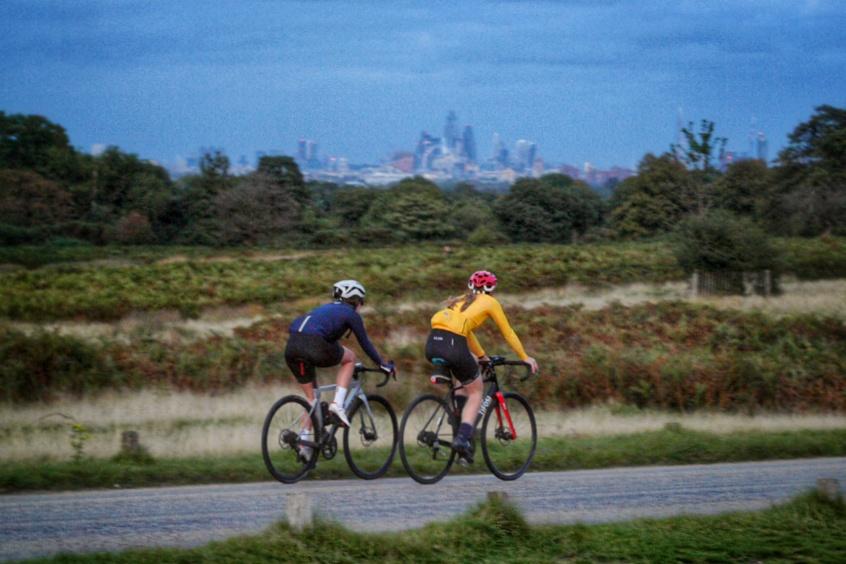 Cyclists in Richmond Park with London skyline (credit: Simon MacMichael)
Consequently, many cyclists and local cycling groups have questioned if the organisation's approach is actually concerned with improving safety, or just implementing stricter rules for cyclists.
So does the data (as The Telegraph says) "contradict claims from bicycle campaigners that cars are main problem" in London's parks?
While we already mentioned the seven reported cases of a cyclist hitting a pedestrian in the Royal Parks, the data also shows at least seven cases where cyclists were hit in collisions caused by a driver. There were three other collisions involving a cyclist being hit by a driver where the report lacks enough detail to say definitively why it happened.
Additionally, three cyclists were 'doored' by the driver or passenger of a vehicle, while three collisions were reported involving dogs off their lead causing cyclists to crash.
Looking more widely at the most serious collision reports of the past 16 months, regardless of if a cyclist was a victim, one incident involved a "racing" driver "travelling in excess of 40mph" in Richmond Park. The driver, later "booked for dangerous driving", was seen "overtaking several cars" before crashing through a post and "destroying" a tree before coming to a stop next to another one. The date and details of the incident match this Royal Parks Police post below.
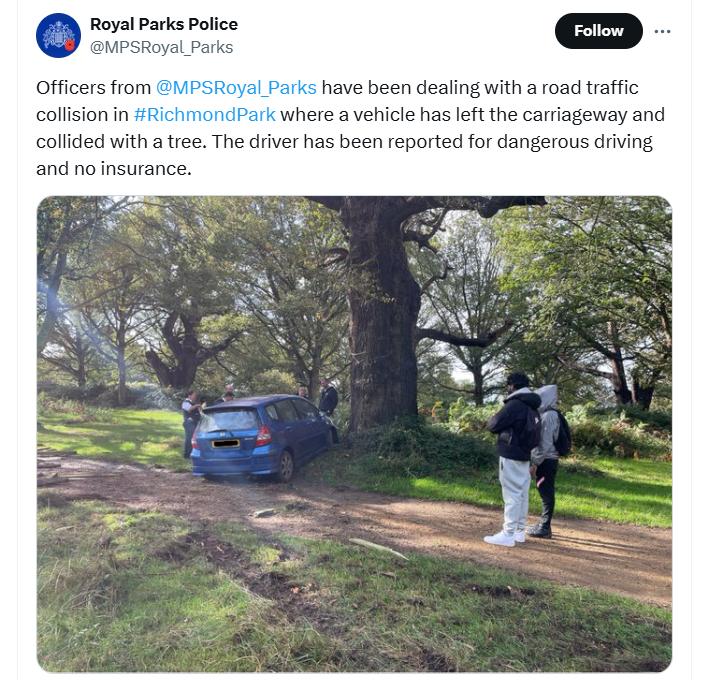 Richmond Park collision (Twitter) (credit: road.cc)
Another "serious collision" in Regent's Park saw a "lamp column taken out" on the Outer Circle and ended with a "car [...] landing in Cornwall Terrace".
In Richmond Park, on 11 May 2024, a cyclist was hit by a driver pulling into a car park "without seeing" the rider. On June 7, someone reported "there's a risk a cyclist is going to get killed" after they saw "two very near misses" involving drivers "failing to spot" cyclists. "Serious accidents [collisions] were only avoided because the cyclist was able to stop in time," the report told the Royal Parks.
On 14 July, also in Richmond Park, a cyclist was taken to hospital with head and pelvis injuries after a collision with a driver who witnesses disputed was indicating when they hit the rider.
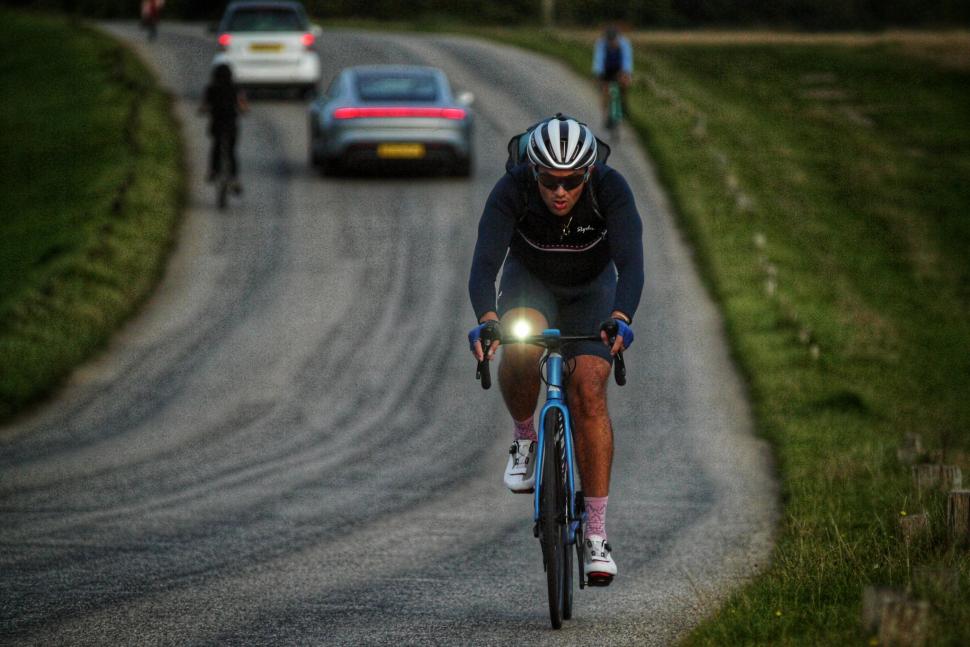 Richmond Park (credit: Simon MacMichael)
Two car park incidents alone saw five cars damaged and a boundary wall knocked down. One saw four cars damaged when someone accelerated rather than braked, while the wall was damaged when another driver's "foot slipped as they were wearing wellies".
In Regent's Park, a streetlamp was "destroyed" in a one-driver collision last month, while last year the Royal Parks also reported a driving incident which badly damaged a tree.
On 14 March last year a cyclist was injured when a turning driver caused a collision, while on 23 May the driver of a "catering-liveried" van hit a cyclist while making a left turn, claiming they had "committed to the turn" (even though from the description provided the Highway Code would give the cyclist priority in such situations).
On 18 July a cyclist suffered injuries and an ambulance was called after a crash involving the driver of a BMW 4x4 who made a U-turn in the road. One other collision, on 18 January 2024, happened after a cyclist "reportedly ran a red light and collided with a vehicle".
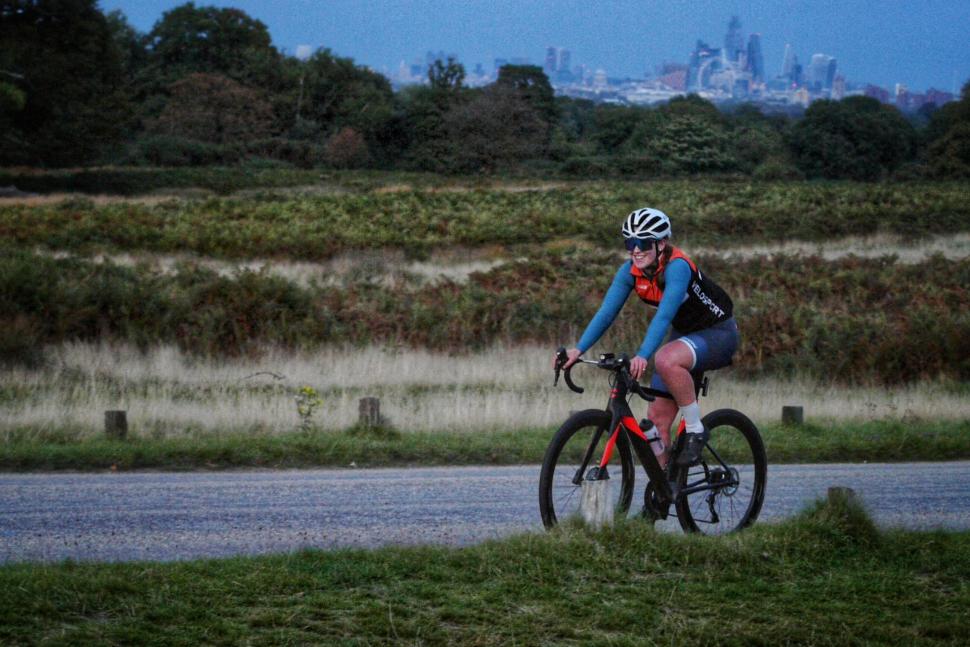 Richmond Park (credit: Simon MacMichael)
It is difficult to compare incident numbers and make overall statements about the comparison of incidents and road users in the Royal Parks, largely due to some reports being ambiguous, lacking detail and context, or just coming from one person's perspective.
However, the extensive driving reports are unlikely to allay cycling campaigners' fears that the Royal Parks' emphasis on cycling-specific policies to combat road danger misses a rather large cause of incidents and collisions in London's parks — dangerous or inattentive driving.
It might also be worth noting when assessing the reports, that those involving 'cyclists' in many cases do not offer evidence of what type of bike the 'cyclist' was riding, some reports suggesting the rider endangering pedestrians was an "e-cyclist" or on an "e-bike, travelling at an estimated 20mph, thought to be a delivery bike", opening the door to the possibility that some reports involve people riding illegally-modified bikes that are in fact motorcycles or mopeds in the eye of the law and would require a licence and insurance.
When we approached the Royal Parks for comment on the collision data the charity opted to stick to its safety messaging approach of recent times, placing most emphasis on cyclists.
"These wonderful green spaces are incredibly important to so many people in London, but they are shared spaces meant for everyone, and we must all play our part and be considerate of others. We welcome considerate cyclists and provide many miles of cycleways across our parks, used by thousands every day.
"Unfortunately, we have seen too many collisions and near misses between speeding cyclists and pedestrians or wildlife, which is why we recently launched a 'considerate cycling' campaign, asking cyclists to slow down, stay within the maximum 20mph vehicle speed limit in the parks and respect others. The campaign is backed by a new code of conduct that all cyclists entering the parks should adhere to, regardless of whether they are commuting, exercising or exploring the parks recreationally.
"The safety of all park visitors is our top priority, and it is our duty to take action to minimise the risk of accidents. We believe that reminding cyclists to watch their speed will improve safety in the parks for everyone and will give cyclists more time to react in the event of a possible collision."
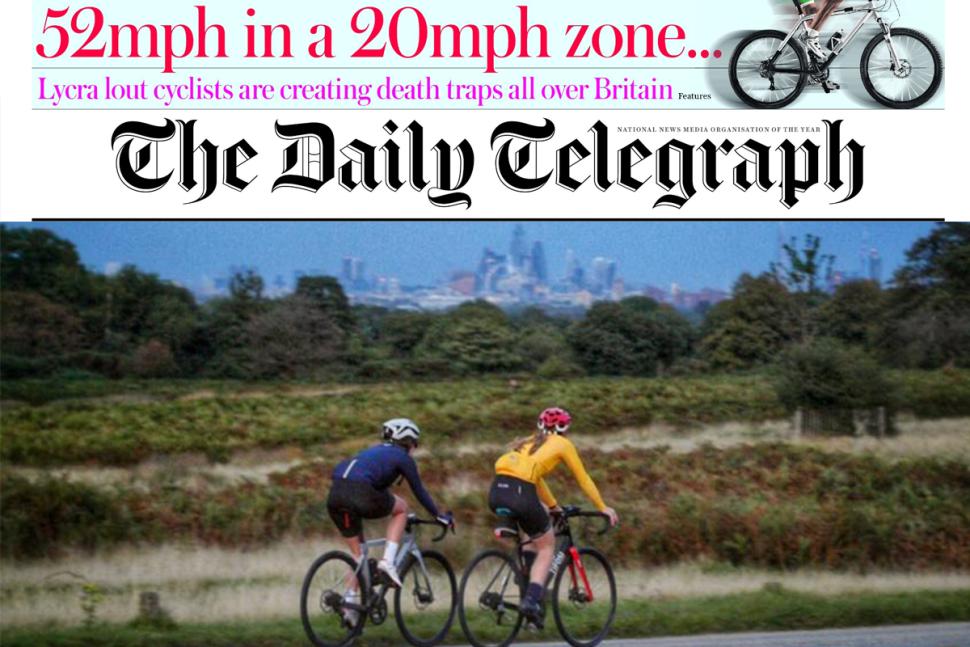 Telegraph front page/ cyclists in Richmond Park (credit: Simon MacMichael/Telegraph)
The Telegraph is of course the newspaper which was found in breach of IPSO's Editors' Code over a front page story last year which claimed that London cyclists are riding at 52mph in the hunt for Strava segments, that despite the speed being faster than Olympic track riders.
The newspaper has also been accused of "manipulating" photos of cyclists riding around Regent's Park for a column which claimed "speeding cyclists" are endangering drivers. The collision data for Regent's Park did not include a single cyclist/pedestrian collision between January 2024 and April 2025, while multiple cyclists were hit by drivers at Regent's Park during the same time.
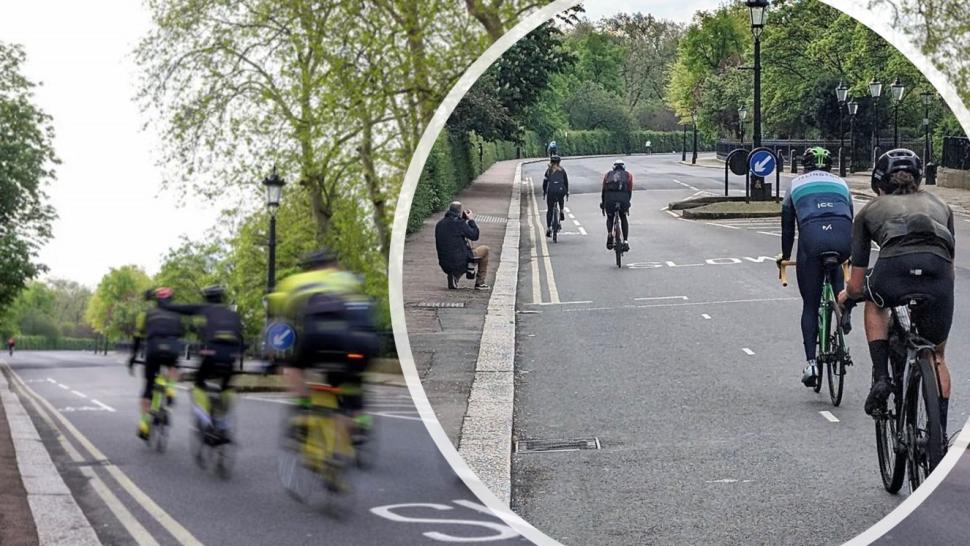 Regent's Park cyclists photographed by Telegraph for 'rogue cyclists' column (credit: Rory McCarron)
However, the death of 80-year-old pedestrian Hilda Griffiths, who died in hospital in 2022 from injuries sustained two months earlier in a collision involving a cyclist riding laps of Regent's Park as part of a group ride travelling at between 25 and 29mph garnered much media and political attention last year during an inquest into the incident.
The inquest into Griffiths' death heard the Metropolitan Police confirm the 20mph speed limit does not apply to cyclists and Brian Fitzgerald would not be prosecuted as there was "insufficient evidence for a real prospect of conviction".
It sparked the political momentum for the stricter 'dangerous cycling' laws which are now expected to be passed.
> Cyclists who kill pedestrians could face life sentences under proposed new 'dangerous cycling' law
In the year since that inquest the Royal Parks has repeatedly made headlines on this website and the wider national press for its approach to road safety and cycling policies. The charity reviewed its cycling policies last year and has made repeated calls for new legislation to allow it to enforce speed limits on cyclists in its parks, that after it was forced to admit that, in line with the wider road laws, speed limits do not apply to cyclists.
Last summer's Richmond Park Time Trials were also cancelled by the Royal Parks. Organised by the London Dynamo cycling club and first run in 2009, they were due to take place on 23 June and 7 July – and had been praised for their inclusivity and for providing a gateway into the sport, enabling beginners to compete on road bikes and on almost traffic-free roads due to their 6am starts.
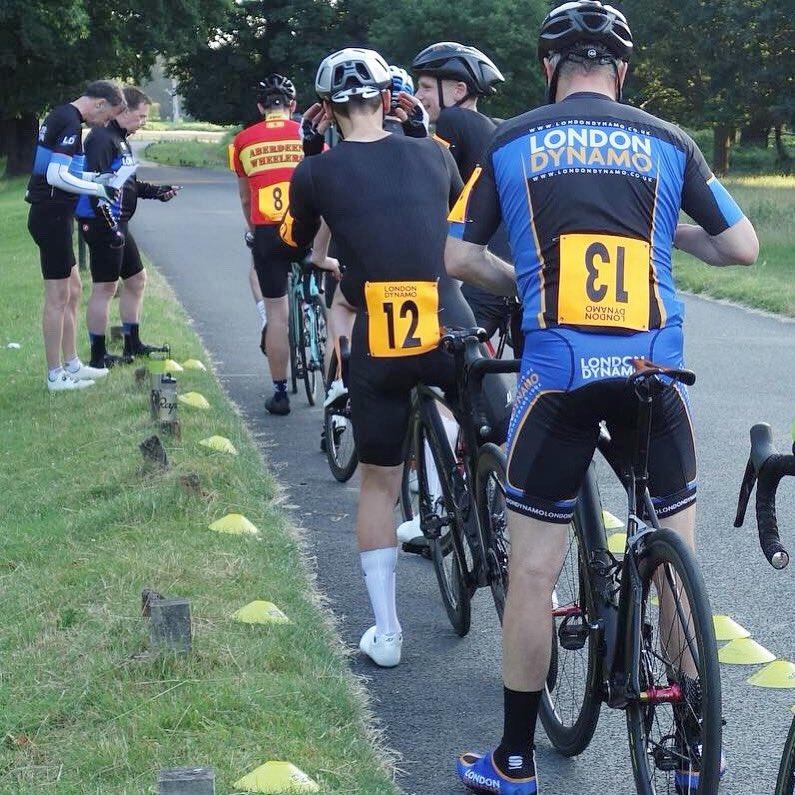 London Dynamo Richmond Park time trials (credit: London Dynamo)
However, the Royal Parks cancelled last summer's events over fears riders would break the park's 20mph speed limit, a decision which left organisers "fuming" and arguing the decision had been clouded by "very irresponsible journalism" and that the alternative is "busy roads and fast-moving cars".
"Following several cycling-related incidents, it is our duty to take action to minimise the risk of accidents and our priority to ensure the safety of all cyclists together with other visitors," Richmond Park's manager said. September's London Duathlon in the park was subsequently also cancelled.
The Royal Parks has received plenty of criticism over the years for its approach to improving road safety in its parks. Many, including the London Cycling Campaign (LCC), have repeatedly asked why through-traffic is still allowed to use Richmond Park as a shortcut, the campaign calling the cancellation of well-organised events "weak" while "daily rat-runs" continue.
While some of Richmond Park's roads are closed to motor traffic on weekends, during weekdays the green space, which the Royal Parks proudly calls an "extraordinary landscape" that is also London's largest Site of Special Scientific Interest and a National Nature Reserve, is used as a cut-through for motorists driving between Kingston upon Thames, Richmond and Roehampton.
 Richmond Park traffic queues Mayday Bank Holiday 2022 (credit: ohbee07 on Twitter)
The LCC has campaigned for the park to be closed to through-traffic for years, arguing it would improve road safety and make it "far better for people walking, cycling and relaxing in". Specialist cycling insurance provider ETA Services Ltd recently also called it an "ongoing embarrassment" that the Royal Parks "allows this nature reserve to be used as a rat-run".
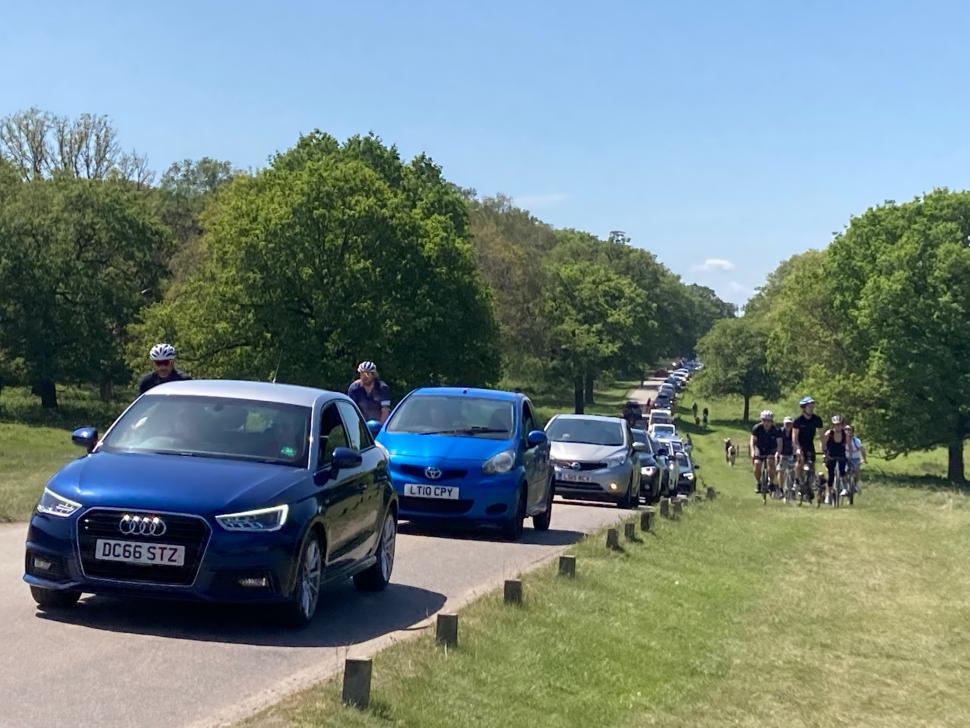 Richmond Park queues (credit: X/The Royal Parks)
Instead, the Royal Parks has focused its efforts on getting Strava to remove segments in Regent's Park and Richmond Park, something the tech giant rejected as the Royal Parks has already "directly acknowledged Strava is not root cause of issues".
The charity also recently told cyclists to slow down and released a much-criticised code of conduct for those visiting the parks by bike and, when faced with a backlash, said it would not be introducing a code of conduct for drivers either.
Dan is the road.cc news editor and joined in 2020 having previously written about nearly every other sport under the sun for the Express, and the weird and wonderful world of non-league football for The Non-League Paper. Dan has been at road.cc for four years and mainly writes news and tech articles as well as the occasional feature. He has hopefully kept you entertained on the live blog too.
Never fast enough to take things on the bike too seriously, when he's not working you'll find him exploring the south of England by two wheels at a leisurely weekend pace, or enjoying his favourite Scottish roads when visiting family. Sometimes he'll even load up the bags and ride up the whole way, he's a bit strange like that.
Latest Comments
- chrisonabike 9 hours 28 min ago
True. But a with so many things it's probably the thousands / millions of much smaller contributions from the rest of us which really tip the...
- WhichWayNow 10 hours 2 min ago
I had some rim brake CLX50 in 2017 that had 21mm internal width. Very few wheels are coming with a 21mm internal width these days. That's why I...
- Another_MAMIL 11 hours 3 min ago
Is this Rapha jacket for poor people? No respectable cyclist would pay anything less than £410 for a jacket......
- kingleo 12 hours 4 min ago
Trying to distract attention away from the road users who do most of the killing and injuring: car drivers.
- LeadenSkies 12 hours 57 min ago
Wogan Junior's comments show the dangers of leaving far too much money to your kids. The bloke thinks he is somehow a celebrity. He wishes. Don't...
- check12 13 hours 8 min ago
hopefully your site doesn't break like the British cycling site did this weekend after what looks like an update gone wrong for logins
- j4m1eb 13 hours 14 min ago
I was amazed that it was included in my membership and to top it off somehow I manged to pay via my iphone and therefore paid £3.99!
- Slartibartfast 13 hours 24 min ago
"For the first time ever – probably because it was cold – Parthena-Rose was wearing her helmet and body protection in the car, which may have saved...
- bornagainbiketart 14 hours 13 min ago
Another vote for Osprey here. I commute with an Osprey Metron 24L backpack and love it. Don't want to go back to panniers. It's so comfortable I...
Add new comment
31 comments
Pages