



The government is hoping a new map showing how well local authorities are maintaining their roads and fixing potholes will hold poorly performing councils to account and drive improvement across England.
British Cycling has welcomed the move and warned that, for cyclists, potholes “are far more than annoyance” and pose a real danger of serious injury or death.

The government announced £7.3 billion of funding for road maintenance at the Autumn Budget, a figure the Department for Transport says is a record, a new traffic light ratings system for England today launched to “let [the] public see which local highway authorities are fixing potholes effectively” and which are falling behind.
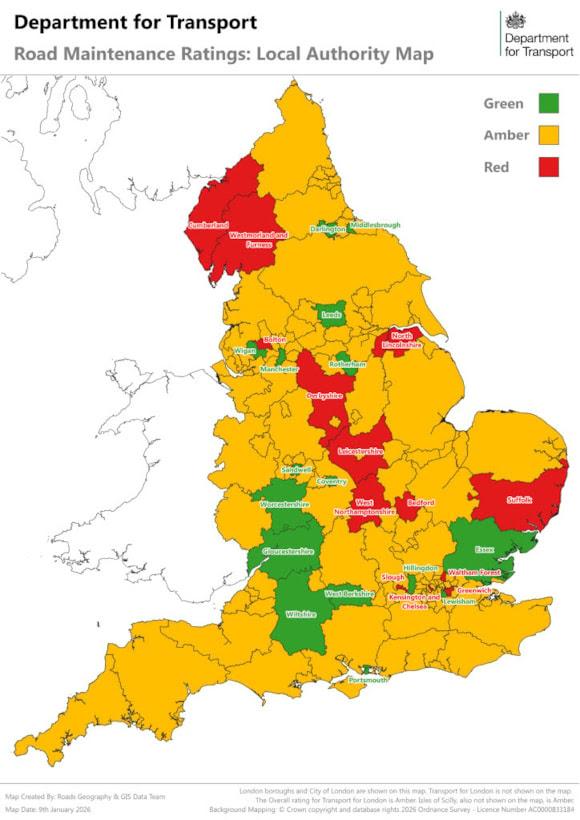
Areas such as Leeds, Manchester, Gloucestershire, Wiltshire, Essex and Worcestershire have, the Department for Transport says, demonstrated “they are following best practice such as investing in more long-term preventative measures rather than just patching up potholes, while also maintaining good road conditions and investing significantly into improving local roads”.
Most councils fall into the amber rating, which suggests Local Highways Authorities in those areas “showed some of these qualities with room for improvement in individual areas”.
The worst performing areas, coloured in red such as Suffolk, Leicestershire and large parts of the north west of England are “not yet meeting the expected standards in one or several areas measured by the ratings”. This could include the current state of the roads, their plans for preventing potholes or investment into maintaining their local roads more widely.
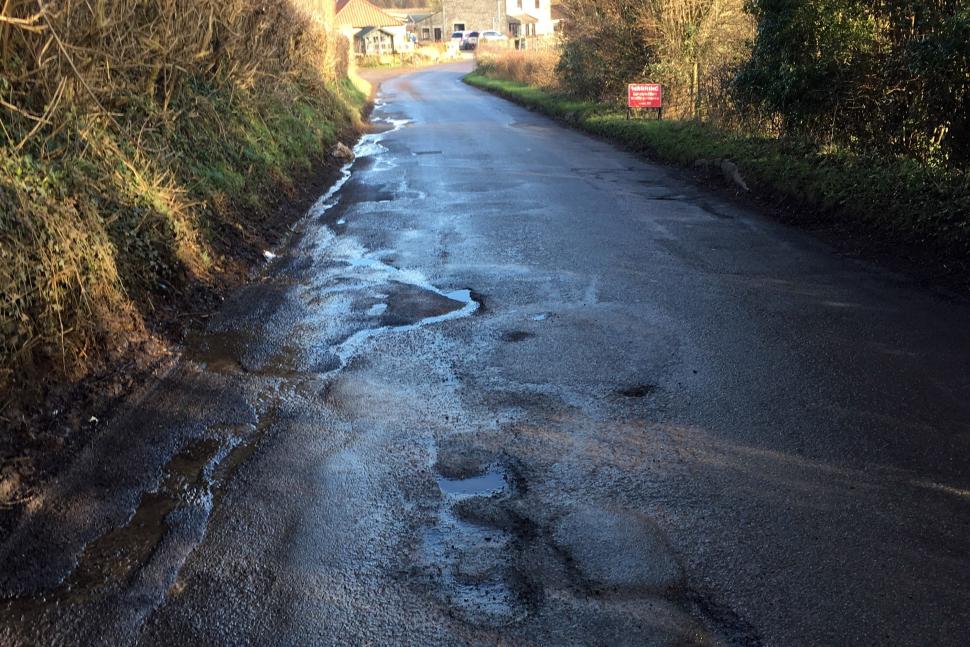
The DfT said any area rated red will receive “dedicated support to bring them in line with best practices, backed by £300,000 worth of expert planning and capability assistance”. The government department also suggested that access to full future funding allocations “will be linked to performance, ensuring councils are encouraged to get on with the job and use taxpayer money efficiently”.
As mentioned earlier, British Cycling has welcomed the news and was involved in the announcement of the new ratings, alongside the AA, RAC and Local Council Roads Innovation Group.
Caroline Julian, the brand and engagement director at British Cycling, said: “For cyclists, potholes are far more than an annoyance. One unexpected impact can cause a serious crash, life changing injury or, in the worst cases, a fatality. Safe riding depends on safe roads, and a smooth, well-maintained surface isn’t a luxury for cyclists, it’s essential for their safety.
“This new mapping tool is a step forward. It gives riders clear insight into how well their council is maintaining the routes they rely on every day, whilst holding decision makers to account.”

AA president Edmund King suggested research had shown fixing potholes was the top transport demand for 96 per cent of its members.
Simon Williams, the head of policy at the RAC, said while “there are examples of good road maintenance practice taking place, this isn’t consistent across the country”.

“We hope this initiative, plus the promise of longer-term funding for councils to allow them to plan and carry out much-needed preventative maintenance, means we’re finally on the way to having smoother, better roads.”
The announcement comes in the same week the government unveiled the first Road Safety Strategy in over a decade, with the stated aim of saving thousands of lives on the nation’s roads by tackling drink driving, improving training for young drivers, and introducing mandatory eye tests for older motorists.
The content of the announcement included commitments to consult on reducing the drink-drive limit, as well as introducing a three or six-month minimum learning period, to “give learner drivers more time to develop their skills in varied conditions such as night driving, adverse weather, and heavy traffic”.
The DfT also announced a consultation on mandatory eyesight testing for those over 70, as well as developing options for cognitive testing too. While the content of the strategy has been welcomed by many, some within the cycling-campaigning world have suggested it does not go far enough and more could be done to protect vulnerable road users.



















21 thoughts on ““For cyclists, potholes are far more than an annoyance”: British Cycling welcomes government’s new pothole traffic light ratings showing which counties “are fixing potholes effectively””
Sponsored by Shell, a company
Sponsored by Shell, a company that benefits from consumers buying SUVs, which by the laws of physics, cause potholes faster.
Why does “the world” have
Why does “the world” have this obssesion with SUVs? They’re cars that generally weigh between 1.2 & 2.2 tonnes, yes they are slightly taller than saloons. Likewise EVs, our car weighs 1.6t the equavalent EV weighs 1.8t.
Buses weigh circa 8t, HGVs up to 44t. Damage is proportional to fourth power of the weight. Not to mention the damage caused by turning multi wheel HGV trailors.
Potholes are “caused” by heavy vehicles and remain because of a lack of maintenance.
Congestion is caused by too many vehicles, of any colour, and yes it is made worse by big vehicles, of any height.
Exactly this, while consumer
Exactly this, while consumer vehicles are getting bigger and heavier, it is of no comparison to HGVs. My road, a busy 20 limit, gets absolutely battered by construction HGVs speeding along early in the morning or other quiet periods. Manholes, buried pipes, etc are fractured every few months, lighter vehicles don’t do anything like the same amount of damage.
Well, SUV is an expensive
Well, SUV is an expansive and ill- defined term.
And while buses and trucks are way more important for road damage, that doesn’t mean cars do none, and that significantly heavier cars won’t do much more.
But (on even more unnecessarily large and heavy vehicles) I guess criticism of them is a thing partly because the history, design and marketing of these creations is like an outrageous but true caricature of everything about the negatives of the mass motoring industry. The drive to sell more stuff regardless of harm caused (see bonnet height, worse visibility, susceptibility to roll on earlier models…), marketing towards the antisocial, the dodging of regulations, the push from the US of stuff which isn’t great there but is wildly inappropriate elsewhere…
On SUVs/light trucks, history and problems https://m.youtube.com/watch?v=jN7mSXMruEo
Why they’re not a good idea in Europe https://m.youtube.com/watch?v=–832LV9a3I
Not really addressing the
Not really addressing the pothole question [I think I’ve got my motorist hat on here 😉 ] but why are cars getting bigger, heavier & more expensive? And how do we reverse the trend.
Manufacturers blame the buyers, who want more space, the politicians who want them safer and themselves because they want more margin*. All of this driven by modern “marketing”, want not need. And even if I buy the same model, I will be supporting this growth.
* Margin: Luxury (bigger) cars – bigger margin, Electronics replacing physical functions – lower cost & the opportunity to upsell the product with often unnecessary & dangerous functionality, not to mention the eyewatering cost of repairs.
ChrisA wrote:
The increasing size of cars also makes them unwieldy to drive.
Large cars can be cumbersome to park, and wide vehicles are unwieldy to drive on narrow rural roads. The wider the car, the worse the driving experience.
ChrisA wrote:
OK, if you didn’t like that then a) first what is the “pothole question”? What are we comparing with? How much is measurable and how much is perception (opinions from elsewhere that then find their own evidence because that’s humans)?
I’d guess it’s mostly about reductions in local government funding, together with more development / works and pressure to get that approved with fewer staff and longer chains of subcontractors, plus growing road use … but that’s speculation.
It’s not cyclists or a stealth war on the motorist, i know that (unless you count war between motorists).
I was meaning, my previous
I was meaning, my previous comment related more to the size (design & marketing) of modern cars, than their pothole generating potential.
I think the pothole problem should be aimed at medium/heavy goods vehicles, road design & lack of maintenance.
Save the design of modern cars for the spacial & safety argument.
And then there’s the volume of traffic & subsequent congestion.
Finally (?) there’s the standard of driving & enforcement (not what it used to be).
Seperate, but interelated problems, if you like.
I generally agree.
I generally agree.
I think it would be of interest to compare with some other countries in our bracket and neighbourhood, only I think “bloody potholes” may now be a thing like “bloody cyclists” and other “war on motorist” complaints, so the “why” may be niche interest.
ChrisA wrote:
I think the first NotJustBikes video does a fair review of the first part.
Like most things one answer is “because we can”. It’s rare that humans have refused more expensive, prestigious things if they can get them, and there are more of us as time goes on and more of us can get the things!
(We’re all getting “richer” in terms of the resources we can command, but of course we mostly feel poorer because the next person “above” us seems to have even more wealth/prestige, which requires more effort by us to chase, to keep ahead of those “below” us catching up).
How did these things come to be? The bright sparks at the manufacturers. As you note, sort of pushing at an open door because finding ways round current tax rules. That might be an issue but we’ve thoroughly bought into mass motoring. And after that it’s all “growth” … which is the tiger our lords and masters cannot dismount. Which of this major national carmakers’ profits will you refuse?
Buses and trucks are far more
Buses and trucks are far more important to the economy than SUVs. They’re the reason roads are centrally funded by taxpayers – they convey a net benefit to society – whilst private car owners are unfairly subsidised in comparison. Stands to reason that the private cars which cause the most damage should be singled out for the most criticism – and that’s before you talk about the fact they’re more dangerous to other road users in crashes (pedestrians and cyclists especially).
Riding in Lancashire, I
Riding in Lancashire, I regularly ride in Wigan and Bolton. The guidance on this traffic light system must be incredibly arbitrary – both areas are identical to the rest of Lancashire, with the majority of roads little more than a ploughed field in places. In comparison to main roads in many other parts of the country I’ve ridden/driven in, the primary routes in Lancashire are in a horrific state, so it can’t be based on that – and rural roads in Wigan around Orrell/Bryn/Winstanley/Skem are, if anything, worse than those round Turton/Belmont/Horwich, so I’d be keen to see what metrics they’re using. Probably just budget spend allocated.
The survey tells us what we
The survey tells us what we already know, very few local authorities are doing a good job (even by their own standards) of maintaining the roads. Many Lcal Highways Authorities set their own motornormative criteria for fixinng potholes, based on the size and depth of the defect and frequency of inspection. They then claim they are following due process.
Why doesn’t Cycling UK take a Pro-active Stance? Write to every Local Highways Authority telling them:-
A pothole which is a minor inconvenience to a motorist can present real danger to a cyclist. Cyclist claims against road defects often include personal injury and are much more costly than typical motor vehicle claims.
Potholes which hve a sharp exit edge and are deeper than the width of a bicycle trye (typically 28mm) can cause a puncture or break a rim.
If the exit edge is angled to the direction of travel can turn a front wheel resulting in a serious fall.
If a cyclist gets a front wheel in a groove in the road (often a failure to make good a trench) then a serious fall is almost inevitable
Multile potholes are an added danger. Cyclists avoid the first pothole only to line themselves up for the next one, putting them in conflict with traffic.
Even if LHAs ignore the advice it would be easier for cyclists to make claims against them.
The most frustrating thing I
The most frustrating thing I find with potholes is collapsed reinstatements or poorly finished reinstatements.
There seems no real effort from Essex county to force contractors to make good. I did note one today I had reported 2 months ago and had rejected as not requiring work, had now been sorted (well, for a bit anyway).
The most frustrating thing I
The most frustrating thing I find with potholes is collapsed reinstatements or poorly finished reinstatements
Pfff! Living in the Dark Ages down there. We have potholes which spontaneously close up and heal themselves in Lancashire, deliberately misleading the County Council’s Pothole Inspector, but then spontaneously open up again causing the death of our elderly fine example: Harry Colledge
The worst potholes are not
The worst potholes are not the ones that you can see and have at least a chance of avoiding, but those that are filled with sand, or water, or even leaves!
Celebrating a huge budget to
Celebrating a huge budget to fix potholes doesn’t solve the real problem here. The quality of the road surface that was or is used needs to be better, utility companies that dig up the roads need to be held to account for the quality of the repairs which they are not
On a separate note Scotland is not on the list but worth noting some areas up here are far worse than anywhere I’ve ridden in England, pay Edinburgh a visit…
I am not sure exactly what
I am not sure exactly what criteria were used for this but they must be either wrong or easily gamed because Essex have a MAJOR pothole problem and they certainly are not doing a good job of repairing them well. The number of really dangerous collapsed edges, wide longitudinal cracks and deep potholes on my local roads is frightening and despite reporting several with exact locations and pictures, the most normal response is “we can’t find any defect at this location”. And if they do find a problem, often the response seems to be to tar and chip the worst affected areas without dealing with the underlying defects which just conceals the danger and makes it more difficult to see.
I imagine it only looks at A
I imagine it only looks at A and with a lesser importance B roads, so largely useless to cyclists
Fair play to Essex. Obviously
Fair play to Essex. Obviously it’s still not perfect but they have made some noticeable progress on many of the roads I cycle in most frequently and some of them were awful before. Quality repairs and total resurfacing. The difference is obvious when you get into neighbouring districts like Hertfordshire and the London boroughs. Credit where it’s due and hopefully they can keep it up and others will follow suit now this grading system is in place. There are obviously much bigger issues at play here, though, not least the massive cuts to council budgets.
Interesting. We clearly
Interesting. We clearly cycle along some geographically very similar roads (I may be slightly further north than you I suspect) and yet we have totally different experience and opinions of them.