


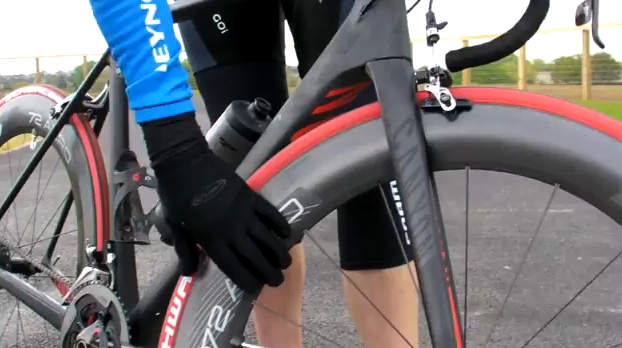

Paul Lew, the chief aero engineer at Reynolds Cycling, recently talked road.cc through the latest Reynolds wheel range, dubbed simply Aero. In particular, Lew described how his latest design tackle the bugbear of deep-section wheels, stability and handling in cross-winds.
Paul Lew is a former pro triathlete, an aero expert and a composites engineer – a genuine big cheese in the world of bicycle design. He set up Lew Racing and is with Reynolds Cycling. When he’s not reinventing the bike wheel he's been known to work on unmanned aircraft for the US government – drones, to you and me.
The Reynolds Cycling Aero wheel range was launched this year and uses their Dispersive Effect Termination (DET) rim design that was first introduced on the really expensive RZR 92 wheels. There are three rim depths, 58, 72 and 90mm, and prices start from £2,099. Expensive, yes, but half the price of the aforementioned RZR 92 wheels.
What is DET? Well, if you watch the video above Paul explains it in detail. In short, it's a rim shape that improves the handling of wheels in cross-winds.
The wheels are built with DT Swiss Aerolite spokes, G2 alloy nipples and DT Swiss 180 straight pull hubs. The complete weight of the three new wheelsets is competitive. The Aero 58 hits the scales at 1,570g, the Aero 72 is 1,680g and finally the Aero 90 is 1,900g.











5 thoughts on “Video: Reynolds Cycling wheels guru Paul Lew talks aerodynamics & sidewinds”
I thought they came with DT
I thought they came with DT Swiss 240 hubs?
Being both a cyclist and
Being both a cyclist and sailor, I found that really interesting (perhaps more so than the interviewer did…?? B-) )
Sounds Nice,But Believe Me
Sounds Nice,But Believe Me You
Don’t Want to Be Caught By A Gust Of Wind In A Group Ride.
The DET won’t Help You.
Only A Prayer.
Just Ask Vino How He Broke His Pelvis.
😕
Lew Is Correct About The Air
Lew Is Correct About The Air Foil Advantage As Measured In A wind Tunnel.
What He Fails To Mention Is That His Model Works In A Steady State.
Sudden Changes In Wind Speed Or Direction are Going To Cause Dangerous Conditions For a cyclist In A Group Ride.
jackp30 wrote:Lew Is Correct
Paul just emailed us to add this: