


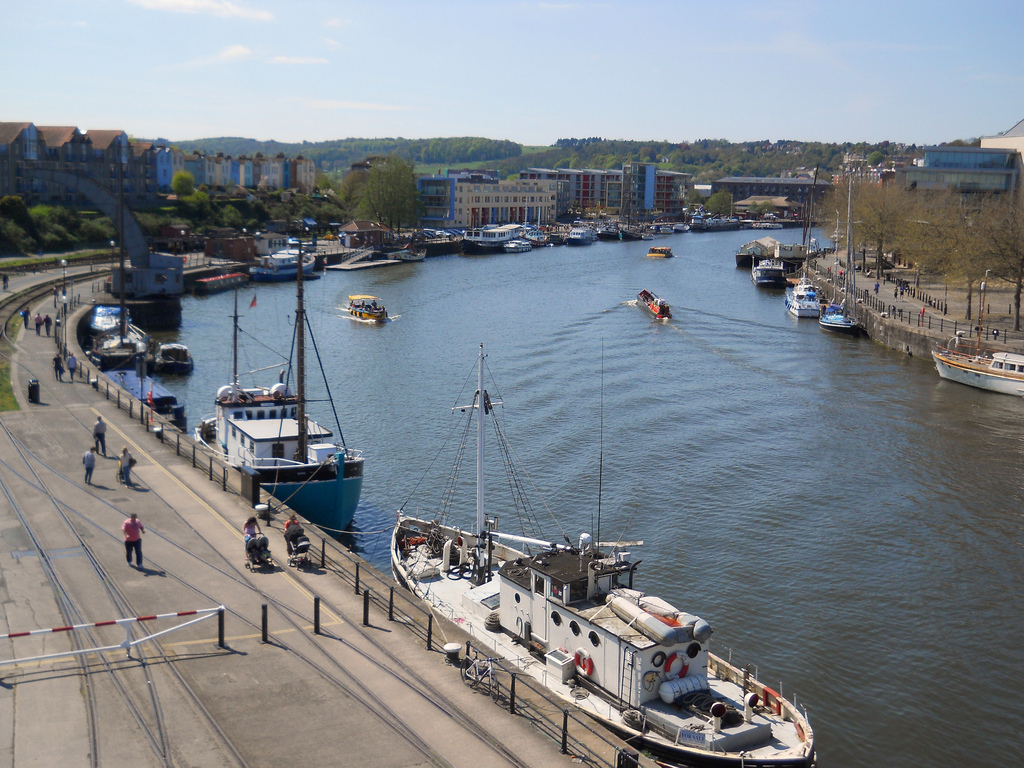

A High Court judge has ruled against the family of a cyclist who drowned in Bristol’s floating harbour and thrown out their £2m claim against Bristol City Council. Sean Phillips fell off his bike and into the harbour as he rode to work along Princes Wharf in March 2013.
The action, brought by Phillips’ partner Hayley Liddle and their two sons, sought to establish among other things that signage was inadequate and that there should have been railings to prevent people from accidentally falling into the water.
Vincent Williams, representing the family, said that if “a combination of measures had been adopted, namely effective signage, railings, some kind of physical impediment or discouragement to cyclists to stop them … that would in all probability have led to this accident not occurring.”
Bristol City Council denied liability for Phillips’ death. James Burton, defending Bristol City Council, argued: “The law does not require occupiers to provide a risk-free environment, and it expects adults who choose to run obvious risks to take care for themselves.”
The Bristol Post reports that on Friday, Judge Mark Gargan QC ruled that a “package of signs” alerting cyclists to the dangers of riding along the wharf was adequate.
He said Phillips “would have been aware of the risk of a fall caused by the rails, even without the notices that have been around it” and said that “any cyclist going along that route would have realised that there was a risk of falling into the dock if they cycled near to the harbour edge”.
He also said that as Phillips was an experienced cyclist, it was unlikely he had lost control of the bike without some external cause.
He found, on the balance of probabilities, that riding over metal tracks used for the harbour train had caused the bike to behave “in a different and unusual manner” after he had lost control.



















8 thoughts on “Judge rules against family of Bristol cyclist who drowned in floating harbour”
A sad case but a reasonable
A sad case but a reasonable decision. Nowhere can be 100% safe, and adults make choices and have to take responsibility that choice.
burtthebike wrote:
Yes, agree. Before they installed the barriers I used that stretch of the harbourside regularly along with my son who had ridden it from the age of aged 6, he’s now 15 years old and never fallen foul of the rails.
There was plenty of signs indicating the dangers and I see this as a waste of time and money with some no win no fee lawyers thinking they could get a large pay out the only motivation.
Agreed. Basically, he wasn’t
Agreed. Basically, he wasn’t a tourist: knew that the rails and water were there. And that’s irrespective of whether BCCs signage was or was not rubbish. Not victim blaming, but I don’t think you can say he was unaware of the potential risks there… The council cannot mitigate everything.
Victims are often to blame.
Victims are often to blame. As in this case. I don’t want to live in a risk free environment, and I don’t care that it means some people will die.
birzzles wrote:
Often? Well, that’s a bold claim. I mean, I agree that he was responsible for the risks he took, but I think you’re getting a fair way beyond that.
birzzles wrote:
Brave words. I also don’t want to live in equivalent of an adult soft play. The more rules and barriers get applied the less reason you have for them not to impose them on you for your own good.
birzzles wrote:
There are few perfect victims, but i’d keep the just world fallacy in mind.
Not a cycling incident but,
Not a cycling incident but,
https://www.google.ie/url?sa=t&source=web&rct=j&url=https://www.irishtimes.com/news/crime-and-law/courts/high-court/woman-injured-tram-surfing-on-luas-awarded-550-000-1.3669184&ved=2ahUKEwjGyorLrZfeAhWHBcAKHRUSAtcQFjAGegQIAhAB&usg=AOvVaw3-UavC6gQcGRPPy5L4WbAA&cshid=1540119093221