



A student who died when she crashed on her bike as she descended the Winnats Pass in Derbyshire’s Peak District screamed “my brakes have gone” just before hitting a drystone wall, an inquest has heard.
August Atkinson, aged 22 and studying veterinary science at the University of Bristol, had gone for a ride on her Genesis Equilibrium bike, a birthday present from her parents whom she was visiting that weekend.
They believe that the bike’s disc brakes were faulty, although the coroner presiding over the inquest into her death, which happened in April 2014, has said he does not believe there was a significant issue with them, reports The Sun.
Ms Atkinson had returned to her family home near Sheffield for the weekend and went out for a ride with her friend and housemate at university, Kieran Patel, with whom she was planning on riding from John O’Groats to Land’s End.
The pair became lost, meaning their planned 25-mile ride turned into a 40-mile one.
At the inquest at Chesterfield Coroners’ Court, Mr Patel said that Ms Atkinson had owned the bike for eight months but had “only been out on it a few times.”
He and Ms Atkinson’s father changed the inner tubes on her bike before they set off on the ride, and he told the inquest that there had been an issue with her front quick release lever, but they resolved it.
They rode up Winnats Pass, with Mr Patel saying, “The wind took it out of us we were tired.”
When they reached the summit, they took a wrong turn, meaning they had to climb the pass again.
“August complained her legs were cramping,” Mr Patel said. “I guess we had a little bit of apprehension about going down Winnats Pass, but nothing major.
“Going down I was cycling in front. I was constantly using my brakes on and off.
“August was behind me, coming down steadily, my speedometer said I was going at about 20mph.
“Then, August came past me on the right-hand side. She was getting faster; she must have been travelling at 30 to 40mph.
“She shouted ‘My brakes have gone’. She was freewheeling, she couldn’t stop.”
Ms Atkinson got through a sharp left-hand turn halfway down the descent, but witnesses said she was “wobbling” and “fishtailing” as she tried to slow down.
At the foot of the pass she swerved to avoid traffic and went over a grass verge before hitting the wall, sustaining fatal facial and chest injuries.
Police Contsable Ian Philips, who investigated the fatal crash, told the inquest: “Something affected her ability to bring the bike to a safe speed. We don’t know exactly what happened.”
Assistant Coroner Peter Nieto has said that he is considering a conclusion of accidental death, but Ms Atkinson’s parents believe the brakes were at fault.
Her mother, Elizabeth, said: “August was a sensible, level headed person, she was not a risk taker or someone who had lapses in concentration.
“She must have had control on the descent because she made it around a sharp bend and steered around cars.
“I know we are never, ever going to prove it, but it seems to me that something has let her down at that point.
“What I have found out since my daughter’s death is that there have been problems with the brakes on these bikes,” she added.
But Mr Nieto said that none of the evidence presented at the inquest suggested the brakes had been a factor in her death.
He said: “There were a number of factors which could have been involved in August’s tragic collision on Winnats Pass.”







65 thoughts on “Cyclist screamed “My brakes have gone” before crash that killed her, inquest told”
An absolute tragic thing to
An absolute tragic thing to have happened.
I’ve often wondered what I’d do if my brakes failed and have thought that I’d push my shoe against the rear wheel to at least slow me down. I’ve not been in the situation where I’ve needed to try.
With 2 brakes, I think it would be a very unlikely event.
What a strange and sad story.
What a strange and sad story. I find it unlikely that an experienced cyclist would proclaim they had no brakes unless they really did have no brakes. The end result is coroner can’t come up with anything conclusive and offers no real explanation but disputes the brakes issue.
This made my blood run cold
This made my blood run cold to read – I can only imagine what her parents and friend went through afterward.
Genesis catalogues list Equilibriums of that era as using Tektro 317 brakes – a capable unit if set up correctly.
I’d like to know the factors the coroner took into account in assessing the brakes – the state of the pads, the rims, the cables, how they were adjusted, etc – I can’t believe there was no conclusion to be drawn here, be it maintenance, setup or other factors. A runaway scenario with both front and rear brakes speaks of a serious issue with both. Do coroner’s reports get published anywhere?
Not that it’s the case here necessarily, but I’ve lost count the number of times I’ve had to tell people to do up their brake QR’s – there’s no doubt deaths have resulted from that simple omission – one very real benefit of disc brakes is that you can’t leave the caliper open. It is constantly amazing to me that some people have a problem paying a decent wage to mechanics who set up their or their loved one’s brakes, where a single error could lead to a system failure and serious harm/death. and that some shops take such a blase attitude toward staff training and standards (Looking at YOU, Halfords Andover – I previously had a lot of work off your ex-customers)
I hope the family achieve some manner of closure here.
Something’s not right here.
Something’s not right here. The Equi Disc was a newly-introduced 2014MY bike, could she have owned it for 8 months if the crash took place in April?
According to the Genesis brochure it was specced with Hayes CX Expert brakes – not the best but not subject to a recall. Not hydros so they’re not going to have boiled their fluid.
Thinking back there was a recall on SRAM hydraulics around then, and also the QR recall where there was a risk of it opening into the disk and throwing you over the bars.
I know I’ve ended up with fade on mechanical discs on steep descents but that was a heavy rider on a heavy hybrid lacking confidence and riding the brakes all the way down rather than modulating them. Can’t understand how both would have failed, one should have been enough to slow down a light rider?
Ditto, my blood also ran cold
Ditto, my blood also ran cold – what terror for the poor girl. I’m mystified as to how this can happen. Relatively new bike and the brakes worked earlier in the ride. And both brakes failing at the same time is, statistically speaking, next to impossible. That the brake pads should be worn down is also unlikely with one hill. Could the rims have gotten wet passing the grass stretch leading her to think her brakes didn’t work and she therefore stopped braking instead of keeping braking?
risoto wrote:
if they were mechanical discs though, they wouldnt be self adjusting for wear, so you dont have to wear the pad out completely at all, you just have to wear the pad out enough, so that the lever just hits the bar and the pad is no longer able to make a strong enough contact with the disc to be able to slow you down, and that can happen on a ride. If it was a new bike its also possible cable stretch hadnt quite been fully adjusted for yet.
what I dont understand though is if there was a question mark on the bikes brakes, why wasnt it checked over in detail,though the Sun article refers to a forensic examination so maybe they did, but it also mentions they had a “QR lever problem on the front brake”, which I assume they mean QR skewer on the front wheel.
sounds a horribly tragic accident, and does make you think what could you do if your brakes failed on a descent.
Awavey wrote:
I think this happened to me on a wet commute home – front (mechanical disc) brake fail, coming down a short 5%er, freewheeling so only up to about 30mph, but the traffic stopped as it levelled off when I was doing about 25… Looked like nowhere to go but into the back of the cars.
I scrubbed some speed with the rear, then it was both feet on the floor (as much as I could – toes down) to scrub a bit more, and at the last split-second I saw a bit of kerb I could jump up, probably 15-20mph at that point but at least it bypassed the traffic… Feet down again and jumped off when it slowed a bit more.
Brakes had felt fine when I left work about 10 miles earlier (I always do the front/back static check, for what that’s worth) and felt fine on the flat, even stop-start in the wet – but having to stop abruptly from about 25/30 was too much for them: that felt like ‘failure’. Adjusted the pads in and they were all set again.
Mike/Risoto,
Mike/Risoto,
Article states it was a disc braked bike so its not pads/rims.
The one time as a kid I had a brake fail I managed to get off the bike and roll – the alternative was going over a garden wall at the T-junction with a 10 foot drop on the other side. Certainly terrifying. I know motorcyclists are advised to try to get off the bike if they have a mechanical – too much risk of being pinned underneath or it clobbering you as you slide across the road.
There is indeed something odd
There is indeed something odd about this. Disc brakes are extremely reliable and it seems incredible that both front and rear would fail at the same time. Given that they had already ridden a considerable distance and the brakes must have been working, I find it incomprehensible that both brakes would then fail at the same time. The bike hadn’t been used that much, so the pads would not have been worn, but perhaps the cables hadn’t been correctly adjusted and the tiny amount of wear on that ride meant that the levers touched the bars, making the brakes ineffective? Cable stretch is a common problem on new bikes, more with gears than brakes, but still not unheard of.
The lack of information from the inquest is disturbing, and it does not appear that all possibilities were considered, or that experts were involved.
My brakes failed (well, the
My brakes failed (well, the front one did – the rear was already broken) when descending the “Death Road” in Bolivia on a hired bike. It was either ride off the edge or crash into the mountainside. I chose the latter. It hurt a bit but I’m still here. Can’t imagine what it would be like on tarmac, on a road bike, at probably double the speed.
As with others, can’t help
As with others, can’t help but feel the inquest has failed to provide much worthy of the description. If a witness suggested she fishtailed it may be that the back was working. On my recent crash on a big descent (euro brake set up) I fishtailed twice and only got down from 50mph to 30 before I hit the barrier.
I could quite conceivably believe that her front could fail and she may not have felt the back was doing anything. Remember they had planned less miles and less climbing so may have been short of food too which can stop you thinking too clearly. That’s a hell of a steep bit of road that straightens towards the bottom then narrows where the car park is.
Again though, it seems strange that they use the fact that she managed to avoid cars as ‘proof’ the brakes were fine ignoring the fact that she wouldn’t then choose to stop.
May have nothing (or
May have nothing (or everything) to do with this but I’ve seen several instances of people with mechanical discs not realising the single sided operation. As the pads wear they simply adjust the cable and not the fixed pad to the point where the disc is pushed against the caliper body greatly reducing effectiveness. I think more could be done to inform about this when selling bikes, many people today expect things to just keep working without proper maitainance.
Is it possible that she had
Is it possible that she had brake fade due to excessive heat build up on cheap pads?
I had this happen in a car 20 years ago. I had put cheap pads on it and almost all the way down a hill in the Lake District and brakes just dissappeared. 5 minutes later it they were fine.
stephenlake wrote:
My thoughts also. Like you I have experienced brake fade in a car in Wales in Snodonia. My car had just had new pads fitted at the time when asbestos in brake pads had been banned. It scared the ife out of me. A few minutes later all ok. If this is what happened with this bike there would be nothing to indicate it.
I think there’s a good chance
I think there’s a good chance she simply ran out of strength on her hands. Holding both levers tight is tiring down long descents, and Winnats is a very steep descent. Once her hands were tired, she couldn’t pull the levers with enough force, so the bike picked up speed and she crashed.
Something really doesn’t
Something really doesn’t sound right here.
Simultaneous double brake failure is pretty far-fetched.
http://www.buxtonadvertiser.co.uk/news/multiple-factors-may-have-led-to-fatal-crash-in-derbyshire-1-8864149
From the above article “DC Andrew Prince, of Derbyshire Constabulary’s collision investigation unit, concluded there were ‘no significant issues’ with the brakes but said the rear tyre was ‘significantly under-inflated’.”
The tyre being underinflated wouldn’t have caused a crash like this. I’ve ridden 28mm tyres at 30 PSI (which would count as significantly underinflated) and it was fine, the front just felt squelchy when cornering downhill.
If it was rim brakes, then some brake fade is conceivable. My tektro rim brakes were fairly hopeless once they had that smooth glaze on them.
Sounds more like inexperience on top of not having a perfectly set up bike leading to an awful outcome 🙁
I remember this incident
I remember this incident happening, I live pretty local to Winnats and it made the local papers.
There’s some stuff in that report which just doesn’t add up such as this:
When they reached the summit, they took a wrong turn, meaning they had to climb the pass again
I’m strugggling to see how you can double climb Winnats and then still end up descending it?! It is a very fast descent, it’s incredibly easy for your speed to run away with you on it and it’s also quite narrow, the sort of “not quite two cars” width which means descending riders can often get held up or blocked in behind cars. Doesn’t give much leeway for error. I avoid descending it – even climbing it is a pain unless it’s a quiet day since you just end up causing hold-ups or getting stuck behind cars burning their clutches.
RIP August. 🙁
No idea if this is the case
No idea if this is the case in the tragic scenario that cost the poor woman her life, but no-one seems to have mentioned the full scenario where mechanical discs can very definately fail.
Single side actuated discs (pretty much all mechanical discs except TRP Spyre, can be extremely dangerous is not correctly maintained. This is because the ‘fixed’ pad must be adjusted regularly as it wears, otherwise a point will be reached where the pad wears to a point that it is effectively hidden by the caliper.
Because these brakes work bythe one moving pad pushing the disc rotor across onto the fixed pad, if the fixed pad is hidden behind the caliper, the disc rotor hits against the caliper and not the fixed pad. The result of this is quite ofter no brakes at all, and often without warning.
I’m an experience mechanic and have sorted brakes when people were complaining of similar loss of braking simply by adjusting the fixed pad position.
For both brakes to fail in such a way would be a mixture of bad luck and/or sloppy maintenance.
I’m not surprised that they couldn’t find an issue with the brakes, because if it was as I describe, it’s not something that many experienced cyclists are aware of, never mind PC Joe Bloggs.
Hey, Road.cc, perhaps you should do an article around the very issue – not just a ‘how to set-up your disc brakes’ but one that properly highlights the issue I describe and how to spot it and sort it before it bites you.
joules1975 wrote:
1. The bike was apparently near-new
2. This can just as likely be an issue with twin-piston mech or hydro calipers, if one piston sticks, or (more likely) the caliper is off-centre causing one pad to wear more rapidly. I’ve had bikes come in with high-spec hydro calipers, and one pad eaten down to the bare metal, with matching groove cut into the rotor.
3. Either know what you’re doing, or use a good LBS on a regular basis. Your life depends on it.
KiwiMike wrote:
“…Owned the Genesis Equilibrium bike for eight months and had “only been out on it a few times”.”
I can’t see it possible to wear brake pads (disc or rim) to such an extent that they fail. after owning a bike for only 8 months and riding it a few times.
I put over 1500 miles on my BB5 disc brakes in about 3 months and they barely had any wear (which I think is more than a few rides).
It would be interesting to have more info from the vehicle tester on the actual condition of the brakes.
KiwiMike wrote:
1. Could just as equally happen on badly set-up new brakes – on some brake the ‘fixed’ pad can be wound back so that it’s hardly showing beyond caliper.
2. Fair point – not seen this but can understand why it might happen, although less likely in my view as whenever I’ve seen a piston stuck, it’s normally been out at least a bit as the calipers been operating correctly for a while at least so it’s pushed out a little to account for wear before then sticking in place, so more likely failure here is pads wearing right down to the backing plates.
3. Absolutely!!!! And given the condition I’ve seen many rim brakes, that goes for all brake types and not just disc. However ,given the shoddy workmanship I’ve seen come out of some shops, it’s important to understand what to look out for, even if you don’t have the knowhow to actually fix the the issues, cause you can’t always trust a shop mechanic (I was one and and employed one, so know what can occasionally get through on a bad day when a person isn’t fully paying attention).
KiwiMike wrote:
Yes to all of these points, but also to the call for a decent article on it, because, the chances are, that when brake fail surprises you, you’re pretty fucked, and you want brakes of any component to be as surprise-free as possible.
The vast majority of people who will buy bikes with disc brakes this year surely won’t understand whether they have hydro or mechanical brakes, much less the subtleties of maintenance.
I completely accept that my brown-bib short moment was down to me not understanding my brakes properly, and I reckon I do now, but I doubt I’d go for mechanical discs again; much prefer the more ‘fit & forget’ nature of hydraulics.
Edit in response to some speculation about both brakes failing: agree that this is unlikely.But it isn’t binary – what seems OKish on the flat might seem like total failure going down Winnats. Could be back was still OK, but front had lost most bite…
What seems to be missing from this inquest (as many inquests) is proper expertise.
joules1975 wrote:
The worst thing about this is you can convince yourself the brakes are working, as one pad up against the rotor gives some resistance. Perhaps enough to stop gently on the flat, or stop the wheel when spun by hand. But not enough to slow you on a descent.
I think this scenario is more likely than the hand cramp, as to state verbally that the brakes have failed, is quite specific.
If testing of the brakes after the accident involved someone unfamiliar with mechanical brakes lifting the wheel, spinning it by hand and compressing the lever. They might have thought the brakes were working. What is actually needed is a test similar to a rolling road, where the brakes effectiveness can be accurately quantified.
joules1975 wrote:
This exact thing happened to me in Sheffield (Decent down into Brook going from Norfolk Arms to Lodge Moor) with Avid BB5’s. Brakes failed and ended up hitting a wall, luckily just the bike hit the wall and I was catapulted into a field. Very lucky.
The point is: IF USING MECH DISC BRAKES KEEP A CLOSE EYE ON PAD THICKNESS AND BE AWARE THEY CAN FADE VERY QUICKLY.
Dont just assume it will be ok. Gravity + No stopping power, is rarely going to end well.
RIP.
I’ve climbed Winnats probably
I’ve climbed Winnats probably a hundred times and only descended it 3-4 times. I can quite easily understand how someone could crash down there as it is quite a scary descent.
Would be best to do an article on best tips for this if you brakes fail as I know for certain there are grass banks on both sides of the road. Still a tragic accident, on what was a local road for me.
RIP
philhubbard wrote:
Drove up it last month. There was female cyclist walking down in cleats, so I guess I now know why she was doing this. Someone also towed a caravan up it.
Didn’t seem much room for error.
Ah I missed it were disc
Ah I missed it were disc braked. Some observations:
My wife’s CdF had CX Experts. A perfectly-good brakeset if set up correctly.
That said, they may have been good enough for earlier sections of the ride – but the descent on Winnat’s Pass hits 20% in places, especially in the lower half – which looks to be where the accident occurred.
Given she’d ‘only been on it a couple of times’, and if like the vast majority of bikes, the brakes had not been properly burnt in, it’s entirely possible that the 20% gradient exceeded the stopping power of the available fiction coefficient for the state of the brakes at the time, leading to a runaway scenario.
I don’t know the exact science, but I’d imagine stuff gets logarithmic pretty fast as you build up speed – E=MV squared and all that gubbins.
Again, most people don’t take bike maintenance anywhere near seriously enough. Disc brakes are beyond the practical remit of almost everyone to set up correctly and maintain. Yes, if you have invested in the kit, the parts, the knowledge uptake and have the inclination, the actual work isn’t that hard. Nor is baking a Battenberg cake no doubt, but I woldn’t have a clue whwre to begin. Likewise changing your car’s oil, but probably only 0.01% of people do that.
KiwiMike wrote:
Possibly I’m odd but I quite enjoy working on my brakes – car and bike. For years it was one of the few things I DIY’d on my car after a bad experience with a garage where they hadn’t done a brake line up tight. I’d rather trust my family’s safety to my own skills and experience – but probably wouldn’t change the oil!
Same now goes for the bikes but I’m damned if I can get my tourer’s discs exactly how I want them. I’m suspecting that the crosstops are the culprit but removing those is a couple of hours work for no definite gain, and I like the extra braking position. At least it would mean I wouldn’t reach for them on the road bike #musclememory
The poor girl, a horrible
The poor girl, a horrible ending to a young person’s life.
I agree with other commenters
I agree with other commenters about it being strange that both brakes had failed. That seems extremely unusual to me.
Which points to multiple factors.
Brake fade happens a lot with disc brakes depending on the compound used in the pads themselves and how the brakes are used. It is not unheard of when riding an MTB to encounter brake fade, especially if you ‘ride’ the brakes, using them constantly during a long descent to moderate your speed.
The first problem is heat. Disc brakes work hard and hot, but need time to cool between uses. Serious MTB brakes come with fins and heat sinks to mitigate this issue, and also we tend to use ‘floating rotors’ (where the braking surface is a separate part from the mounting spider) to prevent warping. I’ve yet to see a road bike disc brake with these innovations, but I’ve not looked that closely.
When a brake gets too hot, the surface of the pad melts slightly, which provides a bit of lubrication between the braking surface and the pad surface – this manifests as a slight reduction in stopping power. The various different compounds of brake pad operate at different temperatures, so it is up to the rider to decide which pads to use depending on their ride and the surface and weather conditions. MTB forums are full of this type of discussion (typically organic vs sintered), but I’ve never seen a roadie one (happy to be proven wrong).
The other problem with ‘riding’ the brakes is that long periods of consistent braking can actually glaze, or polish, the surface of the pad. The pad should feel rough to the touch (though you shouldn’t touch the surface as the oils from you skin an be detrimental to the braking performance) and look matt, not shiny. Glazed pads significantly reduce the stopping power of the brake and, combined with wet conditions, could produce such massive fade that you feel like your brakes have gone (I’ve had this on my Orange Five MTB at Afan mountain and it’s incredibly unsettling). If you ever do have glazed pads, pop them out of the caliper and rough them up on a Mk1 stone – works a treat.
The best way to use your disc brakes on a long descent is to apply them firmly, then release slightly, then repeat and ‘pulse’ your way down – in the same way anti-lock brakes work on your car. Hydraulic disc brakes, if set up correctly, provide tons of ‘feel’ through the lever and wide range of stopping power throughout the lever’s travel. I have never used cable discs, so cannot comment, but suspect they’d have less ‘feel’, through no less stopping power. However Cable Discs will still be subject to cable stretch – we do not know if the bike had been back to the shop for a tune up – but imprecisely adjusted cables will also reduce stopping power.
General comment but I am amazed at the range of quality in Road Brakes available. I bought my first road bike two years ago after twenty years on assorted MTBs and was horrified at how poor I felt some of the rim brakes were when test riding. I have a fast flat bar with Tektros and don’t ride it in the winter as it is too fast for the brakes, especially when descending. However after riding many different bikes I became aware of also how good some rim brakes are. I eventually bought a Felt with Ultegra and feel the braking performance and especially ‘feel’ is as good as some of my mountain bikes. However a great many bikes I test rode had either unbranded or Tektro brakes that felt insufficient compared to the drivetrains (typically Shimano 105). So many in fact that I started looking at disc-equipped road bikes to get what I thought was better braking, figuring even cable discs would be better. It is interesting that all but the very cheapest MTBs come with hydraulic disc brakes and the Shimano M396 that usually turns up is extremely good, both for stopping power, feel and longevity (and they’re £25 complete). IMO the sooner this level of performance is available for this price in the road disc market, the better.
Reading the Buxton Advertiser article it appears that Ms.Atkinson had had the bike for 8 months but had “only been out on it a few times“. The bike’s tires needed to be inflated before the ride began, there was a problem reported with the front brake but this “corrected itself” during the ride and the bike, when inspected after the event, had an underinflated rear tire. This smacks, to me at least, that the bike had not been well maintained or even used that much. The self-correcting front brake smacks of a sticking piston which can bend the rotor and create a ‘rub-rub’ noise which will eventually go away. But if only one side of the caliper is working, you have half the stopping power for the same lever travel. Also the maintenance issue could have manifested itself in other ways – were the disc rotors clean and uncontaminated? Were the pads uncomtaminated? It is very easy if you are a bit heavy with the GT85 to get some on the rotors, especially if you are lubricating the cables in the calipers and don’t take the wheel and pads out. Contaminated pads and rotors can contribute to the lack of braking performance.
Add in they were about 15 miles over the planned distance, Ms Atkinson had cramped at the top of the pass (sign of tiredness and lack of nutrition maybe) and they had been battling the wind. We do not know the weather conditions, through I’d suspect a bit wet and a bit cool seeing as it was April. We do not know what food/water they had with them, but suspect it had run out if they’d planned for a 25 mile ride and ended up doing 40. Had Ms. Atkinson ‘gone bonk’ at the top of the pass, or even sooner?
We also have to question the judgement of riding the Winnats Pass under these circumstances.
IMO this is an awful, tragic accident in which bike maintenance, rider suitability, rider experience, route choice, tiredness, and strength all play a part. Just screaming ‘my brakes have gone’ is not the answer to this, though it does produce the headline.
However thinking of the sheer terror this poor woman must have felt, consistently picking up speed and feeling unable to slow down, is tremendously upsetting.
My heart goes out to her family and friends.
Tazman wrote:
I think this sums it up.
I grew up in Castleton and have not descended Winnats for many many years because it is too hazardous to be enjoyable.
I have encountered (cheap)
I have encountered (cheap) disc pads where the pad has fallen off the mount. Not me but I was going to ride with a friend who couldn’t work out why there was no bite in his rear pads and it was due to a failure in the bond between pad and mount. Net result ride cancelled !
The other possibility is damage to the disc rotor due to grit/grooving which I have experienced and will massively reduce the effectiveness of the brake.
Bottom line for both scenarios, a bit of basic maintenance which will prevent problems.
Whatever the cause, it’s a tragic incident and my heart goes out to her and her nearest and dearest.
I wonder if dehydration &
I wonder if dehydration & Ulnar Nerve Damage played a part.
Very sad.
Also, was she in the drops or
Also, was she in the drops or on the hoods? Massive difference in leverage available between the two positions….
It is awful, awful accident.
I need to have a look at Road discs a bit more. On my MTBs (I have three) I can visually check the pad wear as they are top loading. It literally takes a glance.
I can pop the pads out in less than a minute (remove safety pin and pull) so check them before every ride, and carry a set of spare in my pack JIC. Again, its a matter of a minute to swap them. The biggest problem is remembering a pair of long nose pliers for the Shimano split pin.
I am concerned that road discs are not being explained to people, that the pads can (and do) wear out and that there are different compounds of pad available (I went through a set of organic pads in one day at Swinley forest – a combination of soft pads and wet sand). I also concerned that they are not being set up correctly, or treated with disdain by mechanics that don’t like them, and that there’s a wide variety of types available from cable actuated, to Hydraulic but cable actuated, to full hydraulic but with major differences between them.
In the MTB world there is one type; Hydraulic. Reservoir at the lever, a hose connecting to the caliper and at least two pistons in the caliper. You may see bikes with V-brakes, but they are either retro or BSOs. There are occasional Halfords BSOs, mostly Carreras, with Cable discs, but again this is not a bike anyone would really like to take on a serious trail. From £500 upwards it’s hydraulic discs all the way.
It doesn’t matter whose brakes you have on your MTB, the maintenance is largely the same. The wide variety of brake systems available on Road bikes (at the moment, I suspect it will settle down over the next couple of years), the relative unfamiliarity of the Road community and the lack of owner awareness on how to maintain these new systems is a bit of a problem right now. In 2014 this was a new frontier.
I suspect that some ignorance also may have been a contributing factor in this horrendous event.
RIP.
As they said it was a brand
As they said it was a brand new bike, my guess would be the shop that sold may not have set it up properly. A mechanic in this thread pointed out the possible result of mechanical disks being out of adjustment (although the manufacturers site for that model says Shimano hydraulics for the current model).
I bought a bike from Evans Cycles in London last year and had to return 3 times and demand that they set it up right, everything was out of adjustment including the brakes (cantilevers, pads not even hitting the rims). Someone who is not experienced in bike maintenance simply wouldn’t have the knowledge to realize and wouldn’t ask to have it done right, which the employees of chain stores take advantage of to push bikes out the door, because they don’t have enough trained staff to take the time to fully set up all bikes sold. Have personal experience in that area in a large chain store having worked as a mechanic there a couple of years in the last century.
PRH wrote:
Total conjecture and pretty much a libelous statement, you don’t know anything with all due respect, it appears that the coroner doesn’t either.
To even suggest that the bike shop is to blame is utter bollocks, there are far more well explained reasons here as to why the event happened. making unfounded statements that point the finger is well out of order and can land you in a shit heap of trouble!
PRH wrote:
— PRHEntirely the wrong place to introduce this anecdote of yours.
PRH wrote:
So in your story you:
Personally, if I was in your position, I would have fixed the issue myself and sent pictures of the problems to head office to be resolved and compensated. I would do this because:
Having not gone down this logical route makes me question the authenticity of your story
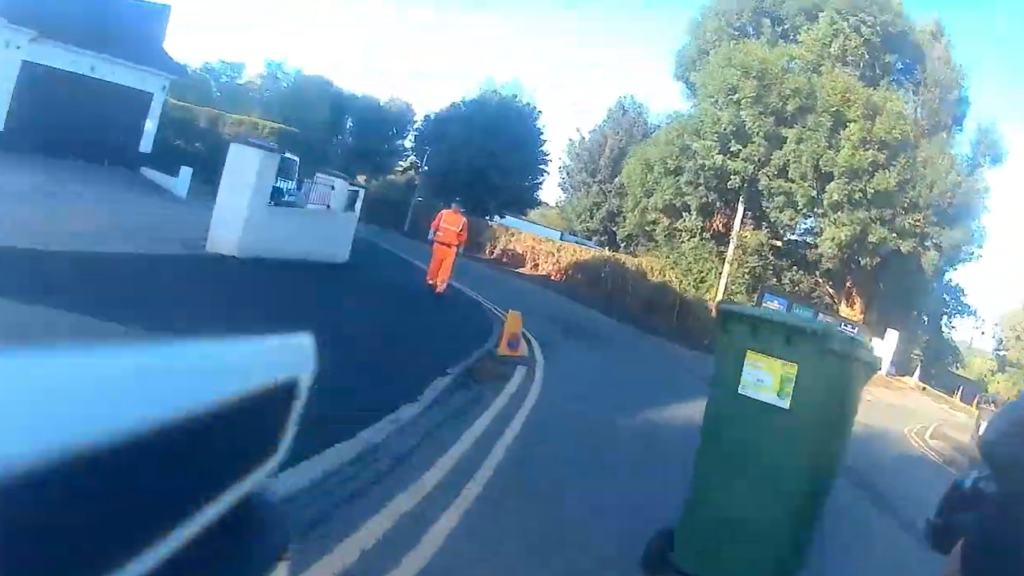
A little context…
A little context…
https://www.youtube.com/watch?v=36TP0YB_a6s
simonmb wrote:
Bit of a stupid move at 2’14” barging through that cattle grid, innit? Then charging through a carparking/pedestrian area. Hope that was shared as an example of how not to use a bicycle on a public road.
KiwiMike wrote:
Also the getting angry about being held up by the motorists who were descending cautiously in front of him.
My experience with mechanical discs is that they work great until they stop working and there is very little warning that they are going to fail until they do. A 40 mile ride around the peaks involves a lot of drag braking for someone who doesn’t ride a great deal as they are naturally more cautious. If the fixed pad wasn’t wound out much at the start of the ride, it could easily have been worn away. This results in only one pad touching the rotor and all of a sudden, you’ve got no brakes. If the front goes, the rear only is no use at all on steep descents. I’ve experienced it myself, luckily with a flat, straight run off at the bottom. The bike companies really need to explain the basic maintenance of these types of brakes when they fit them to bikes, I’m surprised that there haven’t been more problems.
Very sad.
Very sad.
Its easy to forget that descending can be terrifying even to experienced riders, Winnats pass is a severe gradient, and then to add fatigue and poor weather.
PRSboy wrote:
The first time I rode with modern road levers on rim brakes (having come from a hybrid with mech discs) I went down my local 25%er on the hoods. Utterly terrifying – big lad, small hands, weak wrists from too much keyboard use. Fitted crosstops before I went out on the bike again. The worst thing was that if you’re out of control on the hoods its very difficult to switch into the drops to get more leverage so you’re basically a passenger.
Still have the same bike as my “best” dry bike, now upgraded to 105 levers, brakes, and pads. It stops better in the dry, even from the hoods, than my heavy steel tourer.
I think an article on brake failure would be a good one to put together, also one on the various types of road discs. There’s a perception that discs let you descend faster and brake later – yes, providing they’re maintained and set up properly. Mine need constant fettling compared to my rim brakes – there’s a lot to be said for the simplicity of those, if you’re riding in the dry.
From personal experience I know there’s a strong desire to stay on the bike if you’re out of control but its probably better to crash earlier than crash when you’re totally out of control.
No fault was found with the
No fault was found with the brakes after the crash and the fact that she made it around one sharp turn on a steep descent, it would appear that her brakes were actually working, but they didn’t have enough stopping power for the steep descent. As she had only ridden her bike a couple of times since new, then the disc pads/rotors may well not have bedded-in yet reducing their ability to stop. There are also other potential issues from pad/rotor alignment or contamination, but these are things we don’t have supporting evidence for. Many of us tend to ignore our brakes until we notice a problem while riding, but this tragic accident has made me think a lot more about checking my brakes regularly.
nbrus, I suppose we haven’t
nbrus, I suppose we haven’t much context on when she called out that her brakes had gone.
Watching simonmbs video adds some context to me though if we think they failed high up, she’d never have made it so far. I’ve only ever been up it but I’d suggest you can hit 40mph on the way down before it even gets steep and the bends, cattle grid, cars, car park, walls etc. come into it.
btw, on that video, it looks like the mountain biker carried on whilst knowing he didn’t have stopping power. Surely you’d stick it on the grass and walk!
alansmurphy wrote:
I agree, simonmbs video seems like a possible cause were it not for the info stated by others that her brakes were mechanical discs and not hydraulic, so there is no hydraulic fluid to overheat and boil. Mechanical failures usually leave behind evidence (e.g. snapped cable), unless it wasn’t an actual failure, but just poor braking efficiency.
http://road.cc/content/review/108846-genesis-equilibrium-disc-road-bike
Both my Tektro Lyra disc
Both my Tektro Lyra disc failed on a steep desent leading to a monumental crash. Tektro know it’s a probelm and have never done a recall. Their instructions they provided with the brakes have altered and nothing was publicised. The shop didn’t know of the change either. No surprise to me the brakes in this tragedy were Tektro.
I’ve replayed many many times what to do in a similar situation. And experimented. Ideas of foot jams are not feasible. It wouldn’t work at 20+mph. Even sitting on top tube and dragging your feet is very difficult. Going on to any grass verge will just lead to an uncontrolled crash of bike standing up and face plant/wall collision (my instinct when it happened). My conclusion is the best outcome would be to lay the bike over/ditch off of it. This would need to be an instant decision before your speed increased and made things increasingly worse, and a snap decision on traffic. Who knows if you could overcome self preservation instinct to do so were it the case, but hopefully no one will ever need to find out.
Those comments under The Sun
Those comments under The Sun article…what is wrong with those people?
nappe wrote:
Anyone who reads the sun is beyond saving I’m afraid.
Don’t read it.
Don’t read the comments even.
I did say “my guess would be”
I did say “my guess would be”… accent on the word “guess”… that’s all anyone is doing here is discussing their impressions and thoughts and ideas… there’s no “finger pointing” or “libel”… what are you, a lawyer, or you have an interest in a bike retailer…? in any case behave yourself more civilly… telling everyone to shut up and wait for an official report rather defeats the purpose of having a discussion forum…
It’s hard to be libelous
It’s hard to be libelous towards a building especially when not naming it…
Bicycle brakes are way too
Bicycle brakes are way too simple really in order to fail simultaneously in a catastrophic degree on a practically new bicycle. Loose cables resulting in brake levers ending on the hoods or hand fatigue seems like a more likely cause.
In any case it is a shocking, tragic accident, I am wishing all the best to her beloved ones.
Bet it was a combination of
Bet it was a combination of things. Tired hands maybe, especially if, being female, her hands were small. Poor spannerwork? A quick release was incorrectly set and fixed. Why was it wrong in the first place and how was it fixed? Poor technique and a really bad place to use such technique.?
Some disc calipers go “over cam” meaning you pull hard and they suddenly lose all braking. Back off and it comes back. Old Tektros did this and I think others.
I beg to differ with the cooment that most people can’t set up disc brakes. No more complex than any other part and more straight forward than something like a headset. Same as oil n the car. Any numpty can do it. However I still reckon that some one cocked up and would as likely blame those who worked on her bike before the event as the assembling mechanic.
Doubt it will ever come out and doubt it matters really. She will still be dead.
mattsccm wrote:
Mattscm, Setting up any bike brake properly requires experience, or a willingness to be shown / study materials, written or online.
Disc brakes require specialist tools such as bleed kits, pad spacers, rotor truing tools, retaining compound, and the outer cables need to ideally be compressionless, with the ends properly-squared and fitted with decent ferrules in order to avoid excess lever throw due to outer system compression prior to braking force transmission through the inner to the caliper arm. Anything on your bike, but especially where large forces / critical safety-of-life systems are involved requires a torque wrench to do it properly. Into The Sea with anyone who says otherwise.
At the juncture of these three requirements – knowledge, tehcnique and tools – many people can’t be arsed / have better things to do. This is why bikeshops exist.
The supposition ‘any numpty can do it’ also applies to hangliding, making sourdough loaves or knitting. I can’t do any of these things and have absolutely no intention of trying anytime soon.
To say these things are so easy ‘any numpty can do them’ is to fly in the face of actual observable fact, and to make out that the person(s) who worked on the deceased’s bike had a skill/awareness level below that of ‘numpty’.
Wonder what quick release
Wonder what quick release issue was and how resolved if sticky and wd40 used to fix could explain front brake no working. Bike hadn’t been used for a while so normal practice lube chain. Disc brakes deadly if got oil on them feel OK used gently but when needed let you down
Tub
Wonder what quick release
Wonder what quick release issue was and how resolved if sticky and wd40 used to fix could explain front brake no working. Bike hadn’t been used for a while so normal practice lube chain. Disc brakes deadly if got oil on them feel OK used gently but when needed let you down
Tub
Such a tragedy…
Such a tragedy…
I agree with others that there needs to be more awareness of brake maintenance in general. Rim brakes for me are still good on my Fb road bike and my MTB has Shimano Hydraulics. I feel the Hydraulic brakes are the way forward if we are progressing, rather than Mechanical – TRP Spyres tested on a road bike on the hoods were good, and very good in the drops, but in the hoods definitely didnt have as much bite as my flat bar road bike with rim brakes. That’s probably due to the immediacy of flat bar brakes. A big supposed selling point of disc brakes is the reduced maintenance, perhaps with Hydraulics but I still dont buy it, for me rim brakes are easier to replace although need doing more often.. There are youtube videos by reputable organisations but a proper article here would be good too.
waldner71 wrote:
I think on the whole they are easier to maintain,Ive swapped a set of disc pads out in quicker time than it takes to unbolt one rim block, let alone fiddle with trying to put back in and aligning it. I think the issue and lots of the posts on this story have highlighted this, and especially with mechanical disc brake setups, is people just arent aware, because it isnt something the bike shops, or the bike manufacturers really emphasise and it isnt something we are used to with rim blocks, that you do need to be almost checking pad wear as frequently as tyre pressure to keep on top of it.
The pad only has to wear enough, to the point that piston no longer pushes it against the disc, and then you have no brakes, regardless of how much pad material is left, and that adjustment to keep the pads making contact against the disc is a continual moving target, thats the big difference.
Agree on the need for regular
Agree on the need for regular articles on keeping all the various types of brakes maintained. Do bike shops remind people when they leave with a new bike to come back regularly to have them checked?
RIP sister.
RIP sister.
Magazines & websites often
Magazines & websites often have articles of the “x number of things to check before you ride”, you know breaks, creaky headsets and the like. I’m sure many of us think they’re common sense and of course we ALWAYS undertake these checks but invariably we skip them ‘cos we’re pushed for time and just want to ride. A simple check may not have changed this tragic outcome but it may have done. I for one now a have large note of the garage door reminding me to check my bike before I leave, doing the same may mean your loved ones never have to think how important you were to them
jonathanfmcgarry wrote:
Now I’m regularly riding two quite different bikes (1 light and rim-braked, the other a heavy disc-braked tourer) I’ve started doing this. Not least because one has crosstops and the other doesn’t!
Stuff works loose all the time. For example, Shimano don’t loctite the chainring threads on road chainsets and those can work loose really easily – only an 8mm thread. I check brakes and QRs before every ride – that way my brain hopefully knows which bike I’m on and I don’t reach for the crosstops! Also check that wheels are no less true than last time and tyre pressures (thumb rather than gauge). That’s a minimum before chucking my leg over it.
kil0ran wrote:
Now I’m regularly riding two quite different bikes (1 light and rim-braked, the other a heavy disc-braked tourer) I’ve started doing this. Not least because one has crosstops and the other doesn’t!
Stuff works loose all the time. For example, Shimano don’t loctite the chainring threads on road chainsets and those can work loose really easily – only an 8mm thread. I check brakes and QRs before every ride – that way my brain hopefully knows which bike I’m on and I don’t reach for the crosstops! Also check that wheels are no less true than last time and tyre pressures (thumb rather than gauge). That’s a minimum before chucking my leg over it.— jonathanfmcgarry
I do something very similar. Each time before I ride my bike, I very quickly check the headset for play, check the whole bar/stem/steerer isn’t going to slip and I do a quick brake test as soon as I’ve left my drive.
I think it’s something everyone should get into the habit of really.
I had the front wheel Hayes
I had the front wheel Hayes CX Expert brake fail on my Trek CrossRip commuter bike when I tested it as usual after making a cable adjustment.
When I applied full force to the handlebar lever, there was a snapping noise and the brake actuation lever came all the way up without moving the pads. Pushing it back down again re-engaged the brake with an audible click, and the unit then appeared to work normally up to a certain lever pressure, failing again in exactly the same way when the force was increased beyond that.
I returned the bike to the store I’d bought it from, explained the situation, and left it with them. To be honest I was expecting to hear that my cable adjustment had somehow taken the lever beyond its designed range of motion (i.e. user error). Instead, the bike store replaced both front and back Hayes CX Expert calipers with Avid BB5 calipers without charging me anything and without further explanation.
Had I not tested my front brake with full force, I have no doubt that it would have failed in service, most likely at the time when it was most needed. If the rear had followed suit then I would most likely not be typing this comment now.
Given my experience, I find it utterly believable that Ms Atkinson was killed purely as a result of her brakes failing.
Inexperienced cyclist
Inexperienced cyclist possibly uncomfortable with using the dropped handlebars, easy to imagine that on a steep descent, perhaps she let her speed build up on the less steep section to try and catch up with her friend, then frightened of the speed she had built up and scared of going over the handlebars panicked to the position where she failed to use the brakes with any effect. Very tragic, many of us were fortunate enough to have first experienced and learned from such fears in much more benign circumstances.