



It’s no secret that SRAM has been working on a wireless electronic groupset. We first saw it on bikes at the Tour of California last year, and it’s been spotted on numerous occasions since.

I was at the start and finish of the final stage of the Route du Sud today in the beautiful south of France (and the weather is lovely by the way) and several of the AG2R Focus team bikes were equipped with the new wireless groupset.

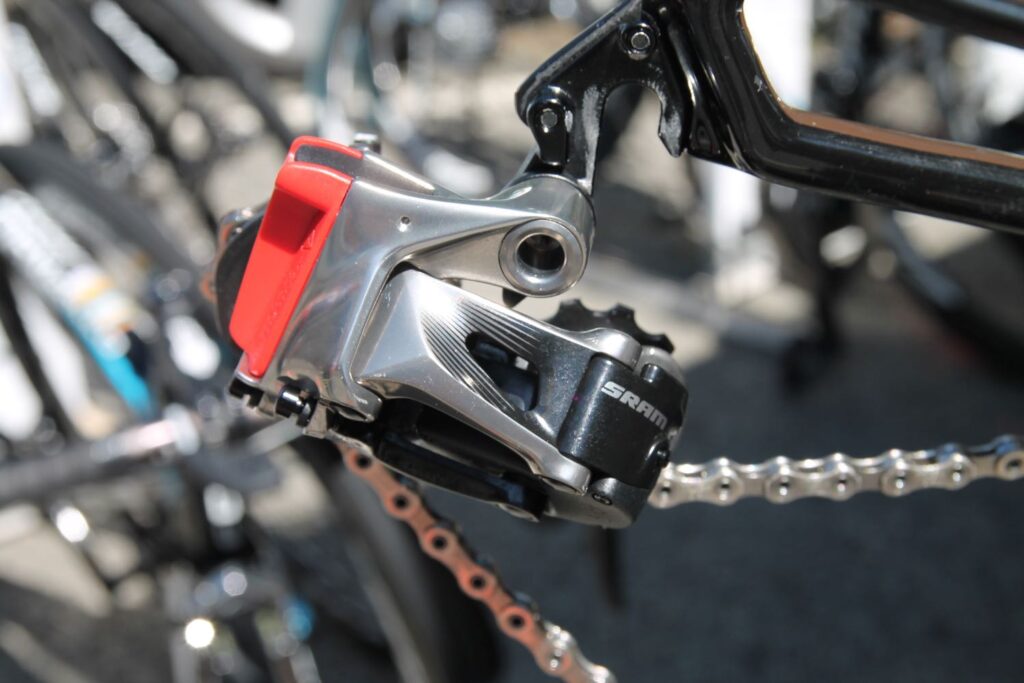
This is the first time I’ve seen the new groupset in the flesh. Looking at it this closely, one thing is very much clear: it looks ready for production. From the graphics on the rear mech, embossed SRAM logos and the ‘Red’ logo on the carbon fibre brake levers obscured only by a strip of black electrical tape, it’s clear the parts aren’t at the prototype stage and are being properly manufactured.

Few details have emerged about the new groupset. SRAM is remaining tight-lipped until it decides to officially unveil it, most likely at the Tour de France. One aspect of its functionality was revealed while I watched the mechanics wash and clean the bikes after the stage.

The batteries, the large black plastic units hanging off the back of each mech, are removable. That much was easy to deduce from early photos, but I actually watched a mechanic remove the batteries. And it’s very simple. A clip on the top flips up, the battery pops off, and a red plastic blanking plate is installed to protect the metal contacts while the bike is washed.

The red plastic cover protects the contacts when the battery is removed for charging
One obvious advantage of the removable batteries is that you don’t have to store your bicycle near a mains power supply, as you do with Di2. I would imagine SRAM has developed its own dock to charge the batteries. It’s not clear how long the batteries last, but combined the two batteries appear the about the same size as a Shimano battery.

With the battery removed, exposing the metal contacts
Despite the clear readiness of these components, SRAM seems to be keen to get as many race miles as possible logged on the groupset, which is why it’s been spotted at so many races in the last year. SRAM clearly doesn’t want a repeat of the hydraulic disc brake recall. There aren’t as many teams using SRAM as a few years ago, but there’s an increasing number of AG2R racers on the new groupset, so it’s slowly being rolled out. We’d expect to see the entire team on the wireless groupset at the Tour de France.

The components in AG2R’s bikes have clearly been getting plenty of use; just look at all the scrapes and scratches. That suggests the groupset can handle the odd knock and crash, which bodes well for its launch. Parts used by the pros need to be reliable and tough.

SRAM’s wireless group doesn’t appear to have a similar central control module. That’s different from Shimano’s Di2 which uses a control module, commonly mounted under the stem, which is used to charge the battery and also to set up the indexing and to make indexing changes during riding. It’s not clear how SRAM’s transmission is first set up when installed on a bike, or how changes are made if the indexing gets knocked out of alignment, say following a crash.

Related story: SRAM’s wireless shifting—a saboteur’s dream?
The shape of lever hoods don’t appear dramatically different to regular RED mechanical shifters, but the pointy bit is a bit more, well, pointy, suggesting SRAM has managed to package the electronic gubbins more compactly than its hydraulic brake levers.

This frame has the Di2 ports taped over because, with no wires, they’re redundant.













50 thoughts on “SRAM’s wireless groupset spotted – massive photo gallery”
SRAM is ahead of another big
SRAM is ahead of another big S now…
The integrated battery on deraulleur is much better than the wired-to-battery design from Shimano.
No ugly external battery or wired batter cable routing now.
Eager to see what Shimano will bring to strike back.
Lisa Brennauer won the Aviva
Lisa Brennauer won the Aviva Women’s Tour this week – she rides from Velocio SRAM so they look to be another of their test teams. Loren Rowney her team-mate was also running it.
Looking around the pits they appeared to be the only team completely running SRAM (a few odd riders in the national teams had it). Wiggle and Ale Cippolini run Campy and the rest were running Shimano.
Still waiting to hear how the
Still waiting to hear how the shifting will work, have heard left paddle down/right paddle up/both for F.mech. The last bit doesn’t feel right and I hope some form of synchro shift is employed.
kwi wrote:Still waiting to
The Canyon product man, who has ridden the new groupset, pretty much confirmed to me today that that is how the new groupset will operate. As with any new shifting setup, such as when SRAM first introduced DoubleTap, it’ll take a bit of getting used to, but I’m sure it won’t take that long to adapt
Quote:The last bit doesn’t
The ‘both paddle’s together’ front shift does sound a bit odd – and a bit imprecise for a racing situation. I have long suspected that this a a smokescreen, and really SRAM will have intelligent sequential shifting.
We will see soon….
My money is on Shimano ‘fighting back’ by rolling out its electronic shifting to the 105 level…
Must be Mad wrote:
My money
Also waiting for 105 level, not Di2, but the hydro one for commuter bike.
BTW, even 105 Di2 is out, the battery and wire thing is still a problem…
For my TCR frame, the rear derailleur cable needs extra zip ties as the hole is a little far for Di2…
Also I’m also worried about the internal battery, as the seatpost is in water drop shape…
kwi – you’ve heard what I’ve
kwi – you’ve heard what I’ve heard.
I did ask them a few details but understandably, neither the team or Lisa would give me any detail about it.
If the battery is removed for
If the battery is removed for washing, how will the system cope in a heavy downpour?
antonio wrote:If the battery
There’s a huge difference between a downpour, where a lot of water flows under low pressure, and pressure washing. Consdering how much time SRAM spend on polishing and testing the design, I remain optimistic.
This has GOT to be the future
This has GOT to be the future of electric gearing, why would anyone want the hassle of routing wires through a frame when you can bypass the whole process. How could anyone not want this innovation.
Doubtless in a couple of years we’ll see claims from frame manufacturer marketing teams such as ‘20% increased stiffness due to not needing to drill holes in frames’… and… ‘due to reduced manufacturing processes riding this bike will make fairy dust come out of your bottom when decending’.
I assume the shifters need
I assume the shifters need batteries too, but they’ll need charging less often?
Andrew Burrows wrote:I assume
Yes, CR-2032 type, non-chargeable last I heard.
That would seem to suggest 4
That would seem to suggest 4 batteries to check and 4 sets of potential interfaces to go wrong.
I like the idea of innovation but I’d be leaving it for a couple of years while the world’s cack handed spanner monkeys put it through some real beta testing.
Interesting to note that the UK is considered one of the most testing places for mountain bike equipment; let’s see how this performs over the year in Huddersfield rather than Los Angeles.
crikey wrote:That would seem
Whilst I’m sure we will see it on X1 in due course I don’t think it’s entirely fair to subject this to off road just yet!
Still it’s better than Di2 or
Still it’s better than Di2 or mechanical. In Di2 you have even more contact points because of the central unit, while in any wired system (both mechanical or electronic) you also have a cable which can be damaged.
crikey wrote:That would seem
CR-2032 battery operated devices are a pretty well understood thing – it’s not impossible they’ll fuck it up but when was the last time anyone really worried about coin battery interfaces to sensor / devices on bikes ? (or anywhere really)
To be fair to them, they do seem to be giving it a good going over before release although you’re right of course – Conan the Amateur Mechanic will give it some abuse professionals could only dream of..
fukawitribe wrote:
To be fair
After the hydraulic rim brakes recall they would never to risk another one.
fukawitribe wrote:
CR-2032
Garmin. A well trodden path of CR-2032 issues on Cadence sensors and HRMs.
Chasseur Patate
Blimey – I stand corrected, that’s an eye-opener (especially the ‘overload’ issue), thank you. It really, really isn’t difficult to do right… idiots.
fukawitribe wrote:Chasseur
Blimey – I stand corrected, that’s an eye-opener (especially the ‘overload’ issue), thank you. It really, really isn’t difficult to do right… idiots.— fukawitribe
The HRM is the worst, you have to short it with tin foil or a paper clip or turn the battery over practically once a month and I’ve had three, all exactly the same. I don’t fancy having to do that mid-ride to get my gears to work. I’ve now got a Polar HRM and it hasn’t done it….. Yet.
If I’m honest, four batteries worries me, especially the two CR-2032. I’ll wait to see how the early adopters get on before deciding if this is, indeed for me.
Chasseur Patate
Blimey – I stand corrected, that’s an eye-opener (especially the ‘overload’ issue), thank you. It really, really isn’t difficult to do right… idiots.— Chasseur Patate
The HRM is the worst, you have to short it with tin foil or a paper clip or turn the battery over practically once a month and I’ve had three, all exactly the same. I don’t fancy having to do that mid-ride to get my gears to work. I’ve now got a Polar HRM and it hasn’t done it….. Yet.— fukawitribe
I’ve had a Garmin non-premium HRM for well over two years now – replaced the battery once with no issue, no faffing around. Works a blinder, never let me down and not heard much bad said against them specifically (apart from “it’s not comfortable” which I find a little odd). Is it an issue with the premium one ? (of which has had more than it’s share, not battery related).
fukawitribe wrote:
I’ve had a
All mine were the premium so possibly.
I have the same issue with two different GSC 10 Cadence sensors that I run too. As these and the HRMs are the only CR-2032 items I own, it’s why I’m in full strokey chin mode.
Chasseur Patate
All mine were the premium so possibly.
I have the same issue with two different GSC 10 Cadence sensors that I run too. As these and the HRMs are the only CR-2032 items I own, it’s why I’m in full strokey chin mode.— fukawitribe
Indeed, I can see your point, as I said – an eye-opener. What’s galling is that there are legions of coin battery operated devices around, even some cheap crap from the Far East, that manage to do this correctly – and Garmin seem to have really dropped the ball with it, at least with some of their stuff. The premium HRM was already renowned for contact issues and general flakiness, i’ll add this to the list.
“Still it’s better than Di2
“Still it’s better than Di2 or mechanical”
Given that it isn’t actually for sale yet, I think that conclusion maybe somewhat premature.
Time will tell.
Quote:If the battery is
8|
Perhaps the battery was removed for re-charging as part of their maintenance workflow?
EDIT – if a plastic cap can seal the electronics, then there is no reason why the plastic cap on the battery cannot perform the same job…
I agree, it seems pretty
I agree, it seems pretty obvious that the batteries would come off for a charge whilst the bike was checked and washed.
One downside to the
One downside to the development of electronic shifting is that it will reduce the research and development of cable shifting.
I would much prefer that cable shifting is taken to its ultimate state, rather than leaving it for electronic stuff.
The latest Shimano stuff is very, very good and I would be keen to see how good it could become.
I’m sure that in 5 years or so we will all be on electric shifting, but there is something to be said for the ability to fettle things without a plug and a computer.
crikey wrote:One downside to
Well Shimano doesn’t seem to have stopped developing mechanical groupsets, but using the latest Dura-Ace groupset, which is simply stunning, it’s hard to see how it can be improved, but I’m sure they’ll find a way
David Arthur @davearthur
Well, they’ve already turned it up to 11, so it’s hard to see where it can go from here.
crikey wrote:One downside to
I’m with you. Although I’ve only tried Di2 and not EPS, I’m on mechanical 2015 Chorus on my ‘good’ bike and think it’s sublime, I have absolutely no complaints about the 2014 Veloce on my steel steed either. The way they perform, especially Chorus leaves me failing to understand why I need electronic shifting. The handful of Di2 rides I’ve had does nothing to convince me.
I want one. Shame it will be
I want one. Shame it will be a decade before it’s affordable for most of us! 😀
This looks great, and I love
This looks great, and I love the idea of no wires/cables to the mechs.
My one concern, is that I don’t see any way to adjust or fix things if it goes wrong. I guess my four Shimano groups I’ve had over the last fifteen years and tens of thousands of km’s have never ‘gone wrong’, so why should this be any different? I just see that something won’t work quite right, and the LBS mechanic will only be able to say ”…we need to replace the whole rear mech…” … much like you get at the car dealer these days … nobody can fix anything, they just replace whole modules.
Still, next bike will likely be electronic shifting without wires and with hydro disc brakes …
Why don’t they just develop
Why don’t they just develop electronic legs !
My source says it’s going to
My source says it’s going to be available next spring as well as XD driver 11-speeed road wheels that go down to a 10t small cog.
Knowing Shimano, they’ll
Knowing Shimano, they’ll already have a wireless group testing but they have a better secrecy policy than SRAM.
I’d still rather ride a Di2 wired set up than wireless from SRAM especially if both levers have to be pressed to change at the front.
In about 20 years or so the
In about 20 years or so the marketing blurb will be something like this: We have developed a new gear mechanism that is lighter, easier to maintain, more reliable, cheaper and does not require you to be constantly charging batteries. We will use a simple cable mechanism, no fuss, easy to set, no let downs and half the price. Why we never thought of this before is a mystery.
How long until Shimano
How long until Shimano develops a jammer? :))
I once had a wireless VDO
I once had a wireless VDO computer that used to cease functioning when I went under the overhead electrical cables near to my old house. As soon as I was away from them, it started working again.
I wonder if a system such as this would be affected in the same way? it does look very tidy compared to the Shimano & Campag systems currently out.
I always feel left out and in
I always feel left out and in the minority when I say I have never had an issue with any coin cell powered Garmin device.
Mind you I haven’t used the premium HRM strap I have but it doesn’t look all that different from the Polar one I used to own.
“The shape of lever hoods
“The shape of lever hoods don’t appear dramatically different to regular RED mechanical shifters, but the pointy bit is a bit more, well, pointy, suggesting SRAM has managed to package the electronic gubbins more compactly than its hydraulic brake levers.” Is compactly a word? Anyway, for their next trick they need to integrate the hydro master cylinder into the lever and then they can stop for a cup of tea and a piece of cake.
surly_by_name wrote:”The
Indeedy.
I have guven up on garmin
I have guven up on garmin cr2032 addons. The gsc10 is great for about 2 months, if you dont lose the magnets. They are terrible for batteries, and for leaking.
The HRMs that came with my 305 and 310 (x2) lasted less than 6 months each. And the number of new batteries I bought only to find the unit was knackered not just out of juice is ridiculous. The current one with my 910 seems to be lasting a bit better but the software on the 910 unit itself is terrible.
kevinmorice wrote:I have
So no issue with battery power per se, but the manufacturers implementation.
A battery’s a battery. As long as the contact works and it’s not duff from the off, I can’t see that being an issue.
I have 2 lights working on CR2032, one works, one doesn’t. Same manufacturer. Could be USB connection and still have a dodgy charge/connection. Don’t think the fact it’s a battery should be a barrier.
Also have the premium Garmin HRM and that’s never missed a beat….(cymbals)
Do electronic gear shifters
Do electronic gear shifters interfere with pacemakers ? ?
ANT+ for a garmin display and
ANT+ for a garmin display and data download giving time/distance/watts/speed0 from a gear combo used?
Batchy wrote:Do electronic
No, pacemakers don’t depend on wireless, so the itty bitty transmissions from SRAM wouldn’t interfere with them. To properly shut down an pacemaker would require a very large EMP to create a big current in the pacemaker and fry it. The kind of EMP created by a nuclear detonation or EMP bomb.
Aapje wrote:Batchy wrote:Do
:B
Do they use these EMP thingys in airport customs then ? Or security beams in ASDA for eg ? Or indeed heart rate monitors because these are all likely to affect my pacemaker !
Aapje wrote:Batchy wrote:Do
Perhaps somewhat surprisingly some pacemakers have a wifi interface, and in some cases it can be hacked: http://www.wired.com/2008/03/scientists-demo/
So it’s not completely beyond belief to think that SRAM’s kit could have an effect, although I’d say it’s fairly unlikely – after all if a pacemaker were that delicate any wifi router or smartphone would present a serious risk…
Aapje wrote:…pacemakers
Nearly all modern pacemakers are re-programmable by wireless (although not always wi-fi protocols).
Usually the communications “head unit” that can “talk to” the implanted unit has to be held against the chest, because the comms is very, very short range.
As a previous commenter stated, nothing coming out of a bicycle groupset can affect such an implant. That is not to say that pacemakers cannot be “jammed”, just that your sexy new SRAM stuff will not do it.
I have multiple Garmin heart
I have multiple Garmin heart rate straps and GSC10’s, never had a problem with any of them.
I always use good quality, branded batteries (inc IKEA) and wash the heart rate straps regularly as instructed.