




SRAM may not have been very good (intentionally or otherwise) at keeping their long awaited electronic groupset secret, but they have been better at keeping the fact that it is wireless under wraps – until now.
Earlier this week we got our first real look at the groupset via a CGN video. Now those decoy wires (c’mon SRAM it’s only a groupset) have come off and GCN have got a lot closer still, talking to riders on the Bissell Development team who have been using the new groupset for some time it would appear.
So what do we learn?
It’s not Double Tap . You press once on one shifter to change up at the back, once on the other to change down and both at the same time to shift at the front. As has been pointed out you can already program Shimano Di2 to do this. Double Tap would have been really hard to program and operate in an electronic system and has always had at least as many detractors as fans.
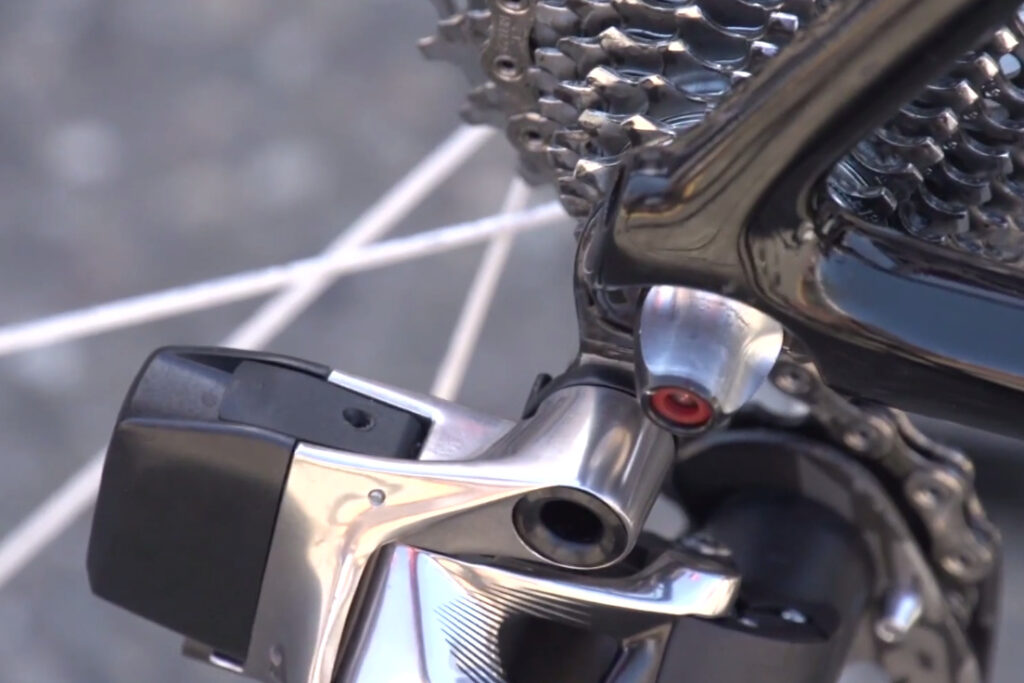
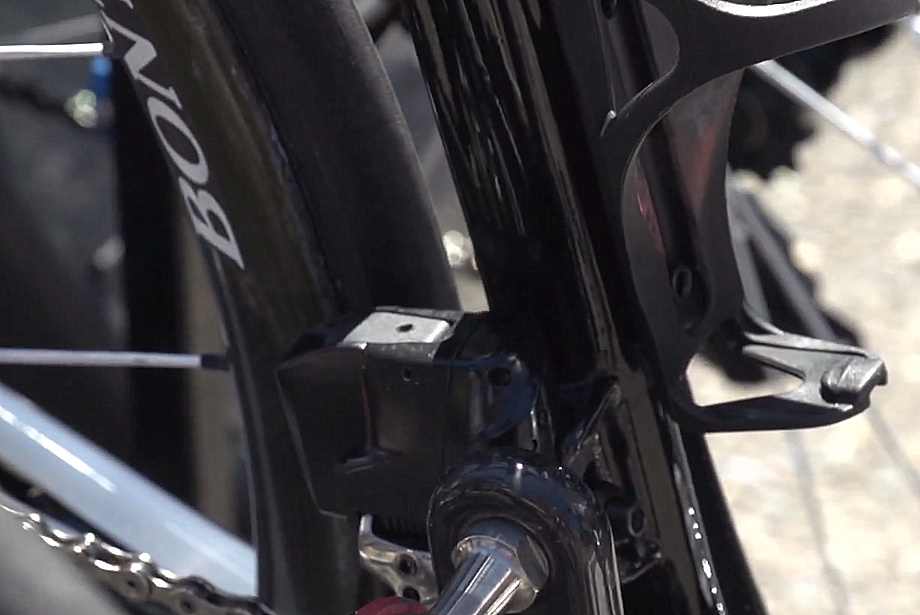
There is no battery unit so the batteries for the front and rear shifters are in the motors. The levers must also contain batteries to power the wireless transmitters.

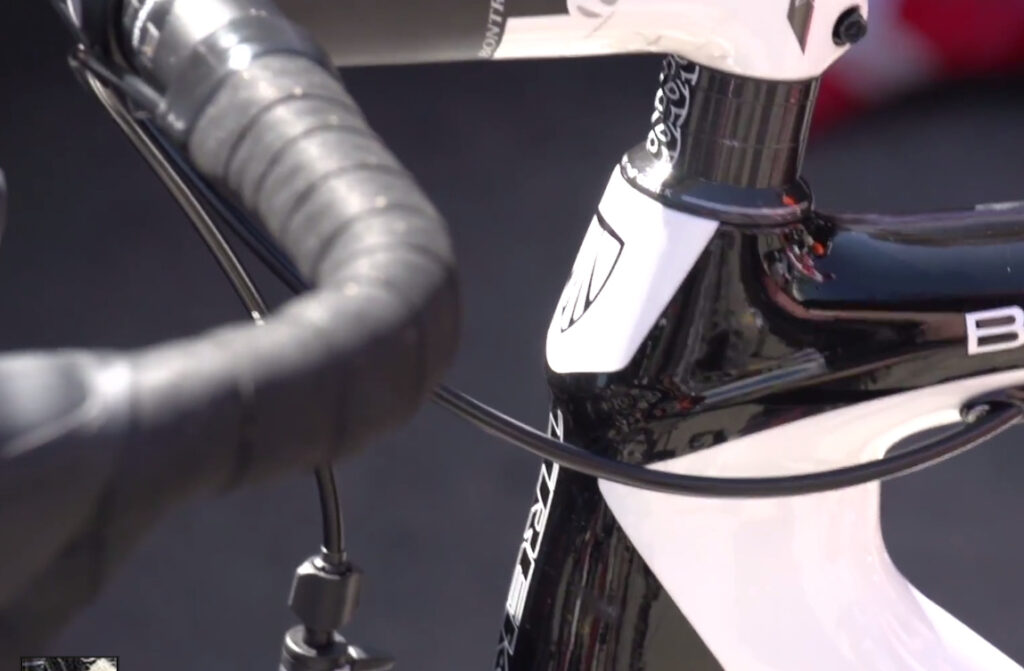
Look ma, no wires. Only a brake cble connects the front and rear of the Bissell team bike,
It’s robust and reliable, say the Bissell riders. Well, they would. It will have to be, though: SRAM can’t afford any more recall disasters. However, it bears repeating that their disc brake woes stem not from poor design, but a failure of quality control, and that’s something that only shows up in production.
“it’s more aero,” says Tao Geoghan Hart . Marginal gains and all that. There must be some advantage, but given that so many bikes have internally routed cables only a wind tunnel could tell us how much.

What's under the tape on the brake lever? GCN suspects an embossed 'Red' logo.
The Ant+ or Bluetooth (or both) wireless system used gives exciting possibilities for a head unit to give you lots more information about what your bike is doing . Or at least what its gears are doing.
It could be lighter than the equivalent Shimano or Campagnolo. The jury is out on this one as the size of the motors plus batteries on the front and rear deraileurs doesn’t suggest lightness. Looks can be deceiving though, and SRAM have done away with all of those heavy cables. Our guess is that is it lighter than competitor systems, but not by much.
So what are the advantages of a wireless electronic groupset over a wired one?
Well, it looks cooler.
It’s marginally more aero.
It should be marginally lighter.
SRAM could (in theory) incorporate a hydraulic brake master cylinder without the aesthetic implications that affect the current SRAM 22 hydraulic levers.
Did we mention it looks cooler?
Erm…
And the disadvantages?
We don’t know yet. So long as the system is reliable, robust and weatherproof it’s hard to think of any.
The big worry for users will probably be that the signal from the levers to the mechs could be disrupted, but unlike say, a GPS, this is a system in which the constituent parts only need to talk to each other when you want to make them do something: change gear. So even if the system did suffer from interference or disruption to affect performance it would have to happen at the same time you were trying to change gear.

The front derailleur has a hole where the previous decoy wires went in. Could it be a charge port?
On the other hand sceptics will point out that an ethernet cable generally gives a faster and more reliable connection than wi-fi. You don't need to operate your gears from your front room when your bike is in the hall so if you're going to use electronic gears why step away from the tried and true? That will probably be the biggest sales challenge for SRAM when it comes to selling the groupset after market.
What the point of the decoy wires was and why they’ve now come off (maybe they fell off?) only SRAM’s marketing department and the Bissell Development team can truly tell us. That world’s bike media has written about SRAM electronic twice in a week rather than once probably tells us all we need to know.

It's easy to imagine the battery being inside that black housing. Perhaps you flip up the latch and pull it off for recharging.
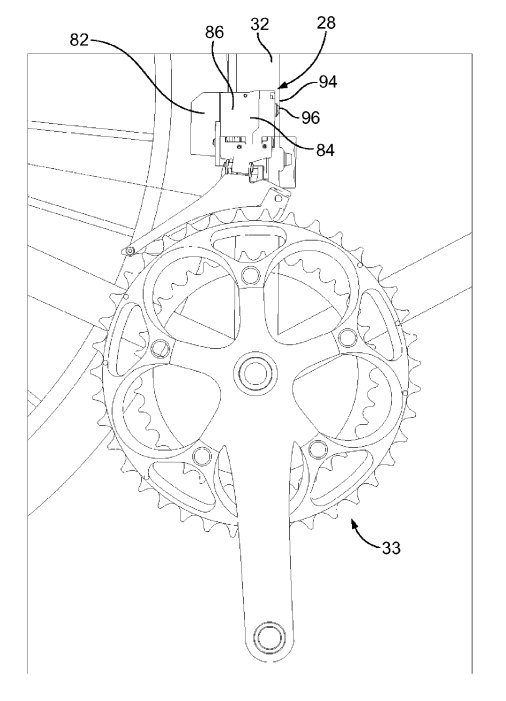
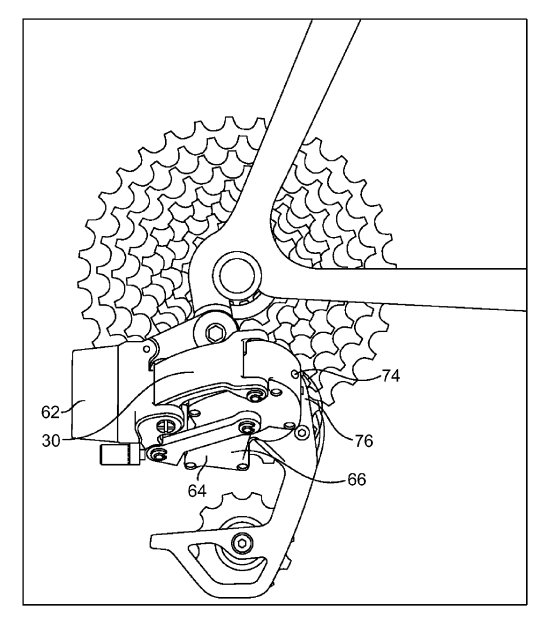
That SRAM have opted for a wireless set up should be no surprise: many in the industry have predicted that is exactly what they would do. Indeed there would be very little point in them going down the electronic route if the final offering was going to be a late-to-the-party product that offered no more than Shimano Di2 or Campagnolo EPS. Earlier this week James Huang, BikeRadar’s technical editor in the US produced a masterful piece of work on the new groupset, seeing through all those decoy wires, and explaining why SRAM electronic had to be wireless. He even had patent drawings to hand.
One of the other clinchers for Huang that the new groupset was wireless was that SRAM have plenty of form when it comes to choreographing a big launch with ‘leaks’, staged spy shots, and even dummied up prototypes. He might also have mentioned (but didn't) that an in-depth James Huang exclusive is often one of the final moves in SRAM’s elaborate launch rituals.
Unknowns
What the likely battery life is we don’t know, nor do we know for sure how the batteries will be charged. Will they be easily removable for external charging or are those holes in the mech bodies in fact charge points?
When are you likely to see SRAM wireless in your local bikes hop? Bissell’s Geoghan Hart reckons it’s a year away; all the kerfuffle of the past few days suggests it could be here some time sooner.
If it’s spotted on a WorldTour bike in the near future then we’ll expect to see it at Eurobike this year; if not, then Geoghan Hart may be right. However, the clock is ticking under article 1.3.007 of the UCI technical regulations which says that prototype equipment can only be used if it is going to be available to buy within nine months of its first use in a race.
Patent pending
So we've been having a trawl of the US patent office website this morning, and turned up SRAM's pending patent for "electronic shifting systems and methods" filed on 12 December 2012. It's clear SRAM have been working on this a long time and they've done well to keep it under wraps until now.
.jpg)
Here's the summary of the patent: "The invention provides a wireless control system for a bicycle, including at least one shift actuator generating an input signal when actuated and a master control unit transmitting a shift signal responsive to the input signal. At least one electromechanical gear changer is provided and includes a gear changer control unit. The gear changer control unit receives the shift signal from the master control unit and controls at least one electromechanical gear changer corresponding to the received shift signal. The gear changer control unit listens for the shift signal during a part of an awake mode cycle time, the master control unit transmitting the shift signal for a message duration time which is greater than the awake mode cycle time."
Regarding battery life, it appears the system will conserve power by "turning the transmitter and receiver off when not in use and by power cycling the transmitter and receiver when the bicycle is active" with the addition of a 'wake sensor' which puts the system into a sleep mode when not being used.
.jpg)
As for the wireless protocol, the patent indicates a " 2.4 GHz transceiver utilising AES encryption and DSS spread spectrum technology supporting 16 channels and the IEEE 802.15.4 communication protocol."
Interestingly, it looks like the groupset will be able to communicate with devices like a smart phone or cycling computer. "It is also possible for the present system 22 to communicate with other third party devices using standard protocols such as ANT or Bluetooth Smart (BTLE)."



















64 thoughts on “Video: SRAM electronic groupset is WIRELESS”
The batteries must be
The batteries must be removable surely, otherwise you would have to wire up the front, rear derailleurs and shifters when charging, wires wires everywhere ! but taking the battery out the shifters sounds painful.
I really don’t see the point of wireless to be honest, aero gains from missing a small piece of 2mm wire… come on ! sounds to me like technology for technology sake.
Wireless? It must be an
Wireless? It must be an absolute doodle to setup, clamp on and you are good to go. I reckon you then use your phone to setup and calibrate via bluetooth. There’s also some weight gain to be had as well. Plus no battery to mount on the frame. Oh and it’ll go on any frame, no internal or external mounts to worry about.
Oh, how about this. The rider in a race goes back to team car during race, ‘hey it’s not shifting perfectly’. ‘No problem, let me adjust.’ Mechanic selects the bike on his phone via bluetooth, adjusts and off goes the rider.
I’m not going to be buying
I’m not going to be buying this bits fall off 8}
I’m pretty sure 90% of
I’m pretty sure 90% of cycling commentary sites knew this was wireless after last weeks convenient reveal.
I reckon wireless is a great
I reckon wireless is a great idea – less cabling. It’s one of the things I love about my Garmin – no cables to the cadence and speed sensors. And with ANT+ (or whatever),the technology is there. A great idea.
And I agree: the batteries have to (should?) be removable. Having to wait for three hours for them to recharge would be a pain. Just being able to pop them out and pop in some charged ones would be a great plus point.
jmaccelari wrote:I reckon
I think battery swap-outs are necessary, otherwise when you come to charge the batteries, your bike will look like a critically ill hospital patient wired up all over the place…
“It’s easy to imagine the
“It’s easy to imagine the battery being inside that black housing. Perhaps you flip up the latch and pull it off for recharging.”
Agree that’s what it looks like to me
I was thinking about the
I was thinking about the batteries in the levers and how they might be changed/charged, but then I thought about car keys, and how long they keep on going… years and years and years.
A good comment above about the possibility of simply having ready charged batteries at hand… that would be a real plus for anyone traveling/racing away.
Wireless makes retrofitting a
Wireless makes retrofitting a simple job. A pretty big benefit I would have thought? One of the problems with current electronic offerings is fitting it to an existing frame that isn’t set-up for it. Wires taped on, battery pack stuck there etc.
Probably a small market, but
Probably a small market, but have hankered after electronic groupset, but with a non-Di2 titanium frame, the idea of either having ugly black tape securing the wires was as much of a put off as the thought of drilling holes in a frame (Kinesis Gran Fondo Ti) that wasn’t pre-designed for it. Wireless resolves that. Will wait for it to succeed in the wild first before committing – but very interesting.
I guess it means that bike
I guess it means that bike manufacturers don’t have to drill holes all over the frame for electrical or mechanical cables or to fit cable guides, so there might be marginal weight/strength gains there too.
I’m probably being stupid
I’m probably being stupid here, I am not that clued up on the subject – but say the entire peloton adopts wireless technology, at the start of every climb, or the start of every sprint the entire bunch will change gear pretty much simultaneously.
Thats a lot of signals bouncing around, would they are be right, all of the time?….
It would only take a missed gear change to ruin a sprint or loose time on a climb – would the benefits of wireless outweigh the relative security of a wired setup?.
andycoventry wrote:I’m
it’s not beyond the realms of possibility. but ANT+ and Bluetooth pairing protocols are pretty robust. all the pro riders’ HRMs/power meters/speed and cadence sensors manage to talk to their head units without much problem
Absolutely. And more to the
Absolutely. And more to the point I was wondering about the possibility of breaking into the system and sending erroneous requests to the mechs. Would it be possible to deliberately mess with someone’s gears? Maybe I’ve been watching too many espionage dramas on the tellybox…
andycoventry wrote:I’m
This occurred to me too. Signal contention might be problematic—just as it is in a building or neighborhood with a large number of wi-fi networks. But this will not be an issue for the solo or small-group rider who wants to retrofit a favorite bike (like the Kinesis GF Ti metnioned above).
Anyone been able to find the
Anyone been able to find the patent documentation mentioned? Can’t find it via Google patent search.
i’d think that the batteries
i’d think that the batteries in the two mechs, which are receivers, will be larger and easily removeable for charging, and the shifter (transmitter) batteries will be more tucked away as they’re likely to last a lot longer
induction charging mat in the shed, anyone? 🙂
I wondered who would be first
I wondered who would be first to try and “one up” the technology…
If they’ll be building in connectivity with (select) computers that would be great – no flat batteries because the screen could tell you the levels.
Not sure I like the gear changing touches – Could you program them so that one touch shifts both derailleurs? I know some people are parochial about picking gear combinations, but I’d be happy to pre-set these. Would work very well with Srams wide cassette set ups too…
Sorry, have I missed
Sorry, have I missed something, are there four batteries.
Those holes in the battery
Those holes in the battery latches. It would be daft if those were charging points. Salty water would love them.
The replacement battery idea is essential I feel both for convenience when charging and for insurance when out on a long ride. I can already see after market adaptors to allow you to allow you to lash on a pair of AAs from the nearest village spar shop!
Those holes in the battery
Those holes in the battery latches. It would be daft if those were charging points. Salty water would love them.
The replacement battery idea is essential I feel both for convenience when charging and for insurance when out on a long ride. I can already see after market adaptors to allow you to allow you to lash on a pair of AAs from the nearest village spar shop!
Huang’s piece suggests that
Huang’s piece suggests that the batteries on the rear mech and the front mech can be removed and recharged via usb port. The first picture shows the latch – that (crude) hole in the top was put there for the “pretend” cabling, suspect it won’t be there on production model. If levers house a battery (to power wireless transmission) then suspect they will similarly be removable to enable repowering, maybe roll hood forward?
One of benefits of Di2 is less gubbins in lever, so when you add in hydraulics you don’t get misshapen hood a la SRAM (recalled) Red hydro lever. Wonder whether wifi gubbins in SRAM levers takes up more room than gubbins in Di2 levers, with result that SRAM will still be stuck with big levers when they finally iron out kinks with hydros and integrate the two technologies.
Not so keen on shifting dynamics. Right hand has always done rear mech (in both directions), irrespective of brand of shifter used. I don’t get why you couldn’t replicate double tap feel with electronic shifting. First detent goes down cassette, keep pushing past that to send detent and you go up cassette, hold in and you keep going up. Maybe this dooms you to single cog shifts down the cassette (although you could have multi shifts up the cassette) and potentially slower downshifts (computer wouldn’t shift to bigger gear immediately, would have to wait a short time (fraction of a second) to see whether you are actually on your way up the cassette) but I think I would have preferred this option. Or put two paddles in, one above the other. If electronic don’t need (mechanical) leverage so could make paddles small.
I won’t be an early adopter but imagine this (or trickle down version) will eventually make it on to a bike I own at some point in future.
“SRAM have done away with all
“SRAM have done away with all of those heavy cables”
Seriously?
Cables? Heavy?
You could generate wireless
You could generate wireless interference at key points in the race, going up a climb for instance. Think you’d get rumbled fairly quickly doing that though.
I thought the same but
I thought the same but Garmins and ANT stuff works pretty seamlessly. However, getting a wonky signal or wrong info on your computer is less of a worry than getting forced into the big ring on a 15% slope. Apparently Astana intend to develop a remote control for Scarponi so he can force all the competition onto 53×11 on the slopes of the Zoncolan next year (allegedly).
Broadcast signal intrusion
Broadcast signal intrusion doesn’t appear to be a problem at radio control car races
The big advantage of this
The big advantage of this will be the retro fit market. I’ve two bikes that I want to put Di2 on but its too messy. I got a new bike with internal di2 setup and internal seatpost battery which is great. No problem with the wires on that.
My other two bikes, winter and TT, the wires and external junction box/battery would be too messy to consider doing and gather a lot of road crap around them too.
But just replacing the dérailleurs with new wireless ones and the brifters would be much preferable.
I might even be able to keep my shimano 10 speed drive train if this is compatible as the sram 10 speed is?
Either way the only downside I can see is perhaps the price and the fact that you’re most likely gonna have very expensive kit, namely the batteries that someone can clip off and steal even if you’re bike is locked up. (assuming they are going to be clip off, if they’re attached that makes charging a bit of a problem)
pmr wrote:
Either way the
Not like shimano Di2 with its battery which easily unclips from the down tube…. 8| which i therefore take off whenever its locked up.
Typically there aren’t 200
Typically there aren’t 200 cars on track at once, though 😉
You can just sense the tour
You can just sense the tour saboteurs plotting, no more need for tacks on the road (so unpredictable) one press of a button and shazaam all riders change to 53 11 on a 25% hair pin.
Very unlikely I know!…
…and yes I would like one along with disk brakes and a decent VO max. But I’ll get more performance out of losing 20 Kg.
Is there a benefit to frame
Is there a benefit to frame builders not to have to think about wires? Would it allow for stronger or stiffer frames? I like this idea of wireless (but then I’m a bit of a tech geek) Super simple and looks great as well. Bring it on!
Mavic Zap Mektronic was
Mavic Zap Mektronic was wireless 10 years ago, odd then that both Shimano and Campagnolo decided wires were better many, many years of development later
I really don’t want to be farting about with batteries down on the chain line.
I’m away to perfect a chain that doubles as a linear generator so you only need to charge the shifters – that’s me copyrighted the idea BTW.
Wires? Need adjusting
Wires? Need adjusting frequently, they stretch, and you’re limited as to the cable runs (internally or externally).
Hydro? Need to be bled, same cable run problem.
Wireless? Fixed. I want.
Gizmo_ wrote:Wires? Need
Really..?
Maybe every couple of weeks or so!
Not exactly a major job though, twiddling a barrel adjuster?
ficklewhippet wrote:Gizmo_
Not a major job, no. But, a job. Wireless: get on and ride.
Gizmo_ wrote:Wires? Need
er, shagged mechs, over shift, worn chainrings, shift carefully. Maybe I am in a minority of one but I run kit into the ground and then some. friction shift let you get away with almost anything, indexing, it has to be vaguely usable and not worn.
How does electronic kit cope with badly worn components?
Mavic Mechtronic…
Mavic Mechtronic…
I would have thought that
I would have thought that each device on the drive-train would have, effectively, a MAC address, which it would transmit as part of its command signal, and only those MAC addresses paired in that system would be accepted as valid signals.
I can’t see why crosstalk should be an issue
Since your term “mechs” is
Since your term “mechs” is technically a shortened form of “mechanical derailleur” shouldn’t you be calling these derailleurs “elecs” if you’re going to be lazy about typing out French words and all?
Earlier this week James
What?
That was all over the cycling forums over the weekend.
I think the 2-buttons to shift the front is stupid. With every other setup to-date you can press a shifter [without looking] and know that it will either go up/down in the direction you intend, or it will do nothing in the event that you are already at the limit.
If you think “I need the inner ring”, and you’re in the big ring. Lucky you. If you think “I need the inner ring”, and you’re in the small ring. Oops.
Matt_S wrote:If you think “I
This may appear mega snobbish but if you cant tell the difference between being on your big ring or your small ring when pedalling then I suspect you probably shouldn’t be dropping mega-cash on a wireless electronic groupset.
http://www.bikeradar.com/road
http://www.bikeradar.com/road/gear/article/sram-wireless-electronic-group-analysis-41023/?utm_source=Adestra&utm_medium=email&utm_campaign=9424&utm_term=5683483&utm_content=11136
Not sure if I can post another website but this explains everything. They are way ahead of the game with this.
Sounds like the wireless
Sounds like the wireless protocol might be ZigBee, or something very similar. 128 bit AES encryption means that there should be no chance of being able to induce someone else’s bike to change gear. You won’t be able to talk to any of its components without knowing the 128 bit key. There will have to be a pairing procedure to go through when setting it up.
What you may be able to do is use a jammer to drown out the signals so that nobody in range will be able to change gear.
SRAM can do what they like, I
SRAM can do what they like, I still won’t buy anything off them until they stop putting out unfinished products every year and prove their reliability.
ajmarshal1 wrote:SRAM can do
Me too. This article wrongly states that it was just the disc brakes that got recalled. The WiFli Red rear derailleur was recalled too because part of it could snap off and jam, this site reported it back in December
The argument in this article that the brake problems could only show in mass production is nonsense. The disc brakes failed in low temperatures – precisely the sort of thing that can, and should, be caught and fixed during product testing.
That is a cool product, no
That is a cool product, no arguments.
You could draw energy from
You could draw energy from the top jockey wheel rather than having a removable battery pack. Run a cable down the chainstay to power the front derailer. This way you could have the unit pretty much sealed. Sapping a couple or ten milliwatts isn’t going to harm a riders performance.
It’d be a bit weird to go to
It’d be a bit weird to go to all the trouble of having wireless shift signals and then join things up with wires 😉
Where do the CTRL-ALT-DEL
Where do the CTRL-ALT-DEL buttons go?
Flying Scot wrote:Where do
Who honestly cares?
It’s all about trying to find out where ‘A’ and ‘Start’ are.
Im not convinced this is
Im not convinced this is fixing a real world problem – its certainly going to get people talking but boy they will need to get it right.
Personally the idea of 4 separate batteries on a bike has already slowed me down a bit!…
It’ll use a proven industrial
It’ll use a proven industrial based wireless protocol, like Zigbee thats mentioned above, or possibly something better.
We run a multimillion pound manufacturing plant with similar stuff, and safety critical applications, your gears will be fine.
Looks good to me but I too
Looks good to me but I too have concerns about multiple batteries. Can’t say the front shifting scheme impresses me. I know you’d get used to it but seems awkward.
bikeandy61 wrote:Looks good
Depends what the feedback and indication is like.
The batteries in the mechs would be more of a concern.
Shifters I would’t see as a problem, some form of passive energy harvesting could be useful as well for that application, after all you’re talking such low load and consumption at that end.
Ideally for the mechs you’d want the same battery that you can change and charge offline.
I’d be very surprised if the
I’d be very surprised if the shifters use an external rechargeable battery pack, that would be extreme overkill from a weight and complexity perspective.
I strongly suspect these will take coin cells, just like Garmin’s Edge computer remote switches/HRM straps do. Those can last in excess of a year from a single battery, and cost pennies to replace.
Gizmo – if you’re worried
Gizmo – if you’re worried about cable stretch on electronic shifters (wired or not) – you need to read the tin.
Might just be me, but the
Might just be me, but the block diagram doesn’t quite match up with each derailleur and shifter having their own battery. It clearly shows a interface for each, with a single battery for both.
How to other companies now
How to other companies now get around the patent ?
Do pending patents get turned down to help a competitive market place ?
Or does this patent if accepted mean that Sram will be the only manufacture of gear changing bike components in the future ?
:/ sorry not very informed about patents.
Cycle tech has been
Cycle tech has been improving/changing a lot recently. I say it’s all good.
I have automatic sequential gear shifts in my car. I can drive manual as well, but auto just makes life easier. Some may say but what about the manual driving experience…What? On UK roads…good luck with that and your license. But It convinced me that Di2 would be a good thing. I didn’t decide until the missed shifts of my Ultegra groupset started getting on my nerves (usually as I’m beating cars from the traffic lights – not somewhere you want missed shifts).
Looking back, when the Cannondales had fat tubes and thin walled aluminum I was there (I miss my Killer V 2000 that was stolen). When Trek was there with its front suspension bike I was there (I also miss my Trek 990 – also stolen).
So I went for my first proper ride on 6870 Di2 today. It’s great, even down to the ergonomics of the shifters.
I’ll enjoy reading the reviews when when the SRAM groupset finally comes to market.
One interesting angle to this
One interesting angle to this – Shimano makes a LOT of profit from all the little wires and boxes you have to buy in addition to the brifters/FS/RS. How will SRAM manage that? You and I will inncoently be comparing the FS price vs FS price ….and if the SRAM is $100 more we’ll be buying Di2… not realising that we’ll be spending that $100 on the junction boxes, PC connector cable, exact length wires, etc.
SRAM will have to do a good marketing job on pointing that out if they don’t want to lose sales to the instant comparision :B
Surely one major advantage
Surely one major advantage that should have been listed is you don’t need a Di2 frame to use it (without having a mess of external wires you get with the external Di2 kit), its the major reason I haven’t gone electronic yet
If I have networked devices
If I have networked devices located a fair distance from each other, or numerous obstructions between them, then I would prefer a wired connection.
But on a bike frame? I fail to understand why anyone would possibly prefer a wired to a wireless connection.
I have a Dura Ace Di2 setup on my tri bike, and to me the revelation of electronic vs manual shifting was at least as monumental of an experience as moving from downtube shifters to STI.
But I’ve just decided to put off an upgrade to my road bike until the SRAM wireless kit comes out. And this is coming from someone who had zero interest in even looking at SRAM’s Double Tap instead of Shimano STI.
In my mind the coolest thing
In my mind the coolest thing will be that you can take a gorgeous looking Ti/Steel/Ali frame with no internal cable routes and bang these badboys on as a clean way to upgrade.
That’s what I’ll be doing on the Version 2.0 of these after they’ve ironed out all the inevitable SRAM teething problems!!!
Ian: Yeah, these will look
Ian: Yeah, these will look pretty tidy on metal framesets with external guides. Where the cabled solution’d be a mess of wiring in loops and batteries and boxes taped on. With the wireless solution, the only unsightly bits will be the now redundant cable guides on the frame.