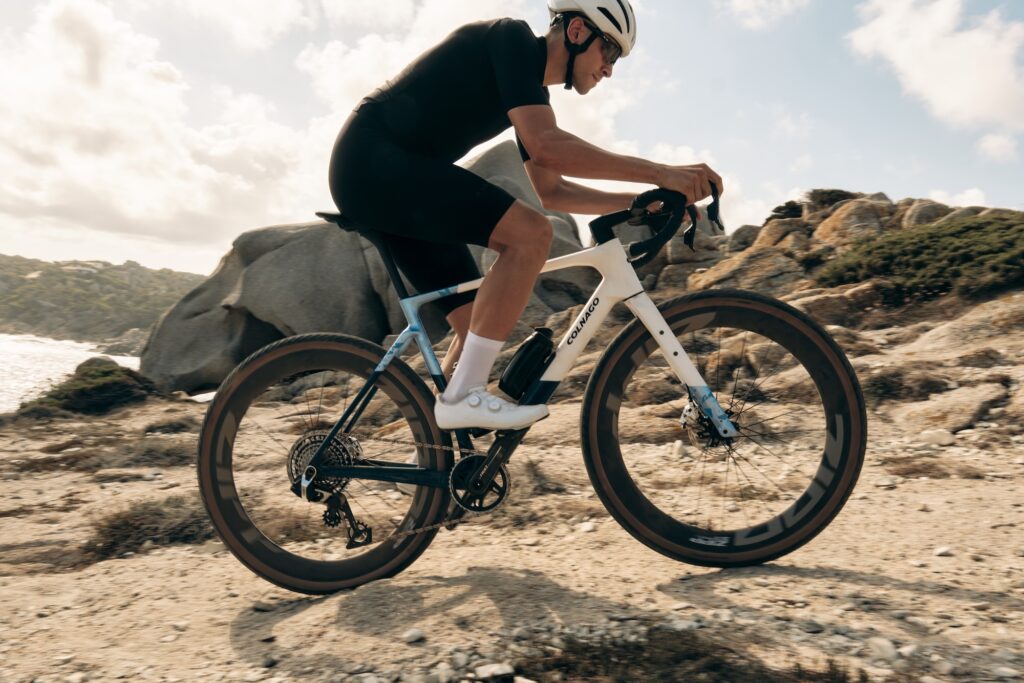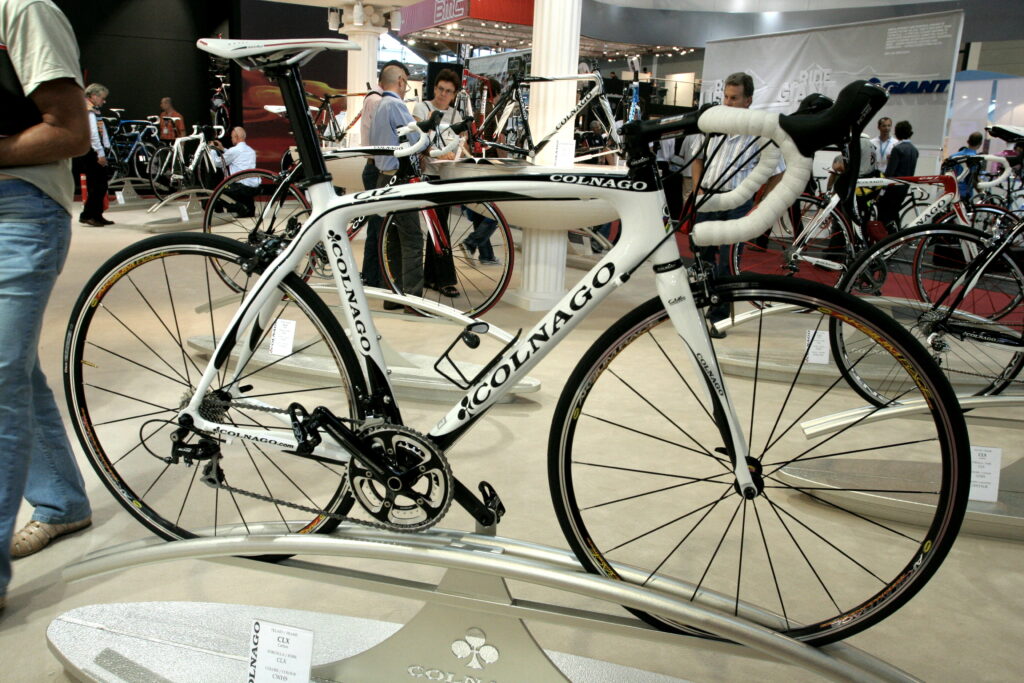

Colnago can do restraint with the paintbox, but it hasn’t been easy and they certainly haven’t quite been able to kick the habit of writing all over their frames – at least Ernesto Colnago has elegant handwriting. Here’s a few tasty treats from their stand. First up the CLX – not top of he range but a very nifty piece of kit nonetheless, interesting to see it sporting Shimano 105 – a good groupset, but maybe not one you’d expect to see on a carbon Colnago. It’s also available with my favourite groupset, if I was spending my own money, Shimano Ultegra… although that new Chorus 11-spd is pretty tasty too. 
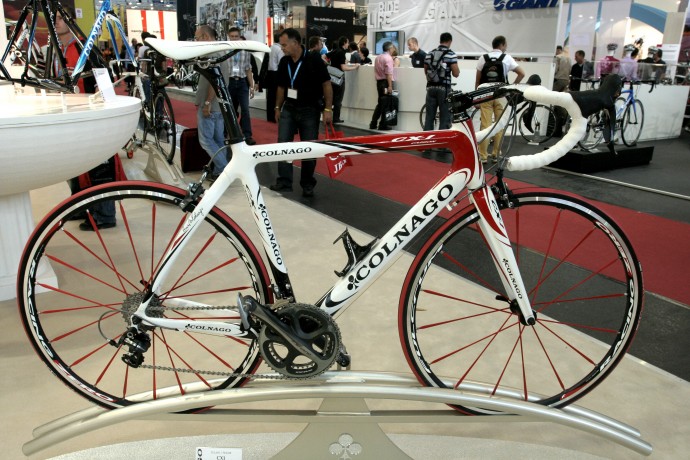
This is more like it. The CX1 gets Dura Ace and a nice pair of Fulcrum Racing Zeros, and an FSA integrated bar and stem… 
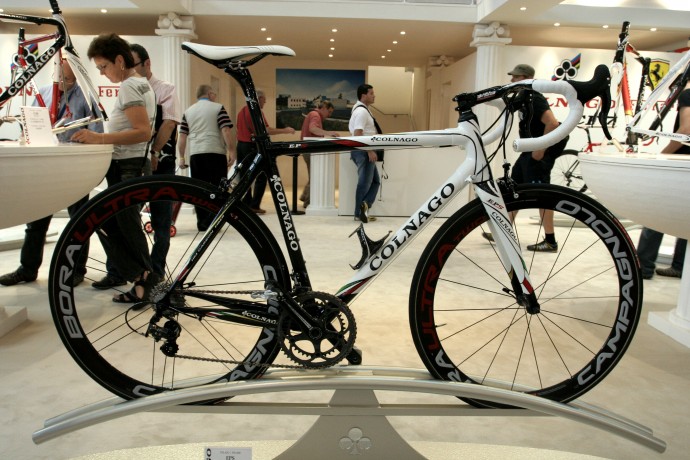
And for the EPS it’s Campag Super Record, Bora Ultra wheels, and classic lines. Interestingly Colnago’s top bike appears technically less advanced than the CLX and the CX1 that sit below it. Both those machines are moulded carbon – the mainframe at least, the backends are lugged – Whereas the EPS is an all carbon-lugged affair. This is the classic way of building a custom carbon bike so maybe that’s the reason. 
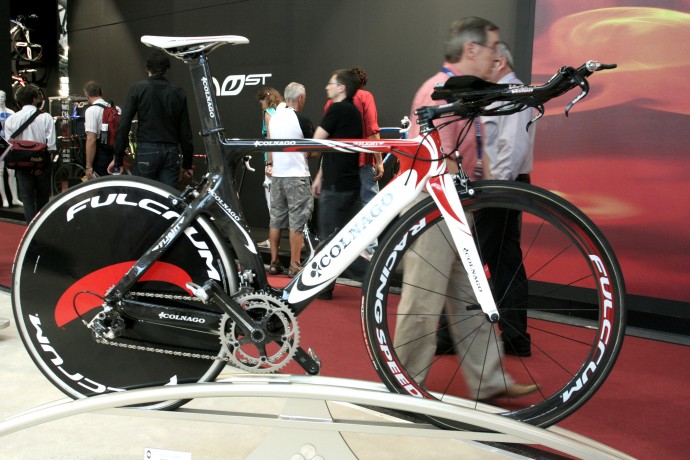
Last one from the Colnago stand is the Flight, their TT machine. Again, you wouldn’t kick it out of the bike rack (not if you liked going fast against clock anyway) on purely aesthetic grounds but the Pinarello FM1 looks a lot crisper with that really tight rear wheel clearance (on second thoughts, not sure how practical such a tight clearance would be on Britain’s crap strewn roads – you wouldn’t want to get a twig stuck in there, or an acorn). Either way it’d be good to know how the Colnago and Pinarello stack up against each other in the wind tunnel – with a rider on. 
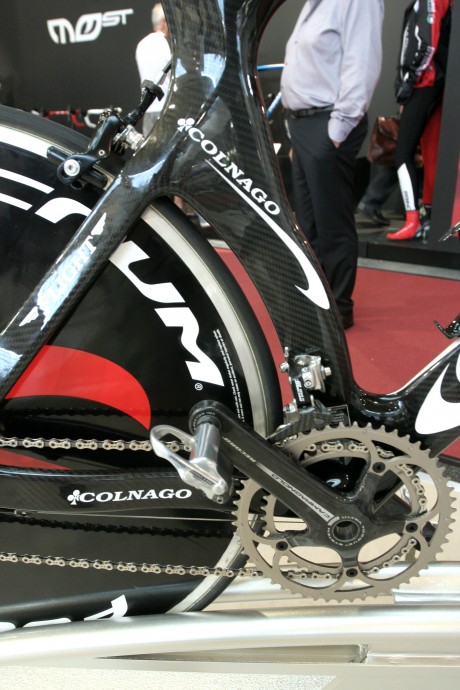
Whatever, any time trial machine boasting Super Record, a Fulcrum Pro Disc on the back, and a set of FSA Vision bars is a highly desirable item and this one’s got the extra advantage in the desirability stakes of being a Colnago.
Colnago at Eurobike
Add as a preferred source on Google
Help us to bring you the best cycling content
If you’ve enjoyed this article, then please consider subscribing to road.cc from as little as £2.49. Our mission is to bring you all the news that’s relevant to you as a cyclist, independent reviews, impartial buying advice and more. Your subscription will help us to do more.
No Comments
Read more...
Read more...
Read more...
Latest Comments
@chrisonabike True, things went back to normal once the pandemic was over. In this case, however the problems are still ongoing, and aren't likely to be resolved in the near future. If anything, they're going to get worse. Food shortages are predicted because of the effect that the heatwave has had on crops. This is bound to push prices up. The Straits of Hormuz aren't likely to reopen anytime soon and the strategic oil reserves are running low. Russia is having to import petrol because its own refineries have been badly hit, so that's even more competition for an even more scarce resource. I think that more and more people are going to see cycling as a way of cutting household bills.
I think if "grown up" cyclists * are quibbling about ASLs we've very much missed the road safety point anyway. (Not to mention the wider "better transport choices" picture). ASLs are poor-to-useless "cycling infra", even for their design intent. If the idea is "for less confident cyclists" then a design that requires that you re-position in front of the motor traffic - waiting to accelerate - seems unhelpful. Of course they're only designed to help when traffic is stopped, and you can reach the front in time and if vehicles aren't already occupying them. As we're noting here drivers frequently ignore them - whether that be deliberate, a lack of road craft, because they were concentrating on following the vehicle in front, or because the paint has rubbed off. * Aside: shouldn't cycling also be safe and accessible for kids? Or should they only be allowed to do this when accompanied by sufficient qualified adults? Or be limited to parks and otherwise being driven around by their carers? Perhaps there is another way...?
Hi Bungle, I saw you follow-up comment. I can't imaging there's a tolerance of 4 seconds on camera enforced lights, seems an odd decision - an offence is committed if a vehicle starts crossing on a red, any tolerance is discretionary. There does seem to be some odd thinking about 'advanced stop lines' where the rules relating to them are identical to a regular stop line, as explained correctly elsewhere in the Highway Code. It does seem a regular offence. Where I live it doesn't help that some of them are very faint and disappear in rain.
@ktache Not sure he's totally ruled out of the worlds yet (though I think it would be best if he doesn't), normal recovery time is about eight weeks but surgery can halve that...depending on the nature of the break he could be just about fit to ride by the time of the elite men's race, but he'll have missed a lot of training. Hopefully his managers and team will persuade him to wait until Lombardia, if not just to knock it off for the rest of the year.
@Bungle_52 The Met told me a couple of years ago when rejecting a submission that they needed a clear three seconds of red visible before they would consider it for an RLJ prosecution. I pointed out to them that this meant that at 30 mph a driver could see a light change to red from 40 metres away and still get through without sanction, or 55 m if they accelerated to 40 as most do. They just replied "them's our rules..."
@Ben Graham I have just checked the footage from my report. The driver crosses the 1st stop line 4 seconds after the light turns red. All on camera from behind the vehicle. No further action. So I assume the margin is at least 4 seconds.
Oh, and active travel funding per head (in England at least) is laughable compared to other places. Plus it is delivered intermittently. It's more like a Blue Peter contest...
Yup, I see those opportunities being missed all the time in Edinburgh. When it gets really bad, dig it all up and put it back down again how it was. Contrast with what seems to happen in NL - when things are dug up the whole thing seems to get a "let's redo this according to the current standards" treatment. They even coordinate with the utilities, so that after a refurb the street isn't immediately dug up again because of leaking pipes / we suddenly realised the new estate being planned for round the corner will want broadband etc. Pros and cons of course - you may wait longer there for changes as smaller changes may be deferred until a major redo is due. (Though in the UK case you likely wouldn't get them at all...) It seems we "can't have nice things" in the UK in part because a) we have greater motor traffic speeds/volumes spead across "streets" / within urban areas b) the funding and organisational responsibility differs. Are we in the "Sam Vimes boots" territory (being too poor to afford better products which not only save money over time but actually work)? There is long term money pressure on LAs and it seems that due to poor construction and maintenance we have to regularly pour money into (pot-)holes in the road. And it seems there's no budget to check up on or enforce adequate standards from utilities work or even private building.
Shame about the world champs defence. Speedy recovery. https://www.theguardian.com/sport/2026/aug/30/tadej-pogacar-vuelta-a-espana-cycling-crash-hospital-stage-nine
I believe the accepted form for this kind of argument is "I know you are, you said you were, but what am I?".