



First published November 4, 2017
With more and more sprockets on our wheels, do we still need two chainrings up front? We take a deep dive into the pros and cons of 1X gearing.
The drivetrain on a modern road bike has evolved loads since the early days when you turned a lever to move the chain to a different sprocket. Electronics are now commonplace and cassettes with ever-wider ranges provide enough gears to tackle even the steepest mountain climbs.
Most modern road bikes use two derailleurs to move the chain across the cassette and chainset, and it works well thanks to many years of product development. We probably take them for granted. But there’s a move in some parts of the cycling world to simplify the drivetrain and it threatens the future existence of the front derailleur.
The arrival of SRAM’s 1×11 drivetrain a few years ago, a gear system that ditched the front mech and instead combined a single chainring with a wide-range cassette, provided another path. Such drivetrains have become hugely popular on mountain bikes and we’ve seen cyclocross and gravel bikes also being specced with single chainsets in recent years. Could the same happen to road bikes?
What are the benefits of 1X gearing?
The simplicity is certainly appealing. With just one shifter, changing gear is much more intuitive than having to manage the front and rear derailleurs. For beginners, that’s an obvious benefit. There’s one less component to fail as well (though front derailleur failures are rare) and on bikes designed for wider tyres, removing the front derailleur can provide additional clearance around the rear wheel and seat tube area.
Read more: Beginner’s guide: understanding gears
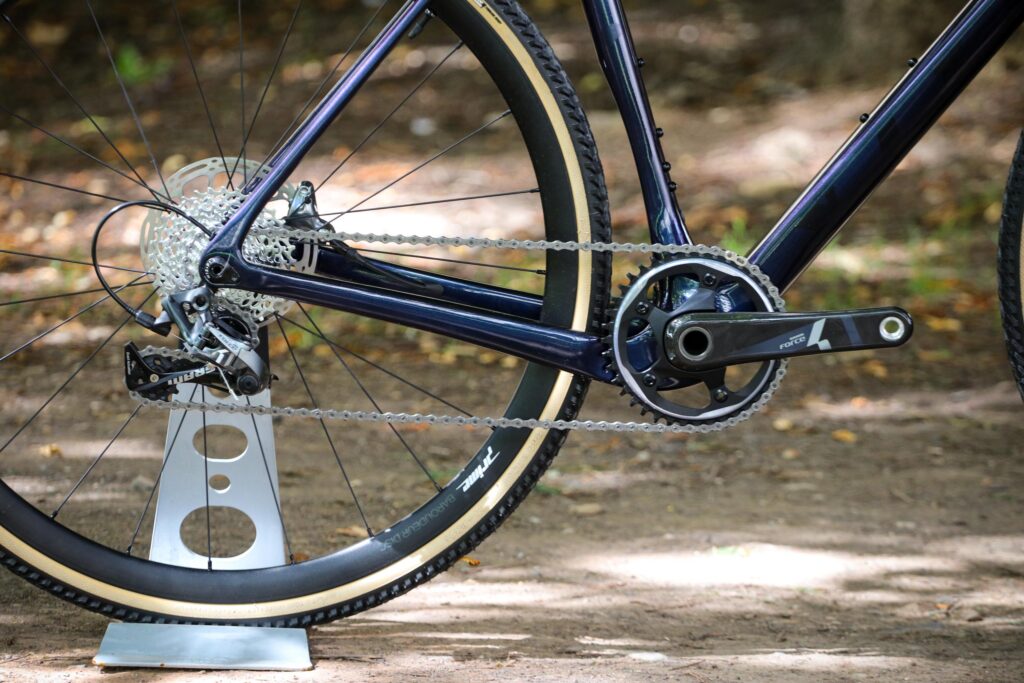
A short history of the front derailleur
Early users of double chainsets didn’t even bother with front derailleurs; they pushed the chain from the large to small chainring with their heels at the bottom of a long climb, then stopped at the top of the hill to manually lift it back to the big ring. In the 1930s, French cycle tourists began using mechanisms to move the chain, as they realised being able to change gears was useful on the flat as well as when you had a long climb ahead.
Front derailleurs of the 1930s were usually actuated by cables; rod-operated front derailleurs appeared in the 1940s, and provided very quick and efficient shifts. You had to reach down towards the bottom bracket to operate them, which looks awkward to modern riders who are used to brake/shift levers, but was reportedly quite straightforward.
Read more: First Ride: SRAM 1x Road
Since then, the front derailleur really hasn’t changed much at all. It’s still a basic component, comprising two metal plates that shove the chain across the chainrings, and the stiffer those plates the better the shifting. But making plates stiffer by making them thicker also adds weight, so gear makers have added ramps and pins to the chainrings, bringing a real improvement in front shifting performance. The biggest recent development has been the addition of a motor in the electronic systems made by Shimano, Campagnolo, SRAM and FSA.
The 1x charge – the industry speaks
But the cycle industry is in a great period of technological development at the moment and everything is up for change. Chainsets have evolved from triples to doubles over the years with loads of configurations available, but a definite trend towards lower ratio setups like a compact, semi-compact and most recently, sub-compact. So if lower gears are popular, why not go all the way and use a smaller single ring?
For mountain biking, a single ring chainset makes a lot of sense. Changing gears is easier with just one gear shifter, there’s one less thing to malfunction, mud and ground clearance is improved, weight is lowered and suspension designers are freed from the limitations of having to factor in a front derailleur when locating pivots. And any loss in gear range is compensated for by a wide-range cassette, with SRAM’s introduction of a 10-42t cassette and more recently 10-50t with its 12-speed Eagle groupset.
SRAM has been instrumental in the popularity of single ring drivetrains, but SRAM’s Global Drivetrain Category Manager Ron Ritzler doesn’t think fans of the front derailleur need to worry just yet.
“Will the front derailleur disappear? Probably not yet as there are certain users, like some elite athletes, who need the range and the steps to perform at their best – but can it kill the front derailleur for users who spend their time in cyclocross, commuting, adventure riding and in events where fast precise single ring performance is preferred; heck yes,” he tells us.
“We still make front derailleur and 2x rings that work really perfectly, but we love the fact that there are some many people using road bikes in new ways that make 1x the right choice.”
While SRAM has been cheerleading the benefits of single ring drivetrains, Shimano isn’t really embracing it. Shimano’s Ben Hillsdon says the versatility of the double ring setup is just too good to ignore.
“Essentially the front derailleur doubles the number of gear ratios available to a rider, and, therefore, gives riders smaller steps in shifting between their biggest gear and their lowest gear,” he says. “That means riders have a wider range of gears, a smoother pedalling experience and their cadence (ie leg speed) can stay constant.
“That, in turn, brings a physiological benefit as muscles and joints are saved from being overworked, which can be crucial when it comes down to the sharp end of a race. The versatility of a double-ring setup is that you can go anywhere without compromise. However, for those riders choosing simplicity, our strategy is to offer drivetrains that can be set up in many different ways for different styles of riding.”
Read more: Your complete guide to SRAM road bike groupsets
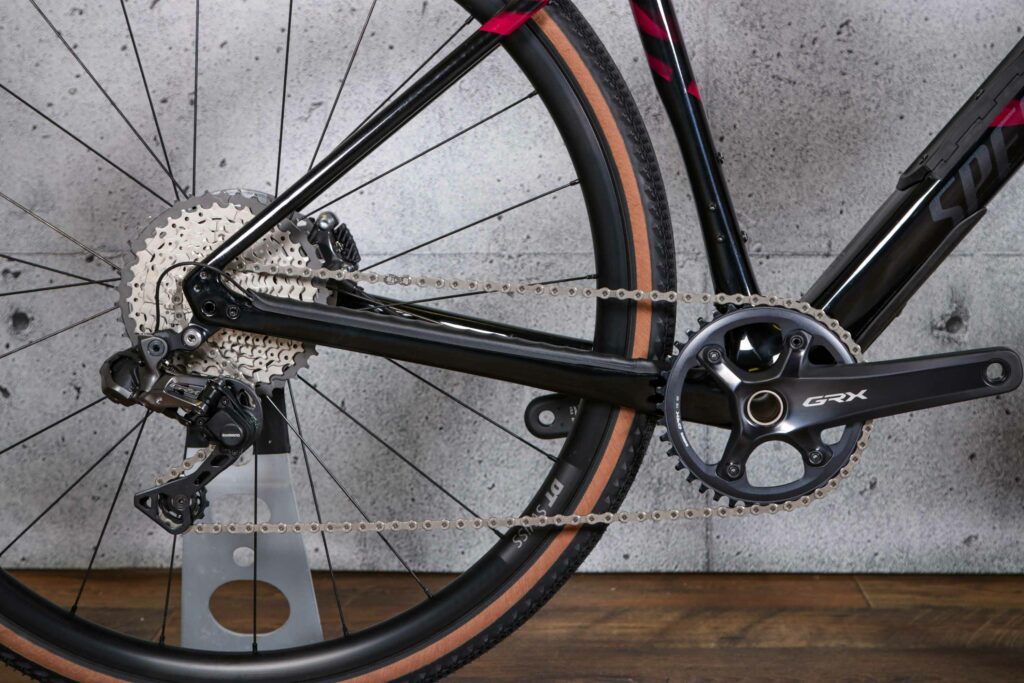
Since we spoke to Ben Hillsdon, Shimano has backtracked a little though, introducing 1X options in the GRX range of gravel bike components. Okay, a gravel bike isn’t a road bike, but there’s no reason you couldn’t use a gravel bike transmission on a road bike as long as you can get a top gear high enough for mountain descents and sprint finishes.
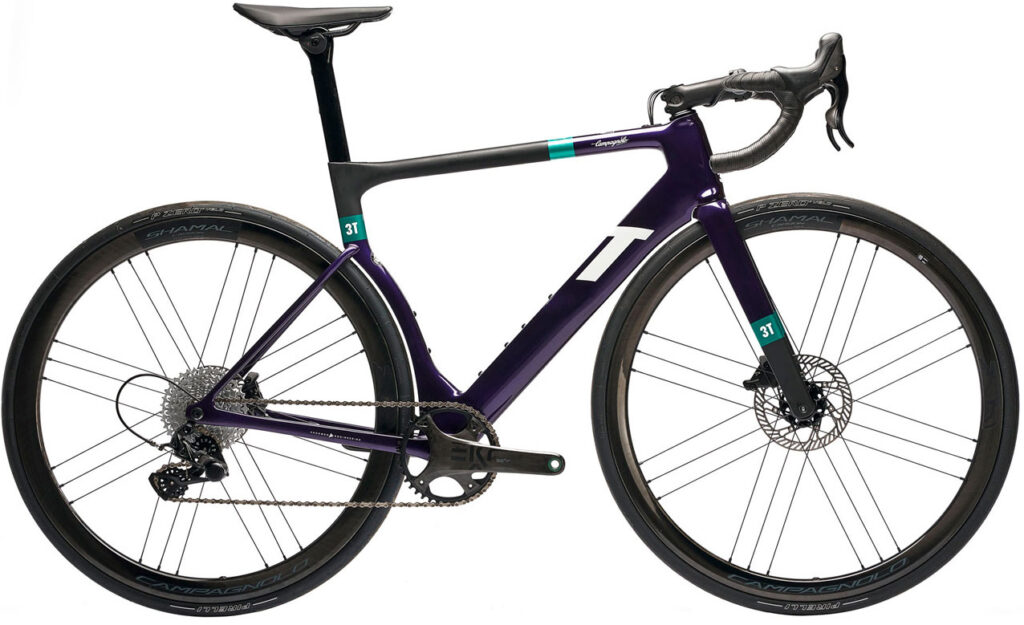
In fact, that’s exactly what 3T have done with their Strada road bike, which now comes in a version with Campagnolo’s 1X13 Ekar components. Ekar is intended for gravel bikes, but 3T clearly don’t believe in discipline boundaries, and who’s to say they’re wrong?
But a front derailleur gives you more gears, right?
One of the biggest advantages of the front derailleur was a big increase in the range of gears. That was an obvious advantage with a 5-speed cassette many decades ago. Over the years, the number of sprockets on the cassette has increased and is now up to 11, 12 or even 13.
Not only has the sprocket number increased, but the size of the sprockets has gone up: most racers predominantly used 12-23 cassettes a few years ago, but 11-30 is now common in the pro peloton and many sportive bikes now come with 11-34 cassettes.
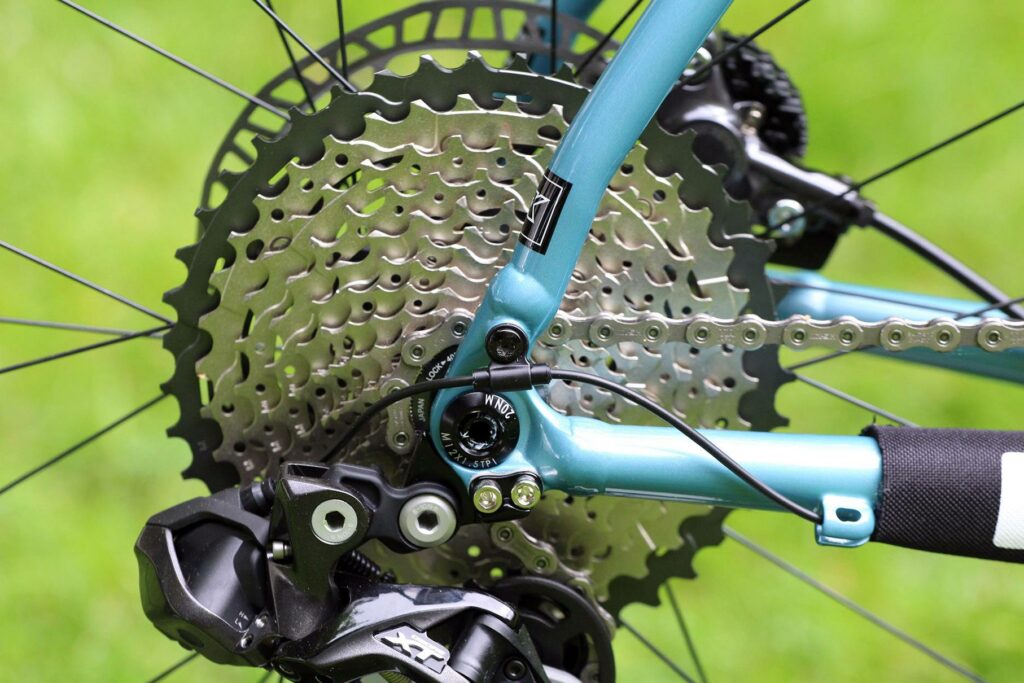
Of course, removing one of the chainrings reduces your available range so to combat this SRAM introduced a whopping 10-42 cassette. It was instrumental in winning over mountain bikers as it was possible for a single ring drivetrain to offer nearly the same gear range as a conventional compact drivetrain.
Read more: SRAM Rival 1 review
How does a single ring drivetrain compare to a conventional drivetrain? Favourably, if you look at the numbers. Combine a 44-tooth single chainring with an 11-36 cassette and you have a gear range from 33 to 108 inches. That’s very nearly the same as the 32.8 to 122.7 range that a 50/34 and 11-28 setup provides, a setup many riders still use, though the latest off-the-peg bikes tend to have an 11-32 or 11-34 cassette.
You can adjust the size of the chainring and the cassette to tailor that gear range to suit the geography of your local terrain and riding style, whether solo touring rides or racing, much like you modify a current drivetrain with different chainsets and cassettes depending on whether you want top-end for racing or low-end for riding in the mountains.
While the gear range compares favourably, where the 1x setup falls short is in the jumps between the gears. This will concern those cyclists who like to be in the perfect gear for the optimum cadence at all times. How big a concern the larger jumps between gears will be to you depends largely on the type of cyclist you are, the sort of riding you do and your terrain. There is much work being done to provide cassettes that can help smooth the transition in the most frequently used gears, with 3T’s Gerard Vroomen developing two versions of a 9-32t cassette that looks to be a good choice.
So should you ditch the front derailleur?
That depends. There are clear advantages and disadvantages to a 1X drivetrain at present. It’s unlikely we’ll see the front derailleur confined to the history books anytime soon, especially given Shimano’s dominant position in the market. That’ll certainly be the case for regular road bikes and especially race bikes where tradition rules.
Where we’re seeing single ring drivetrains really start to become a lot more popular is on bikes where the disadvantages are outweighed by the advantages offered by a simplified drivetrain, where the ultimate range isn’t as critical and where the bigger jumps aren’t as much of an issue.
Read more: Will your next bike be a gravel bike?
We’re talking about cyclocross bikes (where many racers have been going single ring for many years already with home-brewed solutions) and the gravel and adventure bike category where 1X is as common a transmission option as 2X. But with the likes of the 3T Strada and Whyte Wessex One, two road bikes designed around 1×11 drivetrains, we could be looking at more road bikes devoid of front derailleurs in the future.
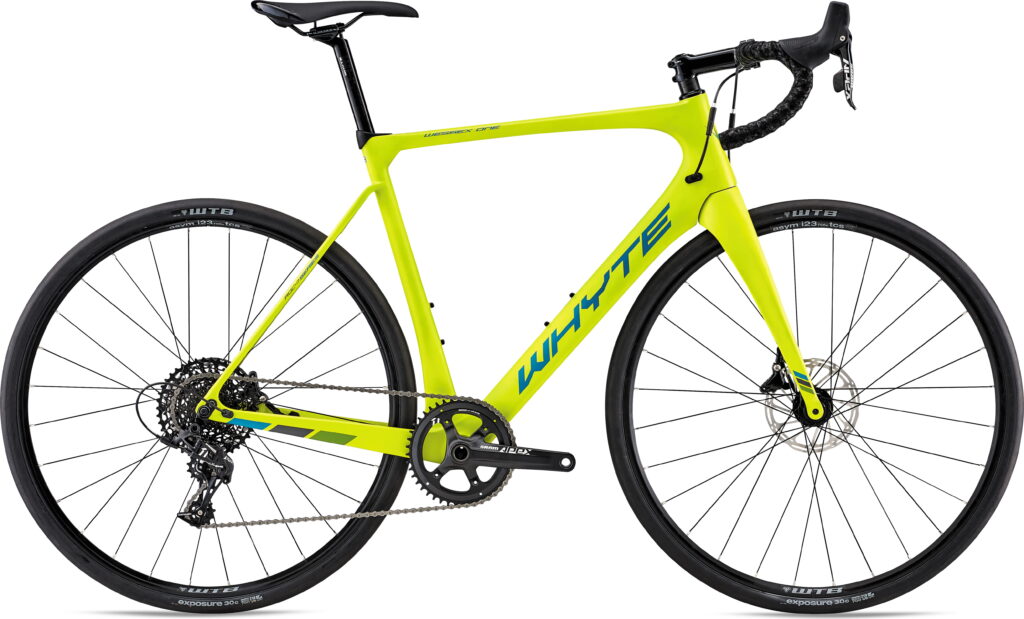
Ultimately, though, the modern double-chainring transmission is too good for many cyclists to want to make a radical change. But the rise of wide-range cassettes does provide an interesting alternative that will appeal to many cyclists, which means we might see a few less front derailleurs on road bikes in the future.
Do you ride a bike with a single ring drivetrain?



















125 thoughts on “Is the front mech dying? Is there a future for the front derailleur on modern road bikes?”
Its not quite dead yet (shame
Its not quite dead yet (shame) but will be once the next generation of cassettes and hubs arrive to correctly facilitate the range needed. It seems the optimal one will be 12spd, with an xd driver with a 9or10-40 cassette and a 40T ring.
jterrier wrote:
I see it different. I think 12 gears in a 400% range is too few; some of the gaps too large. And 12 gears in a 444% range would leave some very uncomfortably tall steps between gears.
When you combine the common 50/34 or 52/36 front cranksets with the ubiquitous 11-28 cassette, you get a range that’s well under 400%. Any serious road 1x system needs to be optimized to replace these set-ups, then have options for wider range.
When there’s a 10-36 or 11-40 13-speed cassette and rear mech, you’ll have my attention. As a flat-lander, I could even get by with an 10-32 or 11-36 12 speed setup, but I don’t see that as a viable option for the mass market.
There isnt the range for a
There isnt the range for a road bike to be truly versatile all-rounder. Yes MTB the simple setup allows just enough range to tackle most climbs/trails.
My own Tripster, I geared down to a MTB setup for primarily climbing mountains. It does this admirably with the gearing. However just recently I was left out gunned on a gradual slope where I couldn’t spin any faster than 120rpm. I’ve fitted a larger outer chainring to bring cadence down for fast low percentage slopes but still capable of climbing mountains,.
I have a XT Di2 setup with 44-28 chainset and 11-40 cassette 😀
CXR94Di2 wrote:
I was thinking of getting a 28-40 chain set and fitting a 44 for special events on my Arkose. Does it work well on a CX bike?
Although 11-32, nothing as bonkers as 11-40!
tugglesthegreat wrote:
I was thinking of getting a 28-40 chain set and fitting a 44 for special events on my Arkose. Does it work well on a CX bike?
Although 11-32, nothing as bonkers as 11-40!
— CXR94Di2
Yes perfectly, it is at the maximum range on the crankset because the front derailleur cage wont allow anything more. There is one benefit with XT Di2 is that the electronics wont allow the rear derailleur to cross chain small/small. It stops the rear derailleur moving onto last 4 sprockets. This keeps the chain from rubbing on the front derailleur lower section. Ive now fitted Syncroshift display- that works beautifully.
I tried several front outer chainrings to get the correct fit and look. I needed longer steel outer crank bolts to create the clearance between the inner and outer rings(steel has shallower heads).
I use an 11-32 cass for general riding, only use 11*40 for alpine type climbs
If you want more info just ask.
CXR94Di2 wrote:
No that’s fine. Was thinking of doing the southdowns way and want a bigger range of gears. the MTB chainset seems to be the cheapest way of achiveing that. Thanks for the advice.
Yeah… but modern front
Yeah… but modern front mechs work really well and e-groups will even do compensating shifts at the rear to minimise the big jump of a front shift. I’m not seeing much of an issue to be solved for a road bike and do we really want pie-plate rear sprockets?
not anti 1x have it on my
not anti 1x have it on my shopper/gym bike and works fine, ridden 1x on hire bikes at trail centre and works fine but am puzzled by
for years all I’ve heard is reduce rotating mass – lighter rims, tubeless etc etc
…so where does sticking all that gearing in the rotating mass really help things or is this a bit like press fit BB’s ? sell the advantages but forget the problems because it works ok for the producers?
antigee wrote:
Not pro- or anti- in general, horses for courses etc, but there’s little change here. Back of fag packet says something like a Ultegra 11-28 -> XT 11-40 is about 150g and an Ultegra 36T inner ring is around 40g I believe – and take off a wee bit for a smaller big ring. Difference is smaller when comparing something like 105 -> XT or even Deore. Slight difference in mass distribution and moment of inertia with the cogs, but it’s really not massive. Overall weight down a bit too as no front mech or cable but meh..
Use 1x if you like, don’t if you don’t – it’s not worth spending much time on.
antigee wrote:
The whole rotating mass thing is largely irrelevant in the world of cycling. The difference (even at the wheel rim) is miniscule, saving 50g from your wheel rims has pretty much the same effect as saving 50g from bottle cage. People will of course argue as it’s one of the great myths in cycling.
“Is the front mech dead?”
“Is the front mech dead?“
No.
“Is there a future for the front derailleur on modern road bikes?“
Yes.
For those of us who don’t aspire to be pro-riders, don’t want a dinner-plate cog out back and are happy to just enjoy our riding, then a double or triple up front ‘ain’t broken and don’t need fixing’.
I know things move on and progress can be a good thing; indeed there have been some great developments over the last decade or so but single ring up front for everyone is not one of them.
IMO
I’ve 1×11 on my mtb and the
I’ve 1×11 on my mtb and the cross-chain is indecent.
In the article it says
In the article it says “ground clearance is improved” (for mtbs). Why or how is this? A front mech is several inches above the BB, so where is ground clearance a problem?
I am anti 1x. It looks shit, and if you are so thick you need ” the simplicity” of one shifter, you probably shouldn’t be allowed out on your own. A semi compact chainset and 11 speed Ultegra gives me a perfect set up for riding in the UK. If I moved to the Alps, I’d get a compact.
1x for the road – you never have the right gear. You can’t climb steep hills because you can’t turn the pedals at 40 rpm. You can’t go downhill fast (or even on the flat with favourable conditions) because you’re spinning at over 120 rpm. And everywhere else you’re always not quite in the right gear…
Daveyraveygravey wrote:
Rubs chin…
Regarding the ground clearance, is the bb the measure of this, or would we consider it to be the result of a smaller chain ring having a smaller radius because there’s no need for a front mech?
Secondly, as long as you’re not riding a 53/39, please don’t mock the choices of others. riding up Morcuera on a 53/28 is doable, difficult and slow, but doable.
don simon wrote:
I apologise for causing offence. But I am just not having the argument that it is simpler.
1x should be renamed “Half by” and then people might have an idea about what is really going on. Gears were invented to give people options, this is the opposite of that. I’ve had some arguments with off-roaders about this, but I still can’t see the benefit.
Daveyraveygravey wrote:
…but mechanically it’s demonstrably simpler, isn’t it ? Surely you can see that ?
Except it’s not “half” the gearing, e.g. this is the gearing overlap on 52/36 with 11-28
http://www.gear-calculator.com/?GR=DERS&KB=36,52&RZ=11,12,13,14,15,17,19,21,23,25,28&UF=2135&TF=100&SL=2.6&UN=KMH
..so about 50% more gear range with a 2x setup. Here’s the same setup with 46 front ring and a 11-42 cassette at the back.
http://www.gear-calculator.com/?GR=DERS&KB=36,46&RZ=11,13,15,17,19,21,24,28,32,37,42&UF=2135&TF=120&SL=2.6&UN=KMH&GR2=DERS&KB2=36,52&RZ2=11,12,13,14,15,17,19,21,23,25,28&UF2=2135
To me, that looks to be around 5 mis-matches which you could argue are 5 / 22 “missing” options. Ideal ? No. Half ? No, not for me.
No, yes
No, yes
SRAM’s Global Drivetrain
SRAM’s Global Drivetrain Category Manager Ron Ritzler…
“Will the front derailleur disappear? Probably not yet as there are certain users, like some elite athletes, who need the range and the steps to perform at their best – but can it kill the front derailleur for users who spend their time in cyclocross, commuting, adventure riding and in events where fast precise single ring performance is preferred; heck yes,” he tells us.
So, single ring transmissions are better in situations where, erm, single ring transmissions are preferred. Very informative, Mr Ritzler.
Bmblbzzz wrote:
He didn’t say they were better there, just that they could (in his opinion) ‘kill’ the front mech in cyclocross, commuting and adventure riding and also “in events where fast precise single ring performance is preferred”.
And an addition to the
And an addition to the “journalists don’t check anything nowadays” file:
“One of the biggest advantages offered with the introduction of the front derailleur was massively increasing the range of gears. That was an obvious advantage with a 5-speed cassette many decades ago.”
Did anyone ever make a 5-speed cassette? I really doubt it. I think you might mean a 5-speed freewheel.
Bmblbzzz wrote:
I don’t know about 5 speed cassettes, but 6 speed was readily available with a Sturmey Archer hub and a cyclo double freewheel! So, no the 5 speed derailleur didn’t massively increase the range of gears!
fewer parts (but same price),
fewer parts (but same price), more chain wear replacements, whats not to like….if you are shimano, sram etc
Simmo72 wrote:
Nail on head Simmo and the main non-selling point for me. Currently I feel that I am getting more from a cheaper system like 2 x 11.
Didn’t realise I was an elite
Didn’t realise I was an elite athlete 😉
What would probably be more
What would probably be more useful to casuals on road bikes would be lower overall gearing.
I ride both, on the same bike
I ride both, on the same bike. Both have their uses, 1x is my “off road” set up but it’s fine for short road rides.
2x I use on longer road rides but works fine on dirt too, if it’s faster terrain or monster climbs two gear ranges is most welcome.
What I’d like is to be able to mix and match Shimano mountain and road parts without extra doohickeys.
Will someone make an adaptor
Will someone make an adaptor so I can just bolt my 42 front ring onto the casette or freewheel to save any waste then?
Flying Scot wrote:
A chap on the singletrack forum did that before the cassettes or expanders were easily bought.
“Combine a 44t single
“Combine a 44t single chainring with an 11-36 cassette and you have a gear range from 33 to 108 inches. That’s very nearly the same as the 32.8 to 122.7 range that a conventional 50/34 and 11-28 setup provides…..”.
Well, the top end isn’t “nearly the same” is it? 108 inches versus 123ish inches…… And what about all the missing ratios in between, where there are now only big jumps in cadence instead?
Mind, I don’t know why your avergare MAMIL, commuter, sportive rider or anyone else not an elite racing fellow wants a 123 inch top gear. How many of us can pedal to 40mph? (No, you don’t need to do so downhill as you’ll go faster if your get tucked and don’t disturb the air flow with your pedal thrashes).
Anyroadup, I like a double or a triple chainring to enable the closer ratios at the back. It must be my 55 years of honing the cadence, eh? Strangely I find the gear changing becomes second nature – like 1001 other human operations of mechanical stuff.
What I do find annoying is the lack of cassettes that begin with a 14 or 15 tooth sprocket and end with a 32 or 36. One must have a useless 11, 12 and 13 sprocket … or buy two cassettes to cannabalise so the ideal sprocket range can be extracted. (Even then, the ramps on the sprockets sometimes suffer a graunch-causing mismatch).
Like the single chainring thing, 11-summick cassettes are just a fashion aping “the professionals” and/or the latest manufacturers marketing gimmick. It all makes work for the landfill attendants to do, I suppose.
Cugel
Cugel wrote:
Well, you can get some of the same effect with the newer subcompact cranksets aimed at gravel bikers and cyclocrossers, or going with mountain bike chainrings….assuming your front mech mount has enough vertical adjustment.
But I do agree that there’s a distinct lack of logic with Shimano’s 11 speed cassette offerings. Why are virtually all them anchored with an 11 speed cog? It means you can’t effectively change gearing to the terrain without either chainging front chainrings or compromising some of the utility an 11-speed setup is supposed to give you (either more top gear than you need on a flat course, or not enough top end on a hilly course).
Ideally, I’d like to have a close-ratio cassette with a 13T smallest cog for flat routes, mid-range cassette with 12T small cog for rolling routes, and a wide ratio cassette with an 11T smallest cog for hilly routes. Shimano offers nothing that meets the first requirement, and only an expensive Dura Ace cassette for the second.
SRAM’s worse, offering no standard-driver 11 speed cassettes with anything other than an 11 tooth small cog.
gary p wrote:
What I do find annoying is the lack of cassettes that begin with a 14 or 15 tooth sprocket and end with a 32 or 36. One must have a useless 11, 12 and 13 sprocket … or buy two cassettes to cannabalise so the ideal sprocket range can be extracted. (Even then, the ramps on the sprockets sometimes suffer a graunch-causing mismatch).
Like the single chainring thing, 11-summick cassettes are just a fashion aping “the professionals” and/or the latest manufacturers marketing gimmick. It all makes work for the landfill attendants to do, I suppose.
Cugel
— gary p
Well, you can get some of the same effect with the newer subcompact cranksets aimed at gravel bikers and cyclocrossers, or going with mountain bike chainrings….assuming your front mech mount has enough vertical adjustment.
— Cugel
Well, there’s the other problem. On two of my bikes there’s a band-on front changer that can be moved to accommodate any size chainring. There’s a 34/44 on one of them. But on my other two bikes there’s a “braze-on” (actually riveted-on) holder for the front changer that won’t descend any lower than the height appropriate for a 50 tooth ring. It will move upwards to accommodate a 56 tooth ring, though! Who needs that!? Just that Wiggo; and a Cav.
For all the blather about how modern cycling wares offer a much greater choice than yesteryear, there is a remarkable lack of anything in the way of gearing for road bikes that suits anyone other than an elite racer able to output 400 watts all day.
The closest to my needs in 11-speed are a Shimano Ultegra 11-32 and a 14-28. Is it not obvious that they should do the other permutation of 14-32? They do an 11-28, the rascals! I had to buy two to make the one I want. Is this their cunning plan?
Cugel wrote:
Well, you can get some of the same effect with the newer subcompact cranksets aimed at gravel bikers and cyclocrossers, or going with mountain bike chainrings….assuming your front mech mount has enough vertical adjustment.
— gary p
Well, there’s the other problem. On two of my bikes there’s a band-on front changer that can be moved to accommodate any size chainring. There’s a 34/44 on one of them. But on my other two bikes there’s a “braze-on” (actually riveted-on) holder for the front changer that won’t descend any lower than the height appropriate for a 50 tooth ring. It will move upwards to accommodate a 56 tooth ring, though! Who needs that!? Just that Wiggo; and a Cav.
For all the blather about how modern cycling wares offer a much greater choice than yesteryear, there is a remarkable lack of anything in the way of gearing for road bikes that suits anyone other than an elite racer able to output 400 watts all day.
The closest to my needs in 11-speed are a Shimano Ultegra 11-32 and a 14-28. Is it not obvious that they should do the other permutation of 14-32? They do an 11-28, the rascals! I had to buy two to make the one I want. Is this their cunning plan?— Cugel
I had (have) the same the same problem with my bike. Why a gravel bike would need a 56t front ring is beyond me, but the front mech won’t drop far enough to accommodate anything smaller than 48.
I have a 46 on there, the gap is pretty big. It mostly worked but could drop the chain when shifting under load. Clutch mech sorted it out, but shouldn’t need to have done that.
“We still make front
“We still make front derailleur and 2x rings that work really perfectly…”
News to me!
Magic beans anyone?
Magic beans anyone?
“While the gear range
“While the gear range compares favourably, where the 1x setup falls short is in the jumps between the gears. This will concern those cyclists who like to be in the perfect gear for the optimum cadence at all times. How big a concern the larger jumps between gears will be to you depends largely on the type of cyclist you are, the sort of riding you do and your terrain”
As a commuter that turned roadie post Boardman it actually took me years to get the hang of this. Always had low cadence (73) ground out a big gear even up the hills. I’m gradually improving but like that I still have that psychotic tendency.
My new bike has 11 gears and the cadence difference is unreal that everything feels smoother and I can attack in different ways. My winterised bike with Claris 8 speed I seem to have made the problem worse – I added an 11-34 cassette. When you’re in the big ring the jump to that last sprocket is ridiculous and you spin out, you shift back up and it’s murder. It’s all about the ratios (and the legs)…
It doesn’t have to be “all-or
It doesn’t have to be “all-or-nothing” as the article title might imply. For some, the large jumps in gears will be okay, and they can have 1x; for those that prefer smoother transitions, they can stay with a front mech.
As far as the weight savings, aerodynamics, how much can be saved?? One watt? Two? For 99% of us, it won’t make that much difference. Pros will like it, as will their machanics.
The question might be – will the industry still offer front mechs, or will everybody be forced to 1x?
I found myself riding a 1×9
I found myself riding a 1×9 off road for a while: what i found was i ran out of gears, a lot, and would find myself only having 1 gear i could use at the end of the range, and found myself in the middle of the block for the rest of the time. so i lost a lot of gears somewhere, and was wearing chains at an amazing rate.
so, faster chain wear, faster sprocket wear, less gears. not a system ill be using again. its a gimmick
The problem with 1X is that
The problem with 1X is that it is usually…more expensive than 2X and 2X usually …more expensive than 3X.
The problem with road groupsets is the HUGE cost of brifters, especially now that hydraulic brakes are part of the game. If we could ditch one of the brifters and the front mech, the cost would be greatly reduced but it simply isn’t happening.
Apart from the cost that doesn’t gets reduced as it should, from 1X I would only be afraid about crosschaining and the watts that it costs. If we can see one day a road groupset 1X10 with a hollow crank at sub-Sora price with crosschaining that cannot be felt I would go for it…
…but until then I will be super happy with my Sora really, it works great for my commuting and touring needs. If you have lived with friction shifters or single speed, basic Shimano is just great.
Having ridden 1x on my 2nd
Having ridden 1x on my 2nd/winter bike for 2yrs, Its takes a bit of working out to get the ratios correct. I had a 10spd 52t chainring 11-36 cassette. It was perfect in terms of range for my requirements. Personally it workd very well for me,
Regarding pro’s and big jumps in ratios, a sram setup with 48 chainring and 10-36 cassette (Sram XDr freehub) will give you almost identical overall range as a standard pro 53/39 11/28 setup. If sram introduce 12spd eagle tech to the road then the additional cog will further help the jumps between ratios. Its worth remembering that there is alot of overlap on a 2 x 11 setup which effectively leaves you 16 or 18 different gears. See gear ratios in image attached, these are ratios gear inches / metres of development as your tyre size effects the that figure.
Saying that the front mech will not die off completely, there will always be traditionalists and others who want to try different or new/updated technologies.
Did anyone mention that the
Did anyone mention that the cost of a cassette is roughly the cost of a 105 groupset yet? And all the weight shifts to ge back axle
stevio1967 wrote:
The Sram XD cassettes are rediculously expensive. But the there are options which are much better value in 11spd standard non XD cassettes. A 52 chainring with an 11-40 cassette give a very decent gear range. There are 11-40 cassette from shimano (XT CS-M8000) which are no more expensive than ultegra stuff and sunrace offer and 11spd m8 11-40 cassette that can be had for less money than 105 cassettes. THe sunrace cassettes are also lighter than the shimano ones by about 20g or so. You don’t have to have a clutch mech for road use, a lindarets roadlink and a a short cage road mech will allow you to use an 11-40 cassette. If you have issues with chain retention when used with a narrow wide chainring, its possible to change the cage spring tension in shimano mechs, the mech ships from the factory in the low tension setting.
stephen connor wrote:
My M8000 11-40 is actually lighter than the stock 105 11-32 it replaced. Interesting stuff on the spring tension, never came up in my research. Hey ho the clutch mech is awesome.
ChetManley wrote:
The Sram XD cassettes are rediculously expensive. But the there are options which are much better value in 11spd standard non XD cassettes. A 52 chainring with an 11-40 cassette give a very decent gear range. There are 11-40 cassette from shimano (XT CS-M8000) which are no more expensive than ultegra stuff and sunrace offer and 11spd m8 11-40 cassette that can be had for less money than 105 cassettes. THe sunrace cassettes are also lighter than the shimano ones by about 20g or so. You don’t have to have a clutch mech for road use, a lindarets roadlink and a a short cage road mech will allow you to use an 11-40 cassette. If you have issues with chain retention when used with a narrow wide chainring, its possible to change the cage spring tension in shimano mechs, the mech ships from the factory in the low tension setting.
— stephen connor My M8000 11-40 is actually lighter than the stock 105 11-32 it replaced. Interesting stuff on the spring tension, never came up in my research. Hey ho the clutch mech is awesome.— stevio1967
@ChetManley are you running the m8000 11-40 on a road bike? How do you find it
I’m considering trying it myself. I had 11-36 on a 10spd setup so i am used to larger ratio jumps between gears and the additional sprocket on the back would be nice on the 11spd setup I have now.
ChetManley wrote:
The Sram XD cassettes are rediculously expensive. But the there are options which are much better value in 11spd standard non XD cassettes. A 52 chainring with an 11-40 cassette give a very decent gear range. There are 11-40 cassette from shimano (XT CS-M8000) which are no more expensive than ultegra stuff and sunrace offer and 11spd m8 11-40 cassette that can be had for less money than 105 cassettes. THe sunrace cassettes are also lighter than the shimano ones by about 20g or so. You don’t have to have a clutch mech for road use, a lindarets roadlink and a a short cage road mech will allow you to use an 11-40 cassette. If you have issues with chain retention when used with a narrow wide chainring, its possible to change the cage spring tension in shimano mechs, the mech ships from the factory in the low tension setting.
— stephen connor My M8000 11-40 is actually lighter than the stock 105 11-32 it replaced. Interesting stuff on the spring tension, never came up in my research. Hey ho the clutch mech is awesome.— stevio1967
Sorry but that’s cobblers, XT 11-40 is 411g, 105 11-32 is 320g! and £20 cheaper.
I see Aquablue have released
I see Aquablue have released image/videos of the 3t Strada Team Ed bike.
Video is courtesy of Road.cc on instagram.
Didn’t think Aquablue would be using shimano on the 3t Strada. Looks like a 50t chaniring and the cassette looks relatively standard size wise, no massive dinner plate bailout cog on inside. Probably 3T’s bailout 9-36 cassette. The long cage ultegra Di2 GS rear mech has max capacity of 32t so possibly using shimano XTR di2 rear mech which has a clutch for added extra security on single ring setup.
Living in the flatlands of
Living in the flatlands of Bedfordshire – I generally use a 50/34 – 12-23.
95-99% of the time this functions very well as a 1X set with minimal jumps between ratios …….but I then have the benefit of the 34 as a bail out.
If I lived in a part of the country that had different terrain I’d be using a different set of ratios – wheter or not they could be prvided by a 1x set up would depend on the terain.
I suspect that it’s best suited to an area that’s either (steeply) ‘Weeee!’ Up or ‘puff-puff-pant’ Down.
(and – as an aside…. <rant> why does no one ever seem to mention the sprockets between the extreams? It may be an 11-28 block or a 12-25….. but you might well find that the ratio you need for most of your ridding can only be found on a 17 tooth cog which sits on neither of those blocks </rant>)
Isn’t the “it’s expensive”
Isn’t the “it’s expensive” issue mainly just that at the moment it’s only available in high end groupsets? I’ve not looked, but at the same groupset level, is a 1X more expensive than the equivalent 2X?
One other note of caution,
One other note of caution, and someone else here alluded to it, is actual cassette weight. The idea of 1x roadbike is great but the cassettes will have to get lighter. My boardman cx came with a 10-42 xd driver cassette, and it weighed pretty much half a kilo on its own. It massively affected the way the bike felt.
Ok so the above video was
Ok so the above video was just showing off the new paint scheme.
AquaBlue have launched their 3T Strada team edition and its running Sram Force 1x. Looks like they’ve gone with a biggish front chairing, probably a 50t and the cassette isn’t a big dinner plate on the back which probably means its smallest gear is a 36t and 10t top gear.
Yes, the bike I saw and shot
Yes, the bike I saw and shot for Instagram last night at the Rouleur Classic show was a mockup by Saddleback, the UK distributor for 3T.
The actual bike was unveiled today, and there’s a story on the homepage of this site (here’s a link http://road.cc/content/tech-news/231711-aqua-blue-sports-3t-strada-2018-team-bikes-unveiled)
They’ve gone with SRAM Force groupset with 3T supplying the wheels, finishing kit and THM cranks because 3T owns THM
Can’t see this being
Can’t see this being practical for professional events like the Tour. Sprinters need the biggest gears but still have to get through the mountains in lower gears than overall GC contenders.
Then there’s the teams invited to these events that aren’t contenders for any of the jerseys. They will struggle through the mountains without the lower gears.
The alternative isn’t practical either, switching bikes mid-stage for the mountain sections.
(Anyway I can’t complain, I live in Peterborough and can’t remember when I last changed gear!)
I’llhang onto my thre ring 84
I’llhang onto my thre ring 84 FUJI for awhile …thank you
I’llhang onto my thre ring 84
I’llhang onto my thre ring 84 FUJI for awhile …thank you
I’llhang onto my thre ring 84
I’llhang onto my thre ring 84 FUJI for awhile …thank you
I’llhang onto my thre ring 84
I’llhang onto my three ring 84 FUJI for awhile …thank you
I don’t think the front
I don’t think the front derailleur will die anytime soon. A system without a front derailleur means that the chain has to twist more to reach the gears both on the tall and small end of the gears, this will rapidly destroy a chain probably in about 300 to 750 miles; some people I’ve read about on the internet get only 1000 to 2000 miles now on their chains which I think that’s obsurd that a chain won’t last at least as long as a tire! actually a chain should last at least twice a long as a tire…not a racing tire but a regular tire most people buy.
If the industry made some sort of plastic chain that was very cheap to buy, like $5 to $8 or so, and it lasted 300 to 750 miles then great, but otherwise forget it, they already made the chains last about 3 times LESS then the old school 5, 6, and 7 speed chains lasted, now they want to shorten the lives some more? I guess I know who else wants a piece of the rich person wallet.
I’ve been using 1x on my road
I’ve been using 1x on my road bikes for a couple of year now. Racing, training and epic mountain rides.
The general use bike has 44f with 10-42 rear. Great range of gearing for 99% of occasions. Since I’ve gone to road riding from MTB, I’m comfortable with the large jumps in gearing. Never felt I need to micro-manage cadence. Changing front rings is a 5min job and I’ve run everything from a 40 for crazy climbs like Taiwan KOM Challenge to a 46 if I know it’s going to be a fast rolling hills bunch ride.
The race bike is set up with 50f and 11-34 rear. Tighter gearing for crits and local club races. Perfect for hilly crits. Personally, I like never having the think about the front mech. And I’ve lost count of the number of times I’ve gapped people on climbs as their 2x has played up changing front rings.
I still have a bike with a 2x, but confess to very rarely riding it these days. So for me, the front mech is dead. But it’s definitely not for everyone. My brother won’t have a bar of it and he can’t stand not riding at his perfect cadence or not being able to pedal up to 70km/h on a descent.
no way.
no way.
I can’t stand cassettes with large jumps. I even miss a 20t between my 19 and 21t, ideally I’d run a 14-23 10speed or 14-25 11speed cassette with 48-39 chainrings.
The finer the increments are, the better for those who are not superb strong and sensitive to large jumps. When I have more power and muscle, I hardly notice 2t jumps, but, whenever I do not commit enough time (and calories) for developing muscle, I’m struggling with anything cruder than 1t increments.
1t-1t-1t for me please
Vejnemojnen wrote:
People say you only need small jumos for competitive riders but it’s just as important when touring or commuting, maintaining your sweet spot almost anywhere on your ride but particularly at the end of a long day is important, if you’re tuckered out then a big jump is just awful, fully loaded it could be the difference between maintaining momentum and actually coming off/putting a foot down.
I’ve been running 1×11 (50×11
I’ve been running 1×11 (50×11-42) for the last few months and it’s been great, obviously a bigger jump in the upper gear range but I like the simplicity and reliability.
Gstar wrote:
Is that a canyon inflite set up as a 1x roadbike? Brilliant!
jterrier wrote:
I’ve been running 1×11 (50×11-42) for the last few months and it’s been great, obviously a bigger jump in the upper gear range but I like the simplicity and reliability.
— jterrier Is that a canyon inflite set up as a 1x roadbike? Brilliant!— Gstar
thats exactly what it is , and it’s great , ticks lots of boxes . Light and fast both on and off road, climbs very well out of the saddle . I’ve hardly touched my road bike since putting the conti 28mms on. Plenty of clearance for the new breed of ‘gravel tyres’ too.
I would certainly welcome a
I would certainly welcome a simpler gearing setup that was lower maintenence and had nice even steps between gears. I’d like a wide gear range and long durability.
I would like to see cheaper and lighter pinion gearboxes with standard bottom bracket mounting points that allow for simple swaps/upgrades between manufacturers/models and that would even allow the standard gearbox to be swapped for a motorised e-bike conversion unit.
Meh.
Meh.
It’ll be like the “radical’ Mike Burrows Giant TCRs that ONCE used. They appeared pre-season with all sorts of tech, but by the time the races started they had all the usual kit on – not the adjustable stems, plastic-spoked wheels or adjsuatble layback seatpins.
1x would be great for a crit bike or TT bike as most riders only use one ring for those events anyway, but for a road bike for any kind of hilly race, they’ll need the overall range and the small gaps between gears.
And for consumers, I’d go for it on the TT bike and probably a crit bike, even living somewhere hilly, but the price doesn’t reflect the saving in complexity and materials.
I did a single ring
I did a single ring conversion on my mtb and love it, although the 40T extender sprocket I chose was probably not low enough for me. I’ve never felt the need to do similar for my road bike – an 11-28 cassette with 50-34 is just enough for me to climb most hills in my area. Switching to single ring means you lose the ability to drop down (or go up) more than a couple of gears at a time. I need that for undulating terrain.
I looked at going for 1x when
I looked at going for 1x when I built a gravel bike earlier this year, but the cost was utterly ridiculous. There was no way I could justify it.
I get the benefit for off
I get the benefit for off roaders, the front mech is an obvious place for dirt so in event and general maintenance (can’t spell) it makes sense to lose it if they can get the range required. Most downhillers could probably use a hub with 5 gears in it and not have a traditional chain.
If it’s fit for purpose, fine. Most ‘propoer’ roadies that want varied terrain, cadence, smooth changes etc. wouldn’t get this from 1x and don’t get any of the so-called benefits either…
This is an old article, did
This is an old article, did something change?
Meanwhile, single-ring racing did not go so well for Aqua Blue…
I just don’t see the point
I just don’t see the point for road riding. Big gaps in the rear cassette can really ruin a ride for me, especially when you find yourself riding into a headwind or up a long, slight incline.
I have 50/34 & 14-26 on my commute bike and 52/34 & 12-29 (or 32) on my best bike. I don’t see how a 1x system with even 12 speeds can replace either of those.
How much maintenance does a front mech need? In my experience it’s the least troublesome part of the drivetrain.
srchar wrote:
A gappy cassette is a right pain. My cross type bike has 46/36 up front and 11-32 ten speed at the back. The cassette has big gaps in the middle. I’d hate to think what it would be like if I were trying to cover 50/11 at one end and 34/28 at the other in just 12 speeds on my main road bike.
Looks like comments have
Looks like comments have covered every opinion, but just my simple input – I have run 1 x 11 on my mountain bike for years, and it makes a huge difference, but not what was mentioned in the article. In (good) mountain biking you are constantly moving from up to down to flat in very short distances, and having to change a front and rear to cope with quick changes in terrain was a nighmare. 1 x solves this brilliantly. On a road bike this situation is amost never encountered, so question the need for a 1 x other than simplicity.
What puzzles me is the cry
What puzzles me is the cry that a front mech is a weak point. Unreliable maybe? Marketing and thats all in that respect. Cobblers. Its the simplest, most fool proof moving part on a bike and its being replaced by a complex clutch mech that dangles close to the ground. Weight. I fail to see that the guts of a changer plus a cable and mech add up to the over long rear mech plus all those sprockets . Complexity? Really ? Whats complex? its automatic.
And there we come to it. If you don’t know any better then you don’t know the whole story. If all you know is a single ring then you don’t know whats wrong A single ring suits the new MTBers who can’t pedal properly .
A single is ok for flat TTs and real CX ( not messing about off road)
Marketing and nowt else.
The first and last front mech
The first and last front mech I ever had fail was a Campag Neuvo Record in 1980 – it was so rare that my LCS replaced it and sent the broken (the ‘band’ broke) back to Italy for examination
Funny thing was when I was a
Funny thing was when I was a youth the traditionalist mocked me for having a ten speed – wasn’t I up to a five speed, did I go for every gimmick? Now the traditonalists say eleven is insufficent. Cycles may have changed a lot, but cyclists have changed even more.
In the year since the article we still don’t have 1*12 speed road, but we can see it is at proto stage, and there’s the 13 speed Rotor too. Looks like a decent solution, but they may never make the mass market.
Personally, if I’m going to have a front mech, I’ve probably enjoyed *3 most, because 90 percent of the time I can just leave it in the middle. Sure the granny gear is clunky, but rarely used so who cares.
On roads, many casual riders
On roads, many casual riders with front mechs have not the slightest idea how to choose the right gear – constantly stuck in a 36 inch or 110 inch gear, who knows: gear or brain seized up? Those with single mechs, often with twistshifts, seem to get it about right..
For casual riders, 1x is great: cheaper, conceptually simpler, less bits to break ?
I prefer to ride at the right cadence, so prefer 2x for road and 3x off-road.
Some interesting posts here,
Some interesting posts here, but moot for me. I’ve given up trying to buy an SRAM Rival 1×11 groupset. When I finally got through to someone at SRAM they seemed to be proud of the fact they don’t sell groupsets and that it’s near impossible to buy their kit.
I’ve just invested in another
I’ve just invested in another triple set up, so 3×11 24/39/50 + 13-30, hello mr 20%.
People ditching the front drailleur are simply making it harder work for themselves whatever the activity IMHO.
IF I decide I want to cart a shedload up a lot of inclines day in, day out, I’d probably opt to fit something like a 34T but even with my lardy arse and aging legs I can still just about manage to do 14% inclines with that gearing with a reasonable load, not for very long mind but low enough gearing to get me over the worst, being able to twiddle away on a 7%-8% without spewing/having to stop/do zig-zags is why a front drailleur and a triple for those environments is essential for me and many others.
1x is dead, long live the FD!
I’m also a big fan of the
I’m also a big fan of the triple.
It does everything! High gear-low gear-perfect cadence-yep!
Adds negligible weight.
I use Campagnolo shifters so trimming the FD to prevent chain rub also a doddle.
Vive Le Triple!!!!
Well I have a single ring
Well I have a single ring shopper bike with 21 gears, it is equipped with the Sram 3×7 ( seven block on 3 speed hub), named shopper as that is it’s main use, it will happily go on any terrain with the 28 tyres. Up to now the chain has derailed a couple of times, mainly due to my abuse of the system, no doubt a thick and thin chainring would sort that out but for the short journeys I do on the bike it is not worth the outlay. Ratios I know not, my legs and lungs tell me when to change gear, I live in a lumpy area and the gears are fine. I use a close ratio compact 9 speed on short time trials, local flat course, the small ring being a godsend on a return to HQ with thick legs. I’m not a hero, just an eighty one year old putting some effort in!
Good on you! Keep doing it!
Good on you! Keep doing it! At your age (81 when you originally posted a year or so ago) there’s no point in sitting around practising to be dead. That’ll happen soon enough. I’m 71 and still go unsupported bike camping/touring. I had a bloke in a caravan park telling me that he couldn’t do it because he was 61. When I told him how old I was his chin dropped and he walked away.
It’s horses for courses…..
It’s horses for courses….. For road use, for most ‘casual’ cyclists, or beginners, a 1x system is the way to go, it is much easier to use. You change one way to ‘easier’ gears, the other way to ‘harder’ gears. As has already been pointed out it is amazing though how many ‘experienced’ cyclists you still hear/see badly cross-chaining so still don’t really ‘get’ how a 2x system works (and don’t get me started on how many expensive bikes I see/hear being ridden with rusty, squeaky chains!) but maybe it is just not important to them as long as it works!
However, as a cyclist becomes more experienced, maybe takes part in sportives, maybe joins a club and rides faster paced club runs, maybe goes for local Strava segments, and then maybe even tries their hand at racing, the importance of having the ‘right gear’ for the particular road, weather and (if applicable) race conditions gradually becomes more and more important and steps between certain gears become more of a problem. That step to someone on a sportive might mean they have to go a bit slower on a particular climb, rather than blow their kneecaps off in a hgher gear but they might actually be glad of that at the time. However, the same step to someone going for a sprint in a race could be the winning margin.
I myself do the bulk of my miles (commuting) on a 1×11 system, well, it is actually Shimano Alfine 11 speed hub gears with Di2 shifting and belt drive but will happily do longer rides on this bike too (it is a drop-bar ‘performance’ bike rather than a hybrid or similar) and only very rarely have I found myself lacking a gear – usually when I am tired and flagging on a long climb, when small differences in gearing have a bigger physical/mental impact. 99% of the time though, for me riding on my own, commuting or ‘leisure’ rides (i.e. 16-18mph average) over a variety of terrain (sometimes do big climbs and up to 50 miles on this bike) it is fine.
For longer, weekend rides however, my ‘best bike’ is 2×11 and although I have a very slightly wider gear range on this bike I often used find on undulating rides I was frequently switching between big and little rings but this is much improved after changing from 53t to 50t for the big ring (I am no racer!).
Personally I think many new-starters are put off by the complexity of front and rear derailleur gears so I think 1×11 could help alot of those people get into cycling more readily and enjoy their rides more, without constantly thinking whether they are in the right gear or not. Those people might then get more interested in the sport and could then relatively easily upgrade to a 2x (or 3x) system when/if their requirements change.
So I think both systems will be around for a long time as there are pro’s and con’s for each setup, and if you are lucky enough to have more than one bike there are good arguments for owning both systems depending on the type of ride you are going on. Thats what I told my wife anwyay…..
I’ve never found using a
I’ve never found using a front derailleur problematic at all, even on triples (which I think still have their place, on loaded tourers, at least), and prefer closesly-spaced gears, but wide gear range. Also, although this is probably not a very valid reason, I don’t like the look of the (relatively) small chainring and huge dinner plate cassette on a 1x road bike.
So I can’t see myself moving to 1x any time soon for road bike riding.
I’ve been predicting and/or
I’ve been predicting and/or hoping for a future that doesn’t feature the front derailleur; I can’t stand moving to the granny ring it feels like a lot of hard work for little gain. Maybe a result of commuting on a fixie but seems to me the same range is very nearly there with one front ring. Shifting the front is no drama but it feels a bit much ado about nothing if you ask me. My prediction is us roadies will get there in the end and we’ll look back and wonder why we ever bothered!
Beeg Reeng wrote:
What do you operate the lever with? Your tongue?
Beeg Reeng wrote:
You need to get some experience.
Get a bike loaded to a total riding weight of, say, 115kg, ride it 20 miles up a mountain pass over 3500m, ride fast down the other side then tell us there’s no need for a front derailleur.
Beeg Reeng wrote:
You seem to have thrown your grammar out with the chain ring 😉
“My prediction is [that] we roadies will get there in the end…” – the main clause is ‘we will get there’, not ‘us will get there’.
I had the chance to build up
I had the chance to build up a really nice tourer using a steel Raleigh frame a neighbour was throwing out (why some people chuck out good stuff escapes me). It had built-in adjusters. I’ve some old but still decent road wheels in the cellar and a decent old mech.
The plan was to build a 6 speed for hacking around, old school but nice. I like the idea of a simpler layout with a rear mech only. Fewer cables means less maintenance.
I still kick myself that I never got round to picking up the frame from my neighbour.
🙁
I think for non-sporting
I think for non-sporting cyclists, the front mech should deservedly die; I’ve seen too many casual cyclists struggling in the wrong gear because they don’t know what to do with the front cogs.
But I won’t ever give it up, I love having close ratios on the rear cogs and, particularly, get a lot of pleasure out of the ‘double squeeze’, going from small to large at the front and two down at the rear (maybe with a ‘blib’ for another one at the rear). It’s part of what makes cycling feel like an art form.
slappop wrote:
So having a choice of 2 chainrings is too complicated for newbies and ‘non-sporting’ cyclists so they shouldn’t have one?
Why can’t they choose for themselves and either learn or continue in ignorance, like in any other activity? You don’t tell people who start playing cricket that they’ll have to buy a really wide bat because they can’t hit the ball every time with a normal one or walkers be told their coat isn’t waterproof enough to walk up hills. And unfortunately we all know that poor cycling technique isn’t limited to gear selection!
It would be great if 1x models were available at a range of price points (Islabikes have been doing it since their inception). And not just flashy ones with huge cassettes that cost £80 or more to replace.
Ive got 3 front ring in
Ive got 3 front ring in digital form
Hi! I have an adventure road
Hi! I have an adventure road bike whith an 1x transmission: Chainring 40t + 10-42.
In winter my rinding is mainly in tarmac and not very steepy and I’m going to buy another chainring. I don’t have to much experience and I would like to ask for advise, I wonder if buying the 44t or 46t, considering I’m going to keep with me the 40t in case I need.
Thank you
Borch wrote:
Have you thought about getting a front derailleur? They allow you to switch to a different size chainring at the flick of a lever. Fabulous invention.
Borch wrote:
Changing a chainring out in the wilds is not something I would like to attempt, chainring bolts can be a bit fiddly, for me always better to remove the chainset to chainge the ring. You probably would want to remove links on the chain too.
The alloy bolts on my XTR almost want to cross thread.
Start at the 44.
I have no intention of going
I have no intention of going 1x on my good road bike, as I like the close ratios achievable with 2x over long distances.
CX/commuter bike would be ok with 1×11 and have certain advantages, but I’m only riding them for an hour, tops, at a time. I probably only use about 4 gears on my commute anyway and could custom spec a cassette for it.
Can see the advantages of 1x on an MTB, as close ratios aren’t such an issue.
However, cross-chaining across 11 gears just can’t be a good thing and cost of cassettes puts me right off.
Wheel strength must surely become an issue with the amount of dish required to accomodate 12/13 speed cassettes, unless the dropouts become wider.
.
.
Chainline and efficiency.
Chainline and efficiency.
With a 2x or 3x setup the chainline can be kept straighter than a 1x system. The efficiency of the drive decreases with chainline offset. A single speed bike has an efficiency of the chain drive of around 99.7% (A Study on the Efficiency of Bicycle Hub Gears, Elizabeth A. Casteel and Mark Archibald, 2013). With a 7 speed (x1) derailleur system that drops to a low of 97.5%. For 11 speed etc. that will come down again – and also drastically increase chain wear as others have said. For me, this 1x set-up doesn’t make engineering sense and is more about selling bikes and bits than anything. For a recreational bike and easy useability, hub gears make more sense, are almost as efficient and the chain and sprockets will last much, much longer.
See also “Are caliper brakes
See also “Are caliper brakes dead?” an other such nonsense.
ride what you like, how you like, when you like, where you like, wearing what you like and ignore both the marketing bozos and their “Is nnn dead?” hyperbollix and the Keepers of the Flame and their “Rules”.
While I completely agree with
While I completely agree with your sentiment Workhard, unfortunately as standards change, parts, especially quality parts become increasingly difficult to obtain.
My getting to work/everyday bike is getting retired at the moment, it’s taking a little longer than I would like, which I started to think about when Mavic stopped making their wonderful XC 717 26 inch rim brake rims, then Sram stopped making nice 8 speed chains (she’s a 3×7, but 8 speed and 7 speed chains are the same) I have been running 8 speed casettes for may years, and not using a cog, mainly the big but my last commute I left the small, and the XT versions are getting very expensive NOS on ebay. Yes I can get stuff but she deserves quality. I’ve been using her for 22 years, she’s a Marin Pine Mountain from 91, best £250 I have ever spent.
My current build, Surly Ogre with Rohloff has so far been with the LBS for 10 months, only recently back from Germany, she’s already more travelled than I will ever be, choices I have made, but “standards”. I am trying to bribe them with cake to hopefully hurry them on a bit. Going to bake them a caramel cookie traybake this afternoon, and go and see them tomorrow. You never know.
Roadbikes are a little more immune to rapidly changing standards than mountainbikers, but it will come. I’m hoping the Ogre with Rohloff has enough wiggle room to get me 10-15 years with ease, and then maybe a few more until my retirement. Already my choice of 3 inch 27.5 tyres is pretty much defunct, but I can switch to 29s with maybe 2.6s easily enough.
1×11 or 2×11?
1×11 or 2×11?
Err, 2x please. For me personally, it’s a 50/34 and 11/32. It’ll get a fat bloke up 20% and down the other side.
I’m quite capable of working a front derailleur and I don’t ride through mud. So, um… Why?
Actually a while back i was
Actually a while back i was all about the 1x. But now i race a bit and do some fast stuff in packs on roads, i think maybe not. Cadence is the issue. Until someone does a 15 speed cassette with 1 tooth gaps all the way through the first 8 sprockets, roadies will always hate the big jumps. But for cross and gravel and mtb, yeah, 1x all day. Actually maybe not for gravel, on reflection; i still think i would rather run GRX 2x than 1x, as its a bit like road racing in some ways.
Jimthebikeguy.com wrote:
Having big jumps in any cycling where you could be on the edge, tired or heavily loaded is not good news, being able to maintain your preferred cadence more readily when changing terrain and/ot speed is pretty much essential no matter what discipline you do including commuting or utility cycling.
Losing the front derailleur to have a lesser efficient/less optimal and less variable set up is just dumb, but the big manufacturers want this so they can save more money whilst chrging punters same rice for less.
Jimthebikeguy.com wrote:
I’m similar. I was all for 1x set ups, and I still am, but it’s not for me. A few years ago I had pains in the knee, after physio, and advice from the Dr, who was a cyclist, he suggested a much higher cadence. And that, for me, is were 1x is no good. There is too big a jump between certain gears. Having had a CX bike, and a MTB with 1x it’s not as bad off road as speeds are usually lower – but in the end I decided that 2x was the way to go.
It’s all about personal choice, and your riding characteristics; however, I do have one complaint. I do feel the manufacturers are giving us limited choice when to come to CX/ Gravel bikes; they mostly seem to be 1x. I’ve been looking at getting a new winter/cx/gravel bike – and all the ones I like are 1x…..
In the end, I’ve decided to buy a bike that has 1x, but will change it to a 2x – but it shouldn’t be like this.
Is this article dead?
no.
Is this article dead?
no.
I thought consumer demand was
I thought consumer demand was supposed to motivate innovation but these days technological development appears to be industry motivated, perhaps for the purposes of standardization and profit. Case in point are disc brakes. Some commentators are saying rim brakes will be phased out in preference to disc brakes. Well I don’t want disc brakes. They make the wheels heavier reducing acceleration performance.
Right. And my interests in
Right. And my interests in gear follow what Pros and other die-hards (as I used to be, so long ago) want to ride. Not the industry’s, or their marketing tools, cycling publications’, interest in promoting. So far they’ve not taken to disc brakes, tubeless tires or single chainrings, and I’ll continue to ride caliper brakes, tubular tires and double chainrings. There’s a lot to be said for established technology and I’ve no interest in fiddling with poorly thought out tech when I just want to ride the bike.
Is the front mech dead? No
Is the front mech dead? No
Is there a future for the front derailleur on modern road bikes? Yes.
Just another re-hashed article brought back. At the CX Euros last weekend some riders were using double chainrings.
Overall, single chainrings are in the substantial minority. A Niche product
Not dead.
Not dead.
The huge cassettes look rubbish on road bikes and the gaps between sprockets are too large – certainly for racing.
I find even with a 13-28 and a 50/36 or a 53/39 that I’m not fully comfortable with the gear I’m in.
I get the preference for
I get the preference for closer shifts, especially for racers.
The range argument doesn’t stack up so well. As in the piece, the right set up with 1x can pretty much equal the range of 2x. If you factor in the ratios you “lose” through not cross shifting it’s even closer.
I work as a bike mechanic and one of the the components that frequently doesn’t work as well as should is the front mech. By that I mean narrow cages, bad machining etc. limit the range available on either front ring even more. I started reading this because I’ve just ordered a 1x setup to try instead of 2x because I’m fed up of the chain hitting the front mech half way up or down the cassette. I always feel a drivetrain should be as quiet as possible!
I’m certainly no racer the days and I’m not expecting to miss anything but we’ll see!
Doubles and tripls will never
Doubles and tripls will never die. The only reason SRAM went for 1x was that they have never been able to make a good quality front mech.
Replacing a double with a 1x makes sense for some applications especially for MTB/Gravel/CX, but for road bikes and especially touring bikes a 1x will never give the same range while still allowing a closer ratio rear cassette for optimum cadence.
I have a gravel bike with 30-39-52T triple and 11-34 9 speed cassette on the rear giving me 27 gears and 536% gear ratio (many will say ah but some of those gears are just the same, so redundant, but I can reach all 9 gears with the 39T ring and I then have the 30T for climbing and the 52T for fast flats/descents.
Also having serviced many of the new 12 speed cassettes, the 10T rings wear our very quickly, and the SRAM SX and NX mechs and shifters are of such poor quality that I often have to replace them with GX or higher mechs for customers, so service costs are actually much higher than a traditional double or triple where you can move around the cassette chainring combos to increase life.
I live in a flat area. we
I live in a flat area. we have quite enough hills. they are not very high, but long. So I ride 52T chainring with 11-32 cassette, and that’s fine. I guess, that 50T with 11-36 drivetrain might be more comfortable. And I see no need in front mech
If I ride my 1x CX bike on
If I ride my 1x CX bike on the road alone, it’s fine. Took it on a fast group ride with road tyres on, the pace was dictated by others and it was difficult to find a comfortable cadence. Also on a long gentle decent with the wind behind I was pushed to keep up with a 42t chainring, couldn’t spin fast enough…but love it off road and obviously for CX racing
Since the writing of this
Since the writing of this article, Classified cycling put their powershift hub on the market. It essentially does away with the front mech and chainring. I’ve been using one for 3 months now and my conclusion is that indeed, for gravel racing, cyclocross and high-end commuting, it’s the future. All of the advantages offered by 22 or 24 gears, wireless shifting under full load, no front derailer drawbacks, no cross-chaining and closely spaced gears. Don’t think it will ever win over the (wannabe) pro road riders but I’m happy.
https://classified-cycling.cc/
Not all cycling revolves
Not all cycling revolves around “go-fast” bikes. As a touring cyclist used to riding with a 42-32-22 crankset and 10 spd 40-11T cassette, it’s becoming more difficult to find components that will allow me to continue to get my 40-50kgs of bike+touring gear up the hills that I can now. I know that serious unsupported bike touring is a small market, but that doesn’t mean that it should be wiped out. I have triples on the rest of the fleet too, because they make riding easier. The constant marketing efforts of the manufacturers to get people to spend money on new bits that provide marginal, if any, improvements for the average cyclists just serve to lighten your wallet rather than your load!
Unless you use a Classified
Unless you use a Classified rear hub, a 2x is still required for the race/performance-oriented riders. Only when we get to something like 14-speed 1x drivetrain, these roadies will have the combination of a wide enough range and close enough steps between sprockets.
For most others, 1x is now already a feasible solution, I think. We only need more cassettes that favour small steps in the middle over small steps in the beginning.
Those wide cassettes are
Those wide cassettes are expensive, and MTB users often trash cassettes cruising in high gear on roads, it was rare for me to be able to change a chain on a MTB without the dreaded skipping.
So it’s a fair bet that most single speeders will not have even wear across the cassette, whereas roadies tend to use more of the cassette and you can get about 3 chains to one cassette with a properly maintained chain.
Some of the SRAM cassettes are eye-wateringly expensive, the days of Campag individually tailored sprockets are long gone.
I think this is one of the
I suspect this is one of the main reasons manufacturers are pushing 1x…
I just my road bike and I’m
I just sold my road bike and I’m using my gravel bike which is 1x on the road with a second wheelset… I gear out at about 60kmh so just tuck at that point… That said bumpy terrain descents when In top gear has seen me lose the chain.
Range is decent for gravel and road and for touring I have a surly 29er with a rohloff… Zero maintenance solution with a 500+% range
Rohloff is bulletproof. For
Rohloff is bulletproof. For touring in remote locations of for that matter in any application where it just needs to work all of the time and where speed is not a concern, it’s the shiz. Huge range, reasonable spread, with the external mech if something breaks you can always put it in an ‘acceptable’ gear. Just (imo) a fairly long run-in period and lots of whirring when you go down to 7 or 8. And they’d have to develop a proper road handlebar shifter. On my commute bike I went with a 1x and powershift hub because I like speed and closely spaced gears. But on one occasion last winter my cassette clogged up with freezing slush and I wished I’d have taken the other bike, hoofing it to work in -5 centigrade.
How many years of updates
How many years of updates will it take for the article just to read “No, it isn’t”
Lets face it, the future of
Lets face it, the future of cycling is whatever the manufacturers want to foist on us, regardless of wheter it is a step forward or back. They know the lure of the new is too strong for too many to resist
3 years ago when this story
3 years ago when this story was first posted (then presumably dredged up for some hits after the writer left) it made sense to question due to SRAMs but 1x drive. Since then noone really followed for road bikes. So I think we are decided on 2x for the foreseeable future. Until marketing deems it unworthy. Look forward to seeing this story reposted next year !
Ihatecheese wrote:
except 13 speed Ekar is already here and 12 speed Shimano is just around the corner. Things are always changing and it looks like 1x is here to stay.
Yes there are more 1x options
Yes there are more 1x options for MTB, cyclocross and ‘gravel’. I’m always happy to see more options. However the road bikes that I referenced? 2x not going anywhere.
Yeah, the 1x worked so well
Yeah, the 1x worked so well for aqua blue
Barraob1 wrote:
And how many road.cc readers are professional or even amateur road racers?
You dont run an F1 car on the road – why does the choice of a professional race team dictate your own bike?