



There’s nothing else on planet bike quite like the annual, autumnal British National Hill Climb Championship and its torturous ways. There are many classic and legendary hill climb courses around, each of them equally as brutal in their own way, largely depending on how you like your personal suffering served up.
The UK might not have the longest climbs in the world, but there is little doubt that we have a grand selection of comparatively short, and extremely harsh strips of the dark grey stuff lurking on our green and steep hillsides. When you strap yourself in tightly and bash your brains, legs, and lungs to a pulp and race up them… well, they can be sadistically masochistic, if you catch my drift.
> Dissecting the barmy British hill climb season with a national champion

> The steepest and hardest cycling climbs in the world
With this in mind, we asked the 2021 national hill climb champion Tom Bell to name his six toughest UK hill climb courses, and to tell us how tackles them. Tom has also nominated a seventh underrated climb, that is not an official course, but one he believes deserves to have its own hill climb race.
Hailing from North Yorkshire, Tom’s climbs of choice are mostly northern, but a couple of others from across the land are thrown in to share the pain with those living south of Peak District.
If you’re not familiar, Tom is a racing whippet and co-owner of the cycle coaching consultancy business High North Performance, and he happens to be very fast at going uphill. He’s had numerous battles with Andrew Feather in recent years, with Feather coming out on top in 2022.
> Andrew Feather’s (disc brake-equipped) 2023 hill climb bike
Without further ado, here are Tom’s pick of the peaks. If you’re new to hill climbing and time trials and are wondering what the codes are in brackets, that’s the name of the courses as assigned by Cycling Time Trials, the national governing body for time trials in England, Scotland and Wales…
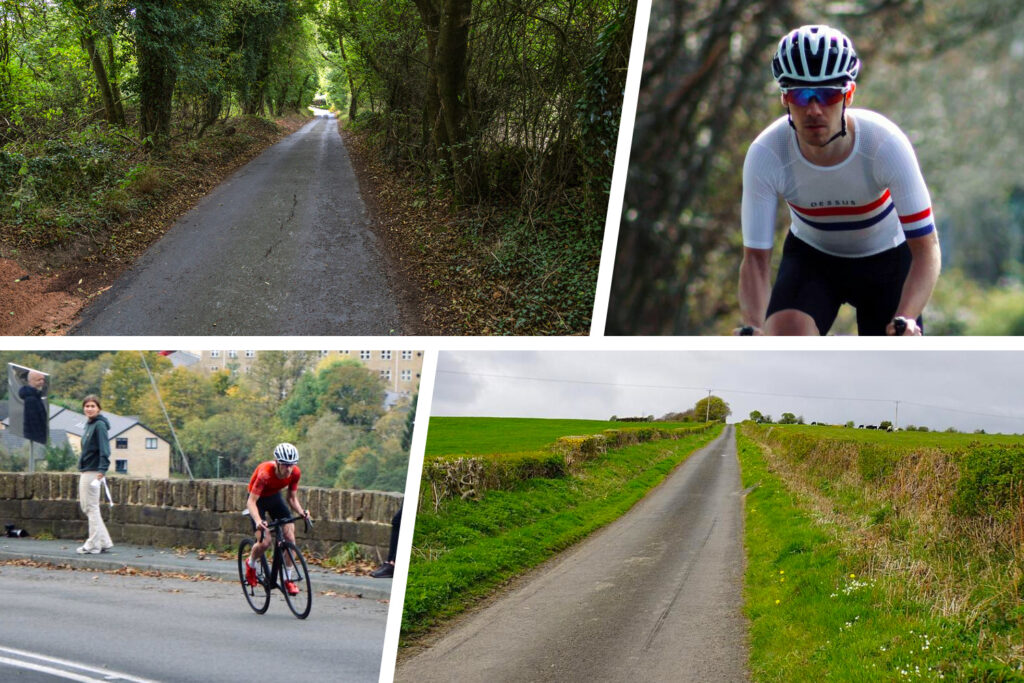
Bushcombe Lane, Cheltenham (UH73)

“While it’s not the longest climb out there at 1.2km, Bushcombe Lane is incredibly steep throughout, with pretty much the whole gradient being above 12-13%, rising to 25% briefly in places.
A lot of it is tree-covered, so smooth pedalling and keeping your weight towards the back of the bike as much as is practically possible is key to maintaining good traction if it’s wet or damp.”
The Rake, Ramsbottom (L8120)

“This is a classic hill climb that always attracts great crowds, because it’s right off the centre of Ramsbottom town centre. It’s a short climb at just 875m, meaning you’re going really hard from the start if you want a fast time!
The main feature is the right turn about two thirds into the course, onto The Rake itself. This is a savagely steep road that slows riders down to a crawl, with its 11% average and 22% maximum gradient.
You want to carry good speed into this final part, and you need to save plenty of power just to make it to the line.”
Jackson Bridge, Holmfirth (MH9)

“Jackson Bridge is 1.6km long with a 10.7% average and 14.8% max gradient. This climb has hosted a number of national championships over the years, and is a tricky one to get right.
It’s important to carry good speed across the flatter part about a quarter of the way in. This isn’t an easy task, since many riders go too hard up the first steep turns.
It’s also essential to maintain decent speed through the sharp right-hand corner towards the top, so that you can enter the final 40-60 seconds with good momentum.”
Streatley Hill, Reading (HCC005)

“Being a relatively short climb at 798m, Streatley requires high power outputs from start to finish. There’s a tricky surface to contend with, and it’s one of those climbs where you can see what’s ahead of you the whole way, giving the impression that you’re making slow progress towards the finish.
While you will want to ride the main steep portion of the climb as fast as you can (25.9% max, 13% average), it’s important to have a decent kick for the final dash to the line, since it flattens off a lot. Plenty of extra speed can be found if there’s a little bit of power left in reserve.”
Mam Nick, Peak District (OHC/10)
“A beautiful scenic climb that is 2km in length, in the heart of the Peak District and just the other side of the valley to Winnats Pass (which hosted the 2021 Hill Climb National Championships), Mam Nick has a mix of faster false flats and some tough bits too, with an average gradient of 9.8% and a 16.3% max gradient.
The climb back-loads the steeper gradients, so you hit these having done a fair bit of work already. If you’ve gone too hard too soon, you really pay for it.
The key is holding back enough in the first two thirds of the climb to allow you to pick up the power in the steeper pitches. Like Streatley, you need a good kick around the final corner, as the speeds increase quite a lot compared to the corners prior.”
Prospect Hill, Corbridge (MH21)

“This is a mini alpine-style climb of 1.4km in length. The main feature of Prospect Hill is its many hairpin corners, which do their best to break up your rhythm and can be quite sketchy when damp and covered with leaves.
It’s not overly steep, with a 7.5% average ad 11.8% max gradient, but it’s a climb which requires you to constantly focus, maintain good speed through the bends, and reaccelerate quickly as you come out of each of them. It’s quite a technical climb compared to most others.”
An underrated climb: Greenhow Hill

“For me, an underrated climb that deserves its own hill climb race would be Greenhow Hill, which is just down the road from where I live.
It rises out of Pateley Bridge and is both long and steep. It begins with a tough initial section and goes on to feature numerous ramps throughout, some which get up to 20%.
It’s tough because it features both slippery, tree-covered sections as well as very exposed parts towards the top, meaning the weather can affect the climb in numerous ways. Once you get out on the tops of the moors though, the views are awesome, and as much as the speed is pretty low for most of the climb because of how steep it is, the last part flattens out and you get a sense that you’re making progress and finally getting to the top!
It’s not a hill climb course, although it has featured in races like the Tour of Britain. I think it would be a really good climb to host an official hill climb race on.”
Tom’s hill climb bike of choice

“My hill climb bike – built around a Rose X-Lite frame – doesn’t change a great deal from hill climb to hill climb, and I try to keep everything as standardised and familiar as possible.
The bike is a lightweight carbon road bike with rim brakes, a tubular wheelset and 1x drivetrain. If any changes are made depending on certain characteristics of the climb, these will be adjustments to the gearing, such as using a larger or smaller front chainring or sometimes a double chainset, or switching out the rear tyre when more grip is needed.”
How Tom recces a course
“For smaller events, I’ll usually just scope out the climb on Strava beforehand, and then ride the hill the same day as the race.
I want to know how long it’s likely to take at race pace so I can dial in the right power output to aim for, and I’m also trying to spot the gradients to see where pushing harder or backing off slightly might be advantageous.
For the national championships, I usually go to recon the climb a few times before the race itself, and try to perform a near-maximal effort to see where I’m at and what that’s like.”
Do you take part in hill climb events, and if so what’s the toughest one you’ve encountered? Let us know in the comments.














14 thoughts on “Britain’s toughest hill climbs, according to a former National Hill Climb Championship-winning cyclist”
Nice to see Streatley hill on
Nice to see Streatley hill on here, one of my local favs. Once rode past another cyclist throwing up halfway up…
Another vote for Streatley
Another vote for Streatley from me. Although my best (back in 2020) is 5 mins, when I was deliberately using it for climb training.
Although I personally find nearby Whitchurch more soul destroying at twice the length, though less steep.
https://www.strava.com/segments/19436856
Whitchurch is also nasty, I
Whitchurch is also nasty, I don’t go up it much plus it had that sad incident involving a young rider a few years back.
Apparently (had to check
Apparently (had to check Strava) I’ve been up Streatley hill 6 times ever, whereas Whitchurch has had to put up with my cursing 21 times.
My main thought on Streatley is just what a horrible thing it is to descend. Nearly always seems wet, greasy and leaf-strewn. Also my imagination is quite vivid for what might happen if I cocked-up that unsighted bend or didn’t manage to stop for the lights at the bottom…
Streatley is a pig, certainly
Streatley is a pig, certainly. I was pleased to get a 3:59 on the Strava segment recently. Fastest is just over half that… I don’t do HCs.
Nice article from Tom Bell although he doesn’t seem to be on the NHC start sheet?
I’ll agree. Wandered over to
I’ll agree. Wandered over to Streatley on a hot day a few years ago, full of over-confidence and disbelief that there could be much of a problem that close to Reading.
I wasn’t trying to get some amazing time, just to get to the top. It wasn’t me puking at half way but I did have to stop for the sake of my heart. It’s truly harsh, but well worth a go if ever in the area (and lovely Goring nearby to buy jelly babies and recover).
Streatley Hill is on my cycle
Streatley Hill is on my cycle commute so I know it well!
There is an abandoned iron bath tub in the wood next to it about 2/3rds up which serves as a useful effort waypoint.
Other local-ish climbs worth a go are Britwell Hill, Swyncombe Hill (a beautiful climb particularly in bluebell season) and Chinnor Hill.
Worst climb I’ve done in the UK is Wynniatts Way from Abberley Village. Not that long but it’s so steep in one bit that I thought I might stop and fall off!
Not so much a list of
Not so much a list of toughest U.K. climbs rather more English ones. Would have liked to have read Tom’s thoughts on the likes of Horseshoe Pass (Wales), Dukes Pass (Scotland) to name but two. There’s a couple of belters over here in Northern Ireland – Benbradagh being one.
Horseshoe Pass isn’t
Horseshoe Pass isn’t particularly tough but is certainly a beautiful climb on a good day.
I would have thought that a national champs on Llanberis Pass would be good. There was the intention a few years ago to run the Welsh champs on Nant Gwtheyrn, a properly steep climb tucked away on the north coast of the Llŷn peninsula.
A return to the Burway above Church Stretton would be good. Last used for competition in 1989 for the national champs won by a certain C. Boardman, the course was revived by local club Paramount CRT with 2 events there in recent years.
It depends what Horseshoe
It depends what Horseshoe pass you Giff is referring to, if it is the old shoe, then that was last year’s Nat champs and it is a very hard climb but the new Shoe is a lot gentler but longer in length. I could name a lot of really brutal accents around North Wales but they would be too many to name and I do not know all of them, I know a lot around North East Wales but again my knowledge is not limitless. In and around LLangollen you could start with stuff such as up from the Bont – Garth – Fron mountain (inc from Berwyn) – worlds end (both directions) Dinbren (up to the Panorama). These all would blow the doors off if you were not prepared for it, but I like them a lot!!!
60kg lean keen climbing
I know it’s quite close to Cheshire & Merseyside, but that’s a bit harsh.
Ha Ha dumb Me, I should have
Ha Ha dumb Me, I should have left a small amout of time before I proof read before trusting my Dyslexic mind, but did not hence this mistake, not the worse I have ever writen but that is another story (I nearly got in a lot of trouble in work once)
Yes, a list of English Hills.
Yes, a list of English Hills. I guess they are ones familiar to Tom (very knowledgale on training, especially lactate ??, though a bit old skool on how to eat for health ?)
I feel, wherever you live, there are very steep hills nearby, you just have to seek them out. Living in Eryri I have an amazing choice, too much really. I still haven’t done the super steeps in the Conwy Valley. They are almost too steep to even walk up! I live ½ way up a very steep one near Llanberis, always a dilema which way to set off on a ride from home ?.
I only know a couple of these
I only know a couple of these. Bushcombe is an absolute brute. I’ve done Streatley a few times and it’s always more difficult than I expect it to be, but it doesn’t compare to the hardest in the Surrey Hills, for example White Down.