


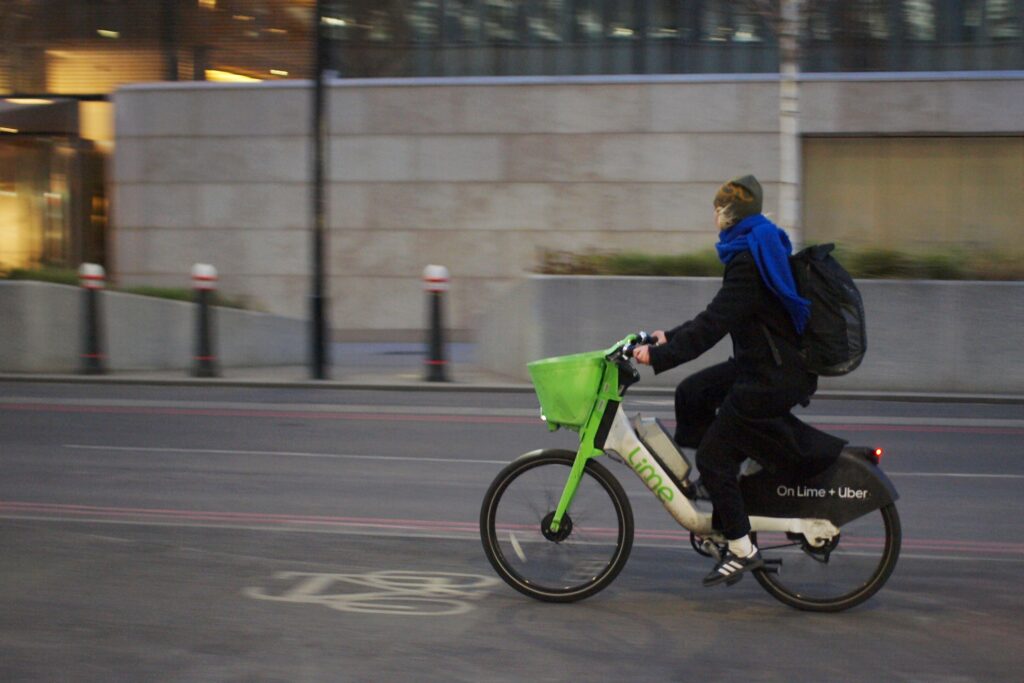

Over the last few weeks, there have been headlines across the UK talking about the disaster of shared bikes being left in large numbers on residential streets. Whether this was after the boat race, where people had the audacity to leave some bikes in Putney, people in Norbiton seeing them as an eyesore, and Brent Council even trying to ban them because they are ruining the famously beautiful Brent riviera…
Meanwhile, we have increasingly dire warnings from the bike industry of how awful the financial situation is at the moment, and how fewer people are buying bikes now than in the 1970s. Meanwhile, ‘real’ cyclists are being crowded out by shared e-bikes, and we are all being tarred with the same brush when drivers see some people riding like idiots or going through red lights.
Is this actually some kind of apocalyptic hellscape for cycling, where the thing we love is being thrown into the ground? I actually think it is exactly the opposite, and this is a change we need to embrace.

Three years ago, I was living in London and I did 90% of my travel on my own bike. I would chuck a couple of locks in my backpack and could generally be anywhere in less than an hour. Lime Bikes were becoming a little more common, but to be honest they had no impact on me, and I just saw them as jumped up Boris bikes. All my cyclist friends had their own bikes, and they did the same thing as me. All my other friends used the tube.
Things have changed now. People are using publicly available e-bikes because, let’s be honest, they are brilliant. The other day I was at a friend’s birthday party in Rotherhithe, and I was staying near Tower Bridge. That would have cost me £20 and 20 minutes in a taxi each way, and it would have taken me about 25 minutes by tube; but on a Lime bike, I could do it in 12 minutes and it cost me about three quid. It was a hot day and I arrived without being sweaty from public transport – or poor because of a taxi fare – and it took me far less time.
It’s not just me who is so enamored with them either. Half of all Londoners between 18-34 use them every single week, and journeys increased by 85% in the previous year.
So, the idea that cycling industry is in decline doesn’t match up to those statistics. People are riding more, and we’re getting young people onto bikes at a rate that we’ve never seen before. At road.cc we see thousands of comments commending Amsterdam or Copenhagen as bastions of cycling infrastructure – those numbers are showing that in only a few years, it’s not impossible that London could be seen in a similar light.
People are not turning their back on the bike industry, they’re just looking at an entirely different part of it. This just happens to be one that many ‘real’ cyclists don’t like very much. Don’t get me wrong, I am a bike lover and have a garage (plus a depleted bank account) that are testament to my love of bikes, their technology, and their form. The industry that we’ve grown up with is taking a kicking right now, and we’re all suffering as a result. But we need to look at the bigger picture.
When I spoke to Chris Boardman on the road.cc podcast, a man who matches my nerdiness for bikes, we didn’t just talk about technology, aero gains, or optimal positioning. The passion we shared is for increasing the number of people feeling capable of using bikes. While there are deep problems in the industry we know, there has been monumental progress in doing exactly that.










39 thoughts on “Stop whining about Lime bikes: they’re currently the jewel in Britain’s diminutive active travel crown”
Yeah I buy all of that BUT
Yeah I buy all of that BUT they are often (50%) ridden so poorly in London that they now outrank Escooters as threat number one. I was surprised to learn that they give a special halo to Lime riders which excuses them from waiting in line, traffic lights, signalling and other distractions which bother us mortals. My personal peeve as a fastish commuter is the Lime who comes to the front of the queue just in front and to the right of you in the assumption that they will be quicker out of the intersection…. And yes, I am aware that I sound like a grumpy motorist 🙂
Nah, Deliveroo and Uber Eats
Nah, Deliveroo and Uber Eats riders are still the worst.
Of course, threat number one is bad motorists.
It’s a common occurrence to
It’s a common occurrence to see motor vehicles drive some distance on the wrong side of the road because they’re turning right ahead and want to skip the queue. Nobody blinks an eye. But do something less dangerous on a bike and you’re suddenly a menace. Drivers hold cyclists of all kinds to a much higher standard than they hold themselves.
Well…I’m not against EAPCs
Well…I’m not against EAPCs but the “dockless bike share” model doesn’t seem to be one terribly well tailored to the public good. Are Lime a charity (no) or a community interest company? Have they been nationalised?
Bikes getting trashed / stolen / dumped anti-socially / not being available when you want them / needing shuttling about by motor vehicle are AFAIK why the biggest / longest running bike share systems are dock-based. (I’m not sure – I’d guess the biggest ones are in e.g. China though and I know nothing about that?)
I’d say Lime bikes are a
I’d say Lime bikes are a surprising example of corporate capitalism leading to a public good.
All of the downsides you list for dockless systems are also issues with docked systems. The only exception is bikes being dumped antisocially, but that’s not an insoluble problem.
Of course, it would help if Lime bikes couldn’t be easily hacked so that they could enforce their parking rules properly. But then, kids riding to school for free on hacked Lime bikes (as happens a lot around my neck of the woods) is perhaps the definition of a public good.
AidanR wrote:
True – but it’s a sliding scale I think. Depending in this case more on the value the people providing them put on the bikes. Again – don’t know Lime’s business model but there are examples of some dockless companies in which neither the bikes nor any money paid for riding them was the point! That’s because they’re really competing for “market share” (e.g. for venture capital or advertising money).
I think the heart of the matter is that it’s going to be hard to actually make money from the “hiring” part of any “mass” scheme. The costs are going to be high (especially labour), bikes need to be custom but wastage is high, and there’s likely a pretty low ceiling on what people will pay for casual cycle hire.
A possible counter-example (“high end” version of a mass scheme): the OV Fiets system in NL would appear to partly avoid some of the issues you list issues and reduce the impact of others. The bikes are important to the (nationalised I think) rail company – probably mostly as they are a (small) extra incentive for people to take the train. There may be slightly less theft / damage since bikes are stored / hired within a station – often within sight of staff. So they’re under cover and presumably any faulty bikes get reported before they set off. So they can be corralled and maybe fixed rather than just dumped by a rider because they were “bust”. Then – they have to be returned to where you got them from (or you pay an extra fee). Doesn’t stop them all being hired but reduces the trucking bikes around. “Who rented” is covered because they’re linked to your rail card.
Of course in NL there’s much better provision for cycling generally – so places to park, less likely bikes will end up in the road under a vehicle etc.
Hmm… I’m sure it looks cheerful and “kids cycling to school” is generally a good thing. OTOH is “kids on stolen ebikes” really the “definition of a public good”? Any more than “ain’t it nice to see the kids dodging bus / train fares and travelling about having fun with their pals”?
I think we could have the “public good” bit without “unintended consequence of some corporate ‘don’t care’ business model making free with public space”, no?
These kids don’t seem to need abandoned / stolen ebikes?
The OV Fiets system is pretty
The OV Fiets system is pretty cool, although the bikes are bloody awful. I’m sure half the ones I’ve ridden have been rammed head on into a wall. Used them every working day for a couple years to cover “the last mile” between station and office. That’s all they’re really fit for. Single speed. Coaster brake on the back. That’s yer lot. But never had one break down, and never got to the station to find they’ve all been taken.
Yes, here in NL we do have better provision for cycling including parking…but, lazy thoughtless twats are lazy thoughtless twats the world over so you’ll still find bikes parked in the most annoying places.
KDee wrote:
I’m sure I’d much prefer any of my own bikes, even the oldest – and if train commuting I’d be one of the many with “a bike on either side”. As you say – it should be seen as a way to extend “walking from station” / fill a small transport gap.
When Abelio tried to bring this to Scotland I didn’t understand it at all * because it’s actually a different model to the one known in the UK (or US) e.g. the city bike share idea. (Others have argued that from e.g. the council’s point of view that is more a compensation mechanism for not having decent street-level public transport in a low-cycling town or city…)
But … aren’t many folks personal bikes pretty much that? (Well – the older cheaper ones – ignoring the large take up of ebikes…) Nothing remotely fancy, and probably indifferently maintained too! I could be wrong but I’d suspect many (most?) people even in NL aren’t actually that interested in cycling – it’s just convenient for some purposes.
I used the (docked) public bike scheme in Glasgow a few times and was a bit horrified at the noises the bike was making (hub gears) and the general wobbles… but “good enough” to skip the bother of taking my own bike there for some casual trips.
Yup, same many places!
* Partly because they only had it at literally a handful of stations – indeed only one in Edinburgh!
Very true in the cities (not
Very true in the cities (not so much out in the polders). Having complete disregard for the condition and maintenance of your bike is a badge of honour here. The rustier, rattlier and squeakier the better.
chrisonabike wrote:
I have an issue with describing the bikes as stolen, given that the kids are only using them for a few minutes. “Stolen” implies a degree of permanence.
The kids in the video you link who all have their own bikes are at a private school in Ipswich. The kids I see riding to school on Lime bikes are going to a state school in a relatively deprived area. Perhaps it is unsurprising that they don’t have their own bikes?
Frankly, I don’t understand why you care so much that Lime bikes are under private rather than public ownership. Corporations inevitably make use of public goods, which is why they pay tax on their profits.
AidanR wrote:
If somebody pinches my bike, rides it five miles and then chucks it in a hedge I’m still calling it stolen even if they only had it for fifteen minutes. The presence of stolen (or borrowed, if you prefer) Lime bikes seems to have dwindled almost nothing in the Brixton/Peckham/Camberwell area where previously one saw quite a few every day. I don’t know if this is because Lime have fixed the hack whereby one could unlock them for manual riding by pushing them backwards or whether people have realised that they are such an absolute pig to ride without the motor that it’s not really worth doing.
AidanR wrote:
I don’t think Chris’ issue is so much with the ownership model as with the extraction of value from the public realm without paying their way.
Your second sentence there is extremely over-simplistic. There are plenty of ways that we prevent private concerns from using public goods. For example, we don’t let anyone set up a market stall just anywhere – you typically have to stick to designated areas and pay a licence/rent. Similarly, if you want to set up a taxi service you’ll have to pay for the privilege. And there are other ways we restrict what they do – we have laws (even if we’re not very good at enforcing them…) about what you can discharge into waterways, or the amount of noise building works can create, and much more.
‘Paying taxes’ doesn’t give companies carte blanche to operate any way they like without regard to the public good any more than paying income tax does for you or I as individuals.
Of course paying tax doesn’t
Of course paying tax doesn’t give companies carte blanche to do what they like, but what are the public goods that Lime are using?
Using the road is one, which we don’t charge anyone for (other than the odd toll road).
Parking bikes is the other, and a lot of ink has already been spilled here. I’m not condoning poorly parked bikes, but increasingly the model is to create parking bays, which councils charge Lime for.
Taxi licencing is not so much about firms paying to use public goods as it is about public safety.
AidanR wrote:
Also suggests that they’re not going to give a monkeys about e.g. dumping the bikes.
Kids are not necessarily going to behave socially of course. And as you note kids in deprived areas may also not.
That seems to be a different topic e.g. why don’t kids from deprived areas have bikes these days (or do they?), is it “stealing” if you’re poor, no?
It’s more concern out of “given we already know where this went with mass motoring” … I’m just interested in to what extent do these schemes really tend to favour “the public good” or are they just “not so bad” – and what conditions favour that? I think comes down to “follow the money”. Who’s actually paying and what are they most interested in from the bike hire company?
I’m awaiting enlightenment on how it works for Lime financially. But from most other examples of such larger-scale public schemes it seems there’s no way the costs can be covered by what riders can actually be persuaded to pay. (More restricted hire schemes may be different of course).
Why is that important? If people are paying little they have less motivation to care about the bikes (which TBF would apply to any mass scheme including the Dutch OV Fiets). If money from riders is less important the operators also have less motiviation to care about what happens with them – e.g. likely too much effort / money to chase rider misbehaviour / sort out “issues”.
If it’s not the riders who pays the piper then? If e.g. the public purse (a council) was paying then I think there’s slightly more chance of a focus on “what are we actually providing in terms of transport and how do we balance that with avoiding the negatives”.
Moderated by “but council” of course. BUT … people can boot them out if they’re not happy. So again – who actually pays for the operation/profit of a bike hire company and what are they interested in?
(Corporation tax is not a particularly specific tax. Although that’s a different topic e.g. should we focus specific taxes on businesses that perhaps get more private value from public goods e.g. road freight / bus companies which proportionally trash the roads far more?)
As far as I am aware, Lime’s
As far as I am aware, Lime’s revenue is primarily from their riders. They also “share” data with cities, councils universities etc, but it’s not clear whether they charge for this. However, the majority of the money they have received to date is likely to be investment (venture capital etc), as they’ve apparently done 11 funding rounds.
Doubtless the primary motivation for Lime is profit, but they still require the consent of councils/cities to operate. So there is accountability in that way, as we have seen with some London councils pressuring Lime into providing parking bays.
AidanR wrote:
So that sounds like it’s not in fact about the income from riders then? Just the familiar game of “dumb money” and selling people’s data? Again there may be exceptions but thus far it seems to be the standard public dockless bike model.
Of course selling folks data is nothing unusual now but if the majority of the money is coming from the sources about I can’t see their motivation points in the direction of better public transport or the “public good” or even working *with* councils at all. On which:
As mdavidford said my beef is not with the profit per se (and certainly not with getting more “normal people on bikes” – which like any thing “en mass” e.g. cars will come with significant down sides because “people”). But is the 2nd point you make actually the case? IIRC in Oxford the council said that Lime just moved in without any by-your-leave and initially they couldn’t do anything about that. (See story here – also here)
I have no idea if that is the whole story – councils need scrutiny as much as private corporations – but that does rather cast doubt on the narrative of some plucky innovators stepping in to the breach to service a public transport need (bikes! green!) with e.g. councils saying “thank goodness! We couldn’t have done it without you!”
AidanR wrote:
Or corporate capitalism subsidised by a public good (local authority funds).
I’d missed this, thanks – I
I’d missed this, thanks – I see local authorities pay Lime to provide bikes in their area. So public funds are subsidising a public good (micro mobility) provided by a private company which is seeking to make a profit.
Living in Bristol with a
Living in Bristol with a similar scheme, dockless basically works bar the odd chump. Much like driving/parking, but with a vehicle that weighs 20kg, instead of 2000kg.
That said, I do think Lime et al should rethink the ‘per-minute’ pricing system, it definitely contributes to people riding like a maniac (or we need green-by-default cycle routes). Waiting at each of the multiple crossings at a junction I commonly cross would cost me nearly £1 of the £3-5 of my usual ~15 minute ride. Over a year, that’s almost £500 (£1 each way, M-F) spent sat at red lights because of the design of that junction! (I ride my own bike 95% of the time, so not an issue, but it definitely contributes!)
Alternatively, tackle it the other way – resolve the issues that force cyclists to repeatedly stop, like we have spent decades doing for cars. The majority of journeys that are ripe for active travel are <5km, or about 15 minutes by bike. If a junction/series of traffic lights adds 5 minutes to that, it’s a huge proportion of the journey wasted.
Also living in Bristol, I
Also living in Bristol, I disagree with the first part of what you say but agree with the second part. The problem with dockless is not just “the odd chump”, it’s a lot of chumps and also the distributors; I see the frequently leaving bikes and scooters spread out across the pavement, effectively blocking it (and totally blocking it for eg mobility scooters). I don’t know how they are paid but I dare say they’re under quite a bit of time pressure (like other delivery drivers and riders).
But the point about delays at lights (and therefore the pricing system) is 100% valid. And the solution to both problems is the same: treat bikes seriously (and also treat walking seriously). Make it the expectation that hire bikes be parked on the road (carriageway), presumably in marked bays for end-of-hire reasons. And don’t subject non-motor traffic to control systems that are needed only for motor vehicles.
Bmblbzzz wrote:
Amen! If your problem is “too many people driving” (or even “micro-mobility”) ultimately your answer isn’t “city hire bikes”. It’s:
a) Sorting public transport. Ultimately “trams in busiest places” (due to their convenience – at street level – and their capacity). We need to reduce / slightly restrict private motoring because e.g. it gets in the way of the buses
b) Sorting out active travel with the same degree of concern as we have for providing for private motoring. That means providing truly convenient separate spaces and effectively networks for walking – and cycling (including wheelchairs, adapted cycles etc) because cycling is just so much more efficient. And that ends up again needing (mild…) restrictions on private motoring.
Reducing the private car use is at the bottom of this all – and really hard to get to happen.
It’s possible to welcome
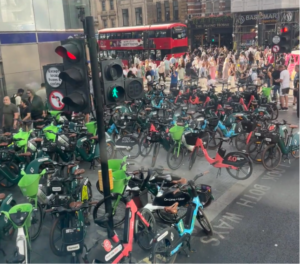
It’s possible to welcome their positive aspect without ignoring the considerable negatives, George (by the way considered and rational objections to things is not whining). When I don’t have to move half a dozen bikes off the pavement so they won’t be a hazard or inconvenience for the elderly or disabled in the course of a 500m walk to the bakery on Sunday morning, I might feel a bit more positive about them. There is no doubt that they are terrifically convenient and (it seems, I prefer to use my bikes) good fun to ride for their customers but until the parking issues are sorted out they are inevitably going to continue pissing off a large number of Londoners, and frankly quite justifiably so. See pictures below of my neighbourhood on a Dulwich Hamlet football club match day, pavements and, unforgivably, the only safe access to the local Sainsbury’s (next door to the club) for wheelchair users who don’t arrive by car completely blocked. If Lime can sort out parking bays and proper penalties for this sort of selfish parking it would go a long way to dispelling the negative image many people quite understandably have of them.
Your second photo highlights
Your second photo highlights the problem. A massive car park provided for motor vehicles leaving little provision for Lime Bikes. I bet it’s a nightmare to walk to also.
DonLogan wrote:
No, it isn’t in fact, there is a lovely park next to it through which one can walk to the store and it’s in the middle of a very residential area – I walk there every day and it’s the opposite of a nightmare. However, if you want to push a pushchair or a wheelchair through there those bikes are blocking the main route for walkers which has dropped kerbs and zebra crossings to allow safe passage. There is masses of room not only in that car park but around the football ground where the bikes could be parked without any problem, it just so happens that that pavement is next to the entrance and clearly people can’t countenance parking unselfishly and walking 50 m or so. It’s not a problem with the lack of provision, it’s a problem with user attitudes. Even if there was “little provision for Lime bikes”, how would that justify just dumping your bikes right where they block access for pedestrians and the disabled?
Rendel Harris wrote:
Well … people are going to be people. More particularly, how they’ll treat rules in certain conditions can definitely be guesstimated. So ultimately it comes back to those who set it up, as far as I’m concerned.
I think the “problematic use” issue is that public share bikes are often a “bonus” – people would manage without by working out other means. And also cycling is seen as a casual activity (and certainly low status) – plus most people aren’t really interested in cycling / bikes per se.
Combine that with “few or no consequences for misuse” (lowered considerably if people can hack and “borrow” bikes). Then anonymous bike dumpers ain’t going to care.
So who facilitated so many people to have easy-use-but-few-consequences-for-misuse bikes (zero if hacked)? What have they done to engineer better behaviour (perhaps “nowt” depending on their business model)? And what if anything is going to motivate them to care?
Perhaps they’re still sucking in venture capital, or once a contract is agreed with advertisers / local authority (if they bother engaging with the latter at all…) the money’s in the bank and who cares about what people actually do with the things? FWIW I don’t know how Lime’s finances work.
I think as you say we can acknowledge people mostly being inured to the arguably much worse woes that motor priveledge / I *have to park here* has brought BUT also query whether some private company should make money handing out stuff that people are predictably going to drop particularly in the way of others wheeling or walking.
There are always people who
There are always people who hate any kind of change and always newspapers who think they can make money out of amplifying this attitude.
Most Lime bikes I encounter
Most Lime bikes I encounter are ridden as if the user is playing Grand Theft Auto, ignoring all rules of the road in the most incredibly reckless manner. The closest I have come to being knocked off my bike on my commute is by Lime bike riders who have cut right across me almost taking out my front wheel. That has happened on more than one occasion. The way they are parked and ridden says everything about their users’ anti-social attitudes, so I find myself strongly disagreeing with this column.
triceratops wrote:
Presumably they’re not very good at it if all they’ve managed to steal is a Lime bike – are they mostly repeatedly driving straight into a wall, or getting on and off again?
triceratops wrote:
That’s the writer’s job done then. (He says, while adding to the engagement!)
I don’t think a large
I don’t think a large proportion of Lime or other rental bikes are ridden poorly. On my commute and travels around London most of them have riders just doing their thing – getting to and from work mostly but the look of it.
I think there is more of a tendency to run red lights on them – presumably because of their charging model. But the idea they’re “blowing through red lights” or whatever is ridiculous. Typically the riders move to the front of the queue, if they can, wait for a gap in the sideways traffic and move across the junction, or into the central divide in the junction to get across in another break in the traffic. It’s not something I do* but they’re generally behaving predicatably and rationally, like the rest of us.
If the main issue is parking them, if users were allowed to park in parking bays, where private vehicles are allowed, I’m sure most problems for pedestrians would disappear. But we can’t have the motorists inconvenienced though, can we?
*Except at one junction that doesn’t register if a cyclist is there and there’s no motor traffic coming from behind at that time of day.
momove wrote:
Is there any reason why you’re not (legally / contractually) allowed to park them there. I suspect it’s more a case of it just not being a normal thing to do. I suppose you could argue that in a way that means it’s not socially ‘allowed’, but I don’t think there’s any reason you couldn’t do it if you don’t mind risking upsetting a few people.
I think the legal situation
I think the legal situation is that you’re not allowed to put anything in bays unless you’ve paid to do so when it’s paid parking, as almost all parking in inner London is one way or another, either pay per visit or residential permits. There were a couple of stories two or three years back on this site of people being threatened with fines and legal action by Islington Council (I think) for leaving cargo bikes in resident-permit parking spaces (as I recall when the owners asked if they could buy a permit that was refused because they were for motor vehicles only!). So I would guess that if you left one in a paid parking bay it’s possible that the council could go after Lime and they could come after you for whatever fine was levied.
Fair enough – that’s my extra
Fair enough – that’s my extra-London blinkers showing through – I hadn’t considered the issue of parking being chargeable.
Out here in the great beyond parking spaces are basically a motoring subsidy, and I’d have no compunction leaving a hire bike in them.
I can’t help but feel that
I can’t help but feel that some of the anti-Lime bike comments on here are that not different (eg in lumping everyone into one homogenous group) to what we complain about drivers saying about cyclists generally.
Is it like this?
Is it like this?
Mainstream view: everyone vs. “cyclists” (out group)
“I’m a cyclist myself” view: same as above only a couple of “sensible cyclists” (me!) are in vs. “most cyclists I see” (out group)
Perhaps a road.cc view?: “cyclists” (in-group) vs. “people on bikes” (often an out-group e.g. “bad cyclists” / the slow / incompetent etc.)
EDIT meant (Wout van Aert not MVDP) view: me vs. everyone else (dunno what they’re doing but they’re going backwards)
You can’t look at what is
You can’t look at what is happening in London and extrapolate to the UK. Rental bikes don’t support the bicycle industry. I think they are an excellent idea but something needs to be done on how they are dropped. I know UK politicians are reluctant to do this, but perhaps look at examples abroad for solutions.
As a concept Lime bikes are
As a concept Lime bikes are great – enabling micromobility, exercise and reducing congestion from vehicle use by single occupants.
In practice it doesn’t work very well:
– endless kids using stolen bikes and riding like they are being chased by the police
– riding along pavements at speed
– throwing the bikes down on the pavement / dumping them wherever
None of this is the fault of Like bikes though – it reflects the increasingly selfish / self centred society we live in – in which no one gives a toss about anyone else.
George-you could always catch
George-you could always catch a 381 bus from Tower Bridge to Rotherhithe.
Apart from the random dumping of Lime bikes, there are reports of poor fleet maintenance, with up to 1 in 8 being unroadworthy. This has led to a number of serious injuries.
https://www.londoncentric.media/p/we-tested-50-lime-bikes-for-safety
https://www.londoncentric.media/p/lime-bikes-keep-breaking-londoners
Visited London the other week
Visited London the other week and used a Lime for the first time.
What a delight! Fantastic acceleration and great phone holder for navigation.
Absolutely loved my time on it and no issues with drivers either.
I’d love to see an article on how they run their system.