



Your bike chain will gradually wear with use and will need changing from time to time in order to maintain your drivetrain’s performance. Worn chains shift poorly, wear sprockets quickly, and sometimes break.
So when should you change your chain?
“For chain replacement we do not state ‘every x kms’ as this is not possible,” says SRAM. “Chain wear is based on multiple factors including maintenance (clean/lube), use conditions (water/mud/sand), user shifting patterns and overall drivetrain condition (cassette/ chainring wear).”
Cross-chaining: is it really all that bad?
Campagnolo agrees.
“It is difficult to pin down an exact number to kilometres due to the fact that riders come in different weights and sizes, ride differently, shift more or less frequently, develop more or less wattage, ride on flat or hilly terrain, clean or nasty conditions, take care or leave their chain dirty… all of which create large variables in just how much wear and tear is created,” says Campag’s Joshua Riddle.
“It can vary between 3,000km to 8,000km generally speaking, but it could be less or even more in some cases.”
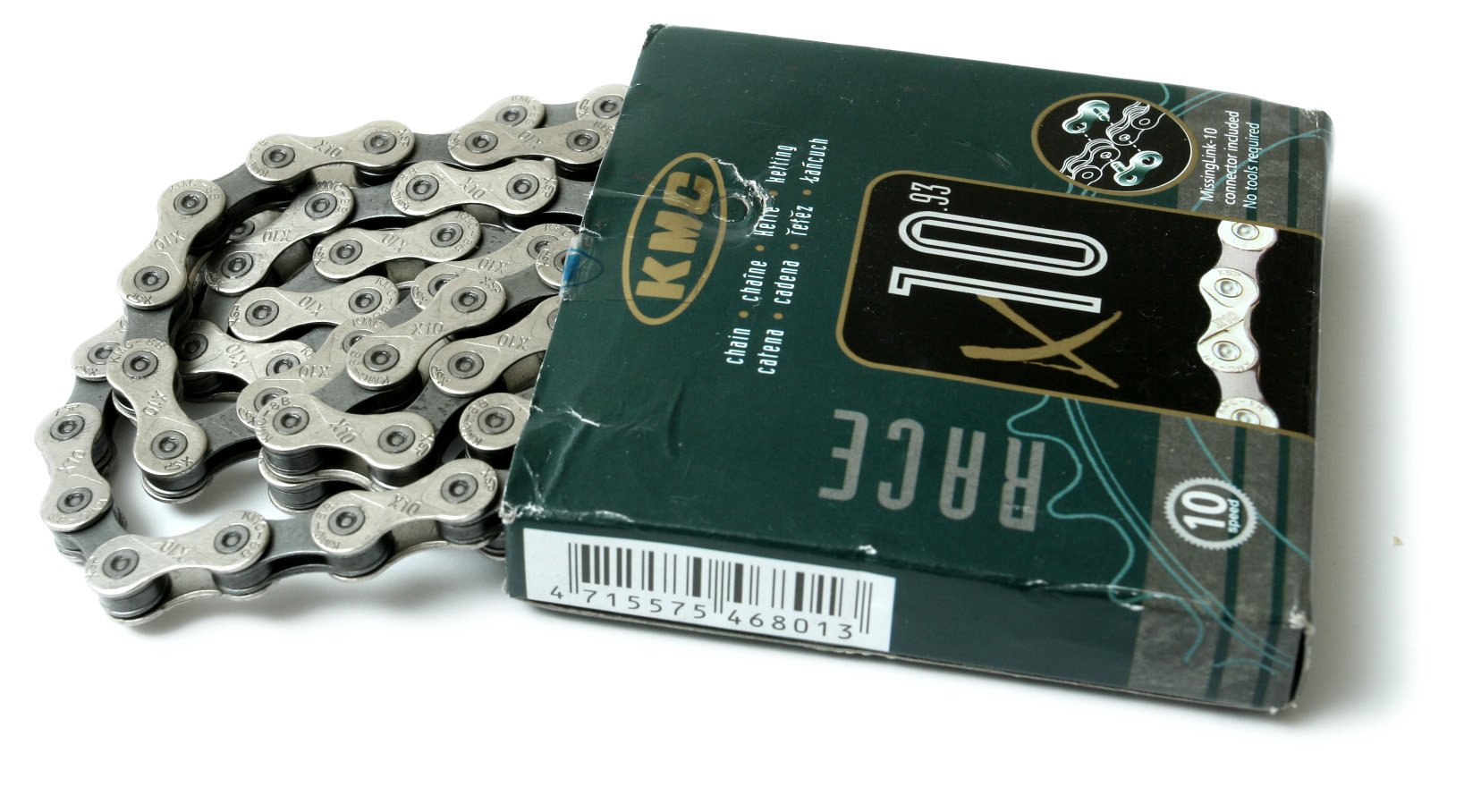
First, you need to replace your chain when you spot any damage (a deformation or crack). You should also check your chain regularly to see if it has worn to the point that you need to change it.
There are several ways to check whether your chain has reached this stage?
Measuring with a ruler
You can check for chain wear with a ruler. It’s a little easier if you go with imperial measurement here because one complete chain link of a standard chain measures 1in.
Start at one link pin and measure 12 complete links. You need to put some tension on the chain to be accurate.
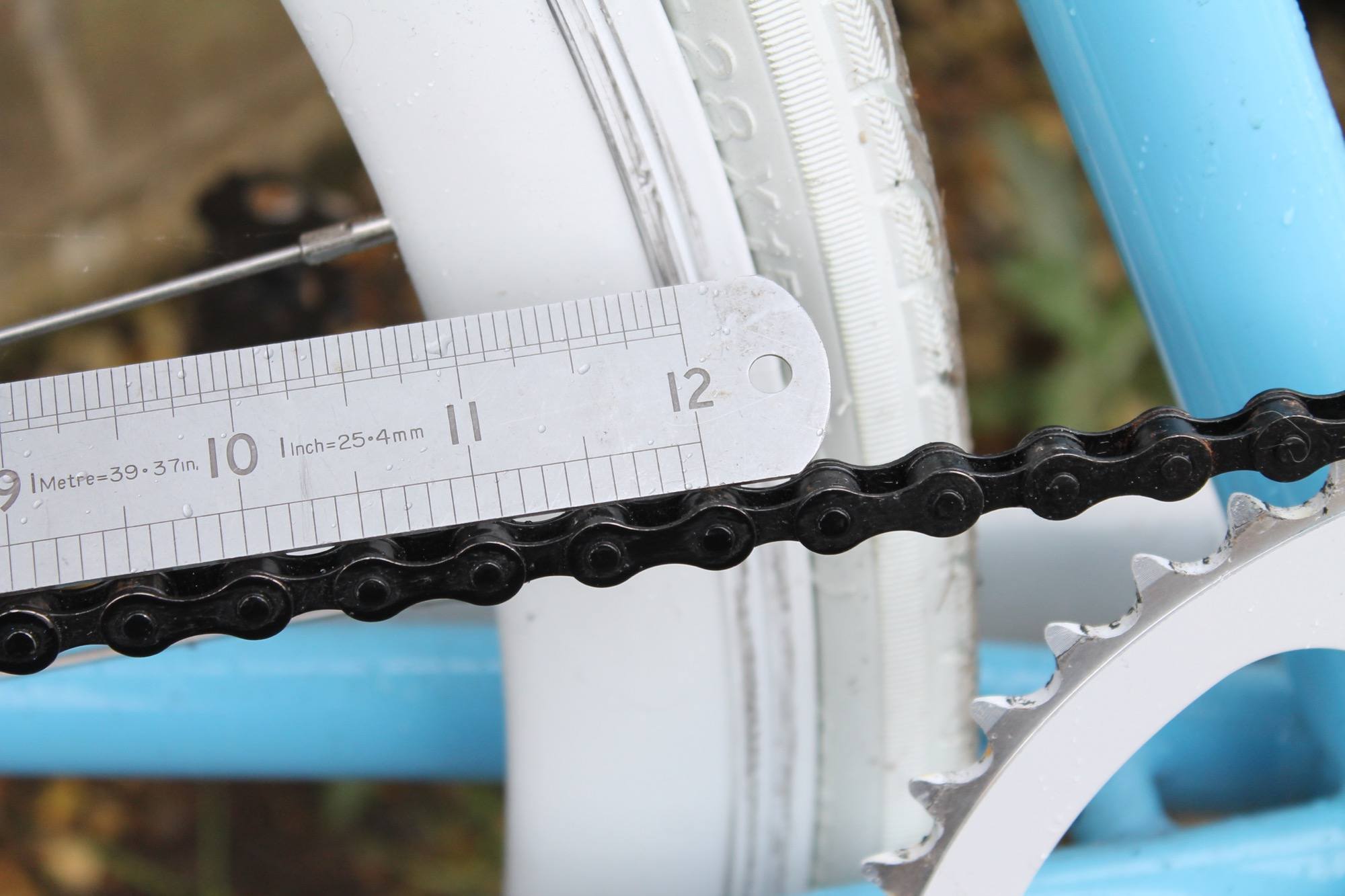
On a standard new chain, 12 complete links will measure 12in, but when a chain is worn the 12in mark of the ruler won’t quite reach the relevant link pin.
If the distance from the 12in mark to the centre of the link pin is less than 1/16in, your chain is fine, but if it gets to 1/8in (or 2/16) mark it has gone beyond the point at which it needs replacing.
If you use metric measurements, it’s easiest to measure 10 links.
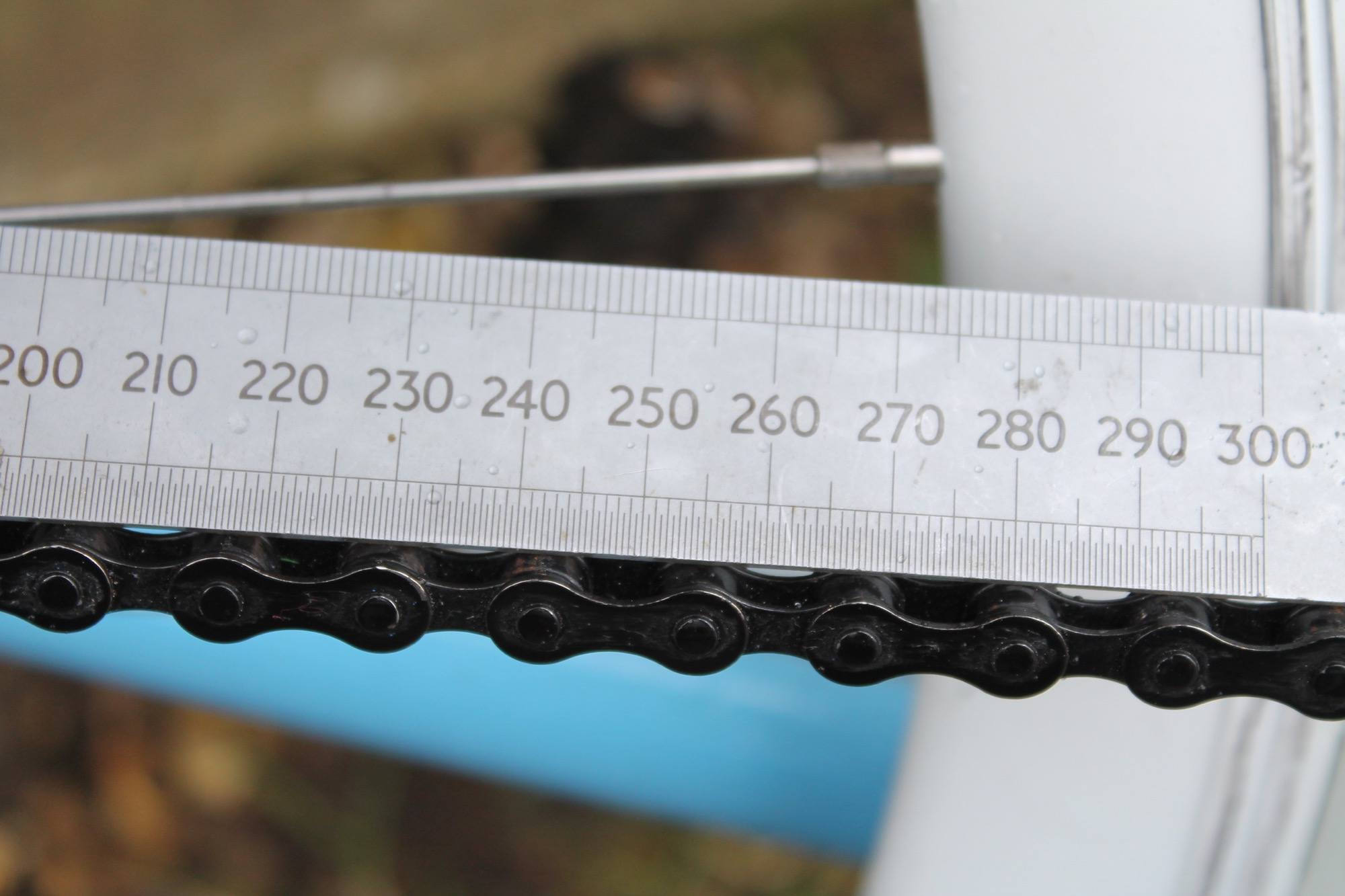
On a standard new chain, 10 complete links will measure 25.4cm.
If the distance from the centre of one link pin to the centre of the link pin 10 complete chain links away is up to 25.5cm, your chain is fine, but if it gets to the 25.6cm mark it has gone beyond the point at which it needs replacing.
If you want to get more accurate, it’s usually advised that you replace chain designed for 10 or fewer gears when it has lengthened by 0.75% – so when 10 links measures 25.59cm – and that an 11-speed or 12-speed chain is replaced when it has lengthened by 0.5% – so when 10 links measures 25.53cm.
If you have a one-speed or two-speed bike, replace your chain as it reaches 1% wear – so when 10 links measures 25.65cm.
Figures like these are obviously very difficult to gauge with a normal ruler, which is why we’d advise the use of a chain wear indicator.
Chain wear indicator
A chain wear indicator, sometimes called a chain checker, is an inexpensive gauge that does exactly what its name suggests.
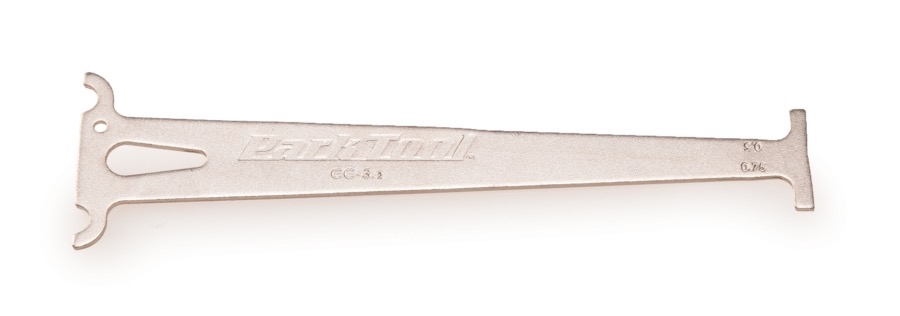
This is Park Tool’s CC-3.2 chain checker with an RRP of £9.99, although you’ll find it cheaper if you look around. Other brands offer similar instruments.
You hook the curved end into the chain and if the gauge tip on the other end fits completely into a chain link, the chain is worn to the point it needs replacing (one side measures 0.5% wear, the other side measures 0.75% wear).
Measuring by eye
There’s one other simple method of checking for chain wear.
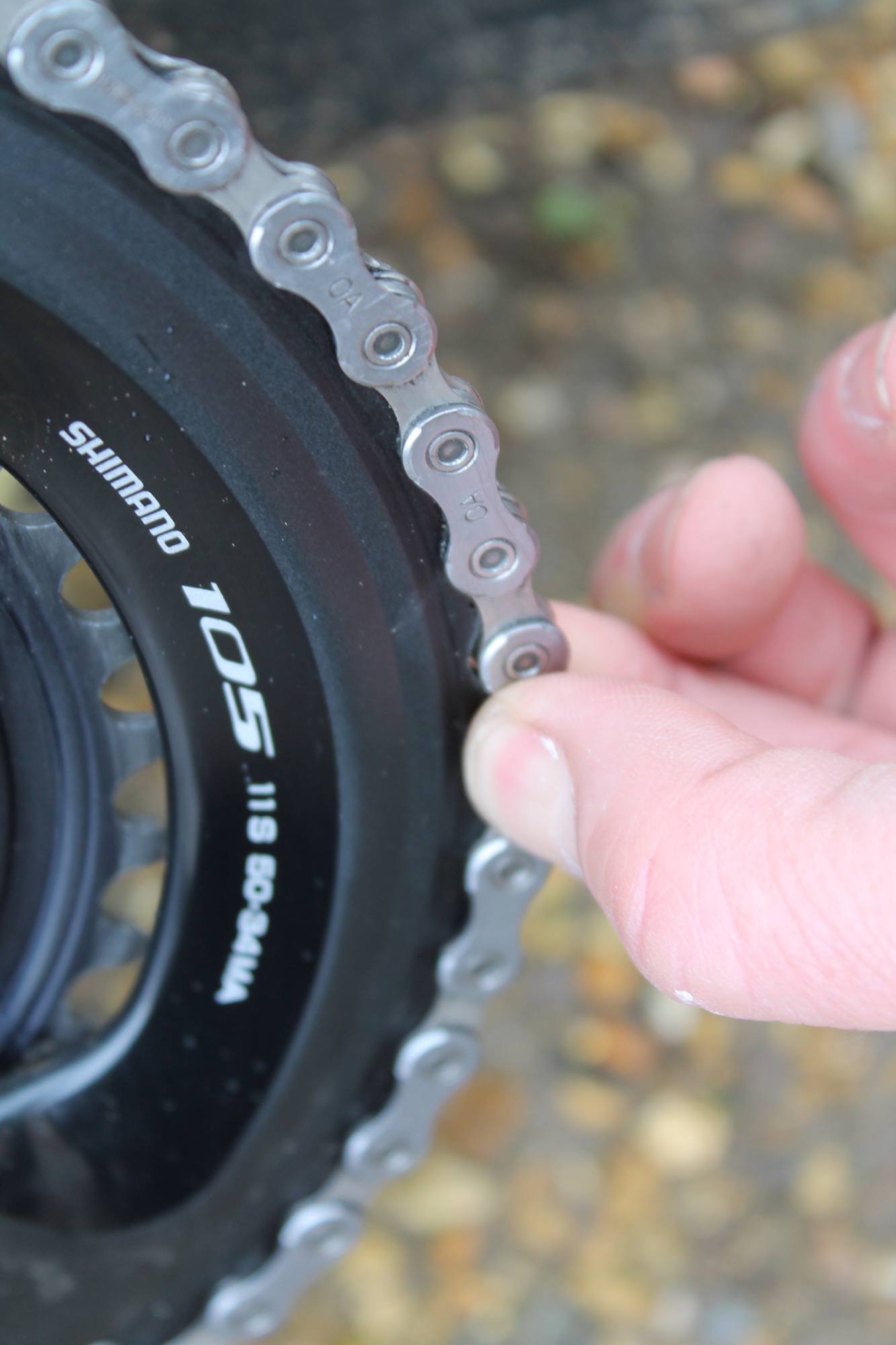
KMC advises, “If you do not have a gauge to test the chain’s elongation you could roughly check by putting the chain on the outer chainring and lifting up the chain from the middle of the chainring. If you can lift it more than half a link, the chain or chainring, or both, are probably worn.”
The chain in the picture is almost new so minimal lift from the chainring is possible.












74 thoughts on “Do you need a new chain? Find out the easy way to tell”
I’ll get the ball rolling
I’ll get the ball rolling with my experience….
Good bike gets two chains a year, doing roughly 3500km on each.
Winter bike does about 2000km per chain, changing every autumn.
If I could afford it, I’d buy more chains for the good bike throughout the year.
One simple thing not given
One simple thing not given enough prominence in the article: the cleaner you keep your drivetrain, the longer the chain will last.
nortonpdj wrote:
The scope and aim of this article is clearly set out in the headline: When should I replace my chain?
And in the standfirst: Here’s how to know when it’s time to fit a new one
There’s plenty more information we could have included about chain longevity, chain maintenance, how to change your chain, and so on, but that’s not what this article is about. The article is an answer to an often asked question.
For advice on cleaning and lubing your chain go to http://road.cc/content/feature/164006-how-clean-and-lube-your-bikes-chain
Views on buying a “better”
Views on buying a “better” more expensive chain?
Had a SRAM chain on my winter bike that only lasted under 1000 miles & changed it at 0.75 wear although it was in the worst of the weather.
Got a KMC on this time & paid slightly more so interested to see how that goes.
ibr17xvii wrote:
i went from KMC to SRAM it wore out very quickly in comparison on my commuter. Back with KMC now.
BrokenBootneck wrote:
If you let the KMC chain get too worn, the chainrings and sprockets would be worn to match. This would cause rapid wear to the new SRAM chain.
Also, another reason for not letting chain wear get too bad is that putting a new chain on a significantly worn chainring causes chain suck, especially in wet and dirty conditions.
BrokenBootneck wrote:
Slightly more expensive than the shimano ultegra (great chain)…but I use the KMC X10/X11 SL variants (Gold – TiNi coating) excellent wear (and bling) on these and can be had for around €30 a pop inclusive of the missing link
ibr17xvii wrote:
I’m using a Chorus chain that’s so far lasted two winters with no measurable stretch using an steel rule (in inches) and the method above.
I was getting only one winter from Ultegra chains.
Chorus 11 speed chains are about £26 and Ultegra 11speed about £21, so I think I’m ahead…
ibr17xvii wrote:
I have a Salsa Fargo adventure bike as my primary bike. It has a SRAM 10-speed 2x drivetrain. It came with SRAM PC-1051 chain, which lasted 800 miles, riding in winter and with lots of hill climbs. I change my chain at 0.5% stretch measured with the Park tool. I upgraded to PC-1071 chain, which costs about US$5 to US$10 more on Amazon (US$29 vs US$40). The PC-1071 chain got 1,450 miles, or not quite twice the miles – which for me, is worth the extra cost.
Worth emphasising that if you
Worth emphasising that if you change it too late you ruin the teeth, which is a much bigger job. Plus nothing feels as good as a new chain for so little money, so one job not to overlook; something I’ve been guilty of more than once 🙁
I purchased the very
I purchased the very excellent Park CC-2 chain checker many years ago, my only regret is not using it enough.
My 7 speed fitted with an 8 speed chain will be changed well before it get’s to the 1% mark, relativly cheap casette. Just taken the ebay discovered XTR off, will use in the summer when the filth is not so bad, Sram no longer make the PC-890 so couldn’t be constantly replacing the chain at 0.75%. Found a couple, will have to try the KMC eqivilent. My commute is more extreme than I have ever done, sections of quagmire, wet lubing 3-4 times a week, and a full clean every 1-2 weeks. Lot of fun though.
The 9 speed XTR will get changed hopefully before 0.75%, that casette is £150, gutting when you check that chain and it’s managed to go far beyond 0.75%, you change the chain hoping it will be alright and get the clunking when laying down power.
For some ridiculous reason I cannot put low grade parts on either of them.
Adds new chain to ‘to do’
Adds new chain to ‘to do’ list. Think I’m hitting 3000+
miles, probably need a new one.
Ultegra 11spd chain is £20
Ultegra 11spd chain is £20 without too much effort. They are pretty much a disposable routine maintenance item.
When my good bike was a 9spd I replaced it every 1000km and moved the old one down to my commuter mtb. I think it is one of those false economies to run a worn chain. Shifting is poorer, power transfer is poorer, they sound miserable and you add extra wear on more expensive components i.e the crankset and cassette.
Quick links make chain removal and replacement a simple job.
One of the down sides of a
One of the down sides of a recumbent. Chain swaps need three of the damn things…
Feels a little less disposable at £60+ a pop.
Darkerside wrote:
That’s another reason my High Racer is a ‘Sunday’ bike. Must get it off the trainer now the clocks have moved.
Paul__M wrote:
If the chain is 3 times longer, it will last 3 times longer. Think about it – the average wear on each link is 3 times less as it is in contact with a sprocket under force 3 times less frequently over its lifetime. Therefore the price is the same.
Applecart wrote:
The average wear on each is slightly less, but it is not contact with the sprockets that causes the wear, it is motion under pressure. The length of the chain has an influence, as the point of exit from the sprockets and entry to the chainwheel are the points of highest wear and it occurs less often in a long chain, but chain wear is not proportional to chain length.
Ive gone through a chain in
Ive gone through a chain in well under 1000km. Stop start riding in London in the winter…and being 100kgs probably did for it…
Rotate 2-4 chains every few
Rotate 2-4 chains every few hundred miles. The whole system will last longer and you’ll never need to measure the chain wear.
BBB wrote:
Rotating chains has NO effect on longevity whatsoever, it is yet another one of those myths picked up on clubruns/forums which people pass on as if it were the absolute truth. Do you really think that taking a chain off and giving it a rest makes it last longer? Do you really believe that? Really?
Welsh boy wrote:
It’s Friday tea time , so I’m not in lateral thinking mode, but might rotating chains reduce wear on the chainrings and cassette?
pockstone wrote:
I think if you take the chain off remember which way round it was and remember to turn it round the other way when refitting it after giving it a good soak, degrease and re lube then yes I’m sure that it may well help to increase longeviety
My personal view is fuck that shit – although I have had to replace a cassette to day so who’s laughing now
Welsh boy wrote:
The chains may not last much longer (if at all) but the whole drivetrain will. By rotating N number of chains you emulate the super chain with rate of wear / N.
You cassette and chainrings will be exposed initially to lower wear and all chains will be gradually “stretching” by the same amount so you avoid grinding the teeth of you cassette first with 0.75% worn and then with new chain (that’s assuming that you remember to replace your chain on time…)
As I said before this system offers a simple answer to “when to replace the chain” problem.
BBB wrote:
So you are saying that by putting a new chain on a transmission that is already starting to wear (and will continue to wear when you use it with whatever chain you fit) you will increases the life of the transmission? Is that what you are saying? I don’t think so, in fact you will expose your new chain to a worn transmission which will increase the wear rate of your new chain.
Welsh boy wrote:
By the time your first chain reaches the end of useful lifespan – 0.75% stretch in a traditional method, three (e.g.) chains used in rotation will be worn approximately just 0.25% each, exposing other components to much less wear. That’s the main difference.
I don’t quite understand why some people here feel so worked up about it. Whether it’s faff and it’s worth it or not , it’s up for individuals to determine.
It takes no time to disconect a KMC link and put another chain on. Many people do it anyway when they clean their drivetrains.
Welsh boy wrote:
I have heard that if you remove and clean the chain, leaving a thin film of lubricant to coat it, then pop it in the microwave for 5 minutes, it will ‘shrink’ the wear on the chain….
campag recommendation is the
campag recommendation is the most reasonable IMHO
132.60mm measured for 6 links. see the picture attached.
http://i-vol.com/bikes/campagnolo_chain_info.jpg
shifting performance begins to deteriorate around this point though, so you’ll notice it certainly, whitout measuring 🙂
I also endorse the Ultegra
I also endorse the Ultegra and Dura Ace chains (depending on which I can find on offer at a given time). For some reason I’ve not be able to the bottom of, KMC chains are noisier on Ultegra Di2 for me.
Yeah, there’s an optimal
Yeah, there’s an optimal number of chains, which varies with use, so the chains, cassette and chainset all get to the end their lives around the same time. Sounds like a lot of faff to me… But if you like removing and fastidiously cleaning chains…
Ooh sir sir, me sir, I know
Ooh sir sir, me sir, I know this one.
You may and/or should replace your chain in any of the following circumstances.
A) The bloke in the bike shop rests his metal gadget on it, sucks his teeth and shakes his head
B) Bang on the wheel of your lead-out man, you round the final curve of the 1st-cat crit, put down all of your awesome power for the sprint … and it snaps
C) You see a nice shiny new one favourably reviewed on road.cc
Can I haz the intern job now please?
Honestly can’t be arsed with
Honestly can’t be arsed with all this chain rotation/replacement bullshit. I just ride my chain and cassette into the ground (until shifting becomes a real problem) then replace both at the same time. Last chain and cassette replaced three years ago both now with 18000 km on them and still shifting fine. I don’t race, so couldn’t care less if I miss a shift every now and again. Oh, and I’m not fooled by the marketing ploy of expensive chains – they wear just as fast as the cheap ones, you’re just paying for the ‘shiny stuff’ and a miniscule weight difference – after a month in the filth of winter they all look, wear and shift the same.
kevvjj wrote:
ditto
…although I do have 5 bikes in rotation, so that’s a 15 year replacement time frame for me 🙂
There is nothing wrong with
There is nothing wrong with buying the lady in your life something shiny.
Rotating chains sounds a good
Rotating chains sounds a good idea, but when I got my spare out of the draw amazingly it had started to rust, so storage needs to be well lubricated if the garage is at all damp. That’s a bit messy for me, so am going the ‘disposable item’ route.
Paul__M wrote:
I degrease chain on removal and relube, then put into a Ziplock bag. A quick spray of whatever combo of 2 letters and 2 numbers you got laying about, seal up and stick in drawer – I write rough mileage on the bag too.
All that’s left is give the chain a good wipe down and refit.
Paul__M wrote:
Most decent new chains are greased and sealed in a plastic bag, so can’t rust; I prefer KMC chains because they are a dedicated chain manufacturer, unlike SRAM and Shimano, and are a lot tougher/longer-life than SRAM chains for daily MTB use.
This pre-emptive maintenance
This pre-emptive maintenance is a bit scary to me and my wallet. TBH I usually change my bike before I change the chain!
Admittedly, I’ve never done hyper miles, but I’ve never felt the need to check or replace a chain unless it was totally ruined (i.e snapped / siezed / super rattly / a really out of shape link). I would only even think of checking it if there was a problem with my shifting.
I’ve also never felt the need to replace a cassette or chainrings unless the teeth on them have done similar or it won’t shift properly / makes terrible noise and all other solutions have failed (ie. adjusting mechs / new cables etc)…
For context, my commuter bike does Roughly 100 – 150 miles per week all weathers and I clean & lube the chain every 3-4 weeks if it’s lucky when I sluice the bike down (fortnightly in the winter or if squeaking starts).
Most exotic drivetrain I’ve had is Tiagra..is that a factor? Do the more expensive parts wear more easily because they are lighter / thinner / different quality and therefore more delicate perhaps?
What am I missing out on by not changing this more frequently? I’m concerned that this sounds like a big important maintenance deal when I presumed a chain was…the most boring part of the machine and pretty indestructible!
Chains I just change once a
Chains I just change once a year, I do about 2000-3000 miles. I use KMC because their link is easy to take off/put on. I just fitted a new Shimano chain to my in-laws bike(he bought the chain), what a faff, those brittle little pins. You need a new one everytime, the chain has to come off.
Those who are concerned about wear, just use a steel rule to measure across 12 links in inches.
CXR94Di2 wrote:
You can buy KMC links separately and use them to reconnect Shimano chains.
. . wrote:
You can buy KMC links separately and use them to reconnect Shimano chains.— CXR94Di2
And clever little things they are too. My three bikes are all equipped with a ‘Missing Link”, it makes removing the chain a 20-second doddle.
> This is Park Tool’s CC-3.2
> This is Park Tool’s CC-3.2 chain checker (link is external) with an RRP of £9.99, although you’ll find it cheaper if you look around.
They are less than £1 from China. https://goo.gl/jxl7Z5 (no affiliation).
I reckon a lot of people are
I reckon a lot of people are replacing chains prematurely, those tools don’t really measure chain ‘stretch’ they measure roller wear. The only reliable way to measure is with a good ruler. Having said that I just replaced a chain because it was dropping in easily on the 0.75 % side but I got a few thousand winter miles out of it.
Anthony.C wrote:
Yes, chains don’t actually ‘stretch’ … it is roller wear that is being measured and those chain neasuring tools work very well and are much simpler and more precise that trying to keep 12 links of a chain straight, in tension, lining up a ruler and trying to take a reading for stretch. However, I would not pay £9.99 for a chain wear tool … I got mine from On-One for £2 some time back.
If you want your chain to last, then use a good wax dry lube.
nbrus wrote:
But rolller wear is not what causes ‘stretch’ It is the accumulation of the wear of the individual chain bushings that cause the ‘stretch’ so measuring with a ruler is a less convenient but much more accurate way of determining when you need a new chain.
Anthony.C wrote:
Both methods measure ‘stretch’ across several links, so pick whichever one is easiest for you. I wouldn’t say one method was better than another, but using a ruler is more reliant on the operator taking a correct reading, whereas a chain guage requires no operator judgment at all … its simple and repeatable pass/fail, though with the ruler you may be able to measure how much wear has taken place rather than the guage method which only shows when a wear limit is reached. Its the rollers on the chain that mate with the cogs in your gears and that is what a chain guage rests on to check for wear. As long as you have a method that you are happy using, then thats all that matters … absolute precision isn’t really required.
Always worth checking the
Always worth checking the jockey wheels too. Here’s three years worth of wear with a chain change once a year on a summer bike. As you can see – the chain chews away pretty fast.Probably 6000 miles worth.
I really recommend Ultegra
I really recommend Ultegra chains. I run 105 groupset and the generic (105?) chain my Cube came with snapped randomly. All the shop had was Ultegra and it felt immediately brilliant – silky smooth shifts and more solid power transfer. Not expensive, and I’m more likely to keep it clean for that good transfer + offset the cost.
Campag. I change chains
Campag. I change chains shortly after .5%generally get 5 + chains before cassette rejects the new chain. Those cassettes are pricey! Record chains do last very well.
Shimano chains seems to wear v quickly & cheap ones seem to be at 0.5% from the box.
KMC is my chain of choice in the workshop.
As everyone has said, clean & lube regularly & they last a long time. Ignore them & watch them melt in a few weeks.
ps, if I had a quid for every time a customer said “that chain’s nearly new, it can’t be worn!” when the 1% goes through, I’d have lots of quids.
Having snapped a chain on a
Having snapped a chain on a winter sportive I always carry the tool and links just in case now.Personally, for some reason my chains seem to wear diagonally (as opposed to streching) which the measuring tools dont always pick up so easily (cross chaining?) and at the rate of about two per year on 3000/4000 miles.
7800 km on my izumi super V
7800 km on my izumi super V and I ve just passed the 0.5% of stretch . , the zen chainring still black on the teeths , she doesnt show any sign of wear . JAPAN !
Replace preferably before it
Replace preferably before it looks like this:
The point is the tools
The point is the tools guarantee inaccuracy as they force the rollers apart and roller wear does not affect chain spacing and so shouldn’t be included in the measurement. Only pin/bushing wear affects chain spacing and performance. I use one myself but only consider replacing the chain when it drops in fairly easily on 1% if I can’t be bothered measuring properly.
Anthony.C wrote:
But roller / bush wear does affect chain spacing. It is the only thing on your chain that wears. The links don’t stretch. If the rollers are worn away inside (or outside) the distance between surfaces that the sprocket or chainwheel teeth catch on are further apart, and so cause wear on the teeth. Both methods, correctly applied will come up with pretty much the same answer. The vast majority of wear is on the inside of the rollers against the bushings and where the pins go through the links as that’s where the grease / oil traps the grit and dirt and then the 2 surfaces grind against each other, whereas the interface with the teeth is largely static.
The ‘accuracy’ that you talk about is trying to accurately measure an unknown / arbitrary number. We know that chains should be changed at about .75 – 1% wear (33% tolerance in measurement) to reduce drive train wear. This is just a guide number, and if either measuring method is within 10% (i.e. .825 – 1.1%) it still achieves the desired goal of picking a point of wear that is not too extreme but allows a reasonable life for the chain.
madcarew wrote:
This explains better than me why roller/bushing wear does not really affect spacing. http://pardo.net/bike/pic/fail-004/000.html
Anthony.C wrote:
Thanks for that – a most informative link.
However, I suspect that roller wear is going to happen at more or less the same rate as bushing/pin wear, so I doubt that the margin of error for chain wear tools is going to be that much of a problem. I’m going to carry on using mine as it’s a lot easier to use than a ruler.
Anthony.C wrote:
And from that article…
Using a ruler can be error-prone because it is necessary to hold the ruler precisely and measure one end while making sure the other does not slip. For that reason, several companies have developed chain wear measuring tools. The advantage of a special-purpose tool is that it is faster to measure wear.
Unfortunately, as of 2009/10 only one commercial bike chain wear measures just pin wear. The usual approach is to spread several links of chain by pushing the rollers apart. However, roller wear is added to the measurement, even though it does not affect proper chain operation. The one exception is the Shimano TL-CN40/TL-CN41, which measures only pin wear.
If a tool is conservative, chains are reported as worn-out when they still have useful service life, which increases chain costs. If a tool is not conservative, then errors mean a worn chain can be reported as good, gets used too long, and leads to drivetrain damage.
Commercial tools are conservative and never report a chain as good when it is actually worn. They may, however, report a good chain as worn, leading to increased chain costs.
You may draw your own conclusions.
Anthony.C wrote:
That’s a great technical argument, but is missing the point. It shows (the non effect of ) roller wear compared to a chain without worn bushings. In reality this isn’t going to occur. The point is technically valid, but practically is almost without value. The common chain wear tools *seem* to take this in to account, as a 1% worn chain as measured with a standard tool *generally* shows 1% link extension as well. So, in theory Jobst is right (as usual) but in practice the standard tools provide an effective means of determining the chain wear. The point at which you chose to replace the chain is rather arbitrary. I’m a decent Cat 2 racer. I don’t change my chains until they are beyond 1% wear. I go through a cluster about every 3-4 years (+/- 30,000 miles) and a chain every 3000 miles. The argument about wear on the rollers vs wear on the chain is rather academic, because as I said, it’s chasing an accurate measurement of a poorly defined point.
Recently, I deliberately ran
Recently, I deliberately ran a chain for a full year of commuting and after the chain wear indicator hit 1.0, I was able to measure the knock-on effect by the change in shape of chainring teeth. It was dramatic.
Don’t underestimate how much damage a worn chain will do to the more expensive bits of your drive train.
Got nearly 4000 miles out of the chain, but the chainrings will need replaced at about 60% of normal lifespan and I got a similarly reduced life from the cassette that was fitted.
For commuting, I’ll generally buy whatever is cheapest but really like Ultegra and KMC X10. Currently running a SRAM 1030. Normally, a chain will last me about 6 months/1800 miles with minimal upkeep. I run for 3 months before I start measuring wear.
On the fun bikes, I use Campag and KMC with the Ti-N coating.
ALL my chains, regardless of brand are connected using KMC missing links.
Jack Osbourne snr wrote:
You’ve touched on the point that most people forget: chainrings, especially modern ones can be very expensive, especially compared to a chain.
I normally start checking my chains at every change-over after about 3000km. For commuting, 3000km to 4500km is typical. On my commuter, I run a 3 chain rotation, with the two that are in storage kept in kerosene to prevent rusting.
For my weekend bike I work on the basis of replacing the chain when I reach 5000km or the chain wears out – whichever comes sooner – that means I replace the chains at 5000km, but the result is that after 15000km the cassette is still in very good condition and the chainrings are not really showing much wear.
I have a friend who used old
I have a friend who used old motor oil to lube his chain. He never cleaned his chain and he ran it until it ‘looked’ worn out (loose and floppy). When he eventually did get around to replacing the chain he found that it skipped on the rear cassette and that only a single link was mating with the front chainring … he had worn out his drivetrain on a single chain that had lasted only 500 miles (estimated). He has since replaced his worn drivetrain and is now looking after his chain using a good wax dry lube. The bike was an old hybrid, though he does have a race bike that was also treated with neglect, but wasn’t used as much, so is still ok. Dirt can quickly grind down your chain and wear out your drivetrain if you let it.
had the same chain on me
had the same chain on me mountain bike for 7 years and use it for commuting every day. Its gets semi regular coatings of house hold 3 in 1 oil and i have absolutely no intention of changing it as i am not a cycling sucker.
john1967 wrote:
So, you’re just going to wait until it snaps (which it will, at some point) before you replace it? Do let us know whether you merely smack your balls into your headset, or have a proper crash and lose some teeth, when that happens.
srchar wrote:
In my experience, with derailleur gears, the gears stop working well before the point a chain snaps. Plenty of people use bikes for many many years without changing chains, and with few injuries reported from chain snapping. I have a friend who is 120kg and races. His chains wear pretty badly, but he has found that it’s more cost effective to run a chain for 18 months – 2 years (15000 + miles) and then replace his 105 chainrings and sprockets and chain all in one shot than pay for a new chain every 1000 – 1200 miles which was what he was doing before. Personally I change my chain ever 2000 miles or so, because I race and prefer faultless, quiet running gears.
john1967 wrote:
well done that man! I like the cut of your jib. I’ve been using the same sheet of toilet paper (the crinkly stuff – it washes better) for just as long.
Waste not, want not!
I agree with the choice of
I agree with your choice of oil, but not with wear of chain.
Fair point john1967 and I
Fair point john1967 and I cannot fault your arguement, but you do realise this is a website entirely for us cycling suckers.
ktache wrote:
I find his argument extremely interesting.
What’s the implication… 7 years of daily commuting has to be worth, what: 14k – 42kish miles.
You’re getting that sort of mileage out of one chain, John?
You should market that 3 in 1 stuff… Honest John’s No Sucker Chain Miracle.
Having just returned from
Having just returned from Hong Kong, I would say ‘never’ is the answer. That also goes for lubing your chain.
I find it’s best to replace
I find it’s best to replace my chain whenever this article is republished.
srchar wrote:
It’s here again, time to replace your chain. 🙂
Another one gone.
Another one gone.
I gave up on the tool as I
I gave up on the tool as I found it way premature for me. Typically at 1,500 miles it would say I needed a new chain. I found in reality I’d get 3x that without the new chain skipping on the cassette. I usually only think about replacing a chain now if its done 3500-4000 miles.
Doesn’t KMC make all of
Doesn’t KMC make all of Shimano’s chains?
I was using Y BAN ,KMC gold
I was using Y BAN ,KMC gold but now switched to black chains
black are the new gold …both bikes sub 4 ,kilo .