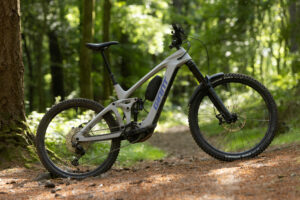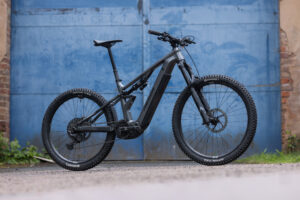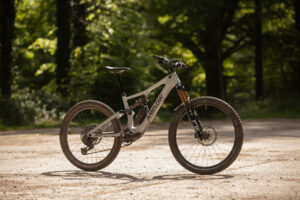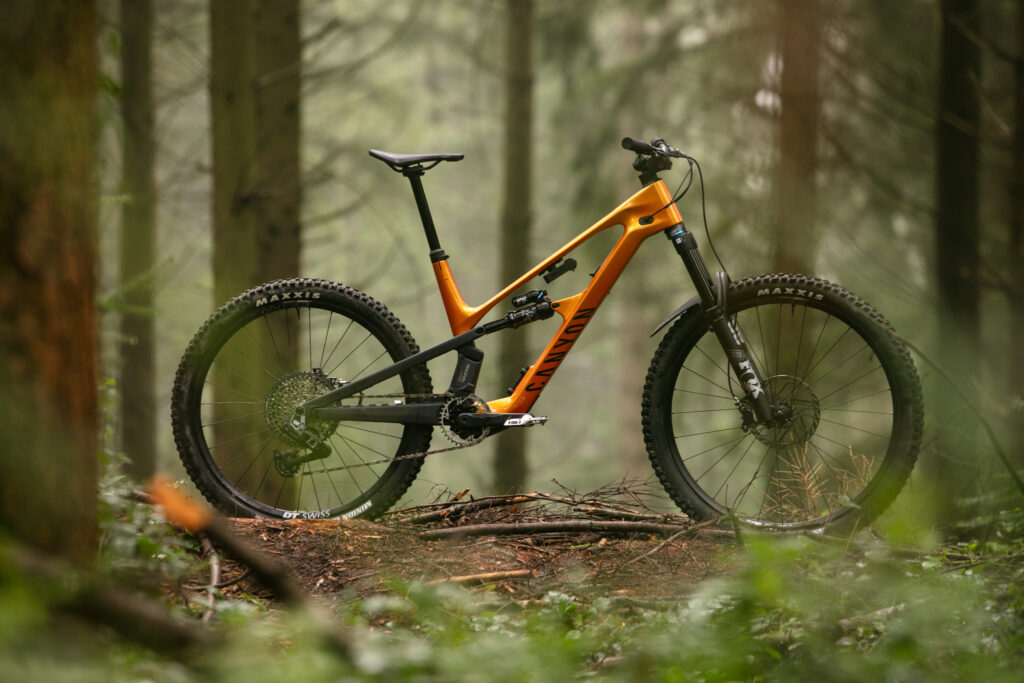

Utilising the TQ HPR150 drive system, the Canyon Spectral:ONfly CLLCTV takes the shape, geometry and suspension kinematic of the well-received Spectral but throws in a hint of assistance – the result of which makes it one of the best e-MTBs on the market.
- off-road Opinion – E-bikes aren’t a menace, it’s all about trail etiquette
- Whyte ELyte 150 RSX first ride review
- Trail Essentials – Kit to take on a mountain bike ride from the bare minimum to safety essentials
Canyon Spectral:ONfly CLLCTV – Technical details
Joining the Neuron:ONfly in Canyon’s burgeoning ONfly e-bike range, the Spectral:ONfly is designed to occupy the middle ground between the excellent EP801-equipped Spectral:ON and the regular mountain bike we reviewed earlier this year.
As such, it utilises the 150mm rear and 160mm of suspension travel as the full-fat e-MTB. Everywhere else, it takes cues from the regular mountain bike regarding geometry, suspension kinematics and aesthetics.
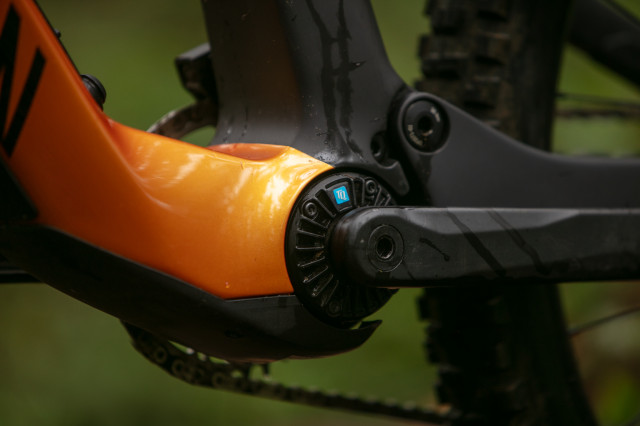
That’s made possible through the employment of TQ’s HPR50 drive system with its small footprint that makes little to no impact on the look of the bike’s slender carbon frame. The HPR50 motor weighs a measly 1,850 grams while pushing out 50Nm of torque and 300W of peak power, fueled by a 360Wh battery. Bolt that into a frame that’s said to weigh 2.7kg in its medium size and Canyon’s onto a rather light machine here. To boost the battery, there’s a 160Wh range extender available but it’s an optional extra.
On the subject of the frame, it’s filled with Canyon regulars including replaceable pivot threads and double-sealed bearings across the board. The brand has also fitted the bike with a short seat tube and a super long dropper providing 25mm of travel adjustment. On this large frame tested, there’s 200mm to play with which is more than enough.
The geometry is identical to the regular Spectral but Canyon has made a couple of tweaks. First off, its head tube and seat tube angles are identical at 64-degrees and 76.5-degrees. Reach shrinks by 5mm to 495mm and the chainstay grows to 440mm, and there’s a 1,280mm wheelbase. It’s certainly a large bike, especially compared to the Spectral:ON with its 1,252mm wheelbase. However, this bike falls neatly in line with Canyon’s modern geometry practices where a 500mm reach, for example, is standard across the brand’s e-MTB range.
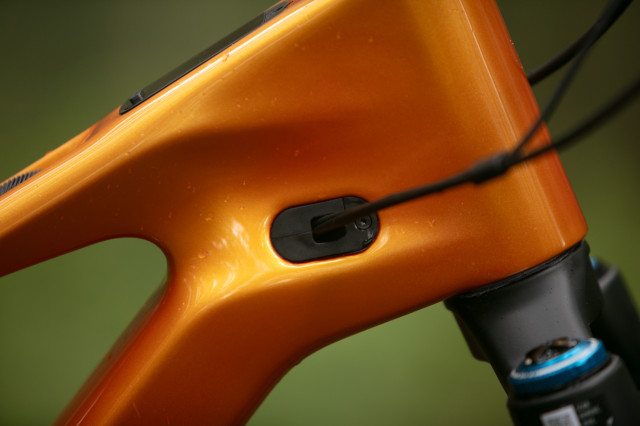
To wrap up the features, the Spectral:ONfly is the second bike in Canyon’s range to use K.I.S, its adjustable steering stabiliser. There’s an accessory mount at the underside of the top tube and plenty of room for a water bottle in the front triangle. Unlike the regular bike, customers can’t swap the rear wheel size and the battery isn’t removable.
Canyon Spectral:ONfly CLLCTV – Components
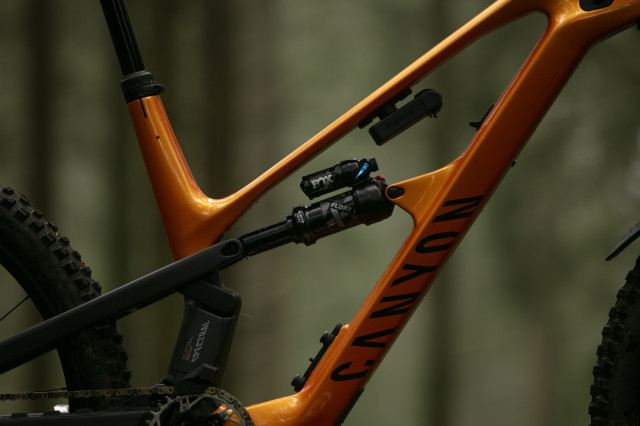
As a CLLCTV edition bike, it’s specified a little differently from the rest of the Spectral:ONfly range. This build is a little burlier with a Fox 38 Performance Elite fork delivering the 160mm of squish, rather than the 36 you’ll find elsewhere in the range. That’s paired with a Fox Float Performance shock, which comes with mild disappointment. The fork gets all of the adjustment but the shock lacks compression dials which makes this choice of shock a bit of a surprise given the rest of the build and its possible intentions. Without such adjustments, making the front and rear of the bike ride similarly is a more difficult endeavour.
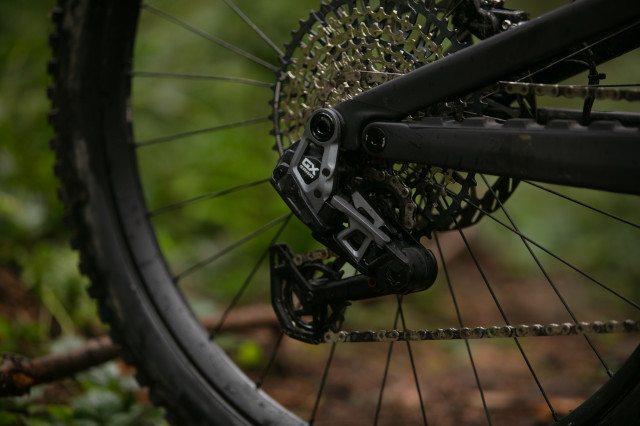
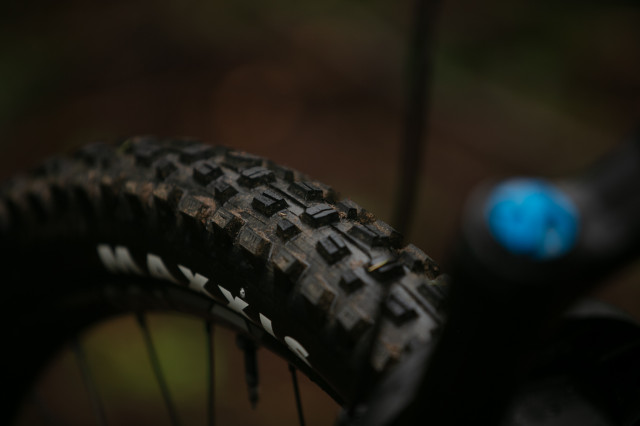
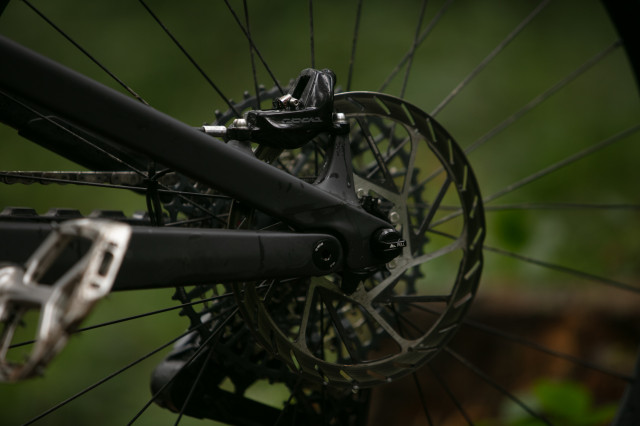
SRAM handles shifting and slowing with a GX T-Type AXS drivetrain and Code Silver four-piston brakes hooked up to a pair of 200mm HS2 rotors. It rolls on a set of DT Swiss HX1700 wheels with a 2.5in wide Maxxis Assegai tyre with an EXO+ casing and MaxxTerra rubber at the front and a Minion DHR II MaxxTerra, EXO+ at the rear.
Apart from the Fizik Terra Aidon X5 saddle (that I swapped for something more suited to me), Canyon sorts the rest of the build kit.
As for weight, this CLLCTV model comes in at 20.02kg. I did swap the front tyre for something significantly heavier, so the stock weight would be a few hundred grams lighter.
Canyon Spectral:ONfly CLLCTV – Performance
When creating the Spectral:ONfly, Canyon aimed to build a natural, almost undetectable e-mountain bike that rides like its non-assist counterpart. In fact, I’ve found myself wishing it had more range so I could keep the good times flowing.
And I’ll do my best to keep comparisons to the regular bike to a minimum from here on but where Canyon has shrunk the reach and stretched the chainstay, the Spectral:ONfly is a rather prolific climber. These changes effectively shift weight more centrally between the wheels, leaving little need for corrections when cranking up a hill. Unless it’s a particularly technical climb, I’ve been able to sit and spin to the top of the hill.
It’s not as effortless a task as something with 85Nm but Canyon’s collaboration with TQ in tuning the motor’s three settings has good power and a very natural feeling delivery of assistance. The motor subtly ramps up its output according to the effort you’re putting in but the assistance cuts out nearly as abruptly as other TQ-equipped machines. It really does feel like pedalling a regular mountain bike but it’s just that bit easier, and faster. It’s a near-silent motor, too, letting off a whirr only when pushed in its highest output mode.

Although it is light for an e-MTB, Canyon has acknowledged that there is some extra weight at play. Pair that with the 150/160mm of suspension travel on offer and there’s heaps of stability, thanks to the overall length. The extra few kilos (in comparison to a non-assist MTB) still gets the suspension working harder and, despite being a little too linear for my tastes, once loaded with an extra volume spacer, I’ve been very impressed with how the rear end handles bumps.
Much like the normal Spectral, the Spectral:ONfly’s rear suspension is tuned to be ‘linearly progressive’ but I found it to be a little too linear for my liking, especially with the extra few kilos present. Even at the correct sag, the rear end blew through its millimetres too readily under compression and when cornering. I added a second 0.2 yellow spacer to the shock’s air can and that boosted support.
With that volume spacer, the suspension tracks the ground impeccably as it’s still free to use a fair bit of its travel. But reducing the shock’s air volume noticeably boosted support which allowed me to push harder into berms and helped keep the bike balanced in all situations.
In recent years, Canyon’s geometries have got longer and this bike gets a lengthy reach but it’s a great example of how the brand is accommodating of sizing up. Technically, I should choose a medium frame according to the size guides but I happily fit on the large (my usual size) and that’s without the seatpost slammed into the seat tube. The real benefit here is that riders can choose their frame sizes to suit how they want their bike to ride, erring towards stability or agility.
And the Spectral:ONfly delivers stability by the shedload, owing to the long front centre. Although long, the bike’s not a slouch in the corners. Because the TQ motor is a small unit, the bottom bracket is lower and reduces the centre of gravity making it feel like you’re ‘in’ the bike rather than on top of it. This helps drive the bike through corners and technical stretches of trail.

The only instances where the length of the bike comes as a hindrance are in properly tight terrain and when outright agility is warranted. But that said, situations where I’ve found myself cursing for a shorter bike have been few and far between. However, as there is a bit more weight at play, there’s a little more stability so sizing down is a very valid option, especially as K.I.S can boost stability.
The Spectral:ONfly is a seriously great bit of kit. It straddles the line between regular MTB and full-fat e-MTB by providing a relatively lightweight ride that’s playful, engaging and lively while throwing in a hint of assistance that’s merely there to get you back up to the top of the hill quickly. Canyon has hit a fantastic balance here.
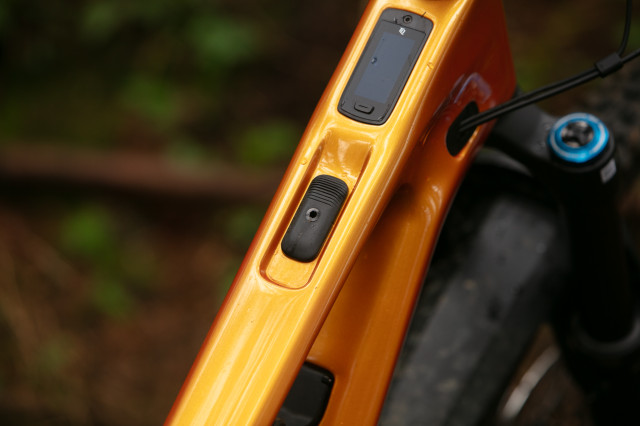
However, I have a minor gripe that probably won’t apply to everyone – the range extender and its mount. It attaches via Fidlock’s magnetic system but it’s specific to the range extender. A regular Fidlock bottle doesn’t fit without completely clearing the frame unless you pick up Canyon’s £47.95 custom bottle.
Canyon Spectral:ONfly CLLCTV – Verdict
An area in which the Spectral:ONfly CLLCTV impresses is in its value. It’s the cheapest TQ-equipped e-MTB on the market with componentry that adds to its ride.
Scott’s Voltage eRide 910 will set you back £6,600, so it’s a couple of hundred quid cheaper but its suspension is much less sophisticated and rather than GX T-Type AXS, it gets Shimano Deore shifting. It’s also a TQ-equipped bike and its geometry is more conventional.
If it’s a lightweight e-MTB you’re looking for, the YT Industries Decoy SN does things a little differently but, in its Core 2 build, it’ll cost £6,499. It’s driven by a Fazua Ride 60 drive system that puts out 60Nm and 450Wh of peak power and has a 430Wh battery. It’s got more suspension travel too as it’s an enduro focussed e-MTB with 170mm up front and 160mm at the rear.
In pursuit of the natural ride, Canyon has nailed it with the Spectral:ONfly CLLCTV. It rides almost as dynamically as a non-assisted mountain bike while providing handy assistance when the trail points up. The motor is tuned beautifully and, with a bit of extra setup tweaking, I’ve loved the suspension. However, the bike would be improved with a small spec change – namely the shock and battery range.
You might also like:
- How to go bikepacking: a beginner’s guide to getting started
- Getting fit for enduro pt2: Finding the training groove
- The best ways to find new mountain bike trails
About the bike
Tell us what the bike is for, and who it’s aimed at. What do the manufacturers say about it? How does that compare to your own :
State the frame material and method of construction. List the components used to build up the bike.:
Carbon frame, Fox 38 Performance elite, Fox Float X shock, DT Swiss wheels, TQ HPR50 motor, 360Wh battery, Maxxis tyres, SRAM GX drivetrain, SRAM Code Stealth Silver brakes,
Frame & Fork
How much suspension travel does the fork have?:
Was the bike comfortable to ride? Tell us how you felt about the ride quality.:
How was the bike in terms of sizing and angles? How did it compare to other bikes of the same stated size and intent?:
Overall rating for frame
How much suspension travel does the rear end have?:
Did the bike feel stiff in the right places? Did any part of the bike feel too stiff or too flexible?:
Tell us about the build quality and finish of the frame:
Tell us about the geometry of the frame:
Tell us about the materials used in the frame:
Riding
How did the bike transfer power? Did it feel efficient?:
How would you describe the steering? Was it lively, neutral or unresponsive?:
Tell us some more about the handling. How did the bike feel overall? Did it do particular things well or badly?:
Rate the bike for sprinting:
Any comments on sprinting?:
Rate the bike for high speed descending
Any comments on high speed descending?:
Rate the bike for technical descending:
Any comments on technical descending?:
Rate the bike for flat cornering:
Any comments on flat cornering?:
Rate the bike for technical climbing:
Any comments on technical climbing?:
Rate the bike for climbing efficiency:
Rate the bike for agility:
Suspension
Rate the fork for performance:
Rate the rear suspension for performance:
Any comments on rear suspension performance?:
Rate the balance and performance of the suspension overall:
Any comments on the balance and performance of the suspension overall?:
Drivetrain
Rate the drivetrain for performance:
Controls
Tell us some more about the controls. Any particularly good or bad components?:
Summary
Did you enjoy riding the bike?:
Would you consider buying the bike?:
Which components had the most effect (good or bad) on the bike’s performance? would you recommend any changes?:
Would you recommend the bike to a friend?:
Rate the bike overall for performance:
Rate the bike overall for value:
Use this box to explain your score:
All the deals displayed on our review pages are pulled from a constantly updating database feed of the best affiliate deals available. The criteria for deciding on what are the best deals is who is offering the lowest, delivered price. In most cases we will be showing the very best deal available online, but sometimes you may be able to find an item cheaper. If you can please feel free to post a link in the comments box below. To find out more about affiliate links on road.cc click here.