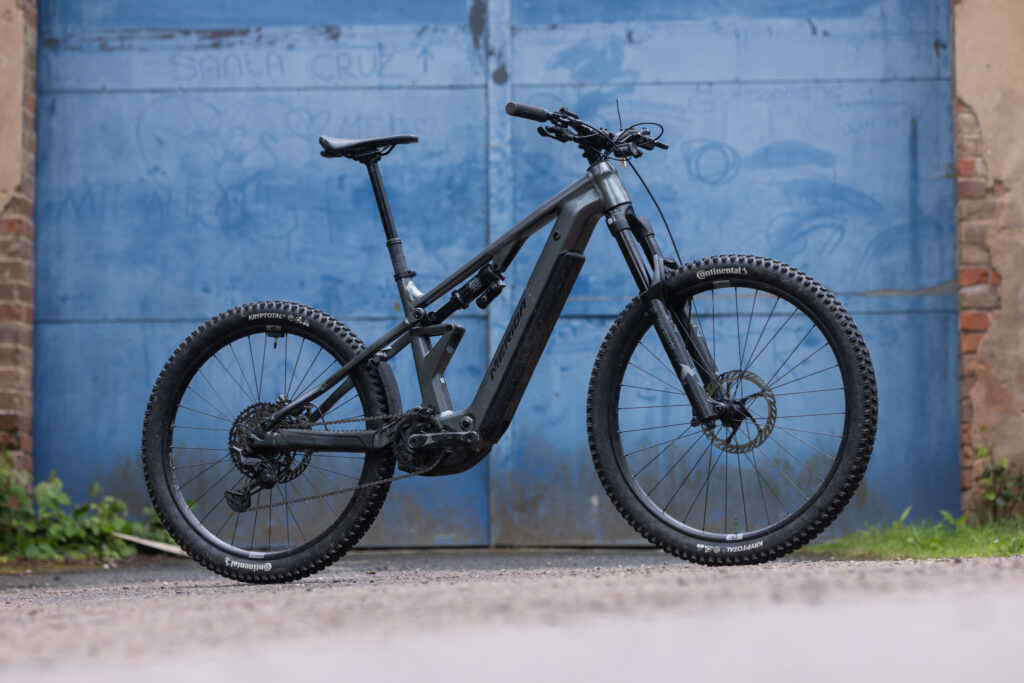

The Merida ETMO 800 is a 160mm trail e-bike that defies its 27kg heft with some clever geometry, an effective mullet wheel size setup, and excellent mid-travel support – it’s at home on all but the most technical trails. The range is excellent thanks to the well-proven Bosch CX system, and the all-round solid spec means there’s no reason to hold back.
Merida ETMO 800 – Technical Details
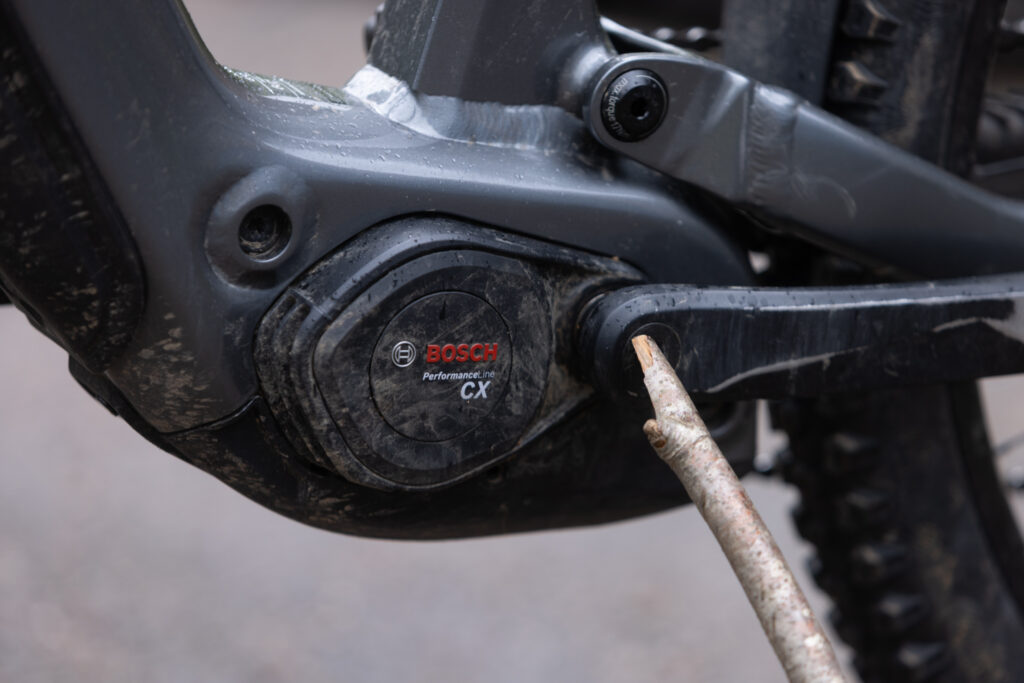
The Merida ETMO is built around the Bosch CX drive system, which now puts out 100Nm of torque and 750 Watts of peak power. An 800Wh battery is onboard – Bosch offers an extra 250Wh (and 1.5Kg) with the PowerMore range extender if you want more.
Bosch’s Purion 400 display gives a whole host of stats for your ride, including battery percentage, assistance level, speed and predicted range. Charging is taken care of via a 4A charger, so it’s a slow affair, taking six to seven hours to fully charge the 800Wh battery.
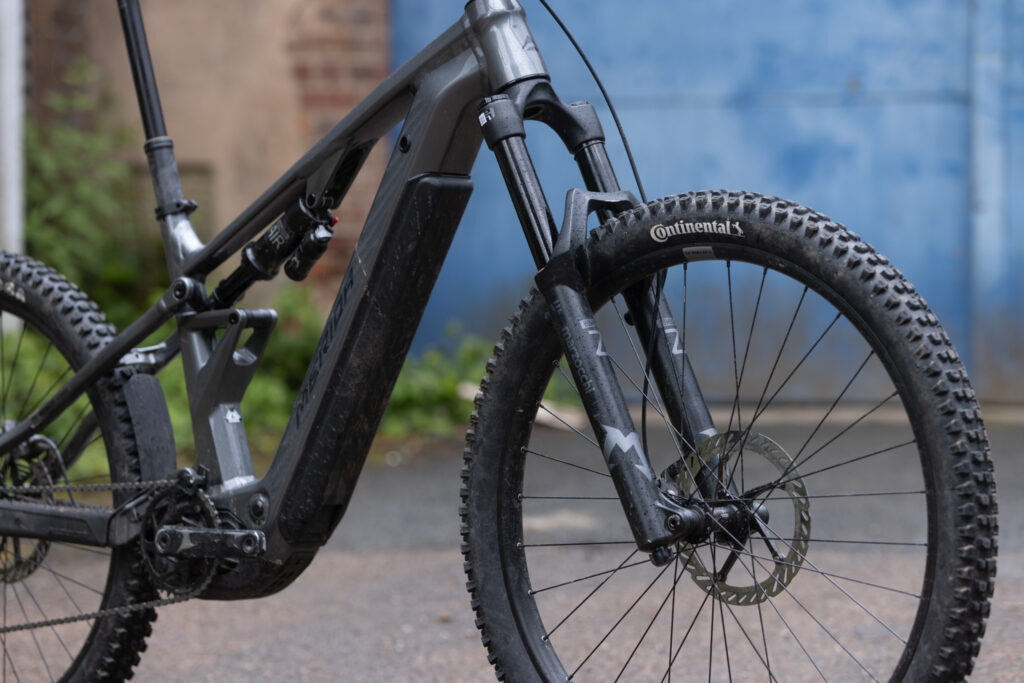
The battery is removable via a cover that runs the length of the downtube. A Fidlock catch secures the cover in place, and you’ll need to use the provided key to release the battery from the frame.
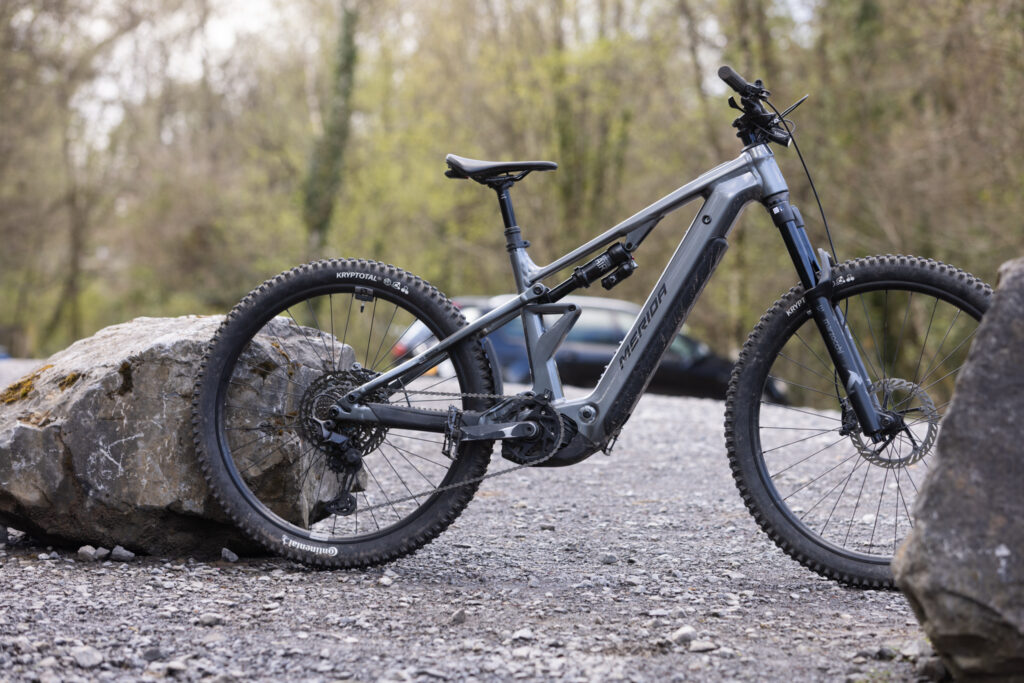
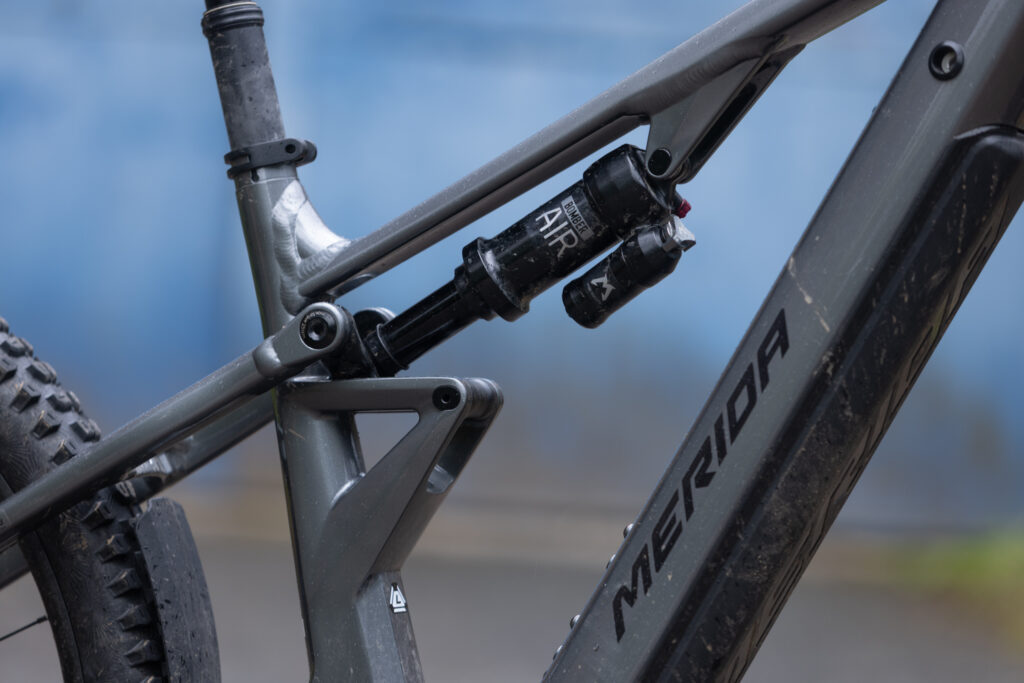
This alloy frame gets only 140mm of suspension on the cheaper 400 and 500 models, but the 800 we have here gets a beefier 160mm fork and a matching 160mm of swing at the back. Using a traditional linkage-driven single-pivot layout, the suspension kinematics and geometry are focused on delivering an agile, lively feel.
The bike comes in a mullet format only – a 29in wheel at the front and a 27.5in at the rear.
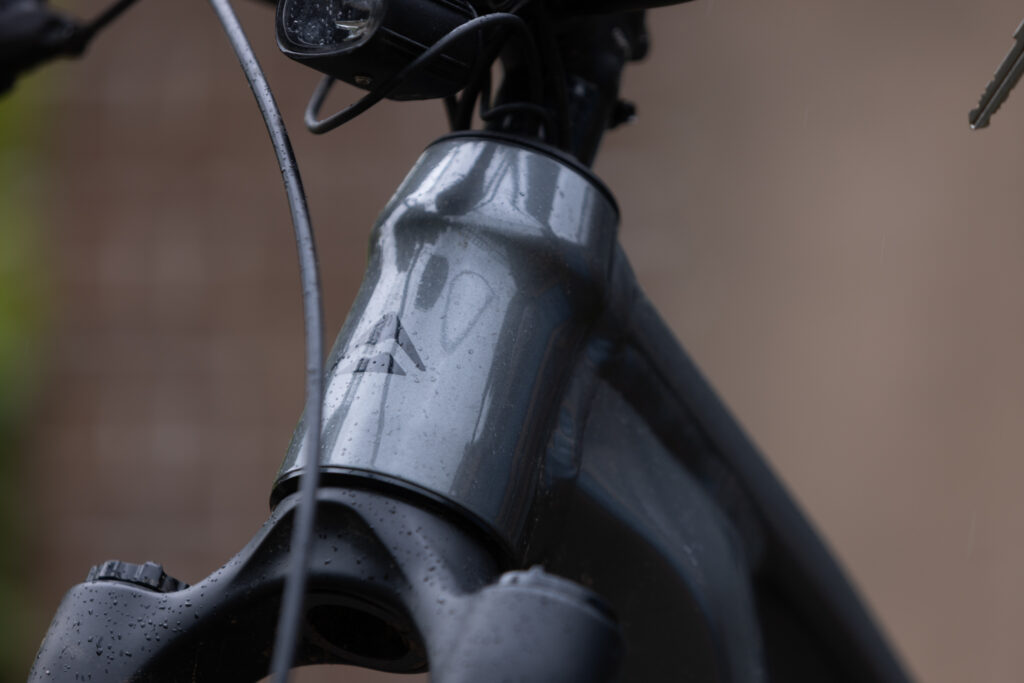
Love or hate it, Merida has routed the cables through the headset and into the frame on the ETMO. It does give a very clean look, and Merida has worked to better seal the headset than in the past, looking to reduce maintenance in that fiddly area.
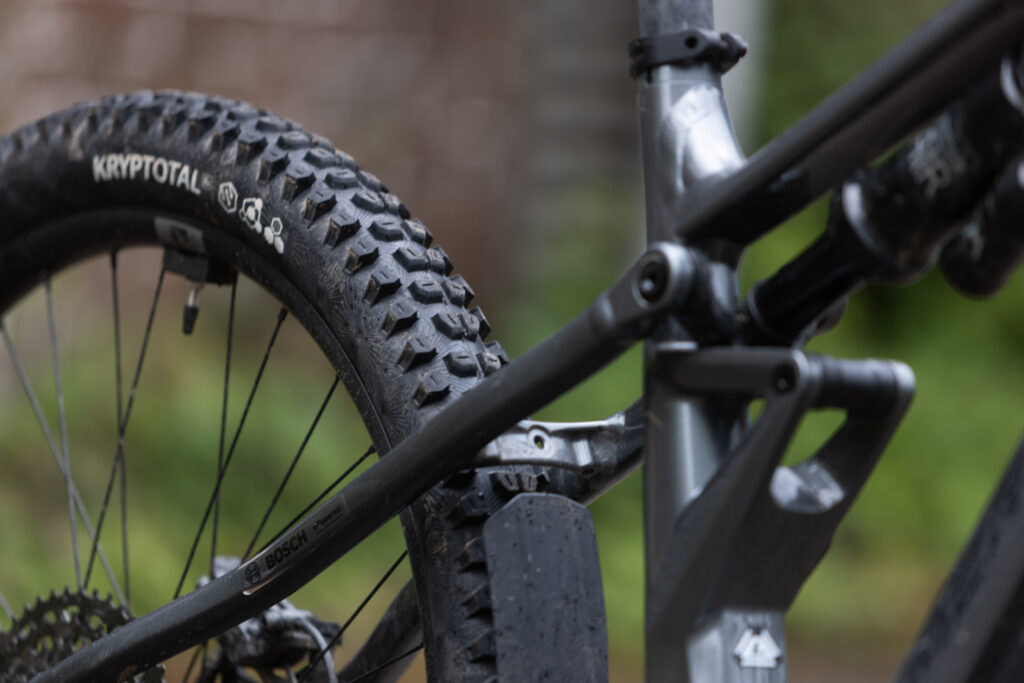
There is plenty of rubber protection around the chainstay to keep chain-slap noise to a minimum, and a handy little mudguard tucked by the rear wheel to protect the swingarm pivot. Four bolts at the bottom of the downtube keep the battery rail secure and double up as a bottle cage mount. A lifetime warranty on the frame is included, which is impressive at this price.
The ETMO is right up to date with its geometry. Reach numbers start at 425mm and grow 25mm per size (Short, Mid, Long and X-long), with the Long (tested) sitting at 475mm, right where I’d like it to be. The 65-degree head angle is right on the money for its manoeuvrable trail bike intentions, too.
The chainstays are 446mm across all sizes, which is a little on the longer side, but that helps with stability. Meanwhile, the seat tube angle of 78.5 degrees is a little on the steep side, particularly for an e-bike, where pedalling efficiency can be sacrificed in the name of comfort.
On the plus side, a straight seat tube is great to see as it gives plenty of room for a long dropper post; the actual drop is frame-size specific, and goes up to 230mm on the X-Long.
Merida ETMO 800 – Componentry
The ETMO’s three specifications start at £3,650 and top out at £5,250. Whilst the 400 is the cheapest, it’s worth noting it comes with a Bosch PX motor with 10Nm less torque than the CX found on the other two, and it has a smaller 540Wh battery as well.
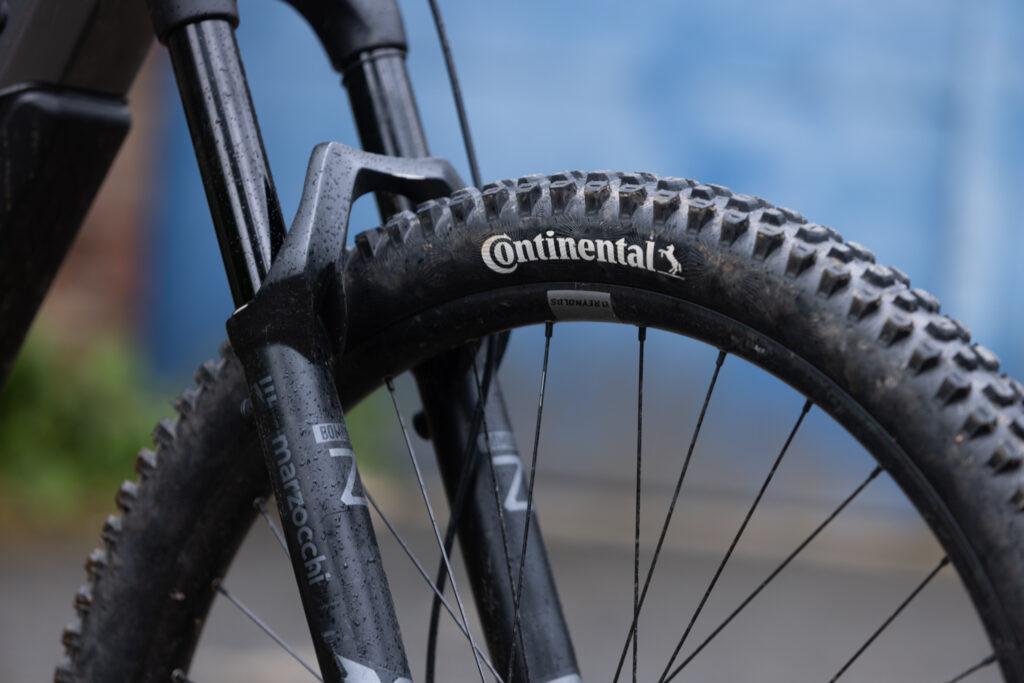
This top-spec 800 has a sensible overall spec for the money. It features a 160mm Marzocchi Bomber Z fork upfront, and a Bomber Air shock out back.
Shimano handles the shifting with an 11-speed LinkGlide XT setup, and matching Shimano XT brakes with 203mm floating rotors slow the bike back down. As a handy little extra, a Merida multitool is included, mounted to the saddle, and there’s a 6mm hex key nestled into the rear axle.
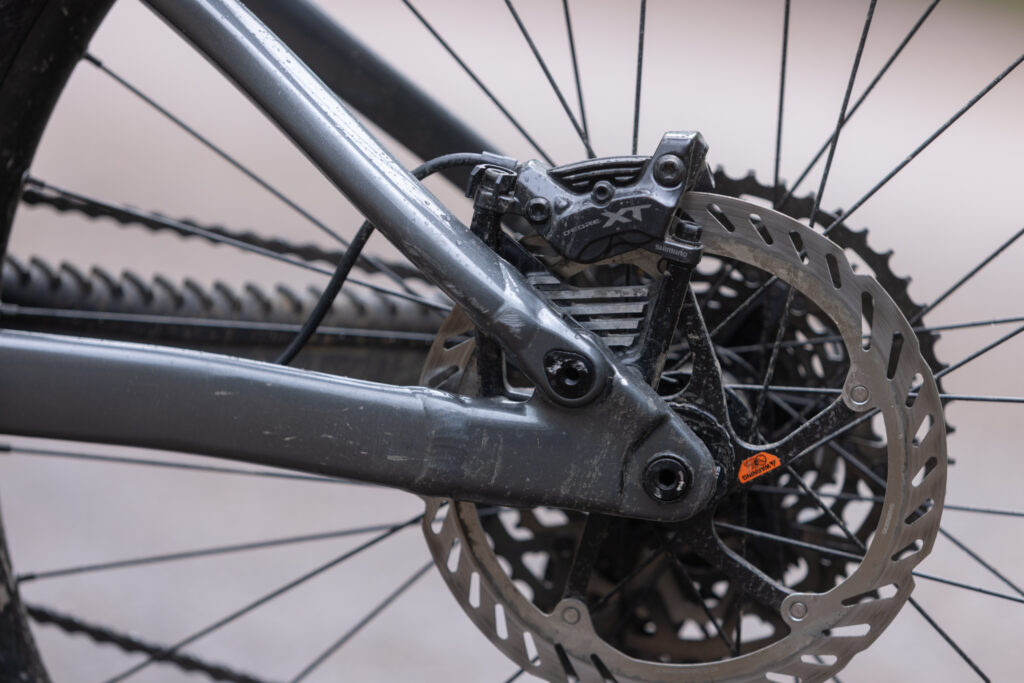
It’s great to see Reynolds 309 Enduro Comp alloy rims here, and they’re laced to reliable Shimano hubs. The tubeless-ready Continental Kryptotal rubber offers plenty of grip with front and rear-specific treads, Enduro casings, and soft compounds front and rear.
Merida ETMO 800 – Performance
The manual helped me with a base setting for the rear shock, so I started with 220psi and six clicks of rebound, whilst the fork has a handy little pressure chart right on it. The result was close to the mark, although it did put the rear shock a little on the firm side.
The wheels are tubeless ready, but our test bike had tubes fitted. Kudos to Merida for speccing sensibly heavy-duty tyre casings too, though I opted to run slightly higher pressures than usual due to the bike’s high weight, settling on 26psi rear and 24psi front.
The e-Bike Flow app is worth downloading should you want to make changes to the motor, as it allows you to adjust the various assistance modes.
Whilst the ETMO is based on Merida’s burlier eOne-Eighty, there are some notable differences in the way this rides. The suspension has a firmer feel with more of a platform in the midstroke, which feels appropriate given its trail intentions. Instead of the point-and-shoot, plough-like nature of the eONE-EIGHTY, this has a welcome liveliness that allows the bike to be more playful on the trails. The mid-travel support keeps the bike higher in the travel for longer and gives the rider something to push against – there’s plenty of feedback for popping mid-trail gaps and pumping the lumpy bits for speed.
Of course, physics still plays a part, and there’s no getting around it; this is a heavy bike, and getting it off the ground can’t be described as effortless.
The Marzocchi suspension isn’t fancy, but it works well enough to provide support and control, whilst the Shimano XT brakes give plenty of stopping power. The LinkGlide shifting works well under load and is ideal for e-bikes, and those chunky, soft-compound Continental tyres offer great grip and lots of confidence.
Merida has once again managed to create something that feels way more agile than it should given the weight. The geometry has a large part to play in the agility, with the mullet set-up, a good stack height and sensible reach numbers leading to manoeuvrability that’s surprising.
Whilst DJI very much hogs the motor limelight, the gen-five Bosch CX motor is a strong competitor with natural-feeling assistance, more than enough power, and strong aftersales support. Coupled with the 800Wh battery, the range is impressive – good enough for a claimed 1,000m vertical metres in the higher boost modes, and 1,800m+ when being more careful with the assistance.
Climbing is comfortable thanks to the steep seat angle, which offers plenty of control by placing the rider towards the front of the bike. The longish chainstays mean front-end lift is seldom a problem either, and with plenty of power from the CX motor, technical climbing is fuss-free.
The paint looks good but chips quite easily, so I’d recommend a frame wrap or at least some protection around the danger zones. And while we’re on niggles, the Fidlock battery cover latch was surprisingly fiddly to secure, and I had it come loose whilst riding too, so pay close attention when fitting it.
Merida ETMO 800 – Verdict
At £5,250 with a really solid spec and an impressive motor, this bike represents impressive value for money. Still, you do have a few alternatives.
The Cube Stereo Hybrid One44 HPC SLX Evo 800 also offers a lot of bang for your buck at £5,199. It uses the same Bosch CX motor and 800Wh battery, though the suspension is a little less competent and it only offers 140mm of rear travel. It has wireless gear shifting, however, and – this is the clincher – a carbon frame.
For £5,499, you can grab a Specialized Turbo Levo 4 Comp Alloy, which uses a Specialized motor and an 840Wh battery. With 150mm of rear travel, it’s a capable bike, but you’re back to mechanical gears, and the Fox Rhythm suspension isn’t the most competent.
The Merida ETMO 800 is a capable, surprisingly lively and playful machine with a great spec for the price. The internal headset routing looks great but might not please home mechanics, and the battery cover is a little temperamental, but overall the ETMO is a fun, effective ride and excellent value for money.
Test Report
What does the manufacturer say about this product?:
“Merida says: “The Etmo 800 delivers serious trail performance without hammering your wallet. Combining our high-value aluminium 160 mm travel frame with Bosch’s powerful 100 Nm CX motor and big 800 Wh battery, so you can explore for hours or lap your favourite loops all day long. With mixed-size wheels for a fun but stable ride and our proven geometry, you’re guaranteed fun whether you’re a fresh face to mountain biking or an experienced hand. Quality kit from Shimano handles stopping and drivetrain duty, while Marzocchi’s legendary Bomber suspension, including a stout 38mm stanchion fork, takes care of the bumps.”
Tell us some more about the technical aspects of this product:
Merida lists:
Advanced LITE aluminium frame design with 160 mm travel
Mixed 29/27.5″ size wheel setup for agile and confident handling
Bosch CX 100 Nm drive unit with 800 Wh internal battery
Marzocchi Bomber Z fork and Bomber Air rear shock, Shimano XT brakes and XT Linkglide 11-speed drivetrain
Reynolds 309 tubeless ready wheelset and Continental Kryptotal tyres
Lifetime frame warranty for Category 4 All Mountain (AM) + Enduro use
Any further comments on quality?:
Overall a solid build, though the paint does chip quite easily and the Fidlock battery catch is fiddly.
Any further comments on performance?:
Capable suspension which handles the rough stuff but has plenty of mid-stroke support. It’s agile in the corners and has a great seated position for climbing.
How does the price compare to that of similar products in the market, including ones recently tested?:
It’s really well priced against bikes with similar specs.
List the components used to build up the bike:
satellite_charging_port Bosch Cable PowerTube Charging Socket 350mm
frame ETMO LITE
frame size Short, Mid, Long, XLong
shock Marzocchi Bomber Air
fork Marzocchi Bomber Z eMTB
motor unit MERIDA Custom Battery Cover w/ Fidlock
drive unit Bosch Performance Line CX
battery Bosch PowerTube 800
battery charger Bosch 4A Charger (220-240V)
display Bosch Purion 400
power button Bosch System Controller
switch Bosch Mini Remote
speed sensor Bosch Rim Magnet, EB11.200.015 + EB11.200.02S
rim Reynolds 309 Enduro Comp
hubs Shimano TC500-B / Shimano TC500-HM-B
front tyre Continental Kryptotal-F
rear tyre Continental Kryptotal-R
Hubs MERIDA EXPERT TR
chainwheel FSA Direct Mount Steel Chainring
crank FSA CK-220 wide E-Bike Forged Crankset
Cassette Shimano LG700
chain Shimano LG500
shifters Shimano MT500-IL / Shimano XT M8130 11
rear derailleur Shimano XT M8130
brakes Shimano XT M8220
rotors Shimano CL700
headset Acros ICR Blocklock
Stem MERIDA EXPERT eTR II
stem size 40 mm all sizes
handlebar MERIDA EXPERT eTR
grip MERIDA EXPERT TR
seat post MERIDA EXPERT TR II
saddle Proxim Altius
seat clamp MERIDA EXPERT
lights Lezyne Hekto StVZO E350+ Reverse / USB REAR Light CG-214RG
mudguard RF-001 mini fender
pedal VP VPE-533
approx. weight 26.8 kg
Tell us what the bike is for and who it’s aimed at. What do the manufacturers say about it?:
Merida says, “The ETMO 800 delivers serious trail performance without hammering your wallet.”
Where does this model sit in the range? Tell us briefly about the cheaper options and the more expensive options:
This is the top of the range bike, and it gets longer travel (160mm) at both ends than the others.
The 500 Pro is £4,400 and has 140mm of travel at both ends. The 400 is £3,650, but gets a slightly less powerful motor and a smaller battery.
Tell us about the materials used in the frame:
Aluminium alloy.
Tell us about the geometry of the frame:
Frame Size Short Mid Long XLong
TYRE SIZE 29/27.5″ 29/27.5″ 29/27.5″ 29/27.5″
St Seat Tubes mm 380 405 430 455
Tt Top Tubes mm 556 584 609 636
Cs Chain Stays mm 446 446 446 446
HTA head tube angle [°] 65 65 65 65
STA seat tube angle [°] 78.5 78.5 78.5 78.5
Bd Bottom Bracket Drops mm 20 20 20 20
Ht Head Tube Lengths mm 105 115 115 125
Fl Fork Lengths mm 580 580 580 580
Fo Fork Offset mm 44 44 44 44
R Reach mm 425 450 475 500
S Stacks mm 644 653 653 662
Wb Wheel Base mm 1202 1231 1256 1285
Sh Stand Over Height mm 745 748 751 754
How was the bike in terms of sizing and angles? How did it compare to other bikes of the same stated size and intent?:
Stable with a reasonable chainstay length, yet sensibly sized to remain trail orientated.
How much suspension travel does the fork have?:
160mm
How much suspension travel does the rear end have?:
160mm
Was the bike comfortable to ride? Tell us how you felt about the ride quality:
Yes, good seated position – controlling and not outstretched. The standing position is on the small end for its sizing.
Did the bike feel stiff in the right places? Did any part of the bike feel too stiff or too flexible?:
No issues.
How did the bike transfer power? Did it feel efficient?:
It’s an ebike…
How would you describe the steering? Was it lively, neutral or unresponsive?:
Neutral
Tell us some more about the handling. How did the bike feel overall? Did it do particular things well or badly?:
Good suspension platform which is nicely trail-orientated – it feels more lively than you’d expect from the weight.
Which components had the most effect (good or bad) on the bike’s performance? Would you recommend any changes?:
Shimano’s LinkGlide is always impressive, with smooth shifting even under load. The brakes are okay for the money, but a more powerful set would be a benefit in the future.
Any comments on high speed descending?:
Reach could be a little longer for more stability, but overall it’s still composed.
Any comments on technical descending?:
Descends well as a trail bike; it’s lively and moves well.
Any comments on cornering?:
Mullet wheel sizes really help with cornering.
Any comments on technical climbing?:
Good strong motor and good traction.
Any comments on climbing efficiency?:
Comfortable seated position and stable.
Any comments on agility?:
Surprisingly agile for its weight thanks to good geometry.
Any comments on fork performance?:
Not bad for the price, but it lacks the adjustments some will be looking for.
Any issues with fork durability?:
No
Any comments on rear suspension performance?:
Not bad for the price, but lacking in adjustments.
Any issues with rear suspension durability?:
No
Any issues with drivetrain durability?:
No
Any comments on drivetrain weight?:
It’s not light, but it’s tough.
Tell us some more about the wheels. Did they work well in the conditions you encountered? Would you change the wheels? If so, why?:
No issues here.
Any comments on tyre performance?:
Excellent tyre choices.
Any comments on tyre durability? How much did the tyres wear during testing?:
Good casings and compounds for its intended use.
Any comments on brake performance?:
Punchy enough, but a little lacking in ultimate feel or power.
Any issues with brake durability?:
No
What kind of motor is it?:
Bosch CX.
What are the stated motor system specs? (Torque/power/maximum assistance speed):
100Nm of torque.
Tell us some more about the motor. How did it feel overall? Did it do particular things well or badly?:
It’s a solid, well proven motor.
How did the motor perform at low speed? (e.g. on steeper climbs or setting off with heavy loads):
Smooth and predicable across the assistance levels.
How did the motor perform at higher speed? Was it noisy? Did assistance cut out smoothly/abruptly at the 25km/h assistance limit?:
No issues.
What type of battery is it? Is the manufacturer named?:
Bosch
Where is the battery on the bike? Is it removable?:
Inside the downtube, removable.
What are the stated battery specs? (Capacity/voltage):
800Wh
Tell us about charging the battery. What’s the charger like? How long does it take?:
Not the fastest with a 4A charger.
Tell us about the assistance levels. How many are there? Are they all useful?:
Five, all useful.
What was your experience of the operational range of the bike?:
Plenty of range when using the modes carefully.
Did you enjoy using the product? Yes
Would you consider buying the product? Yes
Would you recommend the product to a friend? Yes
Use this box to explain your overall score
This is excellent to ride and versatile across a range of trail situations. It’s capable in the rough stuff, agile on the tighter stuff and climbs well. Hard chargers would benefit from a fork upgrade and the weight is high, but for the money it’s great.
About the tester
Age: 32Height: 183cmWeight: 95kg
I usually ride: Mostly mountain bike along with gravel for some good milesMy best bike is: Deviate Highlander 2 (mtb) Custom Titanium (gravel)
I’ve been riding for: 10-20 yearsI ride: A few times a weekI would class myself as: Expert
I regularly do the following types of riding: Fitness riding, Mountain bike XC, Mountain bike Enduro, Mountain bike downhill/freeride