


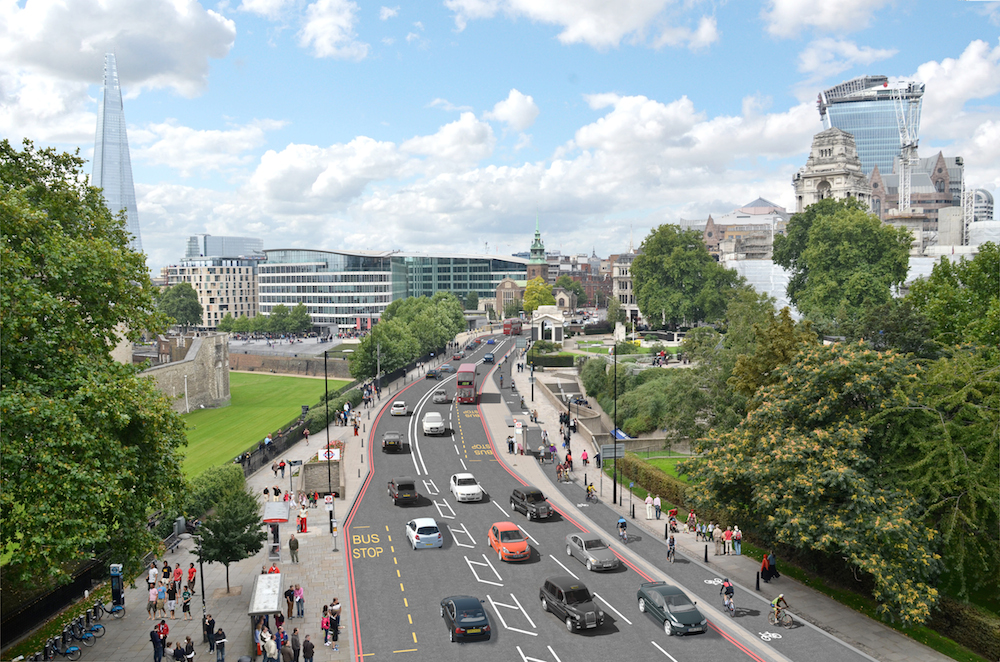

The head of a group representing more than 200 business and other organisations with major operations in London says she is opposed to segregated cycling infrastructure – because she believes it will lead to crashes between faster cyclists and those who are slower on two wheels.
Baroness Valentine, chief executive of the not-for-profit advocacy group London First, also defended its opposition to Mayor of London Boris Johnson’s flagship East-West and North-South Cycle Superhighways, currently under construction.
In an extensive interview with the Guardian's Dave Hill, she drew a parallel with the Congestion Charge Zone introduced by Johnson’s predecessor, Ken Livingstone, saying that in neither case had the impact on the city’s traffic been fully addressed prior to the projects being implemented.
“We’ve found it very difficult to work out what the real consequences of the cycling superhighway are for congestion,” she said. “It’s precisely what Ken did when he first put in the congestion charge in.
“He took a load of road space out for buses – which with hindsight turns out to have been a very good thing – and he took a load out with pedestrian schemes, and before you could blink you were back nearly to the same level of congestion as before the congestion charge began.
London First was joined in opposing the Cycle Superhighway plans last year by the likes of property company Canary Wharf Group and the Licensed Taxi Drivers’ Association, with one of the chief areas of concern being the impact of the infrastructure on journey times for motor vehicles.
Transport for London (TfL) presented its own figures of forecast delays for a variety of journeys to attempt to address those concerns, but opponents remained unimpressed, and Valentine continues to harbour misgivings.
“We’re now going back to gridlock,” she said. “I think it’s incumbent on the GLA and TfL to just be sure that they are taking everybody’s concerns properly into account. I’m not clear whether that’s being done.”
In October, responding to criticism of the project by Canary Wharf Group and others, British Cycling policy advisor Chris Boardman noted that the Cycle Superhighway proposals enjoyed support from businesses and other organisations such as NHS Trusts across the capital, and described opponents as “old men in limos.”
It’s an accusation that Valentine rejected as “rubbish,” adding; “TfL ought to be better at listening to customers, cyclists and all people on the roads.
“As a cyclist, you do get very angry about the way the traffic treats you, that cars cut you up and buses get in the cycle lane.
“Part of the reason cyclists have got so aggressive is that they’ve been so badly treated for a long time.
“When one of them gets killed on a junction where TfL has been told several times it’s unsafe, that’s not a good place to be. Quite a lot of your big picture answers to road problems actually come just from listening, talking and finding out what really does and doesn’t work.”
She told the Guardian that she has been cycling in Central London since she was 14 years of age but insists that physically segregated infrastructure will not improve cyclists’ safety – instead, she fears it will make matters worse.
“I’m a tootling-across-Central-London cyclist as opposed to a superhighway sort of cyclist,” she revealed.
“I’m not interested in segregated lanes. You are being herded like cattle. I’m about the slowest cyclist in London and I always think the thing most likely to knock me off my bike is another cyclist going very fast right at my elbow.
“That would be more of a worry in a segregated lane. I suppose they are meant to prove you’re taking cyclists seriously.”
Besides Canary Wharf Group, London First’s membership list includes a number of organisations that backed the Cycle Superhighway plans through the Cycling Works website.
Those include Royal Bank of Scotland, which has 12,000 employees in London, the law firm Allen & Overy, property owners The Crown Estate, and professional services firm, Deloitte.














58 thoughts on “Business group head says segregated cycle lanes will cause cyclists to crash”
just as a thought, did she
just as a thought, did she watch that vid I posted in the forum about Gronnigen. A Separated traffic is about changing habits and it works elsewhere. Surely in the UK we are not that in love with speed in these kind of traffic ?
Her comments sort of imply
Her comments sort of imply that the segregated lanes are going to be too narrow…
“I’m not interested in segregated lanes. You are being herded like cattle. I’m about the slowest cyclist in London and I always think the thing most likely to knock me off my bike is another cyclist going very fast right at my elbow.
“That would be more of a worry in a segregated lane. I suppose they are meant to prove you’re taking cyclists seriously.”
also this comment just suggests that the congestion charge is set way too low:
“He took a load of road space out for buses – which with hindsight turns out to have been a very good thing – and he took a load out with pedestrian schemes, and before you could blink you were back nearly to the same level of congestion as before the congestion charge began.”
It took quite a long time for the number of cars to creep up again and if you look at what happened to public transport costs in the same time it’s now the same price to cross London in a car £11.50 as three cash trips on the tube. If you come into London from Zone 3 or 4, the 1 day travelcard is more expensive than the congestion charge.
alexb wrote:Her comments sort
““I’m not interested in segregated lanes. You are being herded like cattle.”
This is hilarious! So youre not being herded by the carriageway into going where it determines? (Unless youre one of the vehicles that cause the +350KSI’s mounting the pavement- but who’s going to let the man tell them where to drive?!)
So would she rather have a faster cyclist or a 10 tonne HGV?
Seeing as there have been 6 cyclist deaths in London so far, all caused by HGVs, and most of those are women, she is in the group that statistically are at higher risk of death, even more so if she cycles around Holborn.
In happier news, from this morning, they have set the traffic to single lane counterflow along the stretch of the Victoria Embankment between Westminster and Horse Guards Avenue so the cycle way will start going in soon!
The segregation has occurred on Vauxhall Bridge as well!
https://twitter.com/citycyclists/status/605432570633981954/photo/1
Fascinating that an
Fascinating that an organisation representing business is concerned only about cyclists safety. Money talks. Names of business’s represented. Avoid.
This is just a string of
This is just a string of bogus, non-evidence based arguments.
The worst wind-up merchants/trolls are often the ones who claim to be cyclists but almost certainly aren’t, before arguing against the interests of people who actually do cycle.
HarrogateSpa wrote:This is
I am a cyclist but ….
Yeah, it’s a load of old
Yeah, it’s a load of old nonsense. I can point to examples of existing segregated infrastructure in London and it simply doesn’t happen.
The very fast guys either take to the road, or wait for an opportunity to pass. I’d say there is a bit of a problem with some London cyclists not giving others enough passing distance, but that’s not a case of fast vs slow cyclists. It’s just inconsiderate riding, and you get it on the road already.
so the fast guys take the
so the fast guys take the road and instead run into the likes of Mr Angry Land Rover driver, if people pop a blood vessel about not using a rubbish cycle path, what do you think they are going to do when theres a proper segregated lane in place.
instead of dismissing her out of hand, we should be trying to understand why she feels the very thing that ought to making cyclists like her, ride more in London, isnt the right approach in her view, because if she thinks it, you can bet others like her will think it and be put off by the same reasons.
and I do think there is a point about how we get all types of cyclists interested in using it, the very thing about the Groeningen video, is everyone looks to be cycling the same way at the same speeds, & thats not Londons cycling community.
The lesson of the Groeningen
The lesson of the Groeningen video is that cities get the cyclists they deserve. Behaviour is a product of the environment. If you start modelling the environment in support of bad behaviour, it’s a rapid downward spiral, basically where road planning policy has been for sometime.
Except for a few locations, the cyclesuperhighways are 4m wide, even the new quietways are being designed to 3m, I really can’t see that there’s going to be much of a problem.
A lot of the old bits of segregated cycletracks you’ll find in London today were built back in the 80’s and are at most 2.4m. With those it’s better to use the roads if your much faster than other users.
I read the article earlier. She doesn’t have any suggestions for cycling policy, it was just negative comments about the current plans.
Awavey wrote:so the fast guys
But how did the Netherlands get like that? By never having any dedicated infrastucture? By just carrying on as we have been doing for decades?
(Personally I don’t want a ‘cycling community’ I want a better transport policy for everyone, where there’s no more a ‘cycling community’ than there is a ‘pedestrian community’ or a ‘driving community’).
Because being hit by another
Because being hit by another cyclist is sooooooooooooo much worse than being hit by a car/van/bus/tipper truck. ~X(
Aaaaaaw bless! They just don’t get it, do they?
so slow cyclists are in
so slow cyclists are in danger from faster ones, what about cars and trucks?????
I hate myself for agreeing
I hate myself for agreeing with her, but she does have a point about cyclists passing other cyclists too close. I’ve noticed it on sportives and busier cycling locations like Boxhill. Surely as a cyclist you understand that cyclists can’t always ride an arrow -straight line and need say a foot either side to manoeuvre in. It pisses me off when cars get close, but usually you hear them coming whereas a bike can brush past you and the first thing you know is when they come into your peripheral vision.
Daveyraveygravey wrote:I hate
STRAAAAAAAAAAAAAAAAAAAAAAAAAAAAVVVVVVVAAAAAAAAAAAAAAAAAAAAA!
As far as I am aware, Ms
As far as I am aware, Ms Valentine does not have to use the cycle superhighway if she prefers not to. She can continue to ride on the road, and try her luck with cars and tipper trucks instead if that is what she wants.
And surly the risk of bike on bike collision is the same on the superhighway as it is now on the roads?
ALSO –
One thing I never understand is the general assumption that cyclists all want to crash into things. If we are not crashing into peds, then we are busy willfully crashing in to cars or other bikes. I just don’t get this assumption. As a cyclist, if I crash into something – I AM GOING TO HURT MYSELF. Yes I know accidents do happen, and yes there are a small number of idiots out there – but the idea that we cycle round looking for things to constantly crash into is just plain daft. Makes me think that Ms Valentine is not the cyclist she claims to be.
Yes wouldn’t it be horrible
Yes wouldn’t it be horrible if things that were much faster than you came whizzing past without leaving enough space.
No-one would want to cycle in a London like that.
just like the crashes every 5
just like the crashes every 5 minutes in the netherlands?
Does anyone else think the
Does anyone else think the pit lanes, for want if a better description, they have in Majorca are genius?
if i am to fall off my bike i
if i am to fall off my bike i would rather it be in a place where I’m unlikely to be flattened by a lorry or bus wheel
Did I get that right? She is
Did I get that right? She is more concerned by a bike at her elbow knocking her off in a segregated lane than a car, taxi, motorbike, bus being at her elbow in a non-segregated lane….
I know which I’d prefer.
Not a very progressive view
Not a very progressive view from Baroness Valentine. Getting hit by a cyclist is rarely fatal, unlike getting hit by a car or truck.
Hopefully she will read these comments.
Some of you guys are not good
Some of you guys are not good at listening. Here is the first point made:
“TfL ought to be better at listening to customers, cyclists and all people on the roads.” (And on the pavements, one might add.)
So what’s not to like about that?
Transport works better in Groeningen, Amsterdam, Copenhagen etc because the needs of various modes are in better balance—and because there are fewer people wanting to move around. London is a hard problem because its infrastructure is grossly overburdened.
Contributors to the debate in this forum need to try a bit harder.
harman_mogul wrote:Some of
She’s suggesting that the policy decisions that lead to the superhighways now under construction weren’t based on listening. They were.
It’s also worth remembering who she is. London First is a lobbying group, she’s not an impartial witness to the process.
Cycling in London I feel like
Cycling in London I feel like it’s “be quick or be dead”, feels like the only way to be safe is to be fast. But when I’ve been cycling in Holland, Belgium or Austria on segregated paths I’ve felt completely different. You can look around and take things in, enjoy being part of the cycling crowd. I definitely didn’t cycle as fast or as, how can I put it, ‘intensely’ maybe?
The other thing is that on the continent the use of a bell is normal and doesn’t lead to a punch up. If we can get used to the sound of a ringing bell meaning “faster rider approaching, keep left” then that should solve a lot of the potential crash issues with mixed speed cycle lanes I reckon.
Is London First a local
Is London First a local branch of Britain First? They both spout the same amount of nonsense.
Oh dear – I fear M’lady has
Oh dear – I fear M’lady has not got her thoughts straightened out before speaking. For example (speaking of Ken’s Kongestion Charge™)
“He took a load of road space out for buses – which with hindsight turns out to have been a very good thing – and he took a load out with pedestrian schemes, and before you could blink you were back nearly to the same level of congestion as before the congestion charge began.
So, proof positive that you can take space away from cars, move people into other forms of better-in-every-way transport, and still have the same functional-enough access for trades, deliveries and the filthy rich in their limos.
I’m sure she went to a very good school, but I will volunteer to be hit by an average cyclist if she will volunteer to be hit by an average tipper truck. Fair enough?
CanAmSteve wrote:Oh dear – I
You make a good point. Her argument boils down to thinking that the point of the congestion charge was to make her journey in her own limo faster. I think that speaks volumes about how seriously she should be taken on this subject.
I’d rather have drivers who
I’d rather have drivers who behave themselves than segregated bike lanes. The reason being that unless we are going to put segregated lanes everywhere in the country – spoiler, we’re not – then at some point I am going to end up on unsegregated roads and have to deal with drivers around me. At that point I’d rather be surrounded by better behaved drivers than by the usual numpties who I’d be hypothetically protected from on these mythical segregated lanes.
vonhelmet wrote:I’d rather
Yes, your POV is well known. Just because you keep stating it doesn’t mean it’s any more thought through or based in experience.
Better drivers would be nice, but that’ll mainly come from a better roadscape for everyone, putting safety, not flow, first.
vonhelmet wrote:I’d rather
You don’t think it’s possible to have both? Why is that? How do you plan to counter the issue of subjective safety? – riding in heavy traffic (however well educated the drivers are) simply feels unsafe to many, many people.
If it’s possible to train drivers better (still waiting for a workable programme that will improve things by the time the E-W is built…), it should be done anyway. If it’s possible to increase physical protection on the road (it is) this should be done anyway. Even the highest trained and most qualified drivers make the occasional mistake. Even the best riders make mistakes. Neither of these should result in someone’s death. “Just a bit more training” will never, ever change that.
teaboy wrote:You don’t think
Because, as said, we are never going to cover the entire country in segregated lanes, so I’d rather drivers could drive sensibly without them, rather than our being safe in cities only because it’s that much harder for drivers to harm us. We need them to not be doing things that put us at risk of harm in the first place. Infrastructure is the helmet debate of road planning. It assumes that problems are going to arise and then suggests a solution that won’t help in a lot of cases anyway.
I mean hey, maybe we will find £500bn down the back of the sofa and we can cover the country in cycle lanes, but I’m not holding my breath. Given we can’t even get the NCN in decent nick…
Hello,
I’m French and my
Hello,
I’m French and my partner is Dutch. So I don’t know about the situation in London but I know quite well the respective situation of France and The Netherlands (when cyclists obviously crash into each other aaaaaalllll the time because of their very developed segregated paths).
What is happening here is the exact (read : by the book) effect of lobbying. This lady declares something rather « creative » (to say the least) and suddenly this « something » becomes a subject of debate.
Hopefully she didn’t say she fears that flying cyclists could fail to land and crash on babies in public places !!!!
If cyclists are at risk to be hurt by another moving object, so it’s the best reason to promote segregated paths because if I happen to have to choose between been hit by a car or by a bicycle I would anytime choose the second one…..
As a side note, it’s funny to see that each time a lobbyist anti-bicyle talks it’s about « cyclist are a endangered specie » and nobody reacts to this, proving that it’s becoming a commonly accepted fact.
Take care
Luc
Funny how the old “we are
Funny how the old “we are never going to cover the entire country in segregated lanes” still keeps coming up. Baffling really, it’s not a policy proposed by anyone, and it isn’t what they do in any European country. And yet once again, there it is.
bikebot wrote:Funny how the
Its what ‘vehicular cyclists’ cant grasp.
They think just by asking people to act nice, things will change, instead of the vastly better proposal of engineering out conflict where it needs doing.
zanf wrote:bikebot
Could you imagine if motorists had campaigned against segregated infrastructure, ie motorways?
After all, what is the point in the motorway network, as it’s never going to cover the entire country. If I’m going to have to drive carefully around other users and pedestrians in our towns and our rural B roads, then I should have to do so everywhere. Having different types of roads simply isn’t safe and motorways only make sense if I have one at the end of my driveway and everywhere else I might go.
bikebot wrote:
Could you
Before your time, and mine, but they did. Before WW1 the chairman of the Motorists’ Union werote,
“I am totally and entirely opposed to taking the motorist and placing him on the heights of fame with a special road to himself, or in the depths of infamy as a being who is not fit to be allowed on the ordinary roads of the country… Once allow us to be put on separate roads and there will be an increasing outcry to keep us on those roads and forbid access to the ordinary roads of the country.”
(Quoted in “Death on the Streets” by Robert Davis.)
The CTC was in favour of the proposal. The motorists had nothing to worry about, as it turned out.
That quote is absolute
That quote is absolute genius, the parallel is extraordinary.
bikebot wrote:That quote is
Credit to ChairRDRF who posts here.
felixcat wrote:bikebot
Cheers. I’ll duck out now, I get the feeling vonhelmet will be a stuck record for at least a few years. Vehicular cyclists are slow to convert, but we all know ex-followers of the faith.
I’ll just leave this here which popped up in my timeline earlier today, it’s a rather splendid demonstration of people in London not riding into one another.
bikebot wrote: Vehicular
I am not quite sure how you define a vehicular cyclist. If it means a rider who follows the techniques of Forrester or Franklin to ride safely on the road, then I was one before I came across F & F and still remain one. If you mean someone who ignores most cycle facilities because he knows from bitter experience they are unsafe as well as inconvenient, then I am still one.
I think that in some cycling utopia we should be safe to use the roads freely, but in this fallen world, where motor dominance is so complete, we may have to compromise. I am not doctrinaire about this, and there may be cycle facilities which I would use in preference to the road. Some converted railway lines are good. I have never cycled in the Netherlands.
I welcomed cycle paths when I first came across the idea but the British facilities I have seen are often insults.
I feel that you are setting up yet another schism in the cycling world, by using such words as “follower of the faith”.
felixcat wrote:I am not quite
I didn’t think it through that much, and ignore my faith comment which was a little unnecessary.
My past experience of what for convenience i’ll call “vehicular cyclists”, is that there’s a lot of dogma and the same arguments go around and around no matter how little evidence there is or relevance to what’s actually being proposed. After hearing the same old lines about separate cycling space encouraging bad driving and that they can’t be built everywhere, it all starts getting a bit “road tax argument”. As in, no matter how many times you correct someone on road tax, there’s always someone still using the term.
If those are the beliefs someone wants to cling to, go for it. The only person that will change their mind, is them. I prefer pragmatism, and the idea that our problems will all be solved if only all motorists were forced to behave is the very opposite of pragmatic thinking.
bikebot wrote:Funny how the
My point is that as we aren’t going to do it, we need drivers to be able to deal with cyclists on roads without segregated paths. We don’t want utter chaos on the roads and to be safe only by virtue of being separate, because at some point we will be on unsegregated roads and we need drivers to know how to behave there. Do we want segregated city centres if the minute we get out of the few square kilometres in the centre of town where they hypothetically exist it’s back to business as usual with close passes and smidsy and all the rest of it?
Education and proper enforcement of the law is the way to deal with this. I don’t even know where people are proposing to put all this infrastructure anyway, there’s no room in our city centres as it is. The only way you could do it is to ban cars altogether or up congestion charges to ludicrous rates. If you think either of those things will happen, good for you, but I don’t see it.
Doppelpost.
Doppelpost.
If I believed that we could
If I believed that we could achieve anything approaching sensible infrastructure, then maybe I’d be behind the idea. As it is, I wouldn’t trust the government to boil an egg… Although perhaps that prompts the question of why I think they could institute any sensible policing or driver education… But there we go. As it is, I’ll make do for the time being with my “vehicular cycling” rather than riding up and down a few metres of worn out painted cycle path and longing for this mythical infrastructure.
Mythical infrastructure under
Mythical infrastructure under construction.
A few hundred yards? Great.
A few hundred yards? Great. Good luck when you reach the end of it.
I’ve not said it isn’t being built at all, only that there isn’t an even remotely appreciable amount of it, so I don’t think we can rely on it.
vonhelmet wrote:A few hundred
As I said, no interest in understanding what’s actually being built. Believe what you want to believe.
vonhelmet wrote:A few hundred
You have to start somewhere. What was the point of building the M6? Good luck when you get to the end of it. Are you also against pavements as we don’t have them everywhere? Railways too? Of course there are issues with the design of some of it (especially junction treatment), and people are campaigning for high national standards too, not just ‘build it – everything will be fine’.
Things are currently pretty bad, and you’re arguing against trying to make things better in the long term. You haven’t said how this ‘just a bit more training’ could be implemented, and over what time-frame. You haven’t answered the issue of ‘genuine mistakes’ either. Building protected infrastructure WILL make some roads much more pleasant to ride on in the long term, and pretty immediately, even when drivers and riders make mistakes. It is likely to encourage more people to ride, thus reducing motor traffic. It will enable kids, the elderly and disabled to travel independently in safety, and will reduce the feeling that fast=safe. Why anyone would be against that simply baffles me.
In general, you only convert
In general, you only convert vehicular cyclists when they can no longer sprint up to 20mph, when their bottle goes or when they’ve ridden half decent protected cycleways (which are sadly rare in England). No, protected lanes won’t be everywhere but the incomplete motorway coverage doesn’t stop them being built, so why should that argument work for cycleways? And yes, some councils will try to get away with cheap crap, but they’ll just ignore outright opposition like they have for the last eighty years so please suggest improvements and help make these as good as possible for new riders who can’t see the flaws liker you or I and use the carriageway when it’s safer.
@a.jumper Having kids does it
@a.jumper Having kids does it for most.
bikebot wrote:@a.jumper
Nope… I’ve got two kids.
That stops me descending like a madman, but that’s about it.
vonhelmet wrote:bikebot
Would you accept a challenge to let them ride through central London on a weekday morning on their own?
bikebot wrote:vonhelmet
Would you accept a challenge to let them ride through central London on a weekday morning on their own?— bikebot
No, but what’s that got to do with it? Would I accept them riding along your hundred yards of segregated space? Sure, but what are they going to do when they get to the end of it. The problem isn’t solved, merely relocated.
vonhelmet wrote:No, but
Oh, it’s gone down to just one hundred yards now, from a few hundred. Congrats, you’ve buried your head deeper in the sand.
vonhelmet wrote:No, but
So if the junctions are done right and they can get to the next hundred yards and the next hundred yards and so on, then it could open up a lot of the city to them. The problem isn’t relocated – the problems outside those hundred yardses exist anyway, whether or not the hundred yardses are fixed – but maybe we’ve solved a few of them.
The problem with protected
The problem with protected cycleways is intersections. You arrive at them with motorists completely oblivious to your presence. The statistics suggest any perceived reduction in risk from rear end collisions (which make up only a tiny percentage of cycle/motor vehicle crashes) is more than offset by increased real risk at intersections, which is where the majority of crashes actually happen anyway.
good summary here:
I don’t know what kind of intersection design is proposed, but it is far more important than any other part of any route, protected or otherwise.
imaca wrote:I don’t know what
It doesn’t take long to find out.
imaca wrote:good summary
I agree that junction design can make or break a route’s safety, but that is NOT a good summary. It regurgitates a diagram from a 1980s Swedish (yes, Swedish, not Danish or Dutch) study, then cites a Copenhagen study that finds merely that there were more crashes than the author predicted, then a second Copenhagen study by the same author… spin spin spin… was it a case of decide on your conclusion, then find evidence to support it and if you can’t, then try to spin a mix of old and ambiguous evidence?
Interestingly, https://janheine.wordpress.com/2013/05/28/bike-to-work-4-best-of-all-worlds-together/ seems similar to LCC’s current approach – protected bike lanes alongside busy/fast roads, but no-through-motors and liveable high streets for the slower/quieter ones – although Jan Heine seems a fan of painted bike lanes which few people in the UK seem to like any more because they’re too easy for government to keep narrowing until they encourage too-close overtakes.