
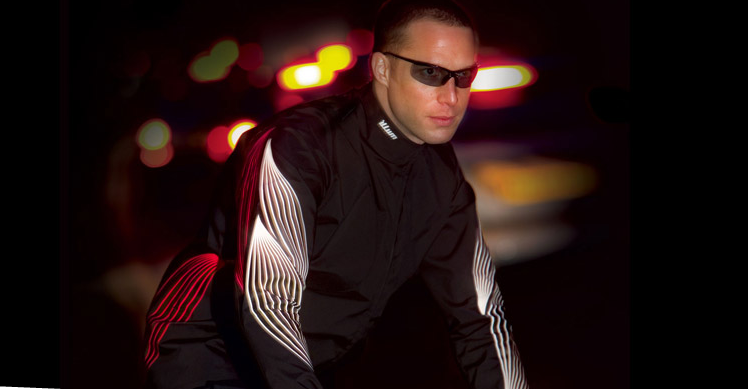
Industrial design companies PDD and Goose Design have teamed up to create a working prototype of a jacket with integrated lighting front and rear. The jacket uses a fabric made from yarns coated with Electroluminescent (EL) ink, and the lighting elements – which are almost invisible when turned off – are powered by a thin film battery and operated using a flexible switch built in to the jacket. The whole thing is washable, lightweight and flexible. EL jackets score over Fluorescent and reflective materials because they don’t require a light source to be visible. Reflectives are great in the dark when cars have their headlights on, but have a blind spot around dusk when the light is failing. Obviously the system is a lot more complex, and would be expensive to produce compared to cheap reflectives, but it’s certainly intersting that EL technology has come far enough for the jacket to be a viable product. For an explanation of how the EL fabrics work, Click here PPD’s product information page on the jacket – named the Illum – is here
- News

Electroluminescent Clothing – light yourself up!

Help us to bring you the best cycling content
If you’ve enjoyed this article, then please consider subscribing to road.cc from as little as £2.49. Our mission is to bring you all the news that’s relevant to you as a cyclist, independent reviews, impartial buying advice and more. Your subscription will help us to do more.
1 Comments
Read more...
Read more...
Read more...
Latest Comments
UK Murdoch/Harmsworth anti-cyclist psychosis continues with the worst politicians money can buy.
@Gd29 You accept going too fast is an issue but don't accept that reducing speed and falling accident/injury rates are related by anything other than correlation? In which case, how do you begin at your own starting point? Either speed is an issue or it isn't. And if drivers won't drive to the conditions, and we all agree speed is an issue, then forcing them to drive at lower speed is a perfectly reasonable solution. There is no harm in also educating drivers in better habits, but that is a much more difficult and timely process. So how many deaths and serious injuries are acceptable in a world where we keep 30mph as the standard limit on relevant roads whilst we wait for drivers to catch up in a utopian world. I do not disagree about most of the other solutions you put forward. Some of them, however, are even less likely to occur within the next generation or two than materially improved driving behaviours.
@Rendel Harris Yep, I’m pretty confident the sale was them wanting an ‘easy’ way of improving Zwift without having to do all the leg work.
Independent variable = speed limit Dependent variable = casualties Control variable = roads where no change made The figures prove that when we change the independent variable by lowering the speed limit then the dependent variable, casualties, falls in comparison to the control variable of roads where no change to the speed limit has been made. That is evidence.
The anticyclist exaggerates the disadvantages of cycle lanes beyond belief; it's like they imagine the worst-case scenario and then make it even worse. The Netherlands and Belgium have no problem with cycle paths.
@DrG82 just wait 'till you hear about the "blanket" 30mph limits it was replacing, or those "NSL" signs that just got stuck up everywhere else by default...
@Clem Fandango from that last observation I conclude that the only way to protect drivers from delays by being forced to stop and argue the toss with cyclists, or even being falsely accused by cyclists of various driving offenses is: - traffic lights at regular intervals along all roads, which should turn red whenever a cyclist approaches, alerting drivers there is a (RLJ) cyclist in front. - lights at every junction which default to all-ways red, unless they are briefly reset to green by a cyclist passing (and obviously riding through on red).
Um, yes, that's how evidence works. Perhaps you meant they're not *proof*, which would be true. But they are the best evidence we have.
These stats aren't evidence, they show correlation. Without isolating the variables they don't actually say that much about the impact of the change. Speed limits are an ineffective tool when the problem is drivers not driving in an appropriate manner for the conditions and environment. Those drivers weren't following the speed limit and/or paying sufficient attention anyway! If that is the problem and you don't deal with it, but you want to keep reducing injuries/fatalities, you have to keep dropping speed limits until you prohibit road use entirely. The solution is driving standards improvement (education) and enforcement. In wider terms but more importantly it's better city and road design, and reducing commuting distances by reforming the housing market (to an easily exchanged basic human need - shelter, not primarily an asset with massive financial inertia to change) But that's expensive, in £, time, administration, politics.
1 thought on “Electroluminescent Clothing – light yourself up!”
Flashing Mac
Fantastic.
I’ve mullered the zip on my mid-weight jacket, one of these would be a great replacement. Bet they’d cost a small fortune. 🙁