


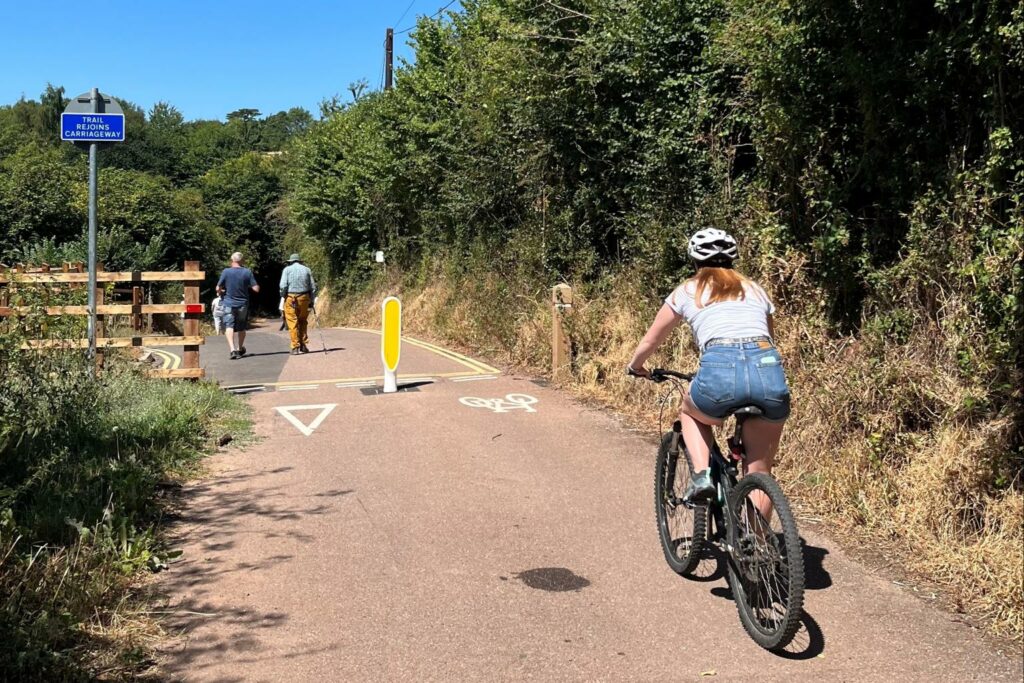

Are quiet lanes the new trenches in the war on motorists? This week, Active Travel England published its Rural Design Guide, which gives local authorities guidance on how to deliver safe and accessible walking, wheeling and cycling routes, with the aim of cutting road deaths in Great Britain — two-thirds of which occur on rural routes.
“With the publication of this Rural Design Guide, we’re supporting authorities to develop infrastructure that works best for local people,” National Active Travel Commissioner Chris Boardman said. “Our aim is to help councils build safe and appealing routes that not only enable more everyday active journeys but also help them make the most of our wonderful countryside.”
Part of the recommendations from Active Travel England includes a 20mph speed limit on certain roads where people walking, wheeling and cycling share space with motor traffic. Inevitably, this sparked headlines from some corners of the press implying all rural roads would be subject to low speed limits. “Cut rural roads speed limit to 20mph, advisers tell ministers,” reported the Telegraph. Tory Transport Spokesperson Richard Holden went a step further and branded it “a sneaky assault on civil liberties”.
“Labour are shamefully sneaking 20mph speed limits on thousands of miles of rural roads through the back door under the guise of ‘active travel guidance’”, Holden told the Telegraph. “These limits were a disaster in Wales when Labour imposed them and are already being widely reversed because they hit rural communities hardest, where pedestrians, cyclists and motorists already share many roads.”
There are some pretty big differences here. The Welsh scheme was a default 20mph limit on built-up roads with street lighting that would usually be subject to a 30mph limit, whereas Active Travel England’s recommendations would only affect certain rural routes which are shared between motorists, walkers, wheelers, and cyclists. It’s also not a mandatory rule.
> Welsh 20mph speed limit “single most significant change we’ve ever seen,” says Cycling UK
“Media headlines implying that the government is saying all rural speed limits should be cut to 20mph are false and misleading,” said an Active Travel England spokesperson. “Local authorities are not legally required to follow this guide, nor is it intended to be taken as a one-size-fits-all approach. [They] have been asking for this document for some time, and so we’ve delivered it for them.”
Is this the latest attack on England’s motorists? Of course not. It’s guidance. The 20mph limit is a small part of the Rural Design Guide, which also sets out recommendations for traffic-free routes and surface improvements that benefit both motorists and non-motorists. As the guidance points out, a 20mph limit is more beneficial to the safety and comfort of walkers and wheelers than it is to cyclists; it’s a way of telling drivers to exercise caution if they weren’t already.
While the UK media panic will rumble on, Active Travel England’s recommendations are aimed at reducing casualties in areas that are notoriously deadly. It’s not scoring political points or restricting the freedom of motorists; it’s an optional set of rules for local councils to make use of, and basic highway design for the 21st century.








32 thoughts on “Tory MP brands guidance suggesting 20mph rural speed limits to create better walking and cycling routes “nonsensical”… but is it?”
Nuance died along time ago in the media – its all about how we can make our readers angry at somebody else. That said speed restrictions for county lanes needs to be revisited. There are lanes around me that are just wide enough for 1 car and yet in theory the speed limit is 60mph. These limits were put in place when there weren’t that many cars, they were smaller and many couldnt even reach that heady speed.
I know the likelihood of that happening is zero because the media nor the general public are interested in saving lives if it inconviences them in the smallest degree.
@ceebee247 Absolutely. When it took 15s+ to reach 60mph it m ight have been ok, now people expect to reach that between two corners 300m apart. And woe betide anybody who prevents that.
I’m think we could have 40mph default on any road without a centre line. If it’s not wide enough for two carriageways then at least the closing speed is only 60mph as I dive into a hedge for oncoming traffic that won’t slow.
Another upside is that it will stop mapping apps from favouring small empty roads for cut throughs. Google has taken me some ridiculous routes based on the assumption I could travel at 60mph on a road.
@bobbypuk that point about mapping apps is very true. I wonder if there is a way to pressure the mapping apps like waze and google to amend their algorimths to take that into account. the drivers wouldnt know as such and so would more likely stick to the main roads.
I am lucky enough to live in a 20mph zone. The main thoroughfare is noticeably quieter. Tbf, they put in a couple of speed bumps but that doesn’t mean that drivers stick to 20mph. The main benifit is that Google has stopped recommending it as a rat run
@bobbypuk I’m pretty sure Google Maps uses actual journey times, rather than assuming you can travel at the speed limit. It’s the same approach they use to detect traffic jams – every phone that is running Google Maps reports real-time speed back to Google, so Google know exactly how long it takes people to drive along any given stretch of road.
I think it uses both, so if actual journey times are slower than the limits it will use those, but if people are exceeding the limit it will still only use the limit in the calculation, so reducing the limit should still help, even if speed compliance from those who do use the route is poor.
@OnYerBike That works well on well used routes with coverage. A lot of the roads around me have 5 cars a day and no mobile signal. I suspect they use the real time data to adjust the expected speed away from the 60mph limit but will not update completely when 2 people travel at 25mph.
Leave the B road limits as they are, I only ever cycle on B roads and gravel now and never really had any issues with drivers speeding on them, don’t feel like 60 is excessive on parts of the road either.
60mph, of course, is not a target. Drivers should still drive safely to the conditions, notably being able to stop within the distance they can see.
I ride a lot of rural roads and, particularly during the winter the number of drivers in ditches, or worse dead deer, would suggest that driving standards are woefully short of expectations.
Obviously that shows that unfortunate drivers are getting taken out by deer! Those creatures should be looking first but there are too many “no-eye-deers”.
The Tories are an absolute joke. ATE was created by them not the labour party. They make recommendations based on evidence not politics.
I also can’t believe that the Tories are still trying to present the 20mph in Wales negatively. Casualties are down by around 10%. Not only does it spare pain to hundreds of families it saves tax payers money. If they could reverse that decision they wouldn’t, because they would have to explain to grieving families why KSIs were rocketing.
Completely agree with this – the Tories set up active travel England along with countless other quangos and departments with a sole agenda to promote woke policies and two tier justice.
So while Kemi badenoch talks a good talk, many of the sensible/real Tories have defected to Reform, resulting in their lead in the polls despite Farage’s grift.
And regarding “guidance”, well we all know in Labour and green-dominated councils this will result in stupidity. See the 20mph debacle in Wales for a foreshadowing of what will happen across left-leaning councils in England. Any country road could have pedestrians or cyclists on it, therefore could logically be subject to this ridiculous and arbitrary speed limit, which directly assaults everyone’s civil liberties.
There was a great article in the Telegraph a few weeks back on why cycling is inherently a right wing past time which has been hijacked by left-wing zealots. After all, what gives more individual freedom than riding a bike wherever you want, whenever you want? No government intervention, no nannying, no silly rules.
I’ll dig it out and post it separately.
Here it is https://www.telegraph.co.uk/news/2026/06/15/cycling-left-right-wing-politics-road-traffic-traffic-light/ , enjoy
You are pirate Jacksparrowcycles and ICMFP!
Given the general lack of any policing on the roads and almost complete indifference to things with two wheels that don’t have a very loud engine …
… I think you could just continue to do you on your bike with all the freedom one can expect as someone who seems to favour a world without “folly-swaddles” (eg. drivers making free also).
@jackcycles There was a great article in the Telegraph a few weeks back on why cycling
Hard to believe!
Aside: also noting that even Google may not understand *cyclists* – or at least different cycling conditions in different countries. (Or possibly “places other than the US”).
notjustbikes has a “compare and contrast” video on that (“Why Google Maps Fails in Amsterdam”)
Link for “Why Google Maps Fails in Amsterdam”: https://m.youtube.com/watch?v=csHdwHTteOw
Re 20mph speed limits.
Although there are obvious benefits, having a blanket limit would seriously disrupt competitive cycling activities such as time trialling.
The introduction of 20mph speed limits in local villages has caused our weekly club time trial to firstly be relocated and then modified to introduce a neutralised zone where competitors travel through a speed limit section at just below 20mph. Although workable, it is really galling that one reason for 20mph is that it makes it more likely that motorists will not exceed the original 30mph limit! And what happens when other villages follow suit?
20mph limits are a good thing but should only be imposed where the road conditions make it necessary.
My concern is that a blanket limit would be an easy option for local councils as it is less work for them. Competitive cycling was seriously affected by the universal 20mph limit imposed in Wales.
Authorities must recognise that cycling is sometimes a competitive sport, which brings health and fitness benefits. It is not just a means of getting to work or the shops.
“Blanket” klaxon!
Also “only where necessary” warning. On the one hand that’s common sense, on the other it’s well known as a strategy to essentially reject reduced speeds. (“Obviously we support this outside the school but anything further than 5 metres from it doesn’t make sense…”)
I understand, sort of … but while demonstrating that “cyclists are good citizens and will even obey laws which don’t apply to them” * …
… part of the reason this *is* a good idea is because drivers on average don’t obey the higher limits as you note (never mind keep strictly at or below the lower ones) but yet despite just changing a number on a sign it does reduce average speeds…
Plus I know it’s a change from a more dangerous situation but this does come out a bit “actually we’re OK with a few others dying rather than affect our sport (which we practice in public spaces)”.
* The fact that most speed limits don’t directly apply to cyclists isn’t well known and might seem unfair to many people.
@chrisonabike wrote “* The fact that most speed limits don’t directly apply to cyclists isn’t well known and might seem unfair to many people.”
I think you are correct to use “directly” here. One of the examples for prosecuting cyclists for “Causing injury by wanton or furious driving” is exceeding the speed limit. All roads have a speed limit and it seems to me exceeding it leaves a cyclist open to prosecution should anything go wrong. Another example is racing.
@Mr Blackbird while it would be nice if “Authorities must recognise that cycling is sometimes a competitive sport, which brings health and fitness benefits. It is not just a means of getting to work or the shops.” …
… I’m not sure they should be under any obligation to facilitate it happening on open roads?
If these events were prevented from taking place on open roads, they would die out and many cycling clubs would die out with them. Few clubs are lucky enough to be near a motor racing circuit or aerodrome etc. and many cyclists are not comfortable with the idea of time trialling on dual carriageways.
Competitive cycling provides a lot of enjoyment and satisfaction for people of all ages. It attracts young people into sport, which can offer physical and mental health benefits for the rest of their life.
I’m not suggesting that authorities are obliged to facilitate these events, but they should recognise their importance and work with cycling clubs and not brainlessly apply 20mph limits just because it makes their risk assessments easier.
With regard to speed limits on time trial courses, the CTT organisation will generally not approve an event in which riders will exceed a 20 mph speed limit.
Well … as with drivers who want to go faster you could always lobby for this or that route to get a different speed and (at least as i understand it) there are mechanisms to allow local authorities to make variations.
On the other hand I think that could lead to awkward conversations around “yes to lower speeds to save the lives of vulnerable road users … only not on those streets we like to cycle on. But do crack down on speeding drivers!”
(Don’t know what are the usual speeds for the groups you’re thinking about but for the speedy folks 30mph wouldn’t be enough…)
Of course if only we had some “fast cycle paths” along the “primary road network” I think all could be happy?
Some fast off road paths / circuits would be Utopia.
With regard to 30mph limits and 20 mph limits in the villages in question, road surface, incline and bends mean that 30 mph would be unachievable and competitors are obliged to follow the rules of the road and cycle at a speed suitable for the conditions. I guess this last point, coupled with speed limits not applying to cyclists covers off the case where a course has a fast downhill section through a 30mph zone.
CTT are stricter on 20 mph because it is far more likely to be exceeded in an event and because the zones are more likely to have chicanes, road narrowing etc, making racing so much more dangerous.
@Mr Blackbird Do speed limits apply to bicycles?
@C3a No. They don’t, but cyclists (competitors in my argument) are obliged to follow the rules of the road and not ride at speeds which are unsafe for the conditions.
The speed limit probably doesn’t change what is or is not safe for the conditions.
If it’s not safe to route a TT through a village, don’t do it.
The Nasty Party just isn’t funny enough with its anti-cycling tirades these days. More from the VNP and the ENP please!
In reply to Harrogate spa.
Your first point is quite sensible.
You may not be aware that all TTs have to be risk assessed, usually by club members with experience of competing and marshalling. This risk assessment has to then be viewed and OK’d by the CTT organisation.
The police also have to be notified that a TT is taking place on a certain course at a certain time.
This process prevents time trials from taking unsuitable routes as well ensuring that marshalling and signage are acceptable.
And when pre-race info is sent out and competitors sign on and collect their number they are reminded that the race is on open roads and that they must obey the rules of the road. Attention is also drawn to specific hazards, such as blind s-bends, 120 degrees turns etc.
This will continue until the Conservative Party extracts itself from the dustbin of history, where the voters placed it and the Party is still wibbling around in ever decreasing circles.
We are in a culture war being run in an attempt to save themselves, which started with Grant Shapps talking the the Mail in 2023 or so, the reverse ferret on the Wales 20mph default limit, and so on.
Richard Holden is just the latest emptyhead repeating the shtick and the routine lies.
I suggest the appropriate strategy is to expose them for what they are, but also more importantly to forge ahead with getting things done we can get done.
I’ve followed the Poole one for years, and that road which takes up a huge chunk of the park, needs simply to be removed and replaced with a nature reserve and shared footpath between the two lakes. But there is a group called Dorset Motorists who are obsessed and irrational.
In my area I have pivoted my activism to barrier removal, which I can usually legally enforce if necessary.
The larger theme here as I see it is to create a third network (“mobility”) beside pedestrian networks and motor vehicle networks.
We have had several types of highways in our country since Roman times. Viae eg Ermine Street, and Itinera (so itinerary) are two of them, plus subcategories within Viae.
Let’s recover traditional British categories.
Someone I met at a walking, wheeling and cycling conference said the way to sell active travel to Tory and Reform types is to talk about dog walking. Then they suddenly get its importance.