


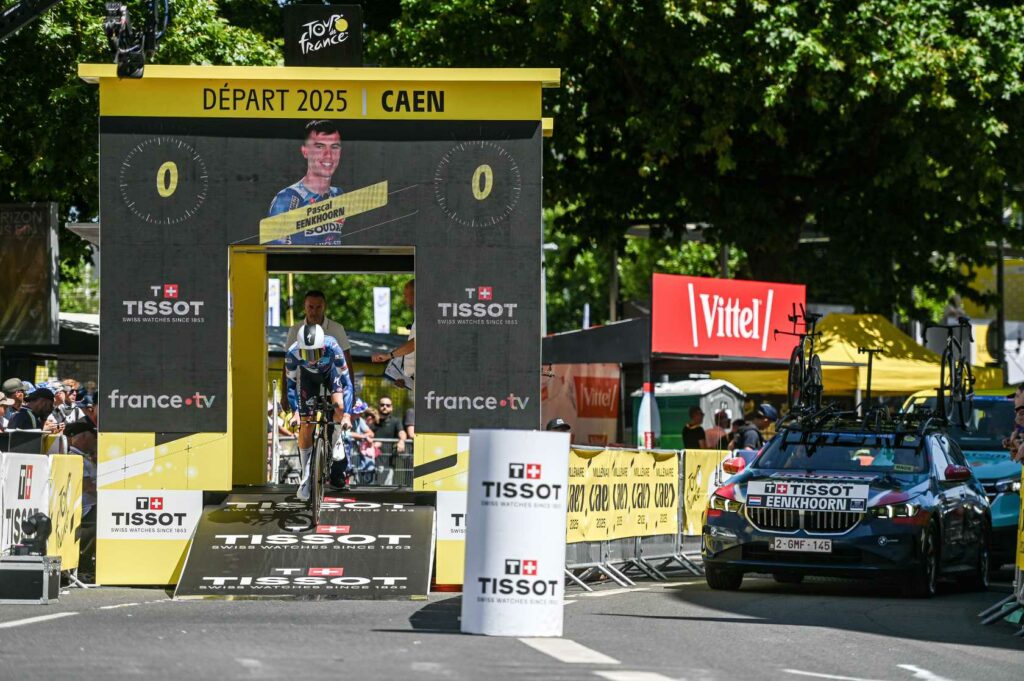

A new study by academics in Scotland found that the aerodynamic benefit created by a following vehicle is directly linked to its drag area, meaning larger or less aerodynamic team cars can provide a greater advantage to riders during time trials.
This really needs to stop, on top of fact that car is likely too close to him anyway. Given calculations i’ve seen likely it gave him the win over Wout#Dauphine2022 pic.twitter.com/PRuyqTgY9G
— G Hofman (@letstalkcycling) June 9, 2022
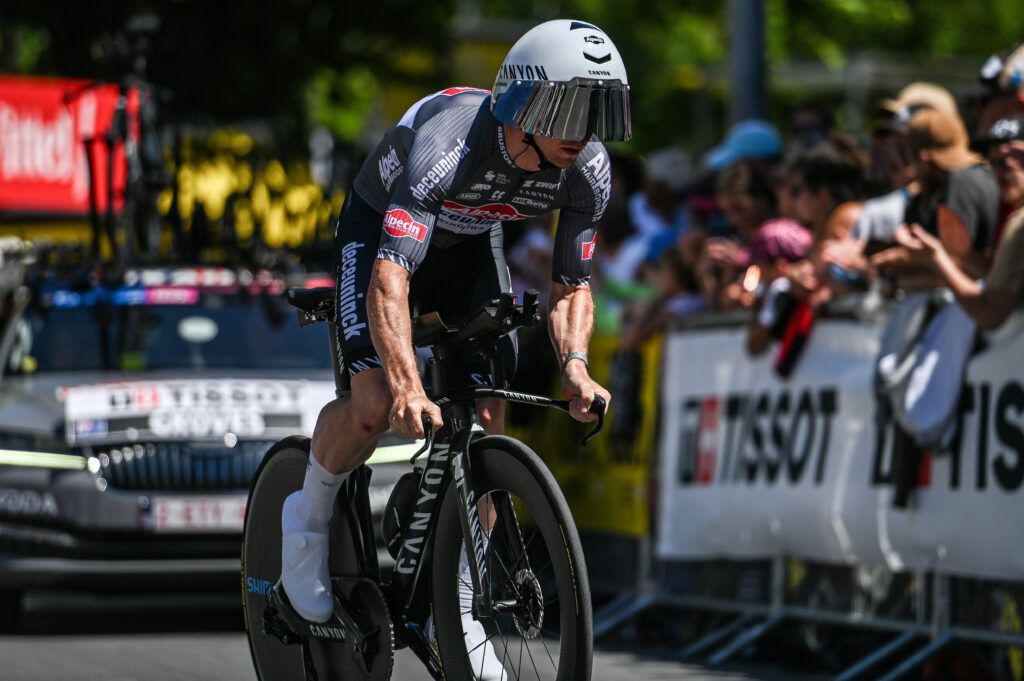
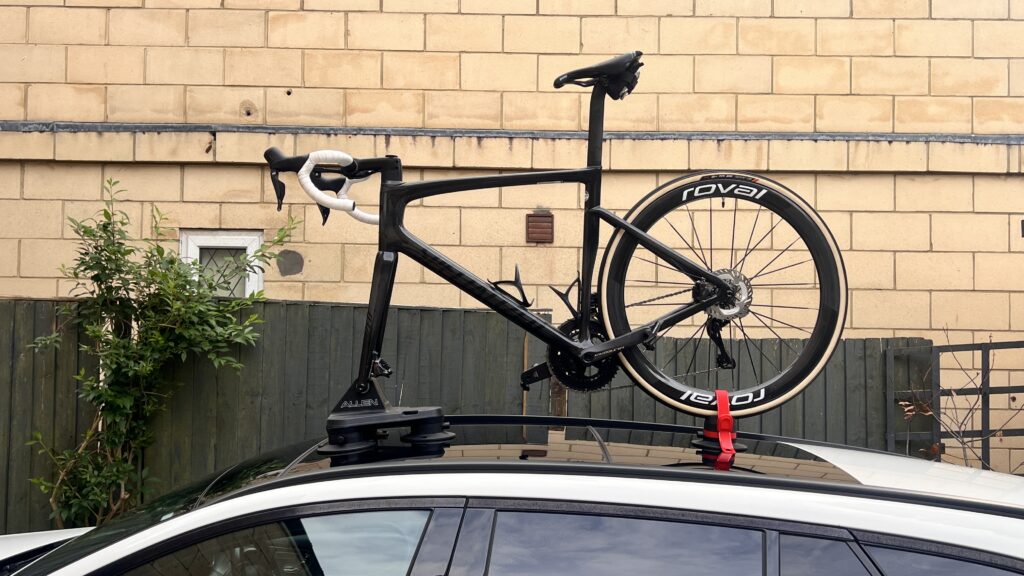
Team cars in time trials came under increased scrutiny in 2022 when the large number of spare bikes mounted on the roof of some vehicles drew attention to their potential aerodynamic impact. Previous research by Professor Blocken has shown that a following car positioned close enough behind a rider can provide a measurable aerodynamic advantage and that stacking multiple bicycles on a team car’s roof increases the push effect further.
The Union Cycliste Interntionale (UCI) didn’t impose any rules for the number of bikes on the roof of team cars, but instead, in 2023, they extended the minimum distance between the rider and following car in individual time trials from 10 to 25 metres. This distance “ensures that the presence of vehicles does not have an effect on the performance of the cyclist”, says the UCI.
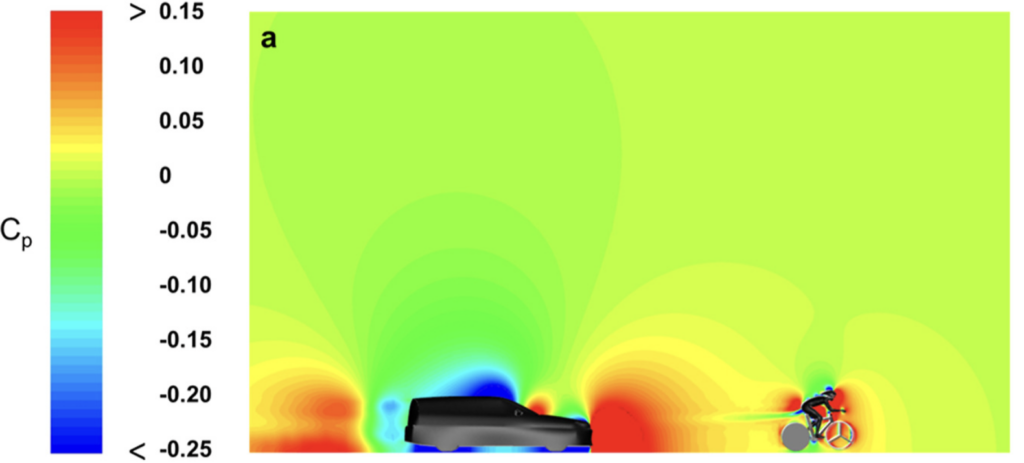
However, Professor Blocken’s argues, “At a distance of just one metre, a rider’s aerodynamic resistance drops by almost 14 per cent, which is massive. The benefit falls away quickly as the distance grows, but it never reaches zero, not at 10 metres, not even at 30.”
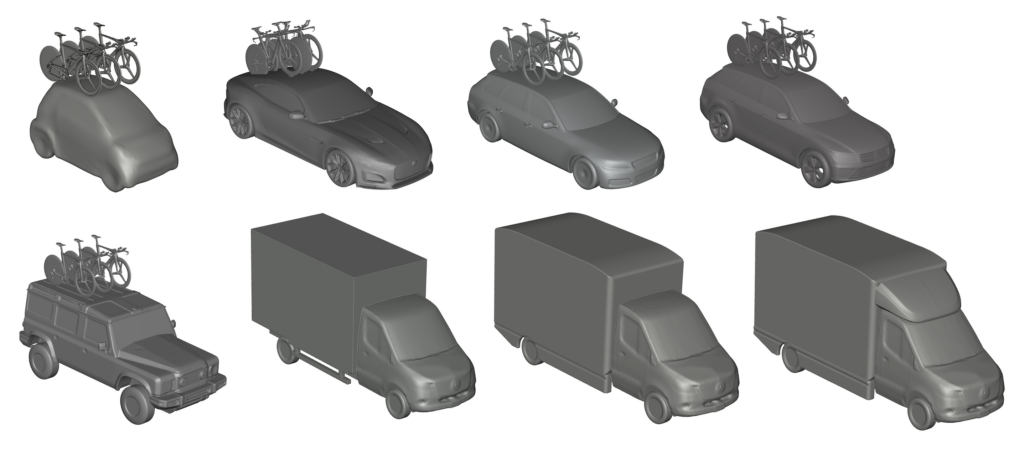
Now, ahead of the Tour de France individual time trial a week today, his latest work suggests the effect is not only determined by the distance between the car and rider – the size and shape of the vehicle also play a role. The researchers found the benefit a rider receives depends on two factors, the distance between the rider and the car, and a single number describing the car’s aerodynamics, its drag area, known as CdA.
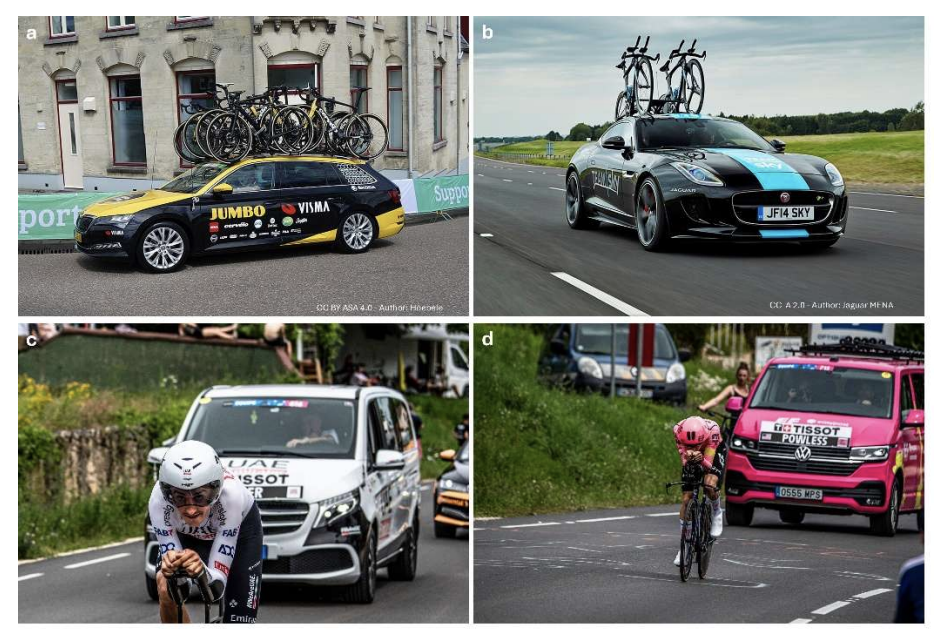
To investigate how much of an effect different vehicles can have, Professor Blocken and his team tested eight different vehicle types. These included a Mercedes Smart forTwo, a Jaguar F-Type, an estate car, an SUV, the Ineos Grenadier Station Wagon and three vans.
The results showed a clear trend: the larger and less aerodynamic the following vehicle, the greater the aerodynamic benefit provided to the rider ahead. Of the cars tested, the small Smart Fortwo created the least benefit, while the boxy Ineos Grenadier Station Wagon produced the greatest effect.
The researchers’ figures are based on a following distance of 10 metres, which is closer than the current UCI minimum of 25 metres. At 10 metres, they calculated that a rider following a typical estate car would gain around 2.3 seconds over the length of the Tour de France time trial course (26.1km), while a rider behind the boxier Ineos Grenadier Station Wagon would gain around 5.5 seconds.
In practice, however, teams – including Netcompany Ineos – typically use estate cars rather than the Grenadier in time trials, perhaps because they allow mechanics to retrieve a spare bike more quickly if one is needed. That makes the estate car figures the most relevant in real-world racing. At the current 25-metre following distance, the estimated advantage from a typical estate car falls to around one second over the same course.
Whether such an advantage could influence the outcome of a Grand Tour is another question. In this year’s Tour de France, with Tadej Pogačar holding a lead of nearly three minutes, a difference of a couple seconds from a following vehicle would be unlikely to decide the overall winner.
So, what should happen? Professor Blocken believes the solution is twofold:
“First, impose a maximum CdA value for team cars, so no team can gain an excessive advantage simply by choosing a bulkier, less aerodynamic vehicle.”
“And second, enforce the following distance. Ideally, the cars would be 40 or 50 metres back, but at the very least the existing 25-metre rule should be enforced by visual inspection until measurement technology is in place.”
However, implementing a maximum CdA limit for team cars may be difficult in practice, as the figure would need to account for each vehicle’s exact race configuration, including roof-mounted bikes, spare wheels, antennas and any other equipment. A simpler solution could be for the UCI to regulate the types of vehicles allowed to follow riders in individual time trials. Currently, teams are free to choose their own cars, though we do see most teams opting for estate cars of similar sizes in time trials.






6 thoughts on “Could this year’s Tour de France time trial be decided by the size of the team car? Expert proposes a “maximum CdA value for team cars” and extended following distances after research finds larger vehicles offer aero advantage”
IIRC correctly the UCI imposed a maximum vehicle height, excluding racks, possibly 2 decades back. I presume this is still in place.
Oddly, time trials are excluded:
There doesn’t appear to be a separate height limit for time trial vehicles.
I’d guess the thinking is that this change was motivated by convoy safety – ensuring that riders can see beyond the cars when moving up through them, and that doesn’t really apply in the same way in time trials.
@mdavidford It’s also about clearance under bridges, advertising pylons and other elements of infrastructure.
Wouldn’t that apply just as much to time trials though? – mitigated a bit by them being shorter courses which you could more easily route to avoid such things, but not removed altogether.
Also allows teams to use other vehicles such as team vans etc. to spread amongst riders if grouped close together in TTs, I guess.