


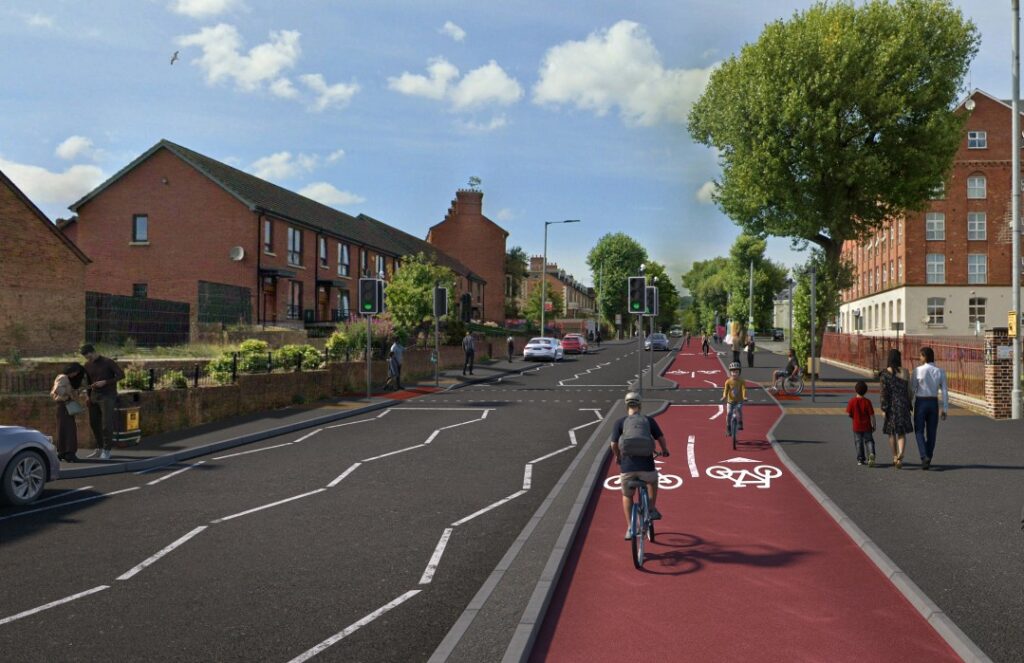

Plans to build a new protected cycle lane in Belfast, a city often slated by active travel campaigners for its lack of safe cycling infrastructure, have been criticised by some of the area’s residents, who raised concerns that the proposals will lead to the loss of parking spaces outside their homes, as well as the removal of the road’s historic, “distinctive” trees.
This week, 21 residents from north Belfast held a meeting to discuss the proposed cycle lane, which is currently under public consultation, and voice their “unanimous” opposition to the scheme, which they claim “will not work” for people who live in the area.
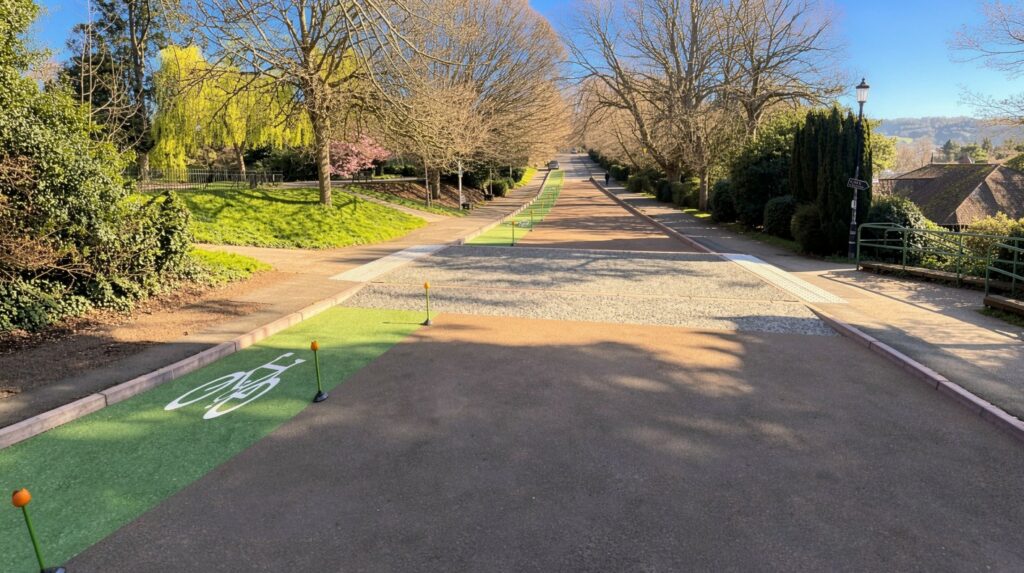
The plans, unveiled by Northern Ireland’s Department for Infrastructure (DfI) earlier this month, involve the installation of “enhanced” protected pedestrian and cycling infrastructure along Cavehill Road, Limestone Road, and York Street, a 1.5-mile stretch in the north of the city finishing at York Street Train Station.
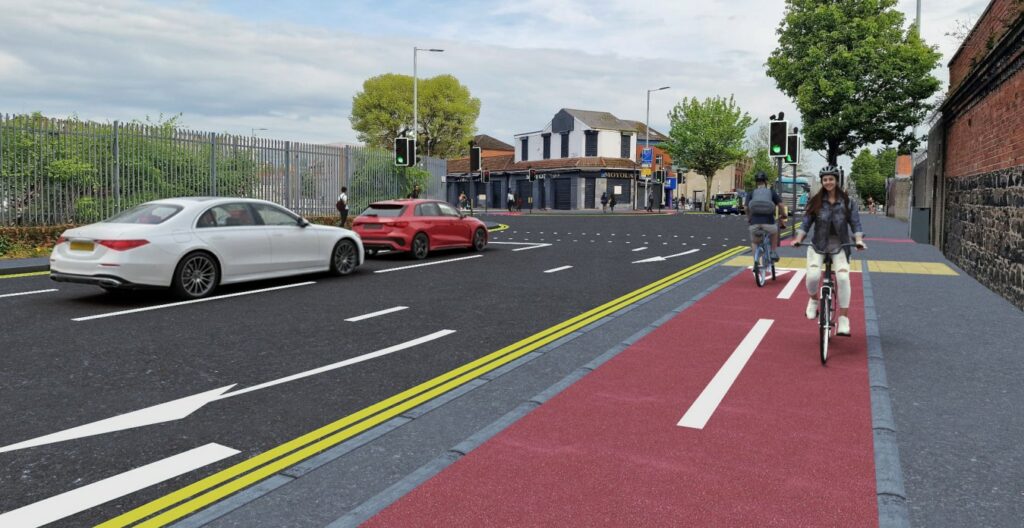
The scheme forms part of the wider, much-maligned Belfast Cycling Network, connecting to other proposed infrastructure projects to provide active travel connections to Belfast city centre. According to the DfI, the key features of the project will include a dedicated two-way cycle track, an improved footway, and enhanced toucan crossing facilities.
In a letter sent to residents, the DfI said the proposed scheme formed part of its bid to “create healthier, cleaner, and more connected places” by providing safe and “inclusive” infrastructure that “makes walking, wheeling, and cycling the easiest and most enjoyable choice for shorter everyday journeys”.
However, a meeting was organised by a group of disgruntled residents at local pub Cassidy’s last Friday, just four days before an official drop-in event was held by members of the project team and the DfI’s deputy director for active travel, Peter McParland.
“I wish we lived in an Amsterdam style utopia, but Belfast isn’t that”
At the residents’ meeting, Lisa Courtney insisted that the residents were not “in a battle against cyclists”, while arguing that the current active travel plans “will not work” for locals.
“I live on the Limestone Road. I wish we lived in an Amsterdam style utopia, but Belfast isn’t that,” Courtney said, according to the Belfast Telegraph.
“What has been proposed looks amazing, and it’s what we would have in an ideal world, but that isn’t the case.”
Courtney argued that the plans would lead to the destruction of trees along the route, as well as the loss of parking spaces outside homes and Airbnbs.
“The trees are so distinctive. The house I live in was built in the early 1930s, and the trees are that old,” she said.
“They’ve survived the Blitz and the Troubles, and we really don’t want to see them torn down for any reason. They’re full of goldfinches, and it’s a lovely thing to see in the morning. If they cut down those trees, there’s no coming back from that.
“A big issue for us is also parking. The houses we live in don’t have driveways, and a lot of the houses have been made into HMOs and Airbnbs.”
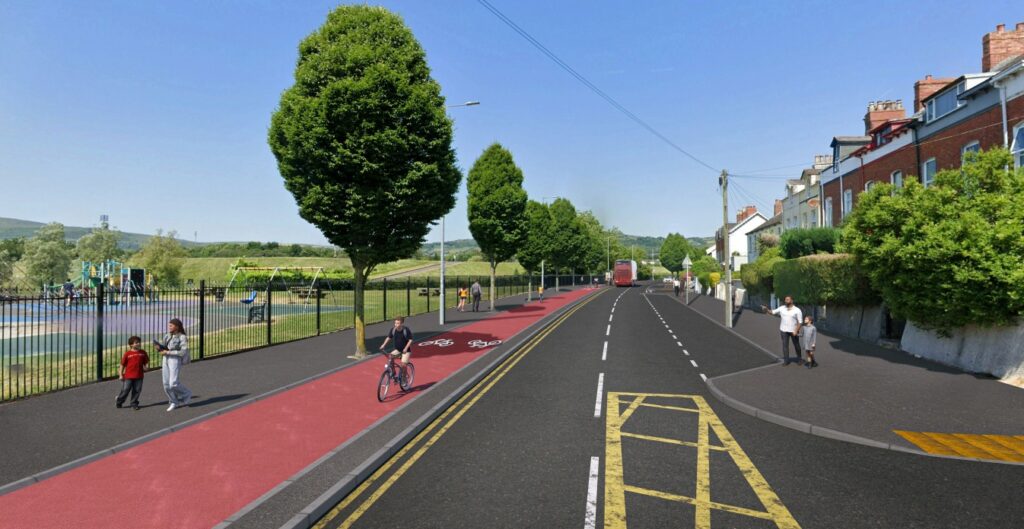
Meanwhile, Cassidy’s Bar owner Joe Killen also voiced his concerns over the scheme’s potential impact on parking, despite admitting that it would be “wonderful” if the project could “work”.
“Something similar was put on the community about two years ago without consultation, when islands were removed in the middle of the Limestone Road and cycle lanes were painted, but because of the community backlash it was taken away,” he said.
“The Department have gone about it the right way this time, but from my perspective it won’t work.”
Those sentiments, especially around parking, were echoed in a local Facebook community group, where the proposed cycle lane was branded a “total waste of money”.
“As a cyclist that uses the road every day, I think this is a total waste of money,” Cavehill resident David wrote.
“Where are all the people who go to the fun runs on Saturday morning going to park? Or the dog walkers who park at the fire station? Or the users of the pitches/facilities at the Antrim Road end?
“And if you are cycling up the Cavehill Road, they expect you to stop, cross the busy road before the fire station, cycle 100 yards and then cross back across the busy road at the lights again. Who thinks that anyone would do that? Cycling down the Cavehill Road, I would not stop, cross the busy road to get on the cycle path, I’ll stay on the road.
“What is wrong with cycling on the road? I’ve been doing it for 50 years without issue. Pure madness.”
However, the scheme did receive some support from the local community, with Jonathan Woods pointing out that the planned cycle lane, as well as traffic-calming measures, will help make the road safer.
“Glad that the road will be narrowed to include a cycle lane,” he wrote. “Apart from protecting cyclists from idiot drivers, that might also go some way to stopping them hitting 50+ mph between the Hughenden lights and the police station. The addition of speed bumps all along Cavehill Road would completely nip that in the bud.”
Speaking at this week’s drop-in event, the department’s deputy active travel director said the “mixed” feedback he had received so far from locals was “good”.
“We’re at the point in our design when we want to get feedback from people and gather information. We’re only seeking people’s views on preliminary designs, and there is a lot of design work still to go,” Peter McParland told the meeting.
“It’s important for us to understand what concerns are here, and what’s important to residents, local traders and road users.
“They’ve spoken to us about the importance of trees and the environment to them, and the importance of road safety for cyclists but also for all the road users.”
McParland will be hoping that the apparent concern for north Belfast’s historic trees (and the area’s current parking provision) doesn’t result in the kind of saga witnessed in Coventry in 2024, when plans to build a new cycle lane faced lengthy delays following a ‘tree-hugging’ campaign from locals which was even endorsed by Sir David Attenborough.
The cycle lane, installed as the final stretch of a 6km (3.7-mile) Binley Cycleway, formed part of a £12m project connecting Coventry city centre with University Hospital Coventry.

However, work on the infrastructure was delayed by a year-long series of protests, including what was described as the UK’s largest tree hug, attended by over 900 people, opposing plans to cut down 26 trees to make way for the route.
Just like in Belfast this week, residents claimed they were not anti-cycling, but were instead genuinely “concerned about the safety of cyclists and vehicles”, and accused the local council of spreading “misinformation” about their motives for opposing the cycleway.
However, Coventry City Council strongly rejected many of the complaints, the local authority’s head of public realm Mark O’Connell telling road.cc that the whole reason the initial plans (which only included the loss of a small number of trees) were rejected was because of outrage at the removal of on-street parking and the road being narrowed.
Back in Belfast, the active travel plans in the north of the city come three months after proposals for an ambitious cycling scheme were also unveiled along one of its busiest commuter corridors, a project described by one politician as “better late than never”.
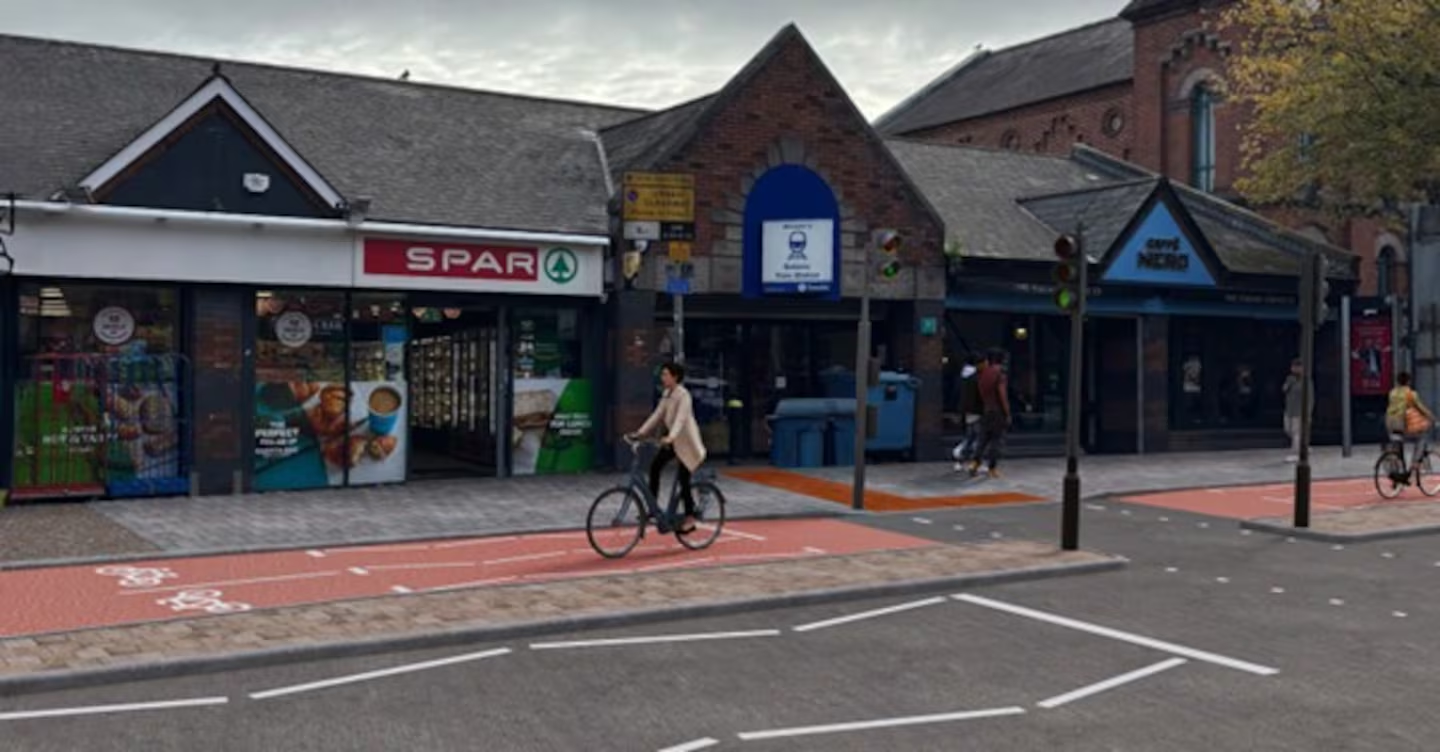
In March, the DfI launched a public consultation on a new protected cycle lane linking Queen’s University Belfast in the south of the city and the centre, which forms part of the Belfast Cycling Network Delivery Plan.
The scheme, if approved, will run from Bankmore Square along Dublin Road, currently home to a lightly segregated bike lane, and the busy Botanic Avenue. It will culminate at the university’s main campus car park, which boasts sheltered bike storage facilities as well as a dedicated cycle repair and hire hub.
Along with the creation of a dedicated 3m-wide cycle lane, the proposals include enhancements to the area’s footpaths, improved controlled crossing facilities, and public realm improvements on Botanic Avenue, where several ‘car free’ events have taken place in recent years, to call for space to be given to cyclists and pedestrians.
However, the project was criticised by a local taxi firm, who claimed that building bike lanes “at the detriment of other road users” will place “immediate pressure on the roads” for motorists in a city with “limited space”.













14 thoughts on ““Where will all the fun runners park?” Locals slam cycle lane plans due to removal of trees that “survived the Blitz and the Troubles”… as well as loss of Airbnb parking spaces”
It’s a bit tiring that any good news about new, decent cycle infra is always written through the lens of angry locals’ “concerns” on road.cc. We all know that there will always be some whiny antis people when it comes building anything for cycling, and it’s about time these moaners were given far less column inches – especially on a cycling website!
21 local residents is fewer than the number of people in my local pub on a Thursday night, yet almost the whole article is dedicated to platforming their NIMBY views. It would be much better to read about how this scheme fits into the wider context of new routes and plans in Belfast, as well as some specific details about where the route will be, if its fully segregated, etc.
(Some) people are always “not against change” as long as it’s the kind of change that doesn’t… change things. Or at least not anything that changes their current convenience.
OTOH it’s hard to get beyond “me, my kids, my elderly parents and my sick ferrets *need to* (something involving driving or cars) – now you’re saying I just can’t do that?”
@chrisonabike It never ceases to amaze me how drivers consider public land to be their private parking spaces.
I think you’ll need to take that up with the media and society more widely. These things only tend to get attention / become ‘news’ when people make a fuss about them, and people are much more likely to make a fuss about things they’re against than they are things they’re in favour of. If road.cc were only to pick up stories where people were being universally positive about them, there basically wouldn’t be any.
The irony of people complaining about cycle lanes making it harder to drive to a fun run.
Also rather confused that they appear to be concerned that people might not be able to park outside a fire station. 🤔
@mdavidford To be fair, I assume they just mean on the road near the fire station, rather than on the actual fire station forecourt. I.e. these cars are all parked: https://maps.app.goo.gl/NHjCmnhKfBn74x6HA
If drivers all over the UK adhered to speed limits and drove in accordance with the highway code, cyclists/scooter riders etc wouldn’t need all these traffic calming. cycle lane changes, and maybe drivers wouldn’t kill 300+ children every year.
If …
… but since we’ve fixed it so everything says “the roads are for motorists … and in fact being a driver is part of your status” what on earth would change the system from that stable point? (Exhortations, greater criminal penalties and even more policing – to affordable levels – won’t).
Without changes which physically limit things like speed and interaction with vulnerable road users drivers will keep causing damage – because cars are heavy and can quickly reach high speeds and drivers are humans.
So… I think while perhaps the majority of *space* could be “shared” (as very low speed “streets” with no through traffic and little motor traffic at all) … while there’s any kind of “motoring” at all, never mind “mass motoring” we’ll always need “traffic calming”. Or rather “infrastructure that manages the danger due to motorists through physical design”.
And where speeds are much higher than say 20mph – separate space for motor vehicles, cycling and walking.
Ultimately for safer spaces, nicer places we need a lot less driving.
“And if you are cycling up the Cavehill Road, they expect you to stop, cross the busy road before the fire station, cycle 100 yards and then cross back across the busy road at the lights again. Who thinks that anyone would do that? Cycling down the Cavehill Road, I would not stop, cross the busy road to get on the cycle path, I’ll stay on the road.”
If that’s true then I’d do the same. Poorly designed infrastructure is worse than none at all.
@bensynnock I would use the road as well but I’m not sure about your statement “Poorly designed infrastructure is worse than none at all.”
In this example the poor design is not unsafe, it is inconvenient. It will still be useful for getting people who lack confidence on to a bike in relative safety. What I would agree with is that unsafe cycling infrastructure is worse than no infrastructure at all. For example murder strips which I refuse to use except when filtering through stationary traffic.
@bensynnock Poorly designed for who? If you’re the kind of person happy cycling on a wide straight 50mph then this isn’t for you in the first place. I’ll take the “poorly designed” infra that doesn’t involve getting buzzed by some wanker in an SUV, thanks.
Yes … but given that many people already have access to a car, they’re even less likely to be tempted to “give it a go” when it’s not just nowhere near as convenient as driving but not obviously a great improvement on walking.
Alas, there is both a minimum hurdle AND a relative one to overcome.
Cycling must appear “safe enough” in the eyes of people who aren’t currently “cyclists”. And it must be reasonably “attractive” and convenient relative to driving. Ultimately that won’t happen unless driving gets just a bit less convenient.
(Which is why “(first) we need to fix the congestion” has it almost backwards. Few people will be interested in change while the motoring status quo still *looks* like the best deal. And while that appears to be the case (more) people will drive more, which will soon enough return to equilibrium – restoring congestion).
Good question. Why isn’t cycling on the road safe? …oh, because motorists think they own the road and the road rules for cyclists are not policed? Doh.
Hello.