



The Scottish government has been urged to recognise the “transformational” impact of active travel schemes, after it was revealed that national changes to how funding is allocated could lead to Glasgow missing out on 200km worth of protected cycling infrastructure over the next six years.
Glasgow City Council has previously committed to installing around 270km of cycle lanes in the city, but only 54.4km are expected to be delivered by 2032, thanks to Transport Scotland’s decision to move from a multi-year funding model to single-year grants.
That move forced the council to place its current programme under review, culminating in a new scaled-back active travel framework, ‘Connecting Glasgow’, which sets out the local authority’s priorities for cycling and walking over the next six years, and which was approved last week, Glasgow Live reports.
The ‘Connecting Glasgow’ scheme will see the completion of a 23km inner orbital loop around the city, linking communities such as Dennistoun, Maryhill, Govan, Shawlands, and Calton. Meanwhile, a further 31km of ‘spoke’ routes will extend the network to “key destinations and neighbourhoods”, according to the proposals.
The council also noted that routes which have not been prioritised this year will be reviewed in 2027/28 to “identify a suitable delivery approach”. Funding for any future scheme will be available through “competitive bidding process” to Transport Scotland’s active travel infrastructure fund (ATIF).
> Scottish Government urged to spend more on public transport and less on cycling
“As protected active travel routes expand, more Glaswegians are choosing the bike for everyday journeys,” the council’s transport convenor Angus Millar said after the meeting approving the plans.
“This plan focuses on completing and connecting routes by 2032, prioritising projects first which can fill gaps in the network and build on the momentum we have seen with growing numbers of users.
“Glasgow’s commitment to a citywide network of safe, connected routes remains clear, and by maintaining a strong pipeline of projects, we can move quickly as funding becomes available and respond to growing demand.”

Addressing councillors during the city administration committee meeting, Millar said the switch to annual funding means “when it comes to larger scale corridors, we then have to segment projects into smaller batches so it can be delivered in one financial year”.
He added that multi-year funding would have enabled the council to forge ahead with a greater number of projects, allowing for the “ability to plan for projects that span multiple financial years as opposed to the current position, which means the programme essentially stop-starts relative to the funding coming available”.
Criticising this shift in how funding is allocated, the council’s Green Party co-leader Jon Molyneux told the meeting: “I guess it is a source of frustration that the funding landscape is the way it is.
“The approach that has been outlined does make sense, it’s the best way of aligning the resource that we have with something that can be delivered, but it doesn’t meet the full level of ambition that I think we have for the city.”
Asking about Millar’s plans to meet with new Scottish transport secretary Stephen Flynn, Molyneux continued: “I think the city will probably have a lengthy shopping list for him, but I think it’s really important that we use that opportunity to persuade him of the transformational opportunity that active travel investment in Glasgow can have.
“Not just for improving transport and ability to get around the city but obviously the climate impact and the health and wellbeing impacts as well. I hope that we can make him a fully-fledged ambassador for cycling in Glasgow.”
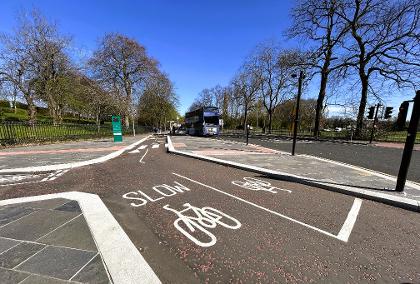
Molyneux’s Green co-leader Martha Wardrop also argued that a five-year funding programme is required to ensure the council’s schemes are fully delivered, while Green councillor Lana Reid-McConnell noted that the changs “could be a significant barrier” to meeting climate targets.
Millar confirmed he has written to the new transport secretary, outlining the “progress that has been made in terms of the delivery of active travel in Glasgow”.
“Clearly there is a very strong case for investment in active travel in Glasgow, we are seeing the numbers coming through on the network,” he added.
“We are seeing that modal shift as we expand the number of protected and safe cycle routes for people to choose as a more realistic option for their everyday journeys.”
In a statement, the Scottish government said it acknowledged the councillors’ concerns, but noted the “challenging medium-term financial position” facing it at the moment.
This threat to the future of Glasgow’s cycling infrastructure comes just months after a survey carried out by Cycling Scotland found that cyclists are outnumbering car drivers at rush hour on a busy road in the south of Scotland’s largest city.
In fact, according to the cycling charity’s figures, bikes accounted for over 16 per cent of all journeys on Victoria Road over a two-day period last September, a mode share Cycling Scotland said “wouldn’t look out of place in the Netherlands or Denmark”.
The success of Glasgow’s South City Way cycle lane formed part of a broader record-breaking picture for Scotland’s protected cycling infrastructure, with routes across the country recording their highest cycling modal shares yet, highlighting what campaigners describe as the “colossal” impact of safe, segregated bike paths in encouraging people to cycle.

















5 thoughts on “Glasgow could lose out on over 200km of cycle lanes as government warned switch to short-term funding a “significant barrier” to meeting climate targets”
Sorry, but Glasgow City Council keep quoting Victoria Road, and the higher than average share of traffic thats on bikes. The majority of the road is blocked to cars, with only buses and taxi’s permitted beyond the southern end, so cars generally avoid going via this route. It’s meaningless. Try looking at the parallel roads to see where the cars are. I am a keen cyclist and all for safer riding, but how Glasgow has gone about this – and totally mismanaged its delivery with schemes that should take months taking years, resulting in chaos and a city that looks like a council dump – has resulted in unprecedented animosity toward cyclists. Glasgow isnt a model to shout about.
Isn’t this the whole problem in a nutshell? Takes ages to deliver half a scheme, which is then poor at the intended purpose, thus promoting even the middle ground to conclude that few want to cycle and it’s a waste of money / capacity?
The status quo is that way because it’s self-reinforcing (now… with large injecting of taxpayer money…)
Cars offer convenience. But they also reduce any desire to walk / cycle in closer proximity to them. Because they’re space-inefficient they then take over spaces. And for decades we’ve framed “where should we site x” in terms of “can people drive there from y”, building in motor dependency.
Then: because all the money and effort goes into motor vehicle works, the councils don’t have expertise or large budgets to hand for active travel – especially not cycling.
Because of the space inefficiency and incentive to drive, small losses in motoring capacity can easily lead to substantial delays and (short term) congestion. And thus promote an outsize reaction from drivers. (“No alternatives” – because we’ve gone all-in on motoring).
And businesses everywhere consistently overestimate the importance of customers being able to *drive* to their business.
It’s a major retail/business destination in and off itself not just a through route, the way you frame it you’d think it was a back water, that’s simply not the case, even if the bit closer to the city centre is a bus/taxi/cycle only space. Have you considered some through traffic using a different route is a success and by design? Not a failure. 🙄
It’s a major retail/business destination in and off itself not just a through route, the way you frame it you’d think it was a back water, that’s simply not the case, even if the bit closer to the city centre is a bus/taxi/cycle only space. Have you considered some through traffic using a different route is a success and by design? Not a failure. 🙄
1 year funding has been in place since Transport Scotland took over active travel funding from Sustrans in 2023/24. It is a PIA for multi year network schemes, but you just have to get smart with your programming. Certainly no excuse to reduce or cancel a scheme so this is just GCC politicking ahead of next years council elections.