


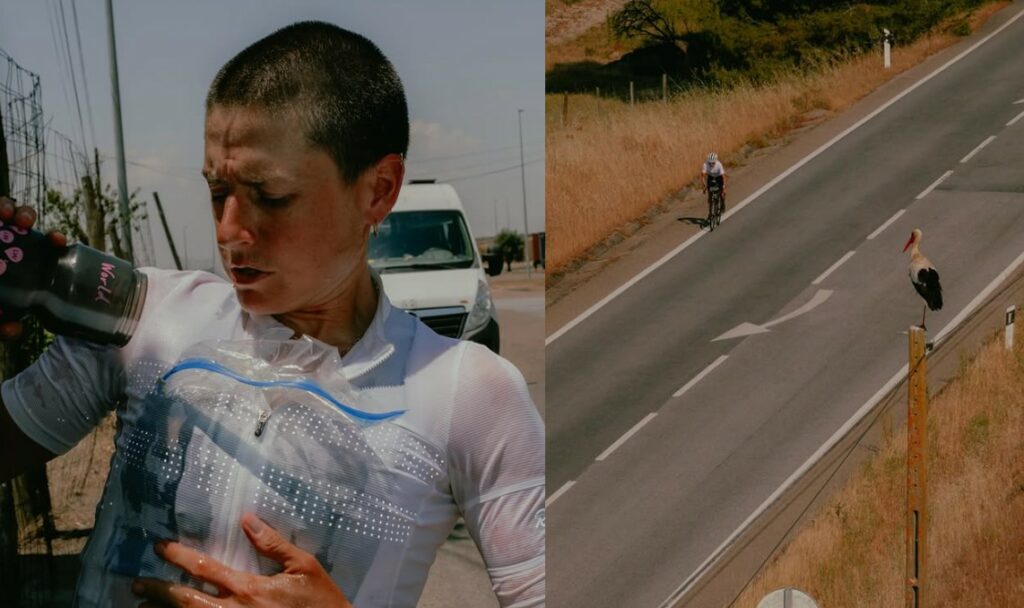

The stark effects of climate change and the rigours of riding a bike very fast butted heads once again at the weekend, when ultra-endurance cyclist Lael Wilcox was forced to abandon her around-the-world record attempt after suffering from heat exhaustion in France.
The 39-year-old Alaskan was 14 days into her bid to beat Mark Beaumont’s outright record for circumnavigating the globe by bike when she was encouraged to stop by her support team, after days of feeling nauseous while riding through Europe’s second heatwave of the year.
“It’s kind of a miracle I haven’t just passed out. I’ve never tried so hard,” an emotional Wilcox said in a video posted on her Instagram account on Sunday. “I was hammering the food, trying to bulk up my body. I even shaved my head and everything!”
In 2024, Wilcox set the women’s record for cycling around the world, completing the 18,125-mile ride in 108 days, 12 hours, and 12 minutes, beating Jenny Graham’s previous marker by more than two weeks.
This time, she was aiming to usurp ultra-cycling legend Beaumont’s 2017 mark and set the outright Around the World record, which would have meant cutting just under 30 days from her 2024 effort.
As part of her bid, Wilcox – whose sparkling career has also seen her set the fastest times at the world’s most important endurance events, such as the Tour Divide, Trans Am, Baja Divide, and Badlands – carried out wind tunnel testing at Specialized’s Californian headquarters, organised a full support crew for the first time in her career, and even shaved her head for comfort and efficiency.
She set off from Chicago, Illinois, on 7 June, battling a headwind and rainy conditions as he completed the first leg of her ride across North America. However, after arriving in Spain earlier this week, into what she described as a “heat dome”, Wilcox began to suffer in the oppressive temperatures currently hanging over Europe.
View this post on Instagram
On Saturday, she posted a video on Instagram showing her battling the extreme conditions – with the aid of a seemingly unlimited supply of ice socks – after a day she described as the “most humbling ride of my life”.
“I’m just getting hosed every day. You think a bike ride is going to be easy,” she laughed. Despite the best efforts of her team, a nauseous Wilcox began to fall behind the pace required to eclipse Beaumont’s record as she suffered in the heat, leading her to being physically sick early on Sunday morning.
And later that afternoon, 14 days and roughly 3,000 miles into her ride, in Fontainebleau, just south of Paris – and with the heatwave expected to follow her during her ride across Europe – Wilcox called it a day.
“I’m the strongest I think I ever have been, but it’s just not coming together. It’s okay, it’s a bike ride,” she said in the video.
View this post on Instagram
“We tried to do a lot with a little, and we already did do a lot. You know what, I feel fine, it’s not the most devastating thing. This one, I feel, is another climate change lesson and every year I’m having more and more of those.
“With this, my biggest concern was smoke in the west, and we’re two months away from that. This is day 14? We were expecting a big challenge but not health problems.”
After being told by one of her crew that she was displaying all the signs of heat exhaustion, Wilcox said: “I don’t take enjoyment out of how hard it is, I just try to survive. But each day I think, this could be the last day. And I guess today is the last day.”
In a post shared on social media, the ultra-endurance star continued: “The heatwave will continue in Europe for the next week, traveling my route’s trajectory.
“I’ve been nauseous every day and finally threw up in the first hour of my ride this morning – heat exhaustion got the better of me. Concerned for my health and safety, my team asked me to stop my ride.
“Honestly, I’m amazed I’ve endured the past 14 days. Conditions have been really tough. I hate to quit, but it’s the right choice this time. I just can’t manage race pace in the heat. It was nice to finish the ride going past Fontainebleau in the centre of France with a sweet crew.
“We’re heading to Switzerland and then back home – maybe adding a quick stop in Lithuania. Thanks to everyone for cheering me on and riding with me, truly great to see people coming together and celebrating the sport.”
View this post on Instagram
The spectre of climate change and rising temperatures has haunted cycling – a sport played out in the great outdoors – in recent years, with races increasingly susceptible to extreme weather conditions.
In February, a new study published by researchers from the Barcelona Institute for Global Health warned that global warming and extreme heatwaves may soon make many July afternoons too hot for racing at the Tour de France.
The researchers looked at the future of European outdoor summer sporting events through the lens of the past half century of the Tour de France, the country-crossing bike race acting as a near-perfect case study for the impact of climate change and extreme heatwaves on summer sport.
Looking at the analysis, the study suggests the Tour has been, thus far, actually quite fortunate to avoid the July days historically featuring the highest heat. This is, of course, down to chance and ASO cannot hope to continue to be lucky enough to avoid extreme heatwaves and the most dangerous conditions.
“With record-breaking heatwaves becoming more frequent, it seems only a question of time as to when the race will encounter the extreme heat stress days that will test the existing heat safety protocols,” the research noted.
For example, while hourly heat stress values for Paris have crossed the high-risk threshold (as per the Wet Bulb Globe Temperature heat index) four times since 2014, this has not yet coincided with the Tour’s visit.
While mountain stages and locations “largely remain safe”, the study highlighted increasingly notable episodes of dangerous heat levels that are becoming most common around Toulouse, Pau, Bordeaux, Nîmes and Perpignan.
However, other locations such as Paris and Lyon are also starting to cross the 28°C WBGT threshold more frequently too.
To combat this, researchers advised extra caution when planning routes, emphasis on hot-weather protocols, and even the idea of scheduling stages for the morning to avoid concerning midday and afternoon temperatures.







16 thoughts on “Lael Wilcox abandons Around the World cycling record attempt after “another climate change lesson” amid European heatwave”
Unfortunately its only going to get worse because we don’t seem to be overly concerned about climate change do we.
On an unrelated note, I’ve never quite understood “around the world” records as they seem to have such loose rules that its almost pointless to compare different attempts.
@mctrials23 the rules aren’t really that complicated:
– at least 18,000 miles
– pass through one set of antipodal points
– travel in one direction
– only use scheduled transport
that’s basically it. what makes the whole thing a mess in my opinion is that there aren’t *enough* rules, so me trying it on my own with panniers is effectively going for the same record as lael is with a full crew
@dave atkinson Thats my point about loose rules, its possible to have two attempts with massively different routes which change the actual feat by a huge margin and yet the two attempts are considered comparable for the sake of the record. I don’t understand it.
You wouldn’t have that in almost any other record. I understand that ultra distance events are a little different but it still feels like there could be more constraints/categories.
@mctrials23 at risk of adding a third voice in an argument where everyone fundamentally agrees…
surely if the record is ‘fastest’ though, it’s down to the athlete (and any crew) to decide how to achieve that. So yes, it might be a very different feat if you route across every conceivable mountain range on route, but if you’re setting out to be the fastest, you probably wouldn’t.
@quiff I don’t necessarily disagree but then it becomes a pathfinding and luck challenge. Is X route open? What is the weather here? How extreme are conditions? Is it politically safe to travel through Y?
Its like any achievement, the requirements are multi-faceted but it just all feels a little arbitrary when the outcome is dictated by so many things outside ones control or within ones control which can make their achievement fundamentally much easier than someone elses.
Will I happen to run into someone who has a hot air balloon they’ll sell me? Have I remembered to account for crossing the International Date Line?
@mctrials23 yeah i don’t disagree, but you can’t really mandate a round-the-world route i don’t think, there are just too many moving parts. maybe there’s a middle ground (like in the TCR) where you have to do specific sections you can pretty much guarantee will be open and rideable, but then I guess it’s a new record and that would annul anything up to now.
@mctrials23 When I was planning my 2025 World Record ride I raised this issue with Jenny Graham. She said Guinness was set up for records like balancing the most number of books on your head, not these multi day efforts. Fortunately, WUCA are putting in place much clearer rules and I expect that the Guiness rules will be less relevant. They are also quite limiting, I am the first disabled person to do the challenge, but Guiness don’t recognise brain injury under their disability category.
With regard to comparing the different routes, Mark Beaumont did a great GCN interview on this at the time of Laels last attempt. He pointed out that there are two approaches. Go fast which means avoiding Asia with big loops in North America, or keep to the ‘spirit’ of the challenge. The latter means if you put your route on the living room wall it looks like you circumnavigated the world. Jenny and Mark’s rides were the latter, Lael’s the former. I originally had a route very similar to hers but decided my record would be ‘tainted’ by being within the rules but not the spirit. So I went to one like Mark suggested, with over 7,000 km in Uzbekistan, Kazakhstan and China.
@mctrials23 Nerdy sort of fact, if the RTW challenge was to cycle round the equator, which would make sense in a way with that being the longest circumference of our oblate spheroid, it would only take 8,714 kilometres of cycling as the rest of the 40,075km would be by boat.
In other news the estimable Amy & Kyle’s attempt to be the fastest couple around the world continues apace – http://www.followmychallenge.com/live/fastest-couple-around-the-world-2026
Two points. A few months I read an article about racing one of these ultra’s and the person (I can’t recall who) said that the route they used would not be safe today due to geopolitics.
Secondly, 10 years ago I was chatting to Chris Bennett in NZ about his hope to race around the world. He was on about riding way up into Norway to get a load of European miles in rather than some hot places in Asia. Last year he achieved a finish in 129+ days aged 66 but he did not stick to the plan he outlined all those years ago.
I believe the problem with what counts as unsupported over that time or distance is difficult to monitor. One example would be staying at a friend’s house overnight in Australia – does that count as support?
@mctrials23 When I was planning my 2025 World Record ride I raised this issue with Jenny Graham. She said Guinness was set up for records like balancing the most number of books on your head, not these multi day efforts. Fortunately, WUCA are putting in place much clearer rules and I expect that the Guiness rules will be less relevant. They are also quite limiting, I am the first disabled person to do the challenge, but Guiness don’t recognise brain injury under their disability category.
With regard to comparing the different routes, Mark Beaumont did a great GCN interview on this at the time of Laels last attempt. He pointed out that there are two approaches. Go fast which means avoiding Asia with big loops in North America, or keep to the ‘spirit’ of the challenge. The latter means if you put your route on the living room wall it looks like you circumnavigated the world. Jenny and Mark’s rides were the latter, Lael’s the former. I originally had a route very similar to hers but decided my record would be ‘tainted’ by being within the rules but not the spirit. So I went to one like Mark suggested, with over 7,000 km in Uzbekistan, Kazakhstan and China.
You have a good memory! I commented on my route decision.
WUCA has really tried to clarify things with the supported vs self supported approach. In my Letter of Intent I laid out that I was going to do it self supported using the Tour Divide principles. So when my derailleur failed in China I organised a new one to be sent to a hotel in Mt Isa, when I tore my rain pants I got a Warmshowers host in North Dakota to receive the replacement, I never sought out people to ride with me, etc. But I still failed. I saw my wife at the end of each day in NZ (but I carried 100% of my kit at all time!), and I spent 2 nights staying with friends. So I think I got as close as possible to the principles of self supported as I could.
@mdavidford Most importantly, will someone name a range of exotic (well, exotic for the 1980s) snacks after me?
It must have been a very difficult decision, but I’m sure Lael made the right call.
You have a good memory! I commented on my route decision.
WUCA has really tried to clarify things with the supported vs self supported approach. In my Letter of Intent I laid out that I was going to do it self supported using the Tour Divide principles. So when my derailleur failed in China I organised a new one to be sent to a hotel in Mt Isa, when I tore my rain pants I got a Warmshowers host in North Dakota to receive the replacement, I never sought out people to ride with me, etc. But I still failed. I saw my wife at the end of each day in NZ (but I carried 100% of my kit at all time!), and I spent 2 nights staying with friends. So I think I got as close as possible to the principles of self supported as I could.