


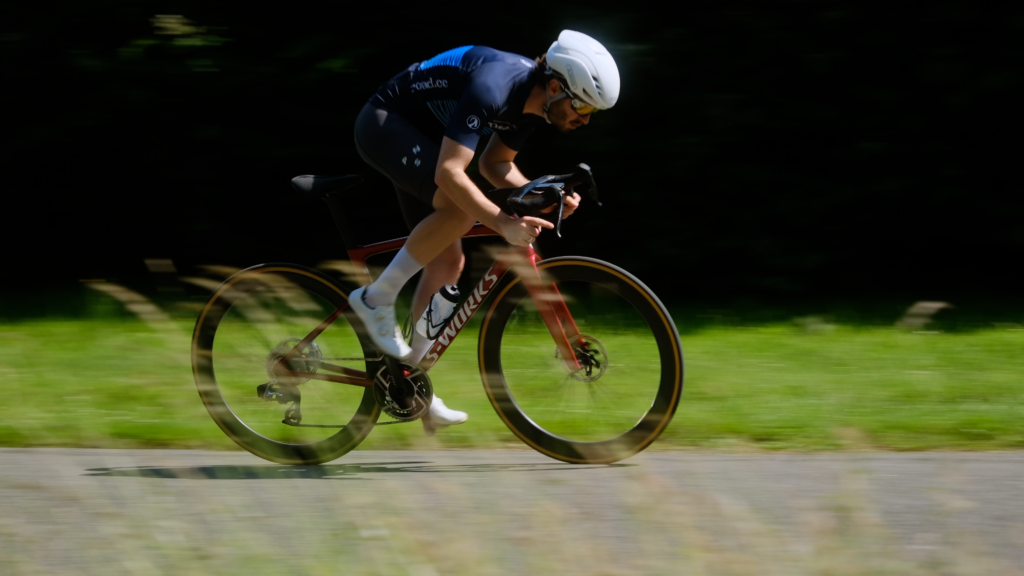

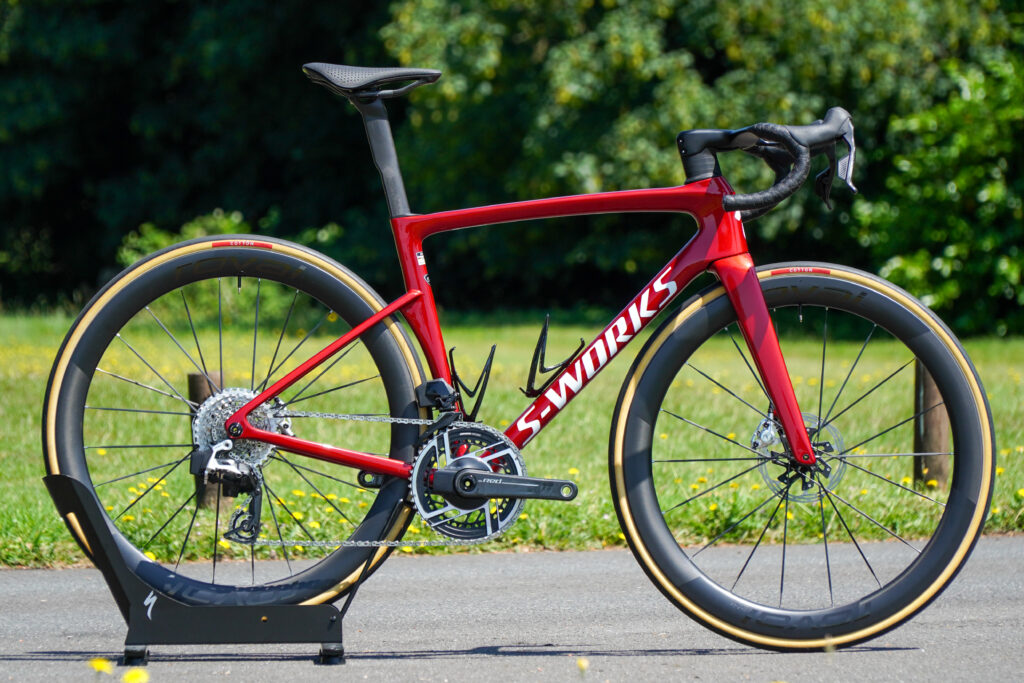
Specialized has finally announced the S-Works Tarmac SL9 with claims that the new model is “the fastest road bike ever made” – more aerodynamically efficient than the existing SL8, with a frame weight of 687g and complete bikes as light as 6.5kg. Specialized has only launched the S-Works Tarmac SL9 today; we assume that the SL9 range will be extended over time, but it’s just the top-level S-Works version at the moment.
We’re all used to new bikes coming along with claims that they’re the most aero or the lightest ever, so let’s deal with those right away.
Specialized says the S-Works Tarmac SL9 is 4 watts faster than its Tarmac SL8 at 45km/h (28mph). Before anyone feels the need to point it out, everyone knows that a watt isn’t a measure of speed; Specialized means that the new bike can hold 45km/h with a slightly lower power input than the SL8.
In the real world, Specialized says that the SL9 would be 14 seconds faster than the SL8 over the last 80km (49.7 miles) of the final stage of the 2024 Tour de France Femmes – assuming the same course, conditions, and rider input, of course. We’ll come back to the reason for that stat in a mo.
In terms of weight, Specialized claims the S-Works FACT 12r frame comes in at just 687g in the lightest RTP Raw Carbon / Gloss Amethyst Frost finish (size 56cm). That compares with a claimed weight of 685g for the S-Works Tarmac SL8 – so almost the same as before and “alone at the top of the road aero category”, according to Specialized. It says that complete bikes start at 6.5kg – below the UCI’s 6.8kg minimum weight limit for racing.
Above all, though, Specialized says that the S-Works Tarmac SL9 is “the fastest road bike ever made”.
“It delivers the lowest real‑world Time To Finish of any road bike we have ever tested,” says Specialized. “The Tarmac SL9 translates more of your effort into speed across real WorldTour race courses, measured, simulated, and validated with riders, terrain, and race conditions fully accounted for. When the goal is to cross the line first, no road bike gets you there faster.”
What is ‘Time to Finish’?
As with its new Crux 5 launched last month, Specialized is keen to emphasise that speed isn’t simply down to aerodynamics, weight or lab numbers, although all of those factors come into it. That’s why it has come up with what it calls ‘Time to Finish’.
> Specialized says new Crux 5 is “the fastest gravel race bike ever made”
“Time to Finish is a physics-based simulation output that predicts total elapsed race time over a specific real-world course, using measured inputs from aerodynamics, weight, rolling resistance, surface roughness, environmental conditions, and rider power… It is the result of measured data applied to real courses.”
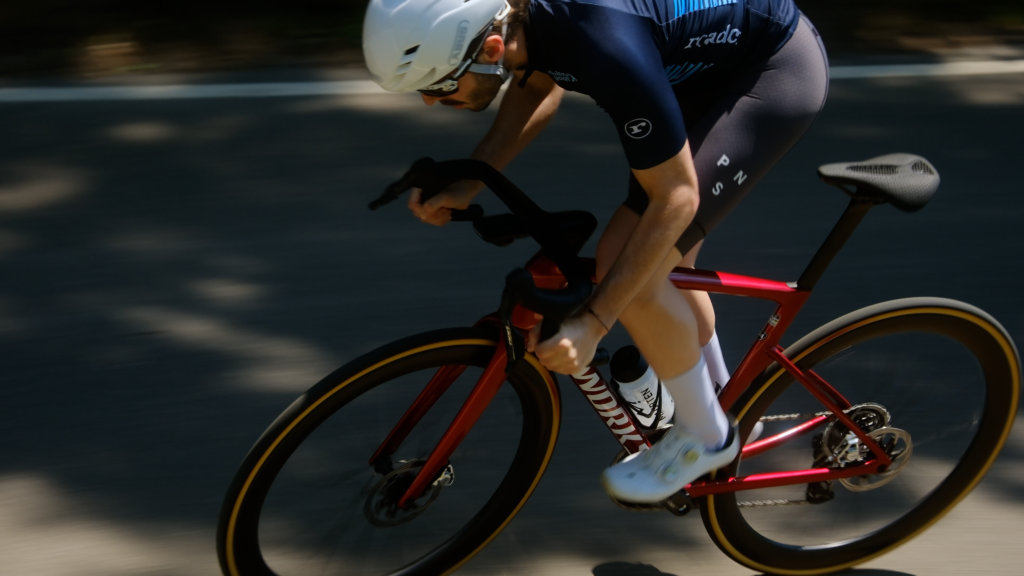
Specialized’s engineers have developed an equation – which the brand calls ‘the Equation of Speed’ – “that converts rider power into elapsed race time by integrating aerodynamics, mass, rolling resistance, mechanical efficiency, rider position, terrain, wind, and fatigue”.
Studying riders in real races feeds into Time-to-Finish simulations.
“One example is that riders in most breakaways carry only one bottle, not two,” says Specialized. “This significantly changes airflow around the seat tube and rear triangle compared to traditional setups that assume two bottles and two cages. We redesigned the entire rear of the bike around this real‑race configuration.”
The bottom line is that Specialized says that inputting all of these factors allows its engineers to calculate Time to Finish over real courses – including key WorldTour stages and Monuments – and that the S-Works Tarmac SL9 comes out on top against bikes like the Colnago Y1Rs, Cervelo S5, and Factor One – the SL9’s advantage varying according to the course profile, distance, and so on.
As an example, Specialized says, “Think back to the final stage of the 2024 Tour de France Femmes, where Demi Vollering launched her decisive 80km breakaway across rolling terrain, flat transitions, and ultimately up Alpe d’Huez to the finish. She rode that legendary effort on the Tarmac SL8. But what would have happened if she had ridden the Tarmac SL9?
”We ran the full stage through our Equation of Speed simulation using:
-
- 4 watts less aerodynamic drag
- A 687g frame
- 6.8 kg system weight
- Hyper-accurate Made In Racing real-world data
- Elite rider power profiles
”The result? She would have been 14 seconds faster. A 14-second gain on a Tour decided by 4 seconds [Vollering finished runner-up]. The difference between losing the overall… or winning it by 10 seconds.”
Specialized says that it hasn’t just applied the SL9’s figures across an entire race distance or even across an entire stage, but looked at “the decisive race segments, the moments where attacks happen, breakaways form, and races are ultimately won” – so the last 80km when Vollering attacked rather than the whole 150km of the stage or the 950km of the race.
Of course, Specialized has shared results where, it says, its bike offers an advantage over its rivals. It would hardly share scenarios where the SL9 doesn’t shine.
If you’re interested in the engineering behind the design, a full explanation of the Equation of Speed and Time to Finish, and Specialized’s calculations covering a selection of real-world races, it has produced a white paper to support the launch of the S-Works Tarmac SL9.
Increased aero efficiency
As mentioned, aerodynamic efficiency is part of the S-Works Tarmac SL9 story, although Specialized claims fairly modest gains over the SL8 – 4 watts faster in the wind tunnel with a moving-legs mannequin on board at 45km/h (28mph).
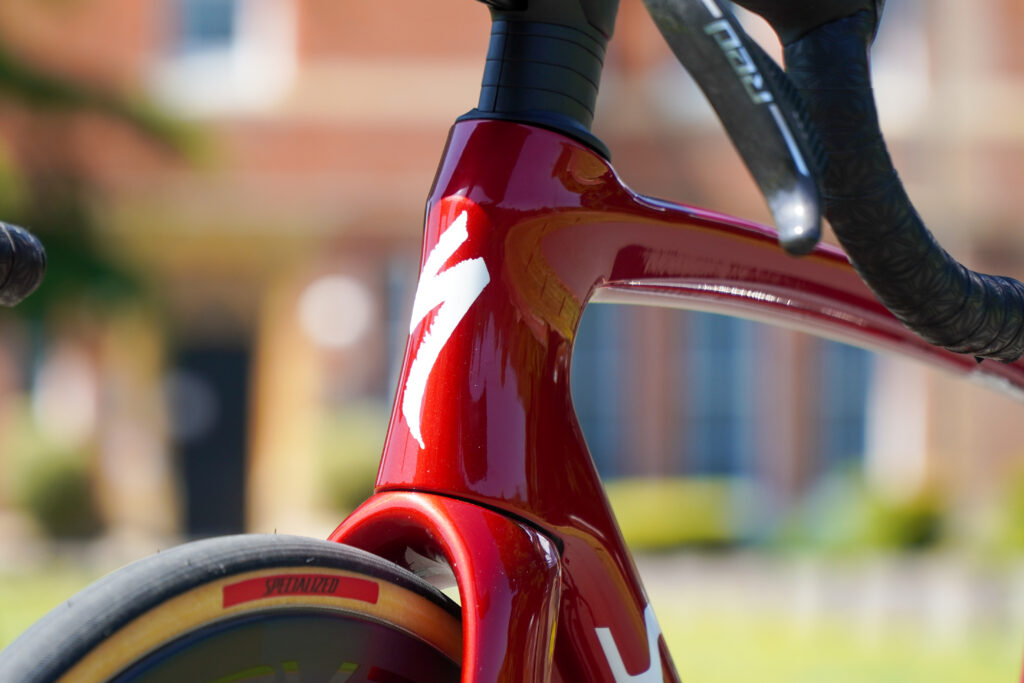
Every frame tube has been redesigned. The Speed Sniffer head tube remains, but it is 4mm narrower than before and delivers a 10% reduction in frontal area.
“We knew we had to go narrower with the head tube and take the space usually reserved for internal cables,” says Specialized. “The aero gains were too compelling to sacrifice, so the team engineered a solution. The Offset Steerer design reroutes the rear brake [hose] along the right side of the steerer, making space for the new design.”
Specialized has also dropped the down tube to work aerodynamically with the head tube and fork.
“By reducing the gap between the fork, head tube, front tyre, and the leading edge of the down tube, airflow moves more naturally through this high‑pressure zone,” says Specialized. “Closing that gap prevents the disturbed air from spilling into the frame, reducing drag and improving the efficiency of the entire front‑end system.”
The fork has also been redesigned
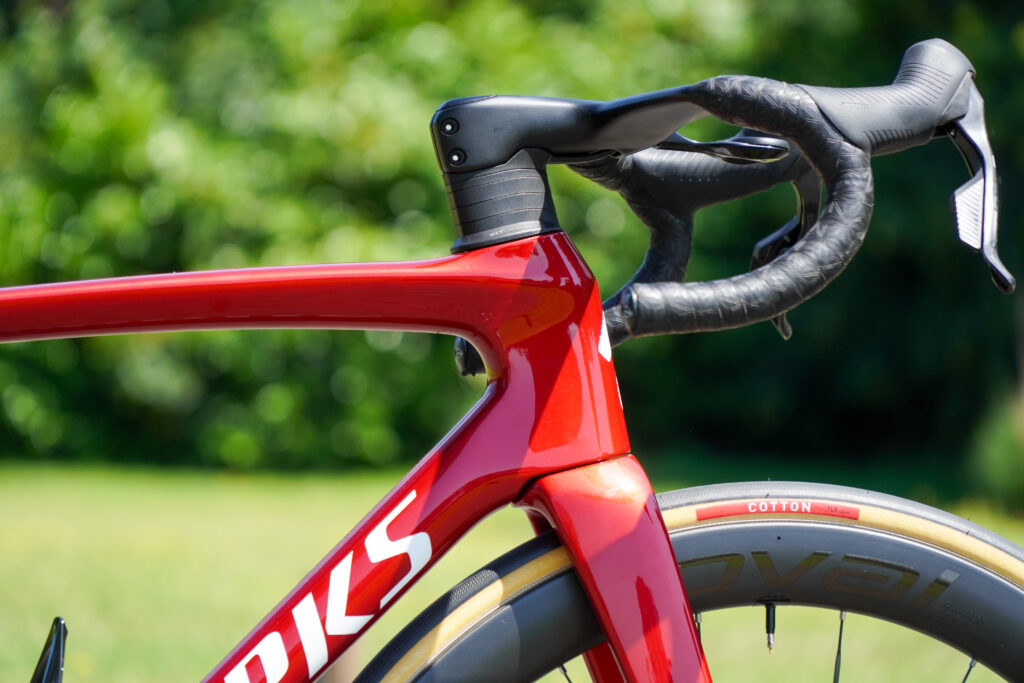
“To better manage the high‑energy airflow from the front wheel, simply deepening fork blades was not enough,” says Specialized.
“A breakthrough came when we twisted the blades outward, guiding airflow more efficiently along the frame. Combined with the fork crown now nesting cleanly into the head‑tube and down‑tube transition, the Flow Fork keeps airflow attached longer and reduces drag across the entire front half of the bike.”
It has also introduced the Win Fin, which is based on the idea (mentioned a little earlier) that racers in breakaways tend to ride with a single bottle rather than two.
Specialized says, “In a break, team cars sit close behind the move, so riders can grab fresh bottles whenever they need them. With no second bottle required, the airflow around the seat tube and rear triangle changes dramatically compared to traditional two‑bottle test assumptions. We re‑engineered the entire rear of the bike around this real‑race configuration. The result is the Win Fin, tuned for the aerodynamic reality of winning moves.
“That single decision dramatically shifts airflow around the seat tube and rear triangle compared to traditional two‑bottle assumptions. We re‑engineered the entire rear of the bike around this real‑world configuration. The result is the Win Fin, tuned for the aero reality of winning moves, saving 0.5 watts.”
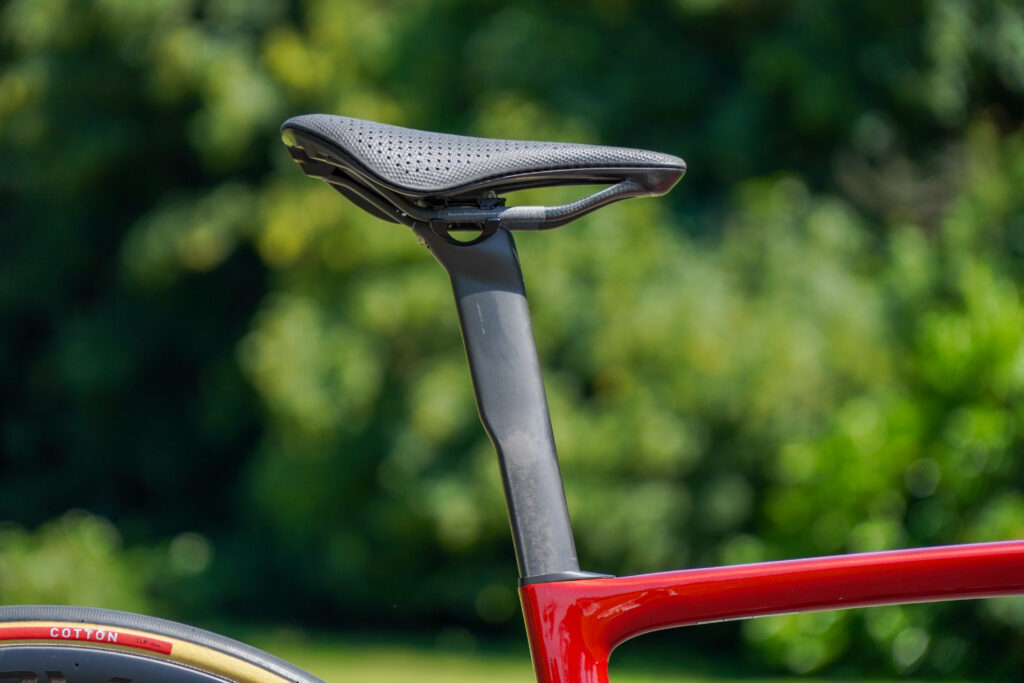
Specialized has also redesigned the seatpost based on data collected from its moving-leg mannequin.
“As a rider pedals, their legs accelerate airflow into the tight channel between the thighs and the frame,” it says. “This high‑speed stream hits the seatpost directly, making this zone far more aero‑sensitive than previously understood, so we re‑engineered the seatpost from the ground up.
“A deeper profile with a reduced frontal area delivers a cleaner airflow. In fact, Tarmac SL9 features the thinnest seatpost section we have ever made, where it matters most. The result is a post that slices cleaner, flows smoother, and significantly enhances the aerodynamic performance of the entire frame, without losing its compliance.”
Featherlight frame
As mentioned up top, Specialized claims the S-Works Tarmac SL9 frame hits the scales at 687g, this low weight being achieved thanks to what it calls Flow State Design, a strategy introduced on the Aethos road bike.
Long story short: Specialized says it has used its supercomputer to shape tubes precisely to carry load efficiently “by optimising shape instead of adding material” and eliminating unnecessary carbon layers.
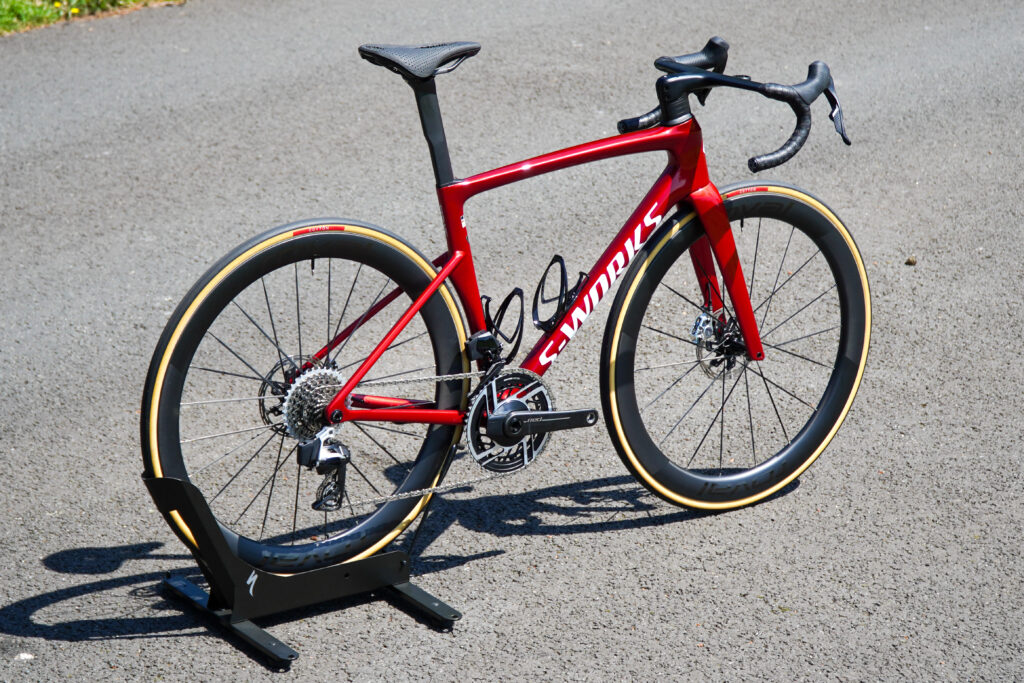
It says that the Tarmac SL9 matches the exact compliance and stiffness targets of the Tarmac SL8.
“Every size from 44–61 cm receives a size-specific layup based on performance metrics unique to that size – delivering stiffness, compliance, and handling that is consistent across all sizes,” says Specialized.
Speaking of sizes, here’s the geometry table.
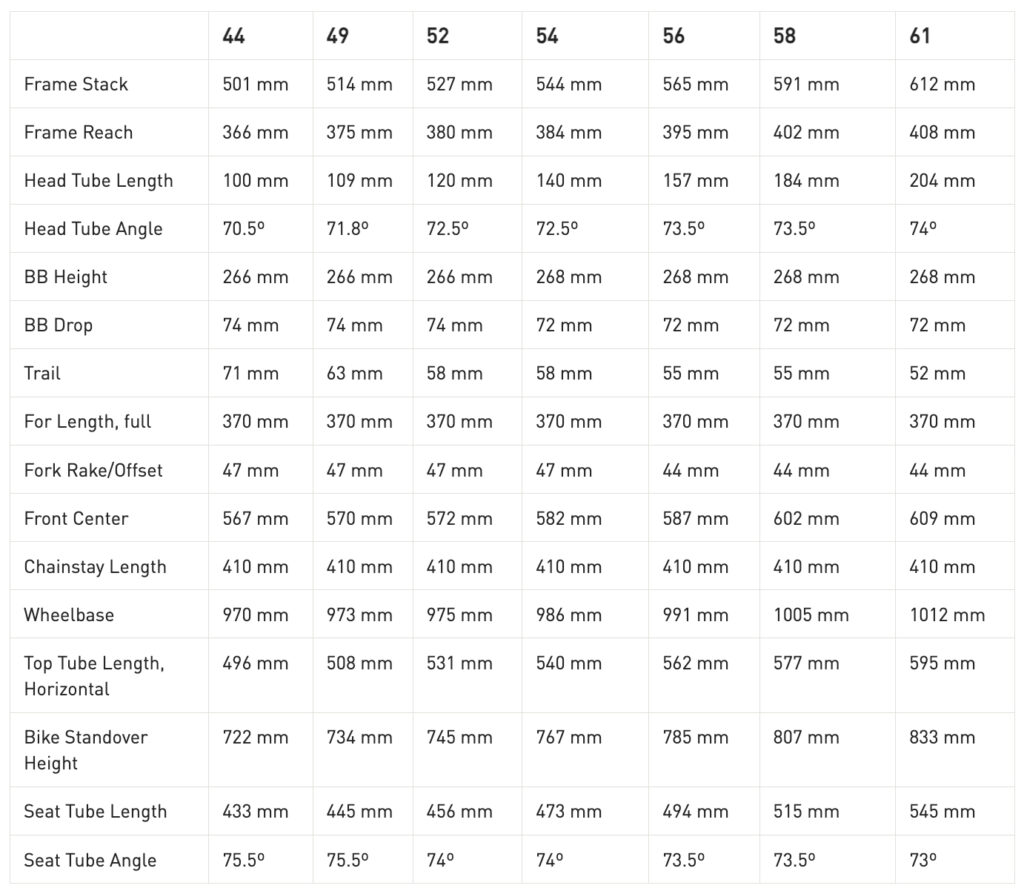
The Tarmac SL9 uses the same geometry as the Tarmac SL8. The only exception is the 54cm model, where there’s a small adjustment to increase toe clearance with the front wheel – added fork offset and updated head tube angle.
road.cc‘s Liam Cahill has ridden the S-Works Tarmac SL9, so head over to his video to find out what he thinks about the performance.
How much does it cost?
The Specialized S-Works Tarmac SL 9 is available in two top-end builds: Shimano Dura-Ace Di2 and SRAM Red AXS (it’s only compatible with electronic drivetrains).
They each come with Roval Rapide CLX III wheels and a Roval Rapide Cockpit – an integrated handlebar and stem – priced at £11,999.
They ship with Specialized’s 30mm Cotton TLR tyres but can take up to 32mm with 4mm of clearance.
An S-Works Tarmac SL9 frameset is £5,249.
S-Works team replica framesets
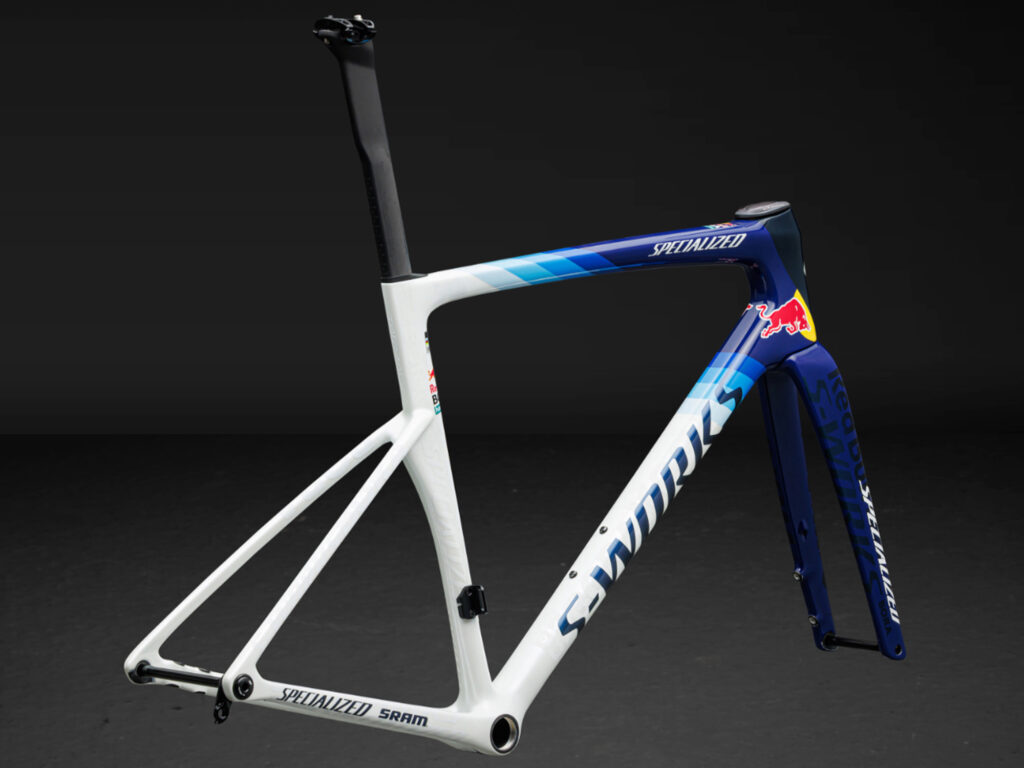
The Specialized S-Works Tarmac SL9 frameset is available in 2026 team colours and graphics for Red Bull-BORA-hansgrohe, SD Worx-Protime, FDJ United-Suez, and Soudal-Quick-Step. They’re each priced at £5,499.




7 thoughts on ““The fastest road bike ever made”: Specialized unveils the S-Works Tarmac SL9”
Meet the new boss, same as the old boss?
@Surreyrider Makes you wonder why they dont just do what they used to go and paint on some go faster stripes.
If it were good enough for a 1995 Vauxhall Corsa its good enough for a spez
@Smoggysteve They probably have with the cheaper models. Perhaps they should have called it SL8+ or something?
@Smoggysteve: Just buy the red version. It’s faster—everyone knows that!
@Surreyrider Still the boss. Ride one, you’ll see why
…adding “Sorry – this doesn’t normally happen…”
The geometry chart is interesting. The progression in stack and reach is quite normal from 52 to 61 cm, but looking at what they call the “49” and “44” sizes, the differences are pretty small. It would definitely be more appropriate to call them 50 and 48. When are the brands going to start realizing that smaller riders need smaller wheels so that the frame geometry isn’t compromised due to squeezing in the big hoops?