


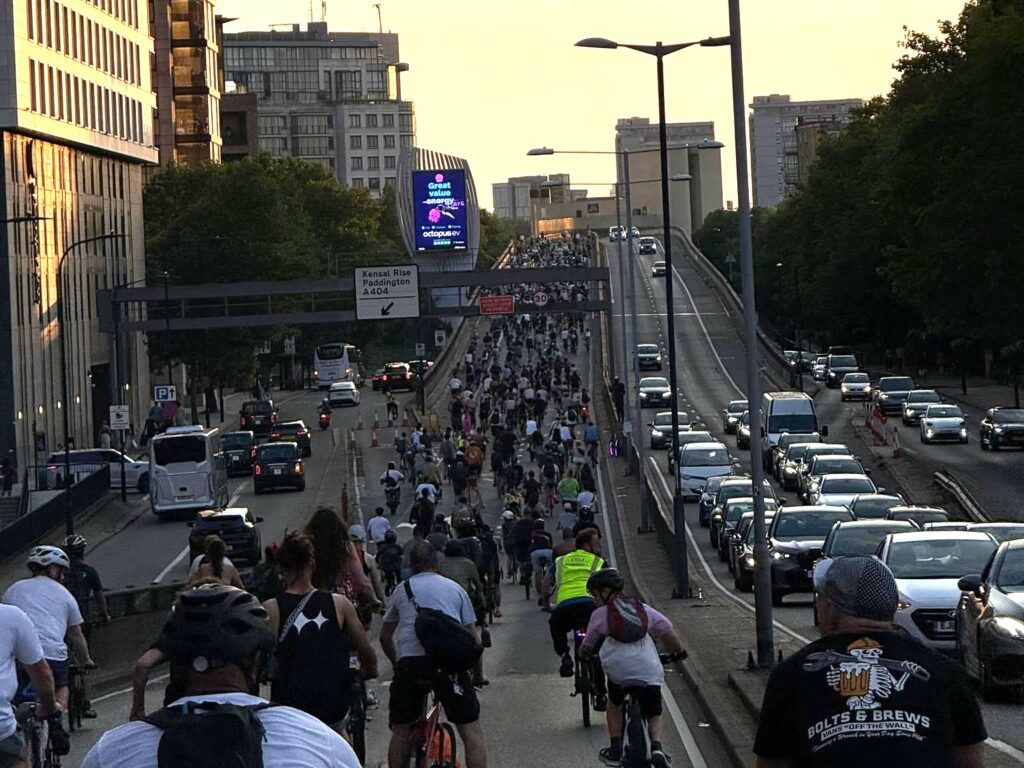

The A40 Westway, London’s second-busiest road, was the scene of a “mass trespass” on Friday evening, when up to a thousand cyclists ignored the road closure signs to ride their bikes on the former motorway, almost a decade on from the decision to scrap plans for a protected cycle superhighway along the route.
As a slow-moving traffic jam was forming along the adjacent Harrow Road, the cyclists rode from the Marylebone flyover to the Westway roundabout, near White City, along the elevated carriageway, which has been closed at numerous points this year to allow for works to replace safety-critical joints.
The route was chosen for Critical Mass London’s latest edition of their jubilant monthly rides, which form part of the wider global movement of Critical Mass events aiming to reclaim the streets from motor traffic and highlight the need for safe active travel routes.
Despite losing its motorway status in 2000, the Westway – stretching for 3.5 miles through inner west London and used by around 100,000 motorists a day – remains ordinarily off-limits for cyclists and pedestrians.

In 2015, then-London mayor Boris Johnson announced plans to create a protected cycle superhighway on the Westway by removing a lane from the flyover, a move welcomed by local cycling campaigners despite concerns over how to enter and exit the road. The plans, however, were quietly shelved by Johnson’s successor Sadiq Khan in late 2016.
The prospect of people cycling on the Westway was finally realised, albeit briefly, on Friday night, with footage shared on showing cyclists making their way onto the elevated carriageway by riding between road closure signs and traffic cones near Edgware Road station.
The large group, which Critical Mass said totalled around 1,000 riders, stopped before the exit ramp onto the West Cross Route, running past Westfield shopping centre, where many participants climbed a gantry to take photos and videos.
“Why did Critical Mass London riders cycle up the closed A40 Westway road on Friday night, westbound from Marylebone to the Westway Roundabout, and then south on to Shepherds Bush Green?” the group posted on Instagram over the weekend.
“Maybe they wanted to be on a road completely free of all motor traffic for a change. Maybe they just wanted to experience the sun setting over the city with friends on bikes.
“Maybe they wanted to send a message to government or TfL to stop spending money on car roads. Maybe they wanted to be part of another positive, joyous celebration and bring it west this month.
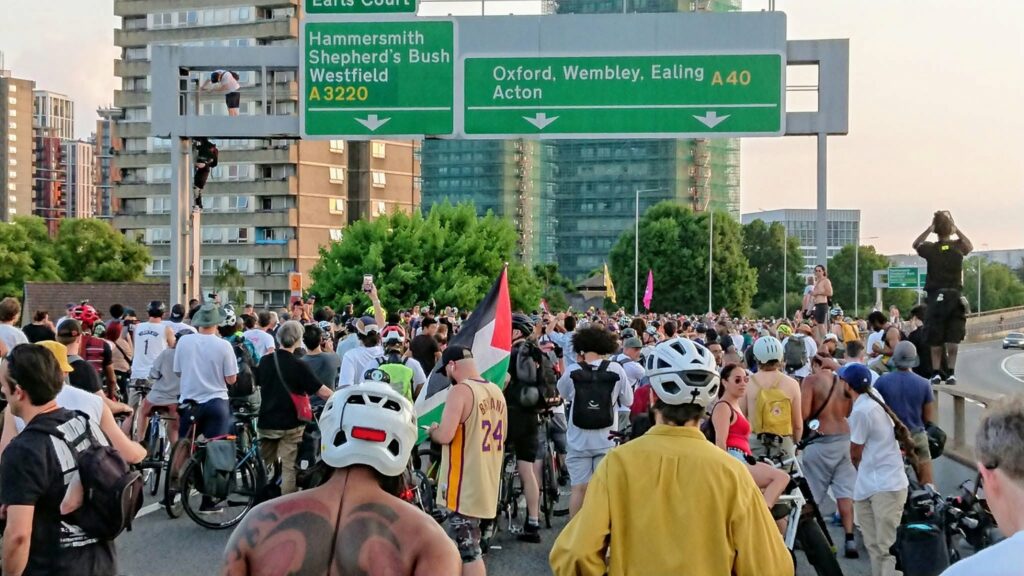
“Maybe they were sick and tired of having a road over their heads that they were excluded from and wanted to turn the tables. Maybe they just wanted some decent clips for their social media accounts. Maybe they wanted to have a new segment recorded on their Strava history.
“Maybe they just followed the people at the front riding over the Marylebone Flyover and weren’t thinking about it. Maybe they wanted a clean open road to do some wheelie riding and swerving across three lanes. Maybe they wanted to climb the gantry and see the western part of London from a new perspective. Maybe they just wanted to experience the giddy thrill of a mass trespass.
“All reasons (and others) are equally valid. There is no one narrative or source of truth. Nobody (including this and other social media accounts) can speak as an authority for the ride. If you want to find out the reasons why participants did it, you would have to ask them all individually.
“Critical Mass London is a messy, organic, chaotic meeting of different minds, tribes, styles, histories, motivations. But they all come together once a month to create (not take up) space across the city.”
View this post on Instagram
Others, meanwhile, argued that Friday’s mass trespass represented a protest against the use of transport money to fund repairs to a “crumbling, costly” road for motorists, which is linked to dangerous levels of air pollution.
“While other cities such as Utrecht, Seoul, San Francisco, and Boston have removed their hulking elevated motorway structures and turned them into linear parks, Transport for London continues with its costly controversial project to maintain the crumbling concrete foundations of the Westway,” one participant told road.cc.
“Despite being an open road with no traffic lights, the speed limit on the elevated section is only 30mph to stop vehicle vibrations from damaging the supporting columns. Although the road passes through some of the most affluent parts of the city, the air quality nearby is consistently at dangerous levels.”

This isn’t the first time, of course, that Critical Mass London has organised a ride on a stretch of infrastructure where cyclists aren’t normally permitted.
In April 2025, hundreds of cyclists also rode through the newly opened Silvertown Tunnel, in protest at the £2bn route’s lack of cycling infrastructure, with riders instead told they must take their bikes on a “greenwashing” bus to shuttle them through.
In that case, Silvertown Tunnel was singled out for its lack of access or safe alternative for cyclists, the project having recently been completed and bicycle riders told they must either cross the river via a lengthy detour or catch a free shuttle bus that has been put on at a further expense of £2m.
The idea that cyclists must, rather than be provided a suitable direct route to ride between Greenwich south of the river and Newham to the north, catch a bus before resuming their cycled journeys on the other side was already branded “ridiculous” by campaigners when the plans were announced.
It was in that context that hundreds of people on bikes defied the ban on cycling and travelled through the tunnel, videos from participants showing the sea of two-wheeled traffic and Critical Mass’s standard carnival atmosphere.















13 thoughts on “Hundreds of cyclists ignore road closure to “mass trespass” on notorious Westway and tell government to “stop spending money on car roads””
No right-wing media frothing about this?
Not quite the first time, I rode over it back in the late twentyteens, just happened to see it was jammed nose-to-tail so thought it would be fun to filter along…turned out there was an overturned lorry at the eastern end blocking all carriageways. I honestly didn’t know cycling was banned (the signs aren’t very prominent), just assumed nobody rode on it because it would be suicidal in normal circumstances. Fortunately the weary copper at the other end who saw me just cut off my apologies and said, “Fuck off over there [a gap in the barrier to a slip road] and don’t do it again.”
I remember thoroughly enjoying the Critical Mass rides in the early to mid nineties. Fun as they might be, they don’t appear to be achieving much if they’re still going. So little has actually changed despite all the good words.
@timscottellis I can’t speak for elsewhere but in London cycle provision and infrastructure has improved out of all recognition since the 90s and as a result fatalities are down 50% and serious injuries are down 20% despite the fact that the number of miles ridden has increased by 300%. What proportion of that improvement is attributable to Critical Mass cannot of course be measured, but it’s absolutely incorrect to say “so little has actually changed”.
@timscottellis In some London constituencies there have been big improvements in infrastructure for cyclists. In mine very little.
The things that really have changed since the 90s:
– attitudes and standard driving of drivers for the worse
– dramatic increase in size of motor vehicles
– increase in congestion
– Advent of electric motorbike-enabled crime
– wholesale removal of police presence and enforcement
– use of legal and illegal micromobility vehicles
– proliferation of dockless electric hire bikes and their sometimes wayward riders
– congestion charging
– ULEZ
Whilst some of these points have benefits for a few or even some road users the last point would seem to be the only one to have a solely positive upside for cyclists.
I remember being in a car on the southbank once in maybe 2010 when one of these went past. Couldn’t move for about 15 minutes. It was glorious.
@timscottellis given the “anarchic by design” organising principle what Critical mass is “for” will vary (even between participants).
I believe part of the original idea was to be “critical” – direct activism against motorists by reclaiming space.
Whether it’s a good idea to annoy people who mostly will have no clue why you’re doing that is a question of course.
It certainly serves a community building and awareness raising function. And for some (perhaps like yourself?) showing them that they *can* ride on the streets. Albeit some would never do so outside of such an event.
Sadiq Khan and TfL cannot be accused of neglecting cycling. They have greatly improved provision in London. Yes there is a lot more that could be done, but we need to be patient. The public finances aren’t in good shape, so things are going to b e tight for some time.
Money’s *always* tight – or rather it’s always tight for active travel because in the UK that is very low on the priority list *.
The vast majority of money goes on apparently unrelated stuff – health and adult social care. But I think active travel could make a minor but positive contribution here.
And a large amount of that money compared to active travel spend goes on things that overall have a negative impact there (indeed are a net cost) – providing for the level of motoring we have. Including repeatedly pouring money into (pot-) holes in the ground.
Could we reallocate some of that?
* For some parties – maybe even governments – it’s actually something they’re against. If only because they’re more keen on motoring which will effectively work against it.
@chrisonabike Given that pot holes a much greater danger to cyclists than they are to other road users, I wouldn’t want to see a reduction in the amount of money spent repairing pot holes – unless it was due to a reduction in pot holes due to less motor traffic.
One of the best things London has done for cycling is the 20mph speed limits, and they cost relatively little money.
@jh2727 if only there were a way of separating where high volumes of (increasingly heavy) vehicles operate (which as you say aren’t so affected by said potholes, but are vastly more effective at causing them) and where cyclists ride…
One practical issue (even if we “went Dutch” in separating modes) is around damage from buses. It’s easy to spot the bus stops * due to the waves they produce in the roads at these points. I don’t know if that’s inevitable, or due to particularly shoddy road construction or drivers stopping too rapidly…
Of course if the buses are in bus *lanes* that shouldn’t be an issue – because no professional transport planners would try to mix buses and cyclists as they’re quite incompatible modes! 🤔
* At least around my area in Edinburgh even without shelters, signs or painted markings.
The article is a little confusing – it says “usually illegal” and “cyclists ignore road closure”. So was the road closed in general or was it closed to allow cyclists to legally ride along it as part of this event?
@jh2727 It was closed for repairs as it regularly is because it’s falling apart, but no works were actually taking place at the time of the CM ride.