



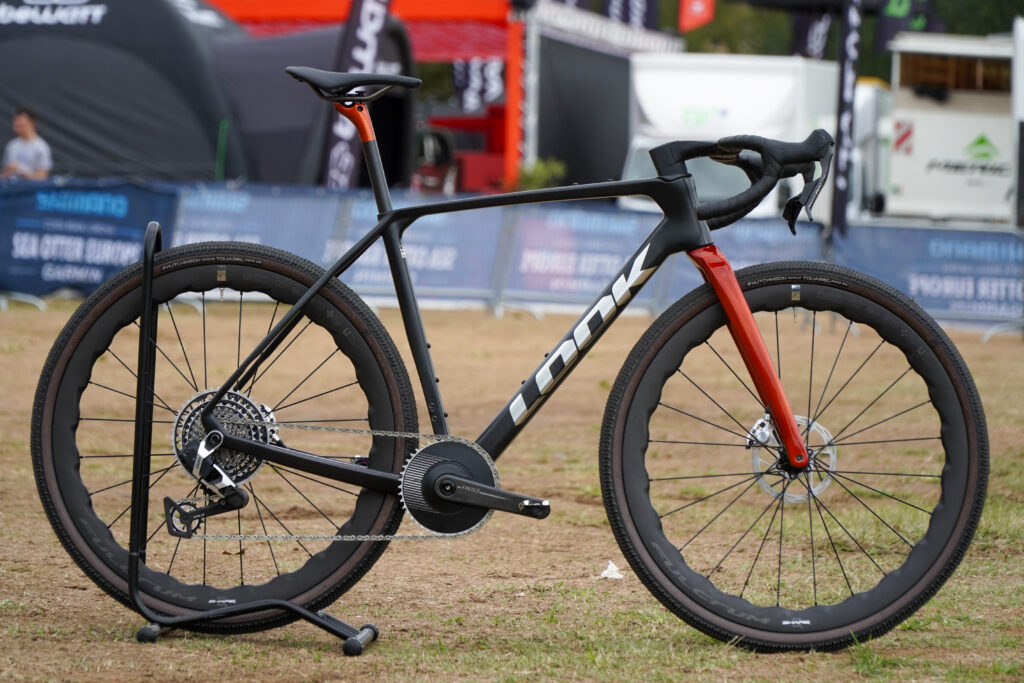
Specialized says that its new aero-optimised Crux is the fastest gravel race bike ever made, with the top-level S-Works frame hitting the scales at just 789g. The Crux S-Level comes in to replace the second-tier Crux Pro, and you get 55mm tyre clearance throughout. Complete bikes start at £3,249.
“Crux 5 isn’t fast because of one breakthrough,” says Specialized. “It’s fast because every variable that matters was measured – and optimised. When speed is defined by ‘Time to Finish’ [see below], the result isn’t subjective and it’s more than objective.”
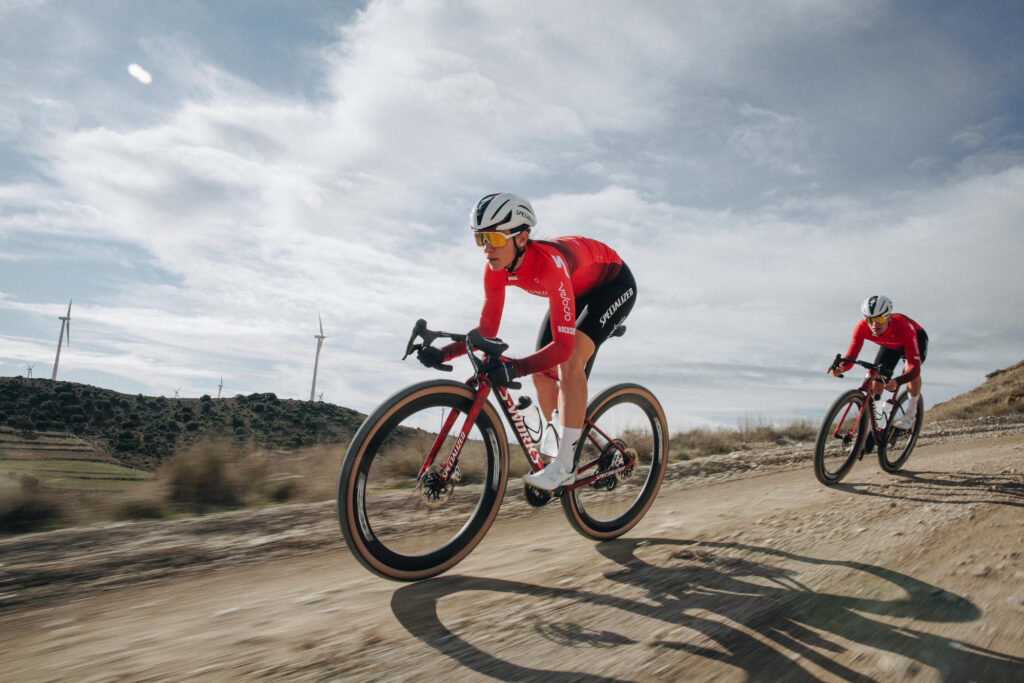
Specialized says that the Crux 5 is 15.2 watts faster than the Crux 4 at 45 km/h (28mph). Naturally, Specialized is fully aware that watts isn’t a unit of speed; it means that its notional rider could hold 45km/h at a lower power output on the new bike.
Reducing Time to Finish
Specialized is keen to emphasise that speed isn’t simply down to aerodynamics, weight or lab numbers, although all of those factors come into it. That’s why it has come up with what it calls ‘Time to Finish’.
“Time to Finish is a physics-based simulation output that predicts total elapsed race time over a specific real-world course, using measured inputs from aerodynamics, weight, rolling resistance, surface roughness, environmental conditions, and rider power… It is the result of measured data applied to real courses.
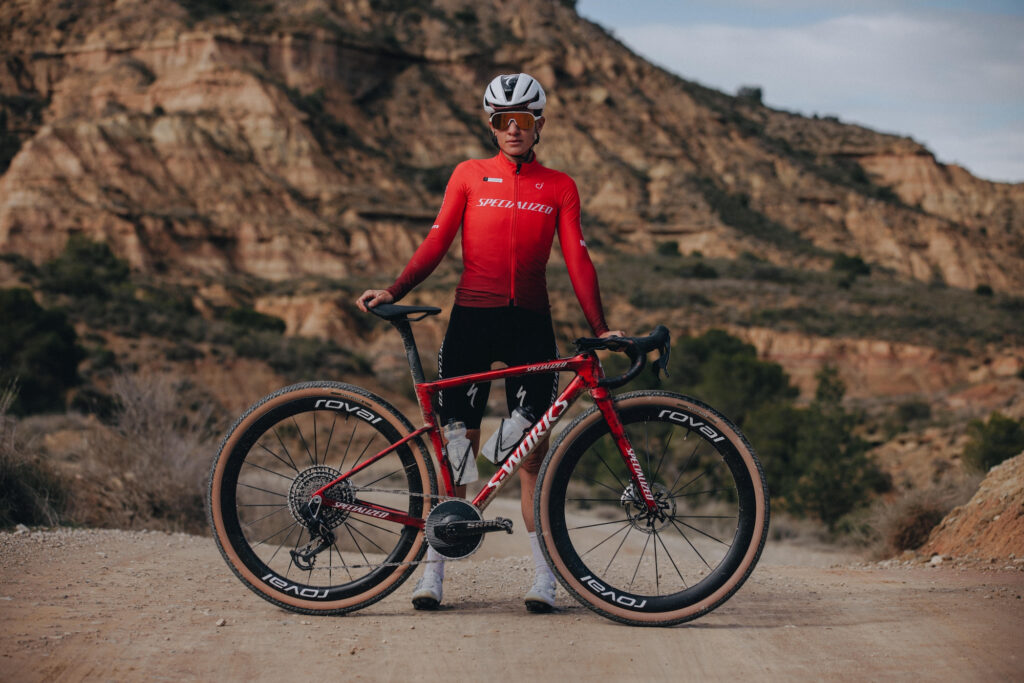
“When the objective is winning races, the Specialized Science Club [the name that the brand gives to its R&D team] set out with a brutally simple goal: Get riders to the finish line faster than any gravel bike in the world.
“For Crux 5, that meant answering one question with absolute confidence: Does this bike reduce total race time on the fastest, hardest gravel courses on Earth? To answer that, we built the most comprehensive gravel race simulation system ever created.”

Aerodynamics and weight are important variables, of course, but Specialized says that it wanted more data because surface roughness directly impacts rolling resistance, energy loss, fatigue accumulation and real-world speed.
To measure this, it developed race-day telemetry packs small enough to run under the saddle, which collected surface vibration data in real time using accelerometers. This data feeds into its Time to Finish simulations.
“The most aerodynamic gravel race bike we’ve ever tested”
As mentioned, Specialized says the new Crux 5 isn’t all about aerodynamics – but aero performance is certainly part of the story. Of the aero gains, it reckons that 50% are down to the frame, fork and seatpost, 30% to the Roval Terra Aero wheels, and 20% to the Roval Terra cockpit.

“Crux 5 is the most aerodynamic gravel race bike we’ve ever tested,” says Specialized. “Drawing directly from Tarmac SL8 learnings and decades of aero research, every tube on Crux 5 was sculpted for speed at elite gravel races.”

Essentially, they’ve turned the aero dial up on the fork, legs, down tube, seat tube and seatstays, and they’ve added the Speed Sniffer head tube profile from the Tarmac SL8.
Specialized says that it tested everything in its in-house wind tunnel with a moving-leg mannequin on board, because “no aero data is meaningful without a rider”.
“Unlike static mannequins or bike-only testing, this system captures how a rider’s full body in motion alters airflow across the bike at race-relevant speeds,” it says.
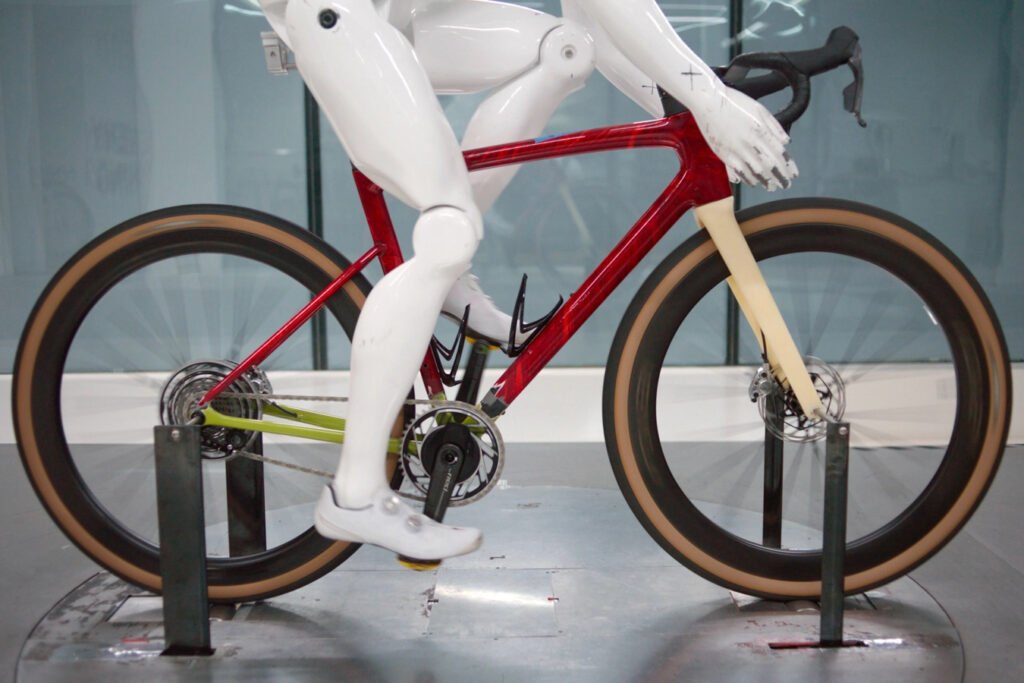
Bottom line: Specialized says that the Crux 5 is 15.2 watts quicker than the previous model at 45km/h (although results will vary depending on individual riders, of course).
On to the scales
Specialized says, “On gravel, with slower speeds and higher rolling resistance, reducing overall package weight is far more important than on the road.”
It claims a frame weight of 789g for the S-Works Crux 5. It quoted 725g for the previous S-Works 12r frame, so adding deeper tube profiles has added a few grams. That’s not unusual.

“At 789g, the S-Works Crux 5 frame stands alone at the top of the gravel lightweight category,” says Specialized. “Complete builds start at 6.9kg – a number most road bikes envy. Even in a full aero setup with Tera Aero CLX III wheels, S-Works Crux 5 is lighter than the competition at 7.1 kg. This was made possible by Flow State Design, first pioneered on the Aethos road bike.”
Flow State Design? What it boils down to is using a supercomputer to optimise shape and eliminate carbon layers to drop the weight. Specialized has been talking about the concept since the introduction of the superlight Aethos in 2020, first using the Flow State Design name when the second-generation Aethos was added to the lineup last year.
The results are in…
Specialized says that it has benchmarked the Crux 5 on the Unbound Gravel course – Unbound (formerly called Dirty Kanza) being the world’s most famous gravel event. It takes place in Kansas, United States, and this year’s event is happening now (28-31 May 2026).
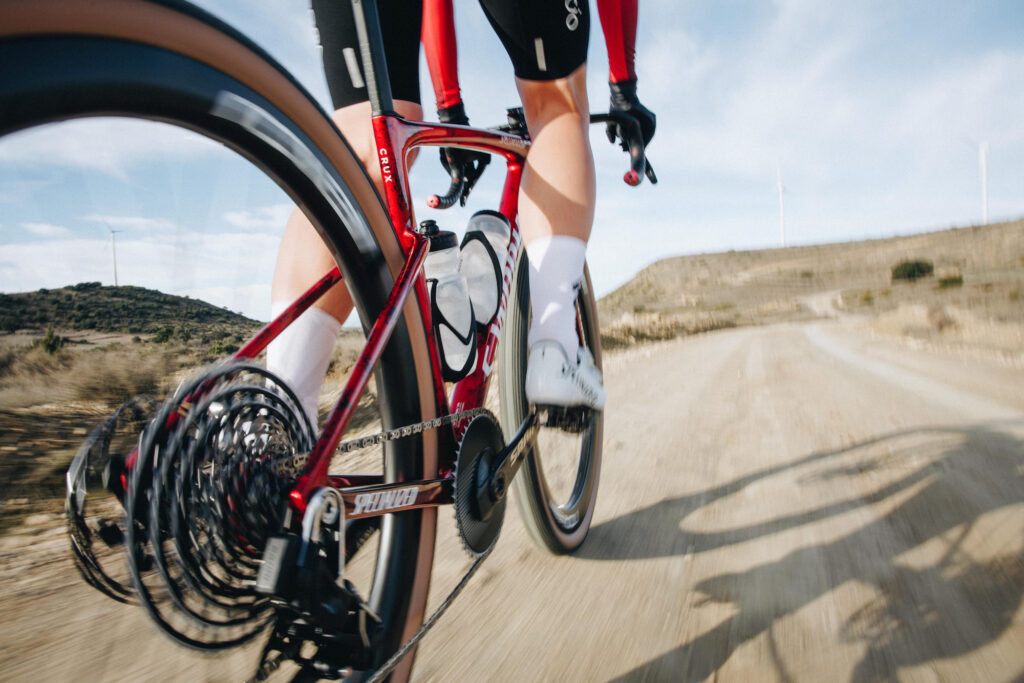
Long story short: Specialized reckons that pro rider Sofia Gomez Villafane could have shaved 9:58mins from her 2025 Unbound Gravel 200 finish time by riding the 2026 Crux 5 (with a 7.2kg weight) instead of a Crux 4. She missed taking the runner-up spot by 9:55mins (finishing in 10:22:24hrs), so maybe the bike would have been enough to make the difference – although, of course, race results are far more complicated than that.
What about the ride quality?
The Crux 5 is focused solely on speed, then? Specialized says not.
“Crux 5 matches the exact compliance and stiffness targets of the universally loved Crux 4 – while adding aero performance,” it says.
“Every size from 49–61cm receives a specific layup based on performance metrics unique to that size – delivering stiffness, compliance, and handling that is consistent across all sizes – because every rider, regardless of height, deserves the same unparalleled performance.”

When reviewing the 2023 Specialized Crux Comp, Suvi Loponen told us, “The overall ride feel of the Crux is something between a true gravel grinder and a nimble cyclo-cross bike. It has a lively and nippy character.
“The bike excels on cyclo-cross-like fast gravel; it navigates rough singletrack paths and tight corners with buttery smoothness and is easy to bash up sharp climbs. The frame is very reactive and once you want to push, the bike responds and feels stiff enough to sprint as well.”
We’ve not ridden the updated Crux yet, so we can’t comment on its feel.
Clearance for 55mm tyres
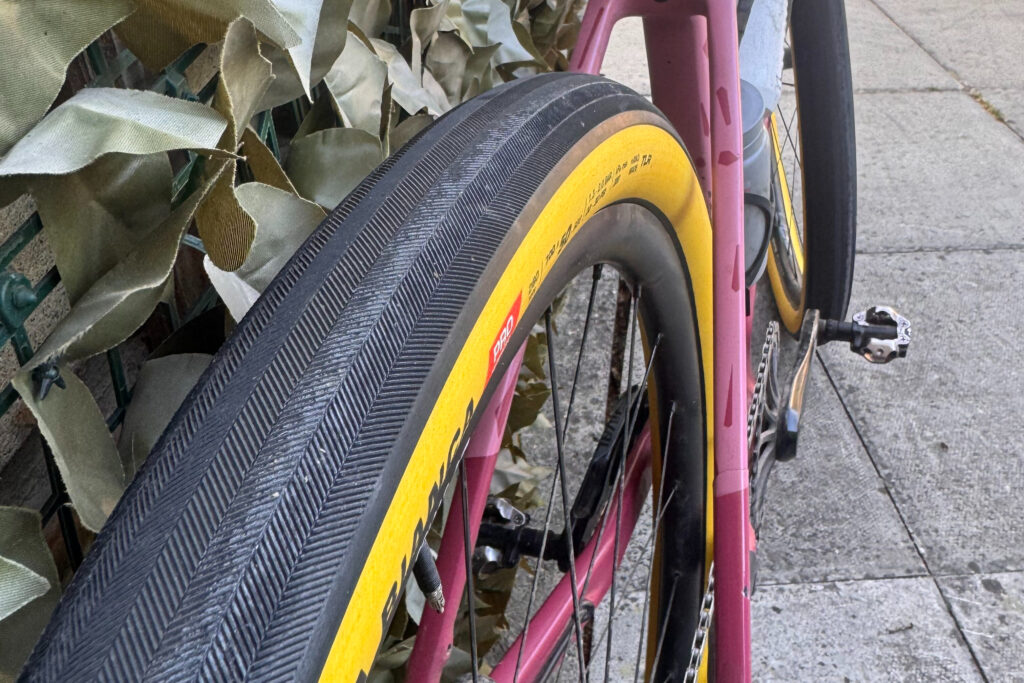
This being a gravel bike, we need to talk about tyre clearance. The gravel world is obsessed with tyre width.
“When our athletes said they needed the ability to run up to 55mm or 2.2in tyres, we knew we had to deliver that clearance with no compromises,” says Specialized.

“Paired with the all-new Roval Terra Aero CLX wheels, increasing tyre size can dramatically improve rolling resistance, traction, and comfort – with no aero penalty. In fact, a 50mm [Specialized] Tracer tyre on a [Roval] Terra Aero CLX wheel has the same drag as a 45mm Tracer on a Terra CLX II wheel.”
Tweaks to the geometry
Specialized says it has tweaked the geometry of the Crux to “create the confidence to go faster over real gravel.”
It says it has improved balance by lengthening the reach (the horizontal distance from the bottom bracket to the top of the head tube) on larger sizes while shortening stem lengths. It has also slackened the head angle slightly “to increase confidence at speed”, while steepening the seat angle to produce a “more efficient power position” while allowing for greater tyre clearance.
It has also lowered the bottom bracket to provide more stability with large tyres.

Here’s the geometry table for the Crux 5 Comp. Frame and fork dimensions are the same across the range, it’s only stem lengths and saddle widths that vary.
Out with the Pro, in with the S-Level
Specialized divides its bike range into various levels, with S-Works at the top, although the tier below that changes from Pro to S-Level.
It reckons that the S-Works Crux 5 is the fastest gravel race bike ever made, while the Crux 5 S-Level is the second fastest.
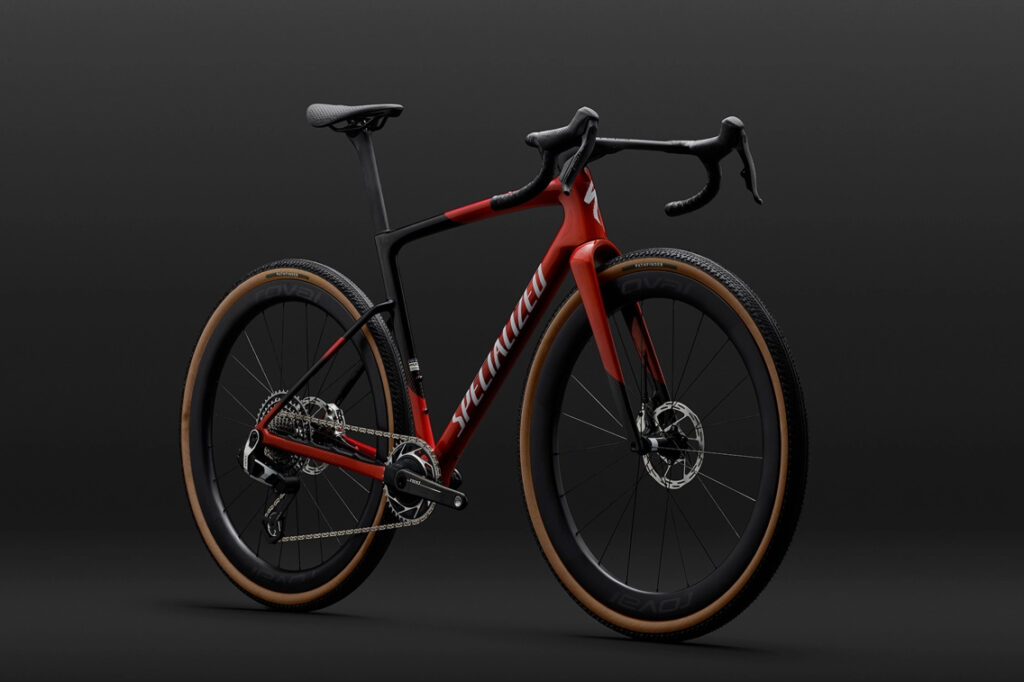
“Built with the same Time To Finish philosophy, shaped by the same aerodynamic breakthroughs, and engineered for uncompromising speed, S‑Level brings pinnacle gravel performance to more riders than ever.”
Mind you, the Crux S-Level is far from cheap: we’re talking about £8,799. Still, that’s over three grand less than the S-Works Crux 5 AXS.
The Crux S-Works is built around a Fact 12r frame with a claimed weight of 789g, while the Fact 10r frame used for the S-Level (and below) is 897g.
All Crux models use a threaded bottom bracket. They are 1x (single chainring) only and can take a maximum 52-tooth chainring. Crux 5 is compatible with 1x mechanical gravel drivetrains with fully integrated shift lines (Roval one-piece cockpits are electronic only).
Here’s a quick rundown of the various models:
S-Works Crux 5 AXS £11,999
Frame FACT 12r
Fork S-Works FACT Carbon
Wheels Roval Terra Aero CLX
BB and headset bearings Ceramic Speed DUB
Saddle Specialized S-Works Power w/ Mirror
Cockpit Roval Terra
Groupset SRAM Red AXS XPLR
Claimed weight 7.1kg
Crux 5 S-Level £8,799
Frame FACT 10r
Fork S-Works FACT Carbon
Wheels Roval Terra Aero CL
BB SRAM DUB
Saddle Specialized Power Pro w/ Mirror
Cockpit Roval Terra
Groupset SRAM Red AXS XPLR
Claimed weight 7.7kg
Crux 5 Expert AXS £5,999
Frame FACT 10r
Fork S-Works FACT Carbon
Wheels Roval Terra C III
BB SRAM DUB
Saddle Specialized Power Expert
Stem and bars Roval Terra (two-piece)
Groupset SRAM Force AXS XPLR
Claimed weight 8.22kg
Crux 5 Comp £3,999
Frame FACT 10r
Fork S-Works FACT Carbon
Wheels DT Swiss G-500
BB SRAM DUB
Saddle Specialized Power Sport
Stem and bars Alloy bar and Roval Rapide stem
Groupset SRAM Rival AXS XPLR
Claimed weight 8.89kg
Crux 5 Sport £3,249
Frame FACT 10r
Fork S-Works FACT Carbon
Wheels DT Swiss G-500
BB Shimano Threaded BSA
Saddle Specialized Power Sport
Stem and bars Roval Rapide alloy stem and Specialized Adventure Gear bar
Groupset Shimano GRX RX820
Claimed weight 8.94kg
The S-Works Crux 5 is also available as a frameset for £5,249.













12 thoughts on “Specialized says new Crux 5 is “the fastest gravel race bike ever made””
I’m sure it’s an excellent bike, but it’s a bit dull isn’t it?
You could always stick some spokey dokeys on it.
@AidanR Looks wise? In the eye of the beholder I guess, looks cool AF to me, especially in the red with those tan sidewall tyres. I’m guessing at 6.9kg and aero optimised it’s anything but dull to ride.
Yup, looks wise. I appreciate that’s subjective, and I’m sure it’s an immensely capable machine.
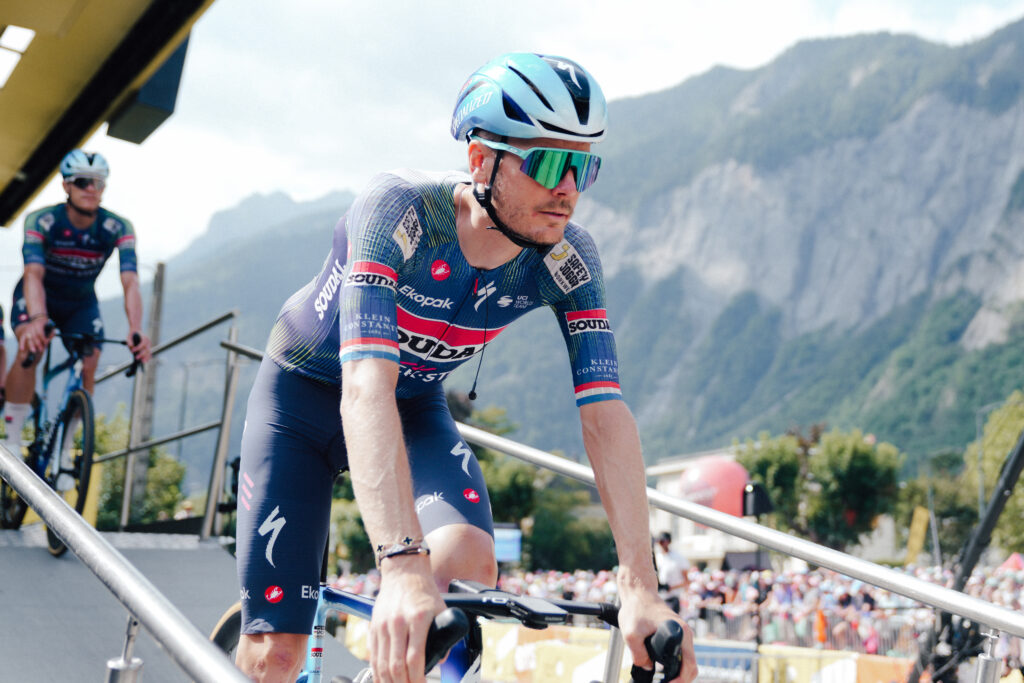
@Rendel Harris If you’re talking about the marbled red (as seen in e.g. the image captioned “2026 Specialized S-Works Crux 5 rider with bike” I agree that looks cool, but unfortunately that paint scheme doesn’t appear to be available for customers to purchase, in the UK at least.
And (as is common practice amongst the major brands, but I still find annoying), the colour scheme is tied to the spec chosen.
Limiting colour choices to a given spec is a pet peeve of mine too. I get it if you’re trying to pile ’em high and sell ’em cheap, but I doubt that anybody’s ever accused Specialized of that.
I agree, the red one does look nice, especially with the tan wall tyres, but trying to keep such tyres looking good in the UK is hard work.
I even recently rolled some similar tan wall tyres up small, so as to fit in a pillow case and put in the washing machine on a 40 degree wash and i still had to scrub them in the bath afterwards.
“the Crux 5 is 15.2 watts faster than the Crux 4 at 45 km/h (28mph)”
Ah yes, I’m definitely riding around holding 28mph on gravel.
Show me a relevant statistic. How many watts am I saving whilst carrying my laptop backpack, pootling along at 13mph with two ciders in me?
15watts at 45kmph…..relevant to about 0.5% of gravel riders then. Also can’t help but think not having an option of a front mech makes it less of a quiver killer than it could be.
Old one looks way nicer and my gravel rides only reach 45kmph free wheeling downhill.
Looking forward to cheap previous gen models selling
How it looks seems to be all anyone seems to be interested in 😳 …well it looks just like a Tarmac. Which is why it looks boring.
It should be called the Tarmac Gravel.
The original Crux is a much more interesting and classically beautiful bike.
Or the ‘British Road’?
I wish they’d sell the lower tier models as a frameset option.