



Has British Cycling “fumbled” its regulations? Are the right rules being enforced? Should British Cycling have done more to make things clearer? Does anyone know what’s going on? Those are just some of the questions being asked this Monday after a video from a race in the UK sent the domestic racing scene into a spin.
It’s all to do with handlebar width rules, everyone’s favourite topic since the UCI controversially announced last year, and implemented at the start of this season, a new minimum handlebar width of 400mm and a new minimum gap between the inside of brake hoods of 280mm.
We say ‘controversially’ because there have been many concerns heard about a disproportionately detrimental impact on smaller riders and the women’s peloton, as well as criticism from riders, teams, staff, component manufacturers, bike fit professionals and various other sources.
Now, while the UCI’s rules apply to all of its events, domestic governing bodies such as British Cycling set the rules for all non-UCI events in their jurisdiction.
British Cycling appears to have rejected the UCI’s stance although, as with other parts of this story, there are multiple confusing threads to unwind.
At the start of the year, British Cycling said participants in cyclo-cross and road races would not need to adhere to the new UCI regulations regarding handlebar width.
“Only racing run under UCI regulations for cyclo-cross and road would apply to the UCI regulation here,” the governing body stated.
So, if you’re riding the Tour of Britain, then yes, you will need to make sure your bars are a minimum of 400mm wide, with a minimum gap of 280mm between the brake hoods. However, if it’s a midweek Cat 3/4 crit you’re lining up, there’s no obligation to comply with that?
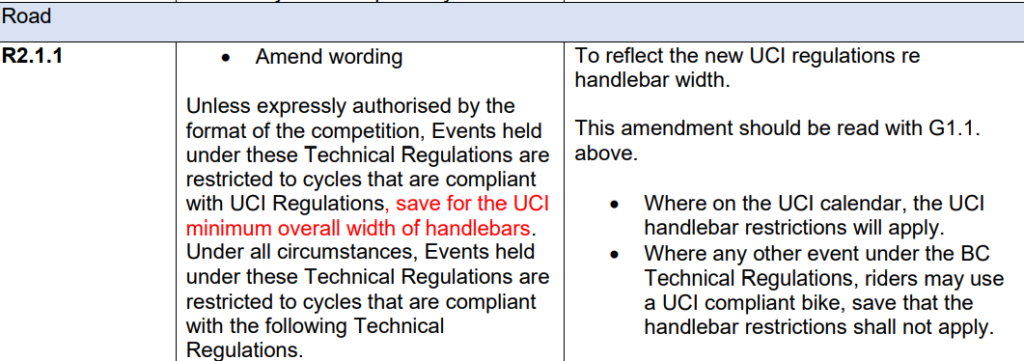
The confusing bit, which former team pursuit world champ and Hour Record holder-turned-aero specialist and now Head of Engineering with Red Bull-Bora Hansgrohe, Dan Bigham, suggested amounted to British Cycling having “fumbled” its own regulations, is that the official wording of the rules in British Cycling’s handbook only refers to “minimum overall width of handlebars”.
So, does that mean it’s just the handlebar width of 400mm which does not need to be adhered to? Or is it wording meant to encompass the entirety of the UCI’s new handlebar regulation, so riders wouldn’t need to adhere to a minimum handlebar width of 400mm or a minimum gap between brake hoods of 280mm? Or, is it only for the specific handlebar width regulation, so riders don’t need to adhere to a minimum width of 400mm, but do need a minimum gap of 280mm between brake hoods?
It’s to that context that a video from the weekend has since attracted plenty of attention on Instagram and appears to show riders’ brake hoods being measured before a British race.
“British Cycling is now enforcing the 280mm shifter rule inside to inside for road and crit racing. But you can run drops narrow as you want…” Atiba Quildan captioned the social media video, which has been viewed more than 360,000 times since Saturday.
View this post on Instagram
In the video, a person can be seen using one of the measuring rigs we’ve seen used at professional UCI races already this season, the device designed to easily show commissaires if a rider’s bars and hood widths are compliant.
The video has prompted hundreds of comments, numerous re-readings of the British Cycling rules, plenty of citings of the governing body’s Technical Regulations handbook, and lots of discussion.
One possible explanation is that the commissaire has just got things wrong and is wrongly enforcing UCI rules on a British Cycling event. Another is that they’ve read the British Cycling rules and decided, from their reading, that the rules say “handlebar restrictions shall not apply” but don’t mention brake hood widths not applying. A third, which feels more unlikely, is that they’re actually correct and the interpretation of the rules that the minimum gap between the hoods does apply. At this point, many people just want some (any) clarity, regardless of what the actual answer is.
“I think both the time taken from the UCI announcement and the lack of communication are both disappointing”
Bigham told road.cc this morning: “It sounds like British Cycling just wrote a very unclear rule. They meant to exclude both the handlebar width and hood width, but obviously they didn’t explicitly say that and left plenty of room for interpretation by keen commissaries. It sounds like they will issue an amendment. Nonetheless, I think both the time taken from the UCI announcement and the lack of communication are both disappointing.”

The whole situation is a mess, Bigham pointing out it took three months from the confirmation of the UCI’s rules for 2026 for British Cycling to release its own guidance. By contrast, Bigham shared screenshots on social media of Australia’s governing body, AusCycle, having apparently provided “clear” communication and an online guide within six days.
Writing in a series of social media posts on Sunday, Bigham suggested British Cycling had “fumbled” its technical regulations.
Bigham questioned the lack of communication around the rules, saying a social media campaign or wider communication on the governing body’s website could have helped.
“Making regulations water-tight is hard. Whether you agree with the current UCI rules is a separate point. AusCycling dealt with this proactively and coherently. British Cycling did not, and now riders will suffer,” he wrote on social media this weekend.
“If you’re disappointed too, reach out to British Cycling and let them know. Your licence fee is paid so that you receive a service. Demand better.”
British Cycling chose not to comment when approached by road.cc for this story. The technical regulations were published in an article on the governing body’s website on 15 January, however the weekend’s events appear to support Bigham’s conclusion that the rules could have been better explained and communicated.
There was plenty of frustration in social media comments about the situation too, riders at times disagreeing on their interpretation of British Cycling’s rules or pointing out other areas of concern around racing that go unanswered while everyone discusses technical regulations.
“And in road races we continue to race on open roads with oncoming traffic,” one comment said.
Another questioned if the weekend’s hood-measuring was “power-tripping comms enforcing rules that specifically say they aren’t enforced under BC rules?”
However, others were unsure of the wording of British Cycling’s rules, someone else stating that from their discussion with commissaires and interpretation of the rules, they believed the 400mm minimum handlebar width could be ignored, but all other areas “hoods, wheels, frame etc. have to be legal”.
The only thing that does seem crystal clear is that further clarification from British Cycling feels inevitable, even if the governing body chose not to comment this lunchtime.
How did we get here?
As per the UCI’s rules newly introduced at the start of this season — which attracted widespread criticism from riders, staff, bike-fitting professionals and other figures from across the sport — road riders in UCI events must now use a bar width of 400mm or wider and the distance between the brake hoods can only be 280mm at a minimum.
The UCI cited safety when introducing the rules, the governing body evidently keen to clamp down on what it views as increasingly ‘extreme’ set-ups, however many have questioned the impact of the rule on smaller riders and the female peloton, many of whom are now forced to run wider bars than they have been prescribed by bike-fitting professionals to meet the UCI’s limit.

The raft of changes ahead of the 2026 season also included a 65mm limit on wheel depth, and a ban on the use of TT helmets in road races.
It would be a large understatement to say that the UCI’s new maximum handlebar width regulation did not go down well in some parts of the cycling world, many accusing the rules of being particularly unfair for smaller and female riders. In fact, at least 7,000 people signed a petition on change.org to appeal the new regulations.
That petition argued:
The new ‘one-size-fits-all’ policy does not account for the variety in body types and biomechanics among riders. Cyclists come in all shapes and sizes, and their equipment needs to reflect that diversity. Not every cyclist can perform optimally under the same conditions; some require wider handlebars to accommodate broader shoulders, while others need narrower grips for better control and manoeuvrability based on their body’s build. The regulation particularly impacts female cyclists who, based on our own extensive database (one of the largest in the world) and other studies, on average require a 38cm handlebar.
The petition said that this regulation could inadvertently place riders at risk of injury – the opposite of the UCI’s intended consequence – on the basis that “improper bike fitting can lead to chronic pain and musculoskeletal issues”.
Earlier this month, Italian pro Filippo D’Aiuto was disqualified after a 60km solo escape ended with one-day race victory, the commissaires deeming his bike fell foul of the new UCI handlebar width rules. However, his team insisted the ‘illegal brake levers’ were bent in crash.




















2 thoughts on “Concerns wrong handlebar width rules being enforced at British road races, as Dan Bigham questions “disappointing” lack of communication from British Cycling over UCI’s controversial new rules”
BC seem to be getting everything a bit wrong at the moment. From IT migration debacles to the shambolic treatment of cycle speedway. At grass roots level nobody has any confidence that their strategizing will fix the issues of road racing or help grow the base of entry level participation. They do a stonkingly good PowerPoint presentation though……
I’d say that the commissaires have definitely got it wrong, and shouldn’t be measuring, because the new regulation only says that riders /may/ use a UCI-compliant bike – it doesn’t say that they /have/ to…