


This year’s Tour de France opens today with a 14km (8.75 miles) individual time trial in Dusseldorf, Germany, and here’s the type of bike the riders will be racing.
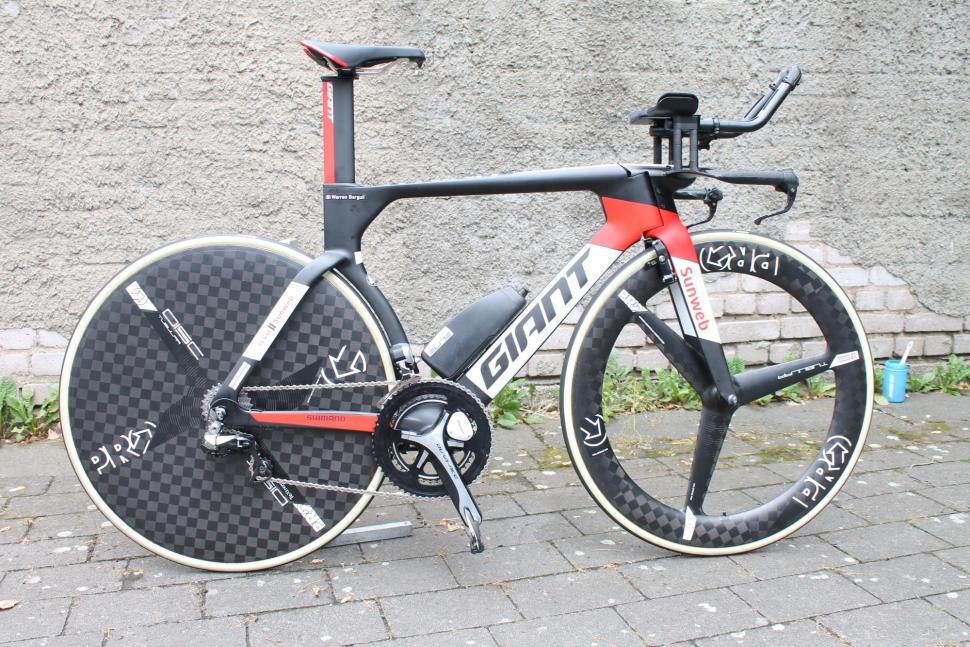
We grabbed the Giant Trinity belonging to Team Sunweb’s Warren Barguil to check out the key differences between a time trial bike and a road bike.
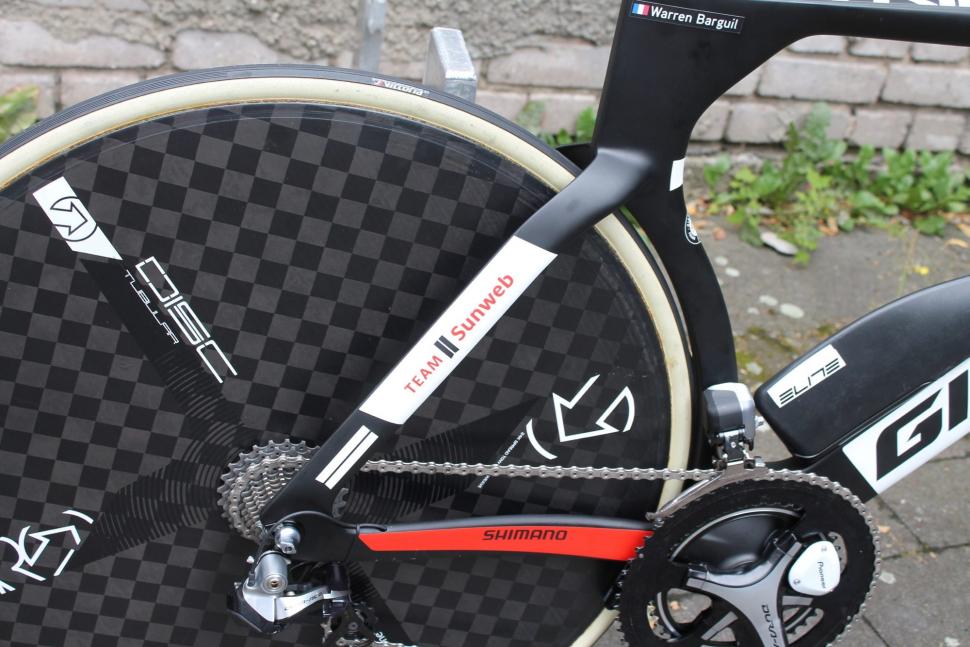
Time trial bikes are all about aerodynamics. The frame tubes are designed to be aero and virtually all come with features like a deep section down tube, a seat tube that’s cutaway around the rear wheel and seatstays that join that seat tube very low down.
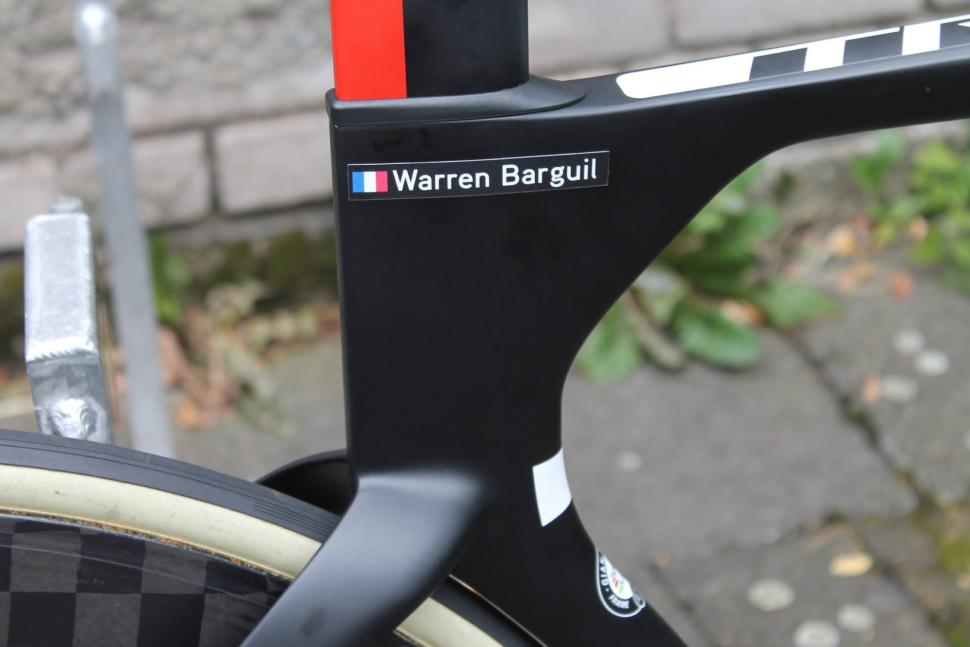
A time trial bike’s geometry is different too. Not only do time trial bikes have a short head tube to keep the front end low, the seat angle is usually steep to help the rider get into a flat-backed riding position. This isn’t necessarily a position they’d be comfortable maintaining all day, but it’s okay for the shorter distances associated with Tour de France stages against the clock.
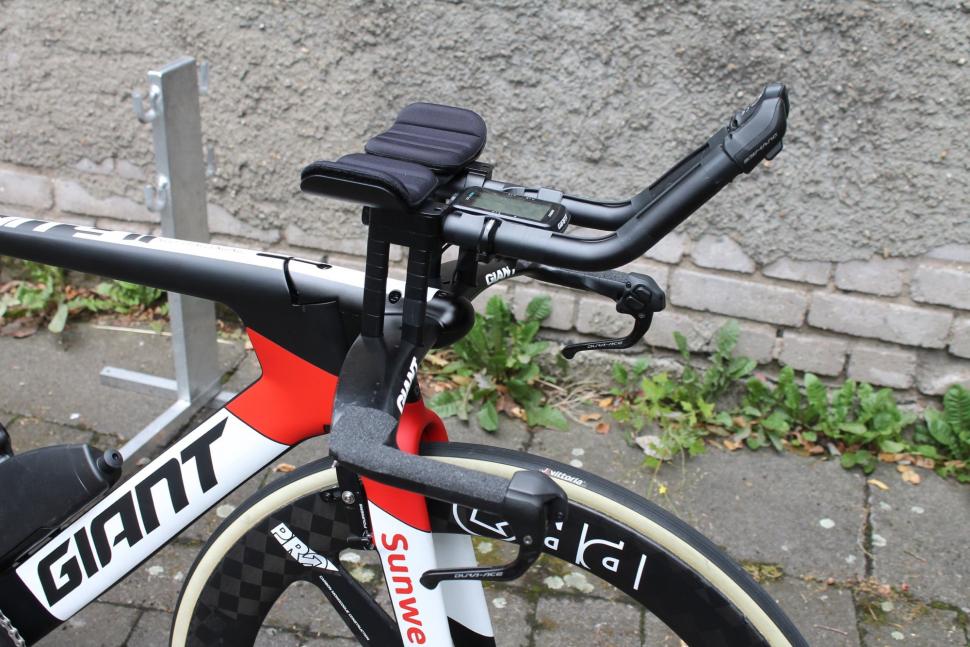
Electronic shifting allows riders to change gear whether they’re out of the saddle and using the base bar or in their aero tuck with hands on the aero extensions.
The second individual time trial in this year’s Tour de France is in Marseille on the penultimate day – Saturday 22 July (there’s no team time trial this time). Again, it’s a short one at 22.5km (14 miles) but if things are close in the general classification it could be very interesting.




11 thoughts on “Tour Tech 2017: What makes a time trial bike so fast?”
The rider.
The rider.
Bigtwin wrote:
As a non-racer, can I ask what makes a good TT rider? As opposed to say a sprinter? What type of training do they do to be so good at it? Genuine question… 🙂
Jayinjapan wrote:
It’s 90% mental, and the rest is all in your mind.
Jayinjapan wrote:
I can only offer my personal observation that it must involve bloody mindedness, the few TTs I’ve done showed me that you simply have nowhere to hide from the pain.
TT training
A good sprinter has (normally) large muscle mass and is able to put out extreme amounts of power for very short periods of time (1800 – 2000 W for 3-8 sec). The muscles of a sprinter will have a high ratio of ‘fast twitch’ fibres which fatigue quickly but contract very strongly
A good TT rider has the ability to hold far more moderate, (but still very high) power levels for much longer. For a pro tour rider this is about 400W for an hour, or for the 16-18 mins in the prologue, about 450W. A really good pro tour TT rider may have a maximum power output of only 1250W.
As for the type of training they do, specifically for their role a sprint rider will do a fair amount of gym work focussing on building up the quickest strongest contractions they can (Moderately high weights pushed / lifted as fast as possible for 8 -10 times to failure.) Their specific riding sessions will involve high cadence work (Cav tops out at about 130 – 140 rpm in a sprint, pushing about 1000 – 1200W), and rolling / standing start maximum torque efforts of 3-10 seconds.
A Time triallist will do a lot of work at Max VO2+ level (about 92 – 95% of max HR) for 5- 8 mins repeating till failure (often only 5-6 reps) and quite a lot of time doing 2 – 3 x 20 min repeats at Max VO2.
Last thing , and it’s nebulous, is good TT riders are slippery – their position, their riding style gets through the air more efficiently. I have a friend who is 2″ shorter than me at 5’6″. He’s 10 kg lighter. I have an FTP of 330 – 340 W which I can hold for an hour, he has never held over 315 for more than half an hour. His time for a 40kTT at 54 min is a full 4 mins faster than mine. (later edit…. 54 mins.oops :-/ )
As for the suffering, I think that is overplayed a little. I think pacing is really really what makes a good TT rider, and as David Millar puts it “You start digging into the barrell of hurt until you scratch the bottom and then you back off a fraction, and just hold it there for as long as you possibly can.” Personally I suffer a lot more in a bunch race getting over a hill or rotating in the break. But then I’m a sprinter.
I’m training for TT.
I’m training for TT. Physically it’s the ability to sustain FTP for long periods. Mentally it’s a total self hate for your body and an ability to take total misery for sustain periods without regretting your life choices and throwing in the towel.
If you’re not cool cleaning puke of your trainer I wouldn’t bother
part_robot wrote:
Agree, I used to be a decent rower, that really hurts, keeping your shit together right til the last is so so difficult! I remember coming back to rugby training after years out and I went to train with the first team (already over the hill at 32 for league), I bust a gut to keep up, technically I was more than ok, physically nowhere near and god did I puke.
I always used to say if you’re not honking or passing out at the finish line you haven’t emptied yourself. I v. rarely get to the point of that these days, far more for pleasure but I do like beasting myself every now and again and it’s definitely a mental toughness you need to overcome the agony.
part_robot wrote:
This. Pushing yourself to your absolute sustainable limit and staying there. Getting as aero as realistically possible goes a long way too… That usually extends to spending a lot on bike/parts.
That and flexibility. Which I
That and flexibility. Which I don’t have yet.
Thanks for all the replies,
Thanks for all the replies, very interesting. Will have to give it a go one day. 🙂
On what makes a good time
On what makes a good time triallist: True on the hurt thing and consistently high power output. Time trials are sore. I’d add attention to detail, not just equipment (though that makes a difference) but braking, cornering, accelerating. That and not panicking: see Cancellara (London 2012, overcooking the finale) and Wiggins (Mendrisio 2009, when Cancellara was flawless – see it on YouTube), even Tony Martin yesterday looked ruined through his last km after stretching himself too early.