



A council has been criticised by a local motorists’ group for installing a single zebra-striped crossing across a newly refurbished £17 million cycle lane.
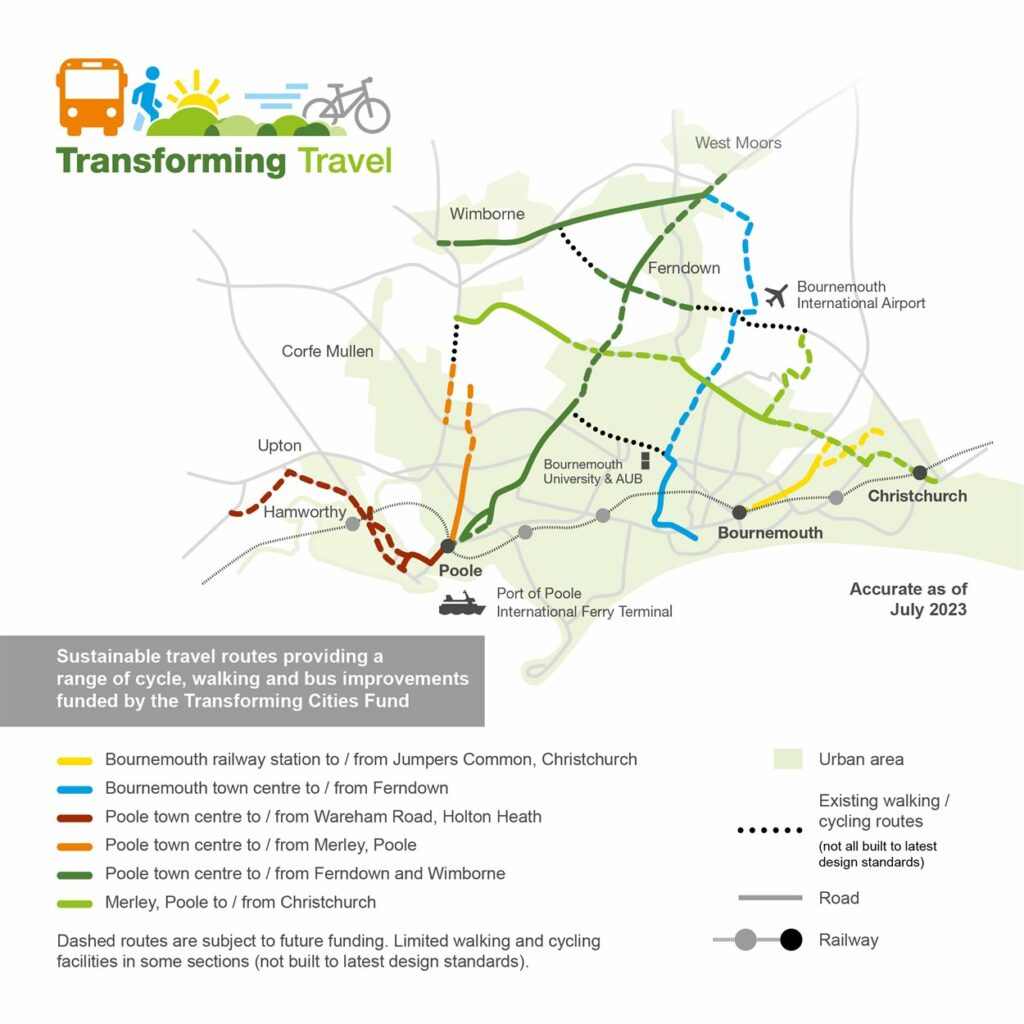
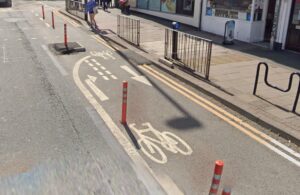
Ringwood Road in Dorset has seen waves of investment in cycle infrastructure in recent years, in line with the target of Bournemouth, Christchurch and Poole (BCP) Council to install around 50 miles of cycle lanes across south east Dorset. Having previously consisted of a shared-use path separating cyclists and pedestrians by paint (pictured immediately below), upgrades have seen the cycle lane fully segregated from other users and with distinguishing red paint.
However, the single zebra stripe has become a source of derision for critics of the proposal who view the project as unnecessary and contributing to further motor congestion in the city, as reported by the Daily Mirror.
The ‘paper quotes Justin Midgely from the BCP and Dorset Motorists group, which has 6500 members on its Facebook page, as saying the crossings “will spark confusion among the general public who will think who on earth has priority now?
“The mechanics of it are strange as you are crossing an active cycle lane to get to a floating bus stop which is still in the cycle lane. The whole layout along the road is jazzy and confusing visually. I don’t think one stripe of white implies a pedestrian crossing and there is no signage for who has priority.
“Pedestrians will probably ignore the crossing anyway and cross where they like.”
Midgely added that he believed the floating bus stop design was facing legal challenges in London “for safety reasons”, although the design has been defended by the capital’s Walking and Cycling Commissioner who said proposals to ban the floating bus stop would “put lives at risk”.
> Warning government considering ban on floating bus stops “could stop new protected cycle lanes”
In the last day, Midgely has shared to the BCP Motorists Facebook page the views of three Reform UK candidates for the local elections, although BCP Council, responsible for the active travel infrastructure, is not up for re-election until 2027. The three town council candidates are all described as being ‘pro-motorist’ and opposed to further bike lane installations.
The infrastructure is part of BCP Council’s ‘Transforming Travel’ initiative that aims to support the council’s declaration to be carbon neutral by 2030, and to reduce traffic congestion in one of the most congested parts of the country. The Ringwood Road work is part of a wider ambition to create a sustainable travel route connecting Poole town centre to the neighbouring towns of Wimborne Minster and Ferndown. The work was approved after public consultation in 2021. The total cost of the initiative is £102 million, of which £79 million is allocated from central government.
The council also told the Mirror, in response to the single striped crossing, “These markings are to ensure the safety of pedestrians crossing the cycle lanes to access bus stops on Ringwood Road. They are not there for motorists and have been installed to national design standards.
“The same markings were previously painted near the Mountbatten Arms roundabout on Ringwood Road to improve pedestrian access to a bus stop and on Queens Road near Bournemouth’s Lower Gardens to help cyclists and pedestrians cross a narrow road safely.”










14 thoughts on ““Jazzy” £17 million cycle lane under fire from motorists’ group due to “tiny” single stripe zebra crossing link to floating bus stop”
Come on, everyone knows that cars have priority. Always.
Shocking how many people are just accepting of the status quo with cars. Car nearly kills someone at a pedestrian crossing and the comments are “yes the car was in the wrong but if the car hits you and kills you, you’re the dead one so you need to take responsibility for your own safety”. That basically encapsulates any opinion on the danger of cars and drivers. “Yes they should do X but its really everyone elses job to mitigate it because you can’t expect drivers to drive safely.
Floating bus stops – it’s reverse “not invented here”. Despite being all over other countries – even in the “deadly” Copenhagen version – there doesn’t seem to be a massive casualty rate.
Of course that could be because everyone is too frightened to get on buses or all those with disabilities or visual impairments are now trapped in their house.
As the Ranty Highwayman pointed out these aren’t even new in the UK! Indeed there are decades-old arrangements where you have to cross a “service road” to get to the bus stop.
Of course those are safer than crossing a cycle path – because motorists are licenced, have passed tests, have numberplates, insurance. And of course motor vehicles don’t “come out of nowhere”…
Article here: https://therantyhighwayman.blogspot.com/2025/02/floating-bus-stops-redux.html
There are no floating bus stops near me so I have no experience of them but one thought does occur to me, take the cycle lane over the top of the bus stop to avoid “crossing the streams”. Obviously this wouldn’t work on an already steeply inclined road but most bus stops are on relatively level terrain and the incline could be made no worse than crossing railway lines etc. A bonus side effect is that the bus passengers are guaranteed a covered bus stop to protect them from the elements.
It could work… it you reduced the bus stop to “person-in-wheelchair” height? Shurely the able-bodied would accept that compromise, seeing as how those with disabilities have usually have to work round a world designed for everyone else?
No examples of this… oh, i can think of a school bypass.
Here you are: https://bicycledutch.wordpress.com/2017/04/11/the-dafne-schippers-bridge-is-open/
Most railway bridges are over 8 feet high, that should give headroom for all but professional basketball players. I also had a thought about bus stops on hills, the downhill route would go over the top and the uphill route around the back, the uphill riders would be slow enough for pedestrians to dodge!
Have you seen how long the cycle ramps to railway bridges are?
The council might be correct – here’s the design standards from Traffic Signs Manual chapter 6:
16.2.9. The stripes immediately adjacent to the edge of the carriageway must be black and be not more than 1.3 m wide. All other stripes, both black and white, must be of equal width and not less than 500 mm nor more than 715 mm wide. The Regulations permit the minimum to be reduced to 380 mm and the maximum increased to 840 mm where an authority considers it necessary having regard to the road layout. For example, the stripes may be narrowed where a Zebra crossing is provided across a cycle track, or widened to reduce the number on a wide carriageway
So, the problem these considerate drivers are highlighting might be that they have narrowed the cycle track to below minimum width to maintain the footway and waiting area widths, which is why it looks so odd. Absolute min at constraints (not that I’d call this a constraint) is 1.5m.
Yours pedantically x
Part of the £17million was used for pavement and road improvements.
I used to be in the BCP group. It is very obsessive and culture war.
Then one day I was purged.
I think they did not like me talking about how mobility infrastructure is for cyclists, the many disabled people who use all types of cycle as their chosen mobility aids, and mobility scooters etc. And how all public highway users are equally important.
I do not understand why that island is only painted.
Money?
(“I was purged”) not surprising perhaps, but disappointing. The more people feel “threatened” the more important conversations and relationships “between sides” become.
Alas, it’s psychology isn’t it? (And a century of “driving propaganda”…) We’re very sensitive to perceived losses and groups unite in an “us and them” way under perceived “attack”.
So discussions about the rebalancing the use of public space – hopefully with net *overall* benefit – are reduced to “war on the motorist”. Existential attacks on people’s “rights” and way of life. And those proposing them as traitors.
That view persists even where people would retain the ability to use their motor vehicle wherever and whenever (maybe not being able to park right there, or not use a certain street as a route from A to B). So we can still utilise motor vehicles – a very significant private mobility force-multiplier!
The idea is just to ensure that other choices are available. And that those who aren’t driving or can’t drive aren’t *so* negatively affected.
And yes, say it; to give people a bit of a push to consider not driving some of those journeys.